

Is your SEO budget a black box? You invest capital and resources, but when it's time to connect organic traffic to actual revenue, the data gets murky. You're left guessing which keywords drive sales and struggling to justify the spend against other channels. This frustration with lag time and poor attribution doesn't just cost you money-it costs you the confidence to scale.
That guesswork ends now. Knowing exactly how to track SEO ROI is no longer a complex puzzle; it is a core business function that demands precision and automation. Stop accepting vague metrics like ‘increased traffic’ as a measure of success. It’s time to demand a direct line between your SEO effort and your bottom line. This is the definitive, results-driven framework for proving the financial impact of your investment.
This guide delivers the exact formulas and attribution models you need for 2026. You will master a system to calculate a clear dollar-for-dollar return, build automated reports that prove value, and gain the data-backed confidence to scale your SEO budget for maximum growth.
Key Takeaways
- Master the core formula for how to track seo roi accurately by breaking down every cost variable, from software to labor, for a zero-guesswork calculation.
- Move beyond vanity metrics like rankings and learn why direct revenue attribution is the only way to measure SEO success in 2026.
- Understand the 'S-Curve' of SEO growth to set realistic benchmarks and see why a 5x to 10x return is the industry standard for mature campaigns.
- Discover how to radically improve your ROI by eliminating the largest variable from the equation: manual labor cost.
What is SEO ROI and Why Does it Matter in 2026?
SEO Return on Investment (ROI) is the measurable profit your business generates from organic search, measured against the total cost of your SEO efforts. It’s the ultimate metric of success. The core concept of Return on Investment (ROI) forces a simple question: are you making more money than you are spending? In today's market, the focus has shifted decisively from tracking rankings to tracking revenue. If your SEO strategy doesn't directly contribute to your bottom line, it's not working.
By 2026, the digital landscape will be even more fragmented. Your customers will use Google, AI-driven search engines, and voice assistants to find solutions. A modern ROI model must account for revenue generated across this entire ecosystem, not just traditional search results. Knowing how to track seo roi is no longer optional; it's the only way to justify your marketing spend and scale effectively.
When tracked correctly, SEO is not an expense. It is a high-growth business asset that generates predictable, long-term revenue.
The Difference Between SEO ROI and Vanity Metrics
Vanity metrics like "keyword rankings" and "impressions" are dangerously misleading. Ranking #1 for a term that never converts is a waste of resources. True performance is measured in dollars, not positions. You must connect organic traffic directly to sales data to see what actually works.
This means distinguishing between high-intent traffic and general traffic. A user searching for "buy emergency plumbing service" is infinitely more valuable than one searching "how does a pipe work." Focusing on high-intent keywords attracts users ready to purchase, directly boosting your ROI. Organic search also plays a critical "assist" role, introducing your brand to customers early in their journey, a value that simple conversion tracking often misses.
Why Traditional ROI Tracking is Failing Small Businesses
Legacy agencies that demand a 6-month "waiting period" for results are operating on an outdated and inefficient model. Small businesses cannot afford to burn cash for two quarters with no clear financial return. This slow, manual approach to content creation and optimization eats directly into your profit margins, making it nearly impossible to achieve a positive ROI quickly. The entire model is designed to obscure performance, not clarify it.
Ultimately, the calculation is simple. SEO ROI is the net profit of organic sales divided by your total SEO spend. If that number isn't positive and growing, your strategy has failed.
The Essential SEO ROI Formula: Calculating the Real Delta
Stop guessing. Start measuring. The core formula to track your SEO return on investment is brutally simple, yet relentlessly effective. It cuts through the noise and gives you a hard number to benchmark against.
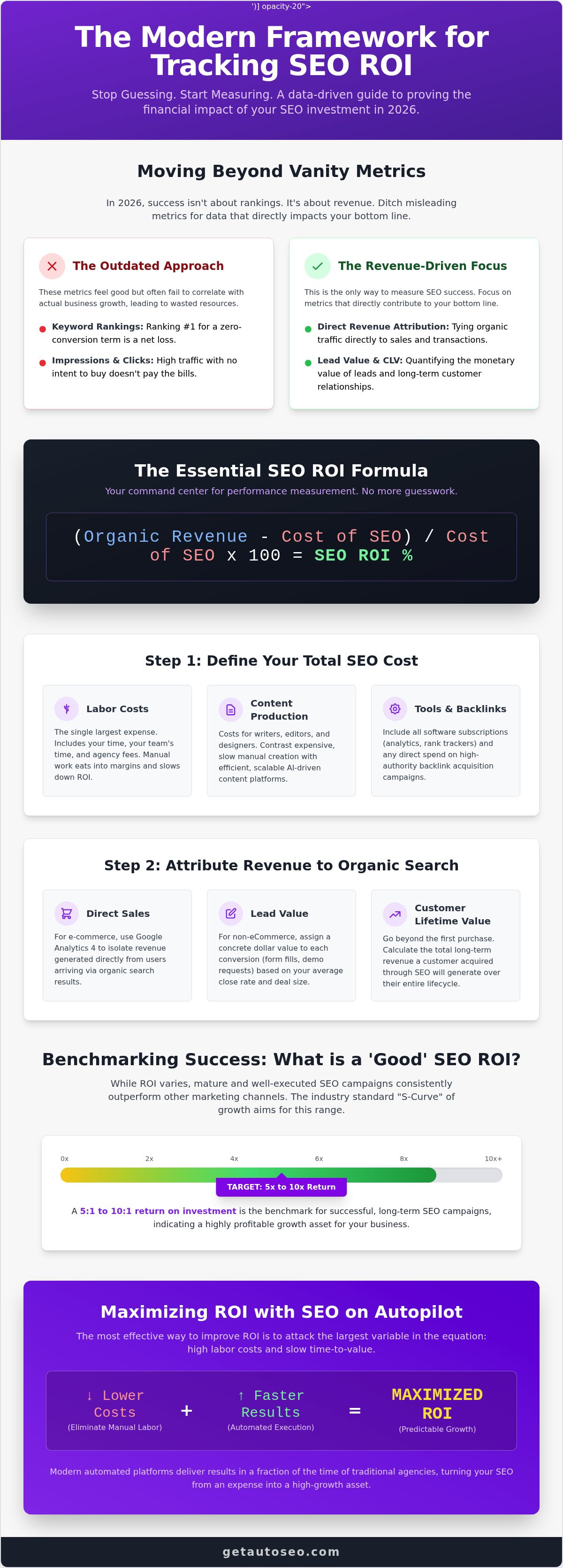
(Organic Revenue - Cost of SEO) / Cost of SEO x 100 = SEO ROI (%)
This equation is your command center for performance. But to get an accurate result, you must define its components with precision. Vague inputs lead to useless outputs.
Step 1: Determining Your SEO Costs
Your total investment is more than a single invoice. A true calculation of your SEO cost must account for every resource deployed. This is a critical first step in learning how to track seo roi accurately.
- Labor: Your time has a dollar value. Whether it's you or your team, calculate the hourly cost of time spent on SEO tasks and strategy. Don't work for free.
- Content Production: "Cheap" freelance content often costs more in lost rankings and endless edits. Contrast that with the efficiency of AI-driven platforms that deliver high-quality content at scale, slashing production overhead.
- Tools & Backlinks: Factor in all software subscriptions-analytics, rank trackers, and technical SEO tools-plus any direct spend on high-authority backlink acquisition.
Step 2: Attributing Revenue to Organic Search
Revenue attribution is where most businesses fail. You must connect organic traffic to tangible income. Google Analytics 4 (GA4) is engineered to isolate organic revenue streams for eCommerce. For a tactical guide, you can learn how to Calculate SEO ROI Using Google Analytics to link traffic directly to sales. For non-eCommerce businesses, assign a concrete "Lead Value" to conversions like form fills or demo requests. Then, to grasp the full picture, calculate the Customer Lifetime Value (CLV) of customers acquired through search to see the long-term impact.
Beyond the formula, the most critical metric is Time-to-Value-how fast your investment turns positive. A $5,000/month agency might show a positive ROI in 12-18 months. In contrast, modern automated platforms built for speed can generate returns in a fraction of that time, putting your SEO on autopilot and accelerating growth.
Advanced Tracking: Attribution in the Age of AI Search
Traditional attribution models are obsolete. AI search engines like Perplexity and Google’s AI Overviews deliver answers directly, often without a click. This fundamentally changes the ROI equation. Your audience may see your brand, trust your data, and visit your site later-a journey that breaks standard analytics. The new challenge of how to track seo roi demands a focus on brand visibility as a direct precursor to revenue.
Success is no longer just about clicks. It’s about influence. Monitor spikes in ‘Direct’ traffic immediately following the publication of high-quality content. This is often your first signal of unattributed organic reach. To close the attribution gap, deploy UTM parameters on all shared links and create custom landing pages for targeted campaigns. These tactics reclaim control and provide clearer data on user origin.
Tracking Visibility in AI Overviews
Being the 'cited source' in an AI answer is the new Page 1 ranking. It builds authority and brand recall instantly. Use advanced brand monitoring tools to track your mentions and sentiment within Large Language Model (LLM) responses. This AI-driven awareness directly fuels the top of your funnel, leading to higher-value branded searches and direct traffic that converts at a superior rate.
Setting Up Conversion Goals for the Future
Your measurement framework must evolve. You need to track the full customer journey, from initial exposure to final sale. This means defining and monitoring two distinct types of conversions:
- Soft Conversions: Top-of-funnel actions like newsletter signups or content downloads. These indicate initial engagement.
- Hard Conversions: Bottom-line results like demo requests, trials, or direct sales. These are your revenue drivers.
Leverage your first-party data. Connect your CRM and analytics to trace a user’s path from an organic search to a soft conversion and, finally, to a purchase. Effective attribution in this new era requires tracking both traditional clicks and AI brand citations to build a complete performance picture. This is how to track seo roi with precision.
Benchmarking Success: What is a 'Good' SEO ROI?
A mature, well-executed SEO campaign should deliver a 5x to 10x return on investment. This is the industry standard for a strategy that is firing on all cylinders. But this isn't a Day 1 metric. New campaigns operate on a different timeline, and understanding the growth trajectory is fundamental to knowing how to track seo roi accurately.
SEO growth follows a predictable 'S-Curve'. Expect negative ROI in the first 1-3 months as your investment builds foundational authority and content assets. By month six, the curve steepens. Traffic and leads begin to scale exponentially. This delayed gratification is the core difference between building a permanent traffic asset with SEO and renting temporary visibility with ads.
SEO vs. Paid Ads: The ROI Overlap
Strong organic rankings create a powerful 'Halo Effect'. As your brand dominates search results, trust increases, boosting click-through rates on your paid ads. This synergy systematically lowers your average Cost Per Lead (CPL) across all channels. Eventually, you can pivot budget from expensive, temporary ads to your permanent, automated organic growth engine.
Predicting Future ROI with Current Data
Don't wait for results-forecast them. Use search volume trends to align your content calendar with upcoming seasonal demand, predicting future revenue peaks. High-velocity publishing (e.g., one article per day) drastically shortens the ROI timeline. The faster you publish high-quality content, the faster you rank. Check out our guide on SEO automation tools to see how speed directly impacts ROI.
While benchmarks provide a target, you must also identify signals of a failing strategy. Watch for these red flags in your reports:
- Stagnant Organic Traffic: No meaningful, upward trend in non-branded organic traffic after 90 days.
- Declining Keyword Positions: Your key commercial keywords are consistently losing ground to competitors.
- Low Engagement Metrics: High bounce rates or low time-on-page for your most important organic landing pages.
- Zero Lead or Conversion Growth: Traffic is increasing, but revenue is not. This signals a content or targeting failure.
Maximizing ROI with SEO on Autopilot
Tracking SEO ROI becomes simple when you eliminate the most unpredictable variable: labor cost. The traditional ROI formula is complicated by hourly rates, agency retainers, and freelancer fees. AutoSEO removes that entire side of the equation. Your "Cost of Investment" becomes a low, fixed number, making your return dramatically easier to calculate and maximize.
Consider the financial impact. A manual agency might deliver one high-quality article per week. AutoSEO delivers one every single day. This relentless velocity creates a massive surface area on Google, capturing traffic and leads at a pace that manual efforts cannot match. We then accelerate your authority by building 100 high-quality DA backlinks every month. This combination shortens the ROI curve, delivering measurable results faster.
Scaling Quality and Quantity Simultaneously
Historically, scaling your SEO meant destroying your budget. More content and more links required more people and more money. Our AI-driven platform shatters that obsolete model. AutoSEO delivers 30 expert-level articles per month, achieving maximum market coverage for a minimal, fixed spend. You get the quality of a specialist and the quantity of a large team, without the crippling agency overhead that eats into your profits.
Getting Started with Automated ROI Tracking
Effective automation begins with intelligent strategy. AutoSEO's research phase identifies the highest-ROI keywords for your specific niche, ensuring your campaign is optimized for profit from day one. This simplifies the entire process of how to track SEO ROI because our system targets valuable terms from the start. Our automated reports integrate seamlessly into your monthly business review, providing clear, actionable data on your growth. Stop guessing and start measuring.
The ROI clock starts now. Start your $1 trial with AutoSEO and automate your growth today.
Automate Your ROI: The Final Step
Mastering SEO ROI is non-negotiable for success in 2026. This framework has equipped you with the essential tools: a precise formula to calculate your real impact and the advanced attribution models required to win in the age of AI search. Knowing how to track seo roi is no longer a reactive metric; it's your strategic blueprint for outpacing the competition. But accurate tracking is just the starting line. The real objective is to build an ROI-generating engine that runs without constant manual intervention. That’s where you shift from analysis to action.
Stop chasing metrics and start driving them. AutoSEO is the engine that puts your growth on autopilot. Imagine one expert, SEO-optimized article published on your site daily. Picture acquiring 100 Domain Authority worth of high-quality backlinks every single month. It all integrates seamlessly with your WordPress site, creating a system for scalable, predictable growth. This isn't another tool; it's a complete, automated SEO solution that actually works.
Stop guessing and start growing-Start your $1 AutoSEO trial now. The era of effortless growth is here. It's time to claim it.
Frequently Asked Questions About SEO ROI
How long does it take to see a positive ROI from SEO?
SEO is a long-term investment, not an instant fix. Traditional methods can take 6-12 months to show a positive return. This delay is due to the time required for content to rank and build authority. However, automated systems that scale high-quality content production can significantly shorten this runway. Expect to see meaningful traffic and lead indicators within 3-6 months, with compounding returns accelerating from there. It's about building a sustainable growth engine.
Is SEO ROI higher than PPC ROI?
Yes. SEO delivers a fundamentally higher long-term ROI. PPC provides instant traffic but stops the moment you stop paying-it's a rental model. SEO builds a permanent digital asset. Once you rank, the organic traffic is continuous and has no direct media cost. While PPC offers initial speed, SEO creates a compounding, scalable asset that drives down your customer acquisition cost over time, delivering superior, sustainable profitability for your business.
How do I calculate the ROI of SEO for a local business?
For local businesses, track tangible conversions. Monitor increases in phone calls from your Google Business Profile, direction requests, and local keyword rankings. Assign a value to each lead-for example, if 1 in 10 calls becomes a $500 customer, each call is worth $50. Compare this generated value against your SEO investment. This direct approach simplifies the calculation and ties organic performance directly to revenue, showing exactly what works.
Can I track SEO ROI without expensive software?
Absolutely. You can track foundational metrics using free tools like Google Analytics and Google Search Console. Set up conversion goals in Analytics to monitor leads and sales from organic traffic. Search Console shows your keyword rankings and click-through rates. While this manual approach works, a dedicated platform automates this reporting, giving you instant insights. This is a crucial step in understanding how to track seo roi effectively and efficiently.
What is the biggest cost factor in an SEO campaign?
The single largest cost is consistently creating high-quality content at scale. Manual content creation is slow, expensive, and a major bottleneck to growth. This is where most SEO budgets are consumed, paying for writers, editors, and strategists. Automation platforms directly attack this cost center, allowing you to produce superior content at a fraction of the time and expense, fundamentally changing the economics of your SEO investment and maximizing returns.
How do I show SEO ROI to a client or boss who wants instant results?
Manage expectations immediately. Frame SEO as building a long-term asset, not a short-term tactic. Show leading indicators of success in the first 90 days: increases in keyword rankings for non-branded terms, growth in organic impressions, and improved technical site health. These are the foundational metrics that precede traffic and revenue. Present these early wins as proof that the growth engine is working and on track to deliver significant ROI.
Does AI content improve or hurt SEO ROI in 2026?
In 2026, the distinction isn't AI versus human; it's low-quality versus high-quality. Generic, unedited AI content will actively harm your SEO and crush your ROI. However, sophisticated AI systems that produce strategic, high-quality content at scale will deliver an unbeatable competitive advantage. The platforms that master both quality and scale will dominate search rankings, dramatically improving SEO ROI for their users. Your success depends on using the right tool.