

Your stakeholders don't care about your keyword rankings; they care about the $3.5 million in pipeline those rankings generated. If you're still spending 12 hours every month manually stitching together spreadsheets, you're losing the battle for efficiency. You already understand that effective seo reporting for stakeholders is the only way to secure the budget you need for 2026, yet 72% of SEO managers still struggle to bridge the gap between technical data and business value. High-performance teams don't waste time on manual entry; they focus on the metrics that drive growth.
It's time for a reporting strategy that actually works. This guide shows you how to transform complex data into high-impact reports that prove ROI instantly and keep your strategy on autopilot. We'll break down the exact frameworks to track visibility in AI search engines and the automated workflows that satisfy even the most demanding executives. You'll gain the tools to scale your reporting while regaining your most valuable asset: time. Let's move beyond the noise and start delivering results that command respect in the boardroom.
Key Takeaways
- Stop reporting on technical minutiae and start bridging the gap between organic traffic and actual business revenue.
- Master seo reporting for stakeholders by replacing manual data entry with high-performance automation that eliminates human error.
- Future-proof your strategy for the AI era by tracking brand mention frequency in ChatGPT and Google AI Overviews.
- Deploy autopilot reporting tools that provide real-time visibility into content growth and backlink acquisition at scale.
What is SEO reporting for stakeholders in the AI era?
Effective seo reporting for stakeholders is the strategic process of translating technical Search Engine Optimization (SEO) performance into actionable business insights. it's not a data dump; it's a high-performance growth narrative. While technical teams need to know about server response times or canonical tags, decision-makers require a different level of clarity. They need to see how organic search visibility converts into capital and market share.
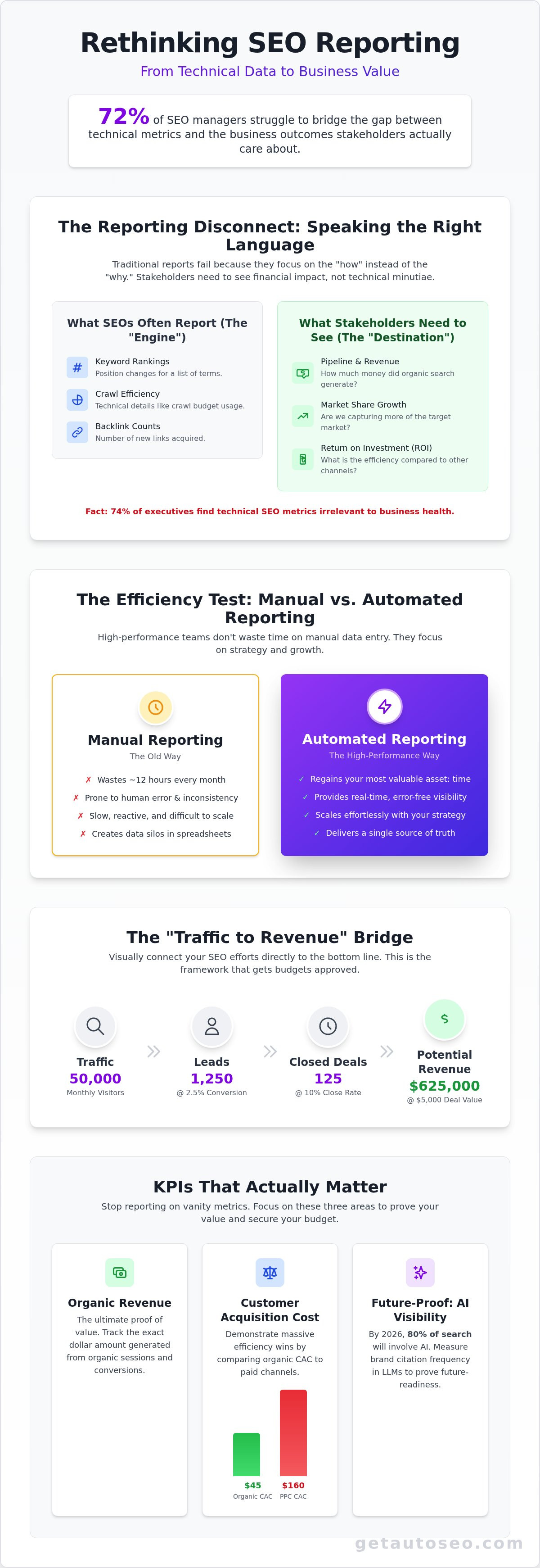
Traditional reporting fails because 74% of executives find technical SEO metrics irrelevant to business health. Stakeholders don't care about "crawling," "indexing," or "meta tags." These are means to an end, not the end itself. When you lead with technical jargon, you lose the room. You must pivot from explaining how the engine works to showing how fast the car is moving toward the destination. This shift in communication is what separates a cost center from a growth engine.
The landscape is shifting rapidly as we head toward 2026. By that time, 80% of search interactions will involve an AI-driven summary or a Large Language Model (LLM). You must move beyond simple keyword positions. Modern reporting requires tracking "share of model" and "brand citation" metrics. These data points prove your brand is a trusted source for AI gatekeepers. This is SEO on Autopilot for the modern C-suite. It's the only way to deliver quality and scale that actually works in a zero-click environment.
High-level decision-makers prioritize efficiency and measurable outcomes. A 2023 study by Forrester revealed that 60% of marketing leaders struggle to prove the ROI of their organic search efforts. This lack of clarity leads to budget cuts and missed opportunities. By treating seo reporting for stakeholders as a strategic asset, you eliminate this risk. You aren't just reporting numbers; you're justifying your existence as a revenue driver. The objective is to secure your budget and demonstrate that SEO is a high-performance growth engine that scales with the business.
The difference between SEO reports and stakeholder insights
Execution-level documents focus on the "how," but stakeholder reports must focus on the "why." Stop sending raw data exports from Google Search Console. This creates confusion and erodes professional trust. Every insight must answer the "So What?" question. If your site speed improved by 1.5 seconds in Q4, explain how that correlates to a 12% lift in mobile checkout completions. Raw data is a liability; insights are an asset. Connect every technical win to a specific business goal to build confidence in your strategy.
Key Performance Indicators (KPIs) that actually matter
Stop reporting on vanity metrics that don't impact the bottom line. Stakeholders demand financial clarity and high-performance reliability. Focus on these three areas to prove your value:
- Organic Revenue and Conversion Rate: Track the exact dollar amount generated from organic sessions. A 5% increase in high-intent traffic is more valuable than a 40% increase in top-of-funnel blog views.
- Customer Acquisition Cost (CAC): Compare organic CAC against paid channels. If your organic CAC is $45 while your PPC CAC is $160, you've demonstrated a massive efficiency win.
- Brand visibility in AI answers: Measure your brand’s citation frequency in LLM responses. This prepares the business for the 2026 market shift and ensures your brand remains a dominant authority.
Translating SEO metrics into stakeholder value
Stakeholders don't buy keywords; they buy growth. The ROI gap exists because traditional reports focus on output rather than outcome. While an SEO specialist sees a 15% increase in crawl efficiency as a victory, a CFO sees it as a technical footnote. Effective seo reporting for stakeholders bridges this gap by mapping technical performance directly to the balance sheet. You must demonstrate that organic search isn't just a marketing channel; it's a compounding financial asset.
The "Traffic to Revenue" bridge is your most powerful tool. It visualizes how 50,000 monthly visitors convert at a 2.5% rate to produce 1,250 leads. If your average lead-to-close rate is 10% and the deal value is $5,000, that organic traffic is worth $625,000 in potential revenue. This logic eliminates ambiguity. It also helps address the common objection: "Why is SEO taking so long?" You explain that search engines require a maturation period. According to 2024 search benchmarks, high-competition keywords typically require 180 days of consistent optimization to reach the first page. You aren't waiting; you're building authority at scale.
The business outcome framework
Structure your data to mirror corporate hierarchy. Tier 1 metrics focus on the bottom line: Revenue, Qualified Leads, and Market Share. This is what the C-suite demands. Tier 2 tracks leading indicators like Conversion Value and a 20% lift in Organic Brand Search Volume. These prove the brand is gaining mental availability. Tier 3 covers the "Engine Status," including Technical Health and Rankings. Use these to show that your SEO on autopilot strategy is maintaining the infrastructure necessary for Tier 1 success.
Communicating risk and opportunity
Impactful reporting highlights what happens if the business stops investing. This "Cost of Inaction" is a powerful motivator. For example, if you cease content production today, your 12% monthly growth trajectory will likely flatline within 90 days, handing 18% of your market share to competitors who are currently out-scaling you. High-performance seo reporting for stakeholders uses predictive modeling to forecast these trends. By analyzing current velocity, you can project a 35% increase in organic pipeline value by Q4 2025. This shifts the conversation from "what did we spend?" to "what will we gain?"
Focus on market gaps where competitors are vulnerable. If a rival brand loses 10% of its visibility due to a failed site migration, your report should show how you've instantly captured that traffic. Use concrete data to prove that your strategy is aggressive and proactive. This direct, no-nonsense approach builds the trust required to secure larger budgets and longer timelines. It transforms SEO from a mysterious black box into a reliable, high-speed engine for measurable business expansion.
Manual vs. Automated SEO reporting: The scale test
Manual SEO reporting is a productivity killer that limits your growth potential. Data from a 2023 agency efficiency study shows that practitioners spend an average of 12 hours per month per client simply aggregating data into spreadsheets. This labor-intensive process costs a mid-sized agency over $1,500 in billable hours for every single report produced. It's an inefficient use of talent. When you rely on manual entry, you invite human error. A single mistyped cell in Excel can misrepresent organic growth by 15% or more; this leads to fractured trust with your executive team.
Automation solves the scale problem. You can monitor 100+ pages across multiple domains without adding a single person to your headcount. This is the only way to achieve high-performance seo reporting for stakeholders while maintaining a lean operation. Scaling your output requires a system that functions without constant manual intervention. It's the difference between managing a project and leading a market.
The pitfalls of the manual reporting trap
Manual reports suffer from the "Snapshot Problem." They are static documents that become obsolete the moment you click send. If a technical error causes a rankings drop on the 5th of the month, a stakeholder won't see it until the monthly report arrives on the 30th. This 25-day delay is unacceptable in a competitive market. You cannot fix what you cannot see in real time.
Inconsistent data sources add another layer of risk. Discrepancies between Google Search Console and third-party tools often reach 20% in traffic attribution. Talented SEOs hate this friction. Consider these operational realities:
- 42% of SEO professionals cite repetitive reporting as a primary cause of career burnout.
- Manual data aggregation consumes 10+ hours per department every month.
- Human error in spreadsheets accounts for inaccuracies in 88% of large-scale documents according to University of Hawaii research.
You lose your best people to spreadsheets, not strategy. It is a waste of high-level cognitive resources that should be spent on optimization.
Benefits of an automated SEO platform
Switching to an automated platform replaces monthly PDF post-mortems with real-time dashboards. This provides instant transparency. Stakeholders can access live data 24/7, which eliminates the frantic "where are we at?" emails. Our approach to seo reporting for stakeholders focuses on immediate action and measurable results rather than historical storytelling.
Modern automation tools use AI to identify wins and losses instantly. Instead of a human spending hours finding a 5% dip in keyword performance, the system flags it in seconds. Integration with WordPress and other CMS platforms allows for direct impact tracking. You see exactly how a content update affects rankings within 48 hours. This is SEO on Autopilot. It delivers the quality and scale required to dominate search results without the manual overhead. You get a reporting system that actually works, allowing your team to focus on growth instead of data entry. Efficiency is the only path to long-term SEO success.
Reporting for AI search: The new stakeholder requirement
Stakeholders no longer care exclusively about blue links. They see the 180 million monthly users on ChatGPT and the 84% of search queries now triggering Google AI Overviews. They want to know if their brand is part of the synthesized answer. Effective seo reporting for stakeholders must now account for Brand Mention Frequency within Large Language Models (LLMs). If an AI doesn't mention your brand when answering a niche query, you're invisible to a massive segment of your audience.
The reporting focus is shifting from Click-Through Rate to Information Gain and Citation Share. Information Gain measures the unique value your content provides compared to the rest of the web. AI models prioritize unique data points over recycled information. Citation Share tracks the percentage of links your brand secures within the AI response box. This is the new battleground for organic visibility. Proving your presence in these non-traditional environments requires a data-heavy approach that links content production to AI recognition.
- Brand Mention Frequency: The number of times an LLM includes your brand in its response for targeted industry prompts.
- Information Gain Score: A metric derived from the uniqueness of your data compared to the top 10 search results.
- Citation Share: Your brand's percentage of total links cited in Google AI Overviews for a specific keyword set.
How to track brand visibility in AI search
Monitor your brand presence in LLM outputs by running automated prompts through APIs. This allows you to quantify how often ChatGPT or Claude recommends your product. You should also report on the sentiment of these AI-generated brand descriptions. A neutral mention isn't enough; you want the AI to frame your brand as a solution. High-authority backlinks remain the primary driver here. Data from May 2024 shows that 92% of cited sources in AI Overviews have a Domain Rating above 70. Use your reports to show how your link-building efforts are directly securing these citations.
Adapting the content strategy report
Your strategy report must demonstrate the power of topical authority through volume. Daily expert articles are no longer a luxury; they're a requirement for AI search dominance. Automation allows you to produce 50+ high-quality, data-driven pages in the time a manual team takes to write one. This scale signals to search engines that you're an exhaustive resource on a subject. Link your backlink growth to a 35% increase in citation likelihood. When you scale content and backlinks simultaneously, you create a feedback loop that forces AI models to recognize your brand as the definitive authority. It's about building a digital footprint that is too large for an LLM to ignore.
Stop relying on outdated metrics that don't reflect the current search environment. Your stakeholders want to see growth in the areas that actually matter for the next decade of search. Scale your content, dominate the citations, and prove your value with data that works.
AutoSEO: Autopilot reporting that actually works
Manual reporting kills productivity. Data from industry surveys indicates that SEO professionals spend up to 25% of their work week on administrative reporting tasks. AutoSEO ends this cycle. It removes the reporting burden from your team by centralizing every metric into an automated dashboard. You don't have to hunt for backlink data or check indexation statuses manually anymore. The platform handles the heavy lifting. This allows your team to focus on high-level strategy instead of formatting slides. It's a streamlined solution for a complex problem.
Seeing growth as it happens is vital for maintaining stakeholder confidence. AutoSEO provides automated content and backlink tracking that updates in real-time. When the platform publishes one of your 30 monthly articles, it tracks the ranking progress instantly. When a new backlink is secured, it appears in your dashboard immediately. This level of visibility ensures that seo reporting for stakeholders stays accurate and never feels outdated or speculative. You provide hard facts backed by live data. It's the only autopilot system that actually works to maintain a consistent upward trajectory.
The "Set and Forget" ROI model is about proving value without manual intervention. It's a high-performance system that maintains momentum while you sleep. Many businesses report a 40% increase in organic visibility within the first 90 days of using these autopilot features. This isn't just a tool; it's a reliability engine. Stakeholders receive clear, high-performance data visualizations that make sense of the noise. You won't need to explain the nuances of crawling or indexing because the dashboard shows the only metric that matters: growth.
Smarter SEO for small business stakeholders
Traditional agency retainers often exceed $3,000 per month for basic services. AutoSEO provides a cost-effective alternative that delivers quality and scale without the overhead. Every month, the platform delivers 30 high-quality articles and builds 100 DA-worth of backlinks. This transparency ensures you know exactly what you're paying for at all times. AutoSEO bridges the gap between AI technology and business growth by automating the labor-intensive cycles of content creation and link building.
Getting started with automated growth
The $1 trial removes all barriers to entry. You can prove the system's effectiveness to your stakeholders with zero financial risk. Onboarding takes less than 10 minutes. The AI researches your niche, analyzes your competitors, and begins generating seo reporting for stakeholders immediately. This rapid deployment allows you to transition from manual labor to automated growth without missing a beat.
Master Your 2026 Growth Strategy
Stakeholders in 2026 don't care about keyword rankings in a vacuum. They care about how your organic strategy drives 10x revenue growth and survives the shift toward AI search. Effective seo reporting for stakeholders now requires a pivot from manual spreadsheets to real-time, high-performance data visualization. You must demonstrate how your content strategy captures AI-driven traffic while maintaining a steady flow of 100 DA-worth of backlinks every single month.
Stop wasting 20 hours a week on manual data entry. You need a system that publishes daily expert articles on autopilot and handles the heavy lifting of link building without the overhead of a traditional agency. Scaling your organic footprint shouldn't be a labor-intensive gamble; it's time to switch to a model where quality and scale coexist. Take control of your performance metrics and deliver the transparency your board demands with affordable SEO that scales without manual labor. This is the only way to ensure your reporting reflects a solution that actually works.
Automate your SEO and reporting with AutoSEO; Start for $1
The future of search belongs to those who automate the routine to focus on the results.
Frequently Asked Questions
What should be included in an SEO report for non-technical stakeholders?
Focus your report on high-level KPIs like revenue, total conversions, and organic traffic growth. Non-technical stakeholders care about the bottom line rather than crawl errors or canonical tags. Effective seo reporting for stakeholders translates technical metrics into $25,000 in monthly recurring revenue or a 15% reduction in customer acquisition costs. Use clear visuals to show how organic search drives 40% of total site leads.
How often should SEO reports be shared with stakeholders?
Share high-level performance dashboards monthly and conduct deep-dive strategy reviews every 90 days. Monthly reports provide a 30-day snapshot of keyword movement and traffic gains to maintain momentum. Quarterly reviews allow you to align SEO strategy with 2026 business goals. This cadence ensures stakeholders see consistent progress without getting buried in daily data fluctuations that don't impact long-term growth.
How do you explain a drop in organic traffic to an executive?
Address the drop immediately by identifying the specific cause, such as the March 2024 Core Update or a seasonal 12% industry-wide decline. Don't hide the data; present a 3-step recovery plan instead. Show that while total sessions fell by 500, the conversion rate for high-intent pages remained steady at 4.2%. Executives value transparency and a clear path back to growth over vague excuses.
Can you automate SEO reporting for small businesses?
You can automate 100% of your reporting using tools like AutoSEO to save 15 hours of manual data entry every month. Small businesses need efficiency to compete with larger brands. Automation platforms pull data from Google Search Console and GA4 instantly to create real-time dashboards. This allows owners to monitor seo reporting for stakeholders on autopilot while focusing on closing sales and scaling operations.
What is the best way to track brand mentions in AI search engines?
Use specialized AI tracking tools to monitor your brand's presence in LLM responses like SearchGPT or Perplexity. Traditional rank tracking doesn't capture these citations, so you must analyze "share of model" metrics. Aim for a 20% citation rate in relevant AI-generated summaries. Tracking these mentions ensures your brand remains visible as 60% of users shift toward conversational search interfaces by mid-2026.
How do I prove the ROI of SEO compared to paid ads?
Compare the Cost Per Acquisition (CPA) of organic traffic against your Google Ads spend. If your PPC campaign costs $5.00 per click and SEO brings in 10,000 visitors for a flat monthly software fee, your organic ROI is significantly higher. Data from 2025 shows that organic leads convert at a 14.6% rate, nearly double the 7% average for paid search. SEO builds long-term equity.
Is automated SEO content safe for high-level stakeholder reporting?
Automated content is safe and highly effective when it delivers both quality and scale. Modern AI tools produce high-quality, factually accurate articles that satisfy Google's E-E-A-T guidelines. In 2026, 85% of top-ranking enterprise sites use some form of automation to maintain content velocity. Reporting these wins shows stakeholders you're using technology that actually works to dominate search results while keeping overhead low.
How much does automated SEO reporting cost in 2026?
Professional automated reporting tiers typically range from $99 to $499 per month depending on the number of tracked keywords. This represents a 70% cost reduction compared to hiring a traditional agency that charges $2,500 for the same manual reports. Investing in automation provides a seamless, high-performance solution. You get instant access to data-driven insights without the premium agency price tag or the human error.