

What if prospective clients could find your expertise before they ever ask for a referral? SEO for financial planners helps make that possible, but visibility alone isn’t enough. People need clear, trustworthy answers to understand your approach and decide whether your firm fits their needs.
Choosing which financial-planning topics deserve dedicated pages can be difficult, and publishing consistently is harder when you’re serving clients. In a high-trust field, content must show real expertise without making unsupported claims. A scattered blog or occasional website update is unlikely to create a clear path from search to enquiry.
This guide shows you how to build a practical SEO plan around the questions your ideal clients ask. You’ll learn how to choose focused topics, strengthen local and AI-driven search visibility, build authority responsibly, and maintain a sustainable publishing rhythm. The aim is to make your firm’s expertise easier to discover and give qualified prospects useful reasons to explore what you offer.
Key Takeaways
- Shape seo for financial planners around the questions and needs of the prospects you want to reach, not just broad industry terms.
- Build confidence with accurate, clearly authored content that distinguishes general education from personalized financial recommendations.
- Match local pages, service pages, and educational articles to different search intents, then give each page a relevant next step.
- Use a repeatable process to map searches, prioritize pages, publish, and track visibility, engagement, and qualified enquiries.
- Consistent publishing and backlink building can support a useful content library, while professional review remains central to financial claims.
SEO for Financial Planners: Why Search Visibility Starts with Prospect Needs
SEO for financial planners helps prospective clients find and use a firm’s information in unpaid search results. It can help relevant pages appear when people look for planning guidance, services, or firms. Paid advertising can also put a firm in search results, but it buys placement rather than earning organic visibility.
Search doesn’t replace referrals or trusted client relationships. It gives people a way to check what they’ve heard, explore a firm’s expertise, and decide whether to take the next step. A referral may prompt a search; clear, useful pages can help a prospect understand what the firm does before arranging a conversation.
Plan content around the prospect’s journey. Early searches often seek general explanations. Later searches may compare services, locations, and approaches. Your website should help people move between those stages with answers that are specific, accessible, and relevant.
What financial-planning prospects look for online
Prospects may want to know whether a firm understands their planning needs, what services it provides, where it works with clients, and what its process looks like. They may also want to understand a financial concept before deciding whether to seek professional guidance. Clear answers reduce guesswork and help readers judge whether a conversation would be useful.
Kitces’ prospect-research perspective is a useful reminder that people can use different personal criteria when choosing an advisor. Treat that as context, not a universal checklist. Explain your expertise and scope in plain language, and make practical details easy to find. Since people bring different levels of financial literacy to these questions, define unfamiliar terms rather than assuming every visitor already understands them.
Which searches can lead a prospect to a planning firm?
Group possible search queries by the need behind them. These examples are hypothetical, not evidence of search volume or a promise that a particular query will produce an enquiry.
- Planning need: “How do I prepare financially for retirement?” signals an informational search. The person is looking for guidance, not necessarily comparing firms yet.
- Service: “Retirement planning for business owners” points to a particular type of support. A relevant service page can explain the firm’s scope and approach.
- Location: “Financial planner in Austin” indicates interest in firms connected to a specific place. A local page should clearly identify the firm’s location and relevant service information.
- Advisor comparison: “Fee-only financial planner near me” suggests the searcher is assessing firms against a stated preference. A firm page can explain its own approach accurately and help the visitor decide what to explore next.
Use search intent to select the right destination. Educational content should answer the question directly; service and firm pages should help visitors assess fit and find a clear next step. This is the practical starting point for SEO for financial planners: make each landing page useful to the person behind the query.
Build Trust with Financial Planner SEO Content That Demonstrates Expertise
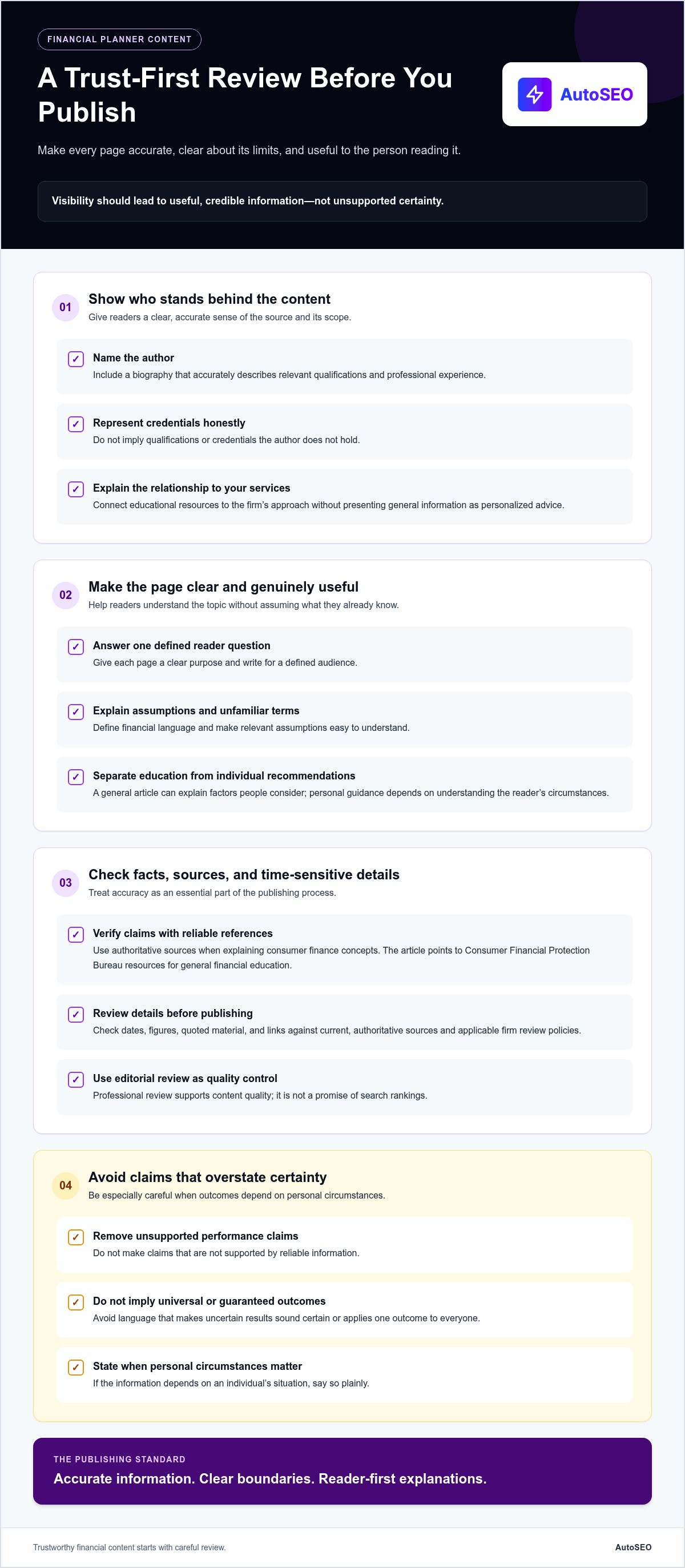
Financial content asks readers to make sense of decisions that can affect their lives. A polished page isn’t enough. Trust grows when information is accurate, the author’s experience is clear, and the page explains what it covers and where its limits are. That discipline is central to seo for financial planners: visibility should lead to useful, credible information, not unsupported certainty.
Show who stands behind the content
Give each article a named author and a biography that accurately describes relevant qualifications and professional experience. Don’t imply credentials the author doesn’t hold. Explain how a service page relates to supporting educational resources, so readers can move from a general concept to the firm’s approach without mistaking one for personalized advice. Editorial review is a quality-control step, not a promise of rankings.
Use reliable references when explaining consumer finance concepts. For general educational material, resources from the Consumer Financial Protection Bureau (CFPB) can help readers explore financial topics and make informed decisions. For an introduction to search principles behind content visibility, see this guide to what SEO is.
Make every page useful and responsible
Give each page one defined reader question. State relevant assumptions, explain unfamiliar terms, and distinguish general education from recommendations tailored to an individual’s circumstances. A general article can explain factors people commonly consider when planning for retirement; it shouldn’t present a reader-specific course of action without understanding that reader’s situation.
Review sensitive claims against current, authoritative sources and the firm’s applicable review policies. Check dates, figures, quoted material, and links before publishing. Avoid universal outcomes, unsupported performance claims, and language that makes uncertain results sound guaranteed. If information depends on personal circumstances, say so plainly.
Pre-publication article checklist
- Reader need: Does the page answer one clear question for a defined audience?
- Accuracy: Have factual claims and time-sensitive details been checked against current, authoritative sources?
- Authorship: Are the author’s identity, qualifications, and experience represented accurately?
- Scope: Can readers distinguish general education from individualized financial guidance?
- Clarity: Are assumptions, limitations, and technical terms explained in plain language?
- Claims: Does the article avoid unsupported promises, universal conclusions, and misleading certainty?
- Review: Has the content passed the firm’s relevant editorial and policy checks?
Use this checklist before every publication, whether a draft is written in-house or prepared with an automated SEO platform. Automation can support a consistent publishing process, but a qualified human should review financial claims before they go live.
Compare Financial Planner SEO Priorities: Local Pages, Service Pages, and Content
Different pages serve different search needs. A local firm page helps prospects understand where and how you work. A service page explains a specific type of planning support. An educational article answers a focused question. Strong seo for financial planners connects these page types without making them compete to answer the same query.
When a local SEO page is the right priority
Prioritize a local page when your firm serves a defined area and prospects need to understand that connection. Keep the firm’s address, contact details, and service-location information consistent and accurate. Add local context only when it genuinely helps explain how the firm serves people there. Guidance on small business SEO also applies when local visibility matters.
Avoid publishing near-identical pages that swap in different town names, especially for places the firm doesn’t meaningfully serve. Thin location variations give visitors little useful information and make the site less clear. A single, substantive page is better than copied pages with no real local distinction.
How service pages differ from educational articles
A service page should help a visitor assess fit: explain who the service is for, what it covers, and how to proceed. An educational article should answer one specific informational question rather than simply restating the service page. Link from the article to the relevant service when it offers a logical next step, and link to helpful education where readers may need more context.
These pages support each other, but neither replaces referrals, existing client relationships, or paid media. They add an organic discovery path that can work alongside those channels. For professional context, the Financial Planning Association (FPA) provides resources for financial planning professionals. Useful, accurate pages help make your firm easier to understand, wherever a prospect first encounters it.
Create a Practical Financial Planner SEO Plan and Measure Progress
A workable plan turns SEO for financial planners into a repeatable process, not a collection of disconnected tasks. Set a direction, publish for real prospect needs, then use evidence to decide what to improve. Search rankings and enquiries can fluctuate, so treat SEO as ongoing work rather than a fixed-timeline campaign with a promised outcome.
- Define your audience. Identify the types of clients the firm aims to serve and the planning questions most relevant to them. Use this focus to guide page priorities.
- Map searches. Group queries by need, service, location, and firm-comparison intent. Note the language prospects use in conversations and enquiries, then organize topics around those needs.
- Prioritize pages. Match each important search theme to the most useful destination: a local page, service page, or educational article. Avoid creating multiple pages for the same purpose.
- Publish with a process. Set a manageable schedule, assign authorship and review responsibilities, and check financial claims before publishing. A consistent workflow helps build a useful library over time.
- Review performance. Check whether key pages are indexed, how often they receive search impressions, and whether organic visitors engage with the content. Compare trends across consistent reporting periods.
- Refine based on evidence. Update pages that are outdated, unclear, or attracting the wrong searches. Strengthen useful pages and create new content only when it meets a distinct audience need.
Set measurable objectives without promising rankings
Choose indicators that connect search visibility to reader actions and firm priorities. Monitor indexation, impressions, organic visits, engagement, and qualified enquiries. Record a baseline before making changes, then review trends consistently instead of reacting to a single ranking shift or short-term rise or dip in traffic.
Interpret enquiries by their source. Keep organic-search activity distinct from referrals, paid media, and other channels where possible. This makes it easier to understand how search contributes without treating it as the only route to new relationships. For a practical view of workflow options, explore this guide to SEO automation.
Build a sustainable publishing and improvement workflow
Prioritize topics where prospect questions overlap with the firm’s expertise. Schedule recurring reviews of factual accuracy, time-sensitive details, internal links, and page usefulness. This keeps the site relevant without requiring a full rewrite every time you revisit it. A content calendar can assign a clear owner and review step to each page.
AI content creation can support production, but expert oversight remains essential for financial claims. To add consistency to your publishing workflow, explore AutoSEO’s automated SEO platform.
Scale SEO for Financial Planners with Consistent Content and Backlinks
Building a useful SEO programme takes more than choosing topics. Each topic must be researched, developed into an accurate article, published, and supported by authority-building activity such as backlinks. Handling every step internally gives your firm direct control, but it also takes time away from client work and requires a reliable process. An automated service can support execution while your team remains responsible for reviewing financial content.
What consistent SEO execution can involve
Separate the work into clear stages. Research identifies relevant questions and topics. Article production turns a topic into useful, well-structured content. Publishing makes the content available on your site. Backlink building can help establish your site’s authority, but it doesn’t guarantee rankings, enquiries, or recommendations in search results.
For financial-planning content, expert review matters where accuracy and context are at stake. Review claims, assumptions, and scope before an article goes live. Consistency can create a broader library of expertise, but activity alone doesn’t measure quality. Without a repeatable process, a firm risks being 2.5 years behind competitors. That phrase describes an execution gap, not a forecast or promised outcome.
How AutoSEO fits a financial planner’s content workflow
AutoSEO is an automated content and backlink service, not a traditional SEO agency. It provides 1 expert article daily. and builds backlinks. This supports a regular flow of content and authority-building activity; it doesn’t remove the need for financial professionals to review claims for accuracy and suitability before publication. See how SEO automation can fit into a repeatable workflow.
Client feedback describes individual experiences, not guaranteed results. Alexandra Truta of MiniCRM.one praises article quality and formatting. Martin Bonauer of Real Estate Switzerland reports acquiring a first customer from a published article. Neither testimonial guarantees another firm the same outcome.
Choose the operating model that fits your team. An internal workflow may suit firms with editorial capacity and a defined review process. Automation may suit firms that want consistent article production and backlink building without managing every production task themselves. In either case, connect topic choices to your expertise and retain professional oversight of financial claims. Explore AutoSEO’s automated SEO service to see how its article production and backlink building can fit your publishing workflow.
Make Your Next SEO Step Consistent
Turn your priorities into a publishing habit your firm can sustain. Choose a prospect question, create a useful page, review it carefully, and use what you learn to shape the next one. That steady cycle gives your expertise more opportunities to be discovered through search without replacing professional judgment or client relationships. Strong seo for financial planners comes from relevant work repeated with care, not promises of instant visibility.
AutoSEO supports execution with 1 expert article daily and backlink building. Alexandra Truta of MiniCRM.one praises the article quality and formatting, while Martin Bonauer of Real Estate Switzerland reports acquiring a first customer from a published article. These are individual experiences, not guaranteed outcomes. Keep expert review in your process, especially for financial claims.
Ready to reduce the manual work behind consistent publishing? Put your SEO content and backlink building on autopilot, then keep refining your programme around what prospects need. Give your expertise a clear, dependable path to discovery.
Frequently Asked Questions
What is SEO for financial planners?
SEO for financial planners helps make a firm’s accurate, useful information easier to find through unpaid search results. In practice, it can mean ensuring a page about estate planning is accessible to search engines, clearly titled, and helpful to readers considering that topic. It also includes building relevant authority signals. SEO supports discovery, but it can’t promise rankings, enquiries, or new clients.
Why is SEO important for financial advisors?
SEO helps prospective clients find and assess a firm while researching financial questions or comparing advisors. For example, a clear page explaining a firm’s investment-planning process may help a visitor understand its approach before deciding whether to reach out. Treat organic search as one part of marketing, alongside referrals and other channels. Review results over time, and judge success by relevant visibility and enquiries, not traffic alone.
How do financial planners choose SEO keywords?
Choose keywords by starting with the firm’s actual services, intended audience, and the questions prospects ask. A planner serving physicians might map a broad question about financial planning for doctors to an educational article, while a search for a specific planning service may suit a service page. Group terms by informational, service, and local intent, then assign each group to a page that provides a direct, relevant answer.
Can AI-generated content work for financial planner SEO?
AI can assist with content production, but a financial professional should review drafts before publication. Check figures, explanations, assumptions, and wording that could be mistaken for individualized advice. Make the author’s identity and qualifications clear, and state when a topic depends on personal circumstances. A defined review process helps a firm maintain quality as publishing scales. AI or any other production method can’t guarantee rankings, recommendations, enquiries, or business results.
How long does SEO take to work for a financial planning firm?
There’s no dependable universal timeline for SEO results. A new site may need to address accessibility or indexing issues, while an established site may need to improve page relevance or fill gaps in its content. Track indexation, impressions, organic visits, and qualified enquiries across consistent reporting periods. A brief ranking increase or decline is one data point, not proof of a lasting trend or future outcome.
How much does SEO for financial planners cost?
SEO costs depend on the scope of work and whether the firm handles activities internally or uses paid support. The work may involve technical improvements, content production, local visibility, or authority building, and each firm’s needs differ. Define priorities first, then compare the work included with your goals and capacity. Avoid relying on a generic estimate: this guide doesn’t quote prices for SEO services.
Do financial planners need local SEO?
Local SEO can help when a firm serves clients in defined places and nearby prospects need accurate information about its presence or services. Keep location and contact details current, and make clear which communities the firm genuinely serves. For example, a firm with an office in one city can provide useful details about that location. Don’t create location pages for places with no meaningful connection to the firm.
Do backlinks help financial planner SEO?
Backlinks can contribute to a site’s authority when relevant, trustworthy websites link to it, but no link guarantees a higher position in search results. A link from a professional organization to a useful educational resource, for example, may make sense for readers as well as the site. Assess backlinks as one part of the wider programme, alongside useful content and an accessible website, rather than as a standalone ranking shortcut.


