

More rankings won’t help if the wrong buyers find you. SEO for logistics and transportation companies works when each search topic connects to a service, a buyer need, and a clear next step. Broad SEO advice often misses the differences between freight services, locations, and trade lanes, leaving teams unsure what to prioritize or how to judge results.
You need a practical plan that links search visibility to qualified enquiries, not just traffic charts. This guide shows you how to prioritize commercially relevant keywords, build useful service and location pages, strengthen technical SEO, and earn credible links. It also covers how to measure progress by enquiry quality and contribution to business outcomes, while accounting for visibility in Google and AI search.
For companies comparing ongoing SEO workflows, AutoSEO combines business-specific research with 1 expert article daily and backlink building. Its service is designed for businesses that are 2.5 years behind competitors. The sections ahead turn that approach into an ordered plan, so you can focus effort on the searches most likely to connect your logistics business with its next customer.
Key Takeaways
- Build seo for logistics and transportation companies around the services, cargo types, locations, and trade lanes your buyers actually search.
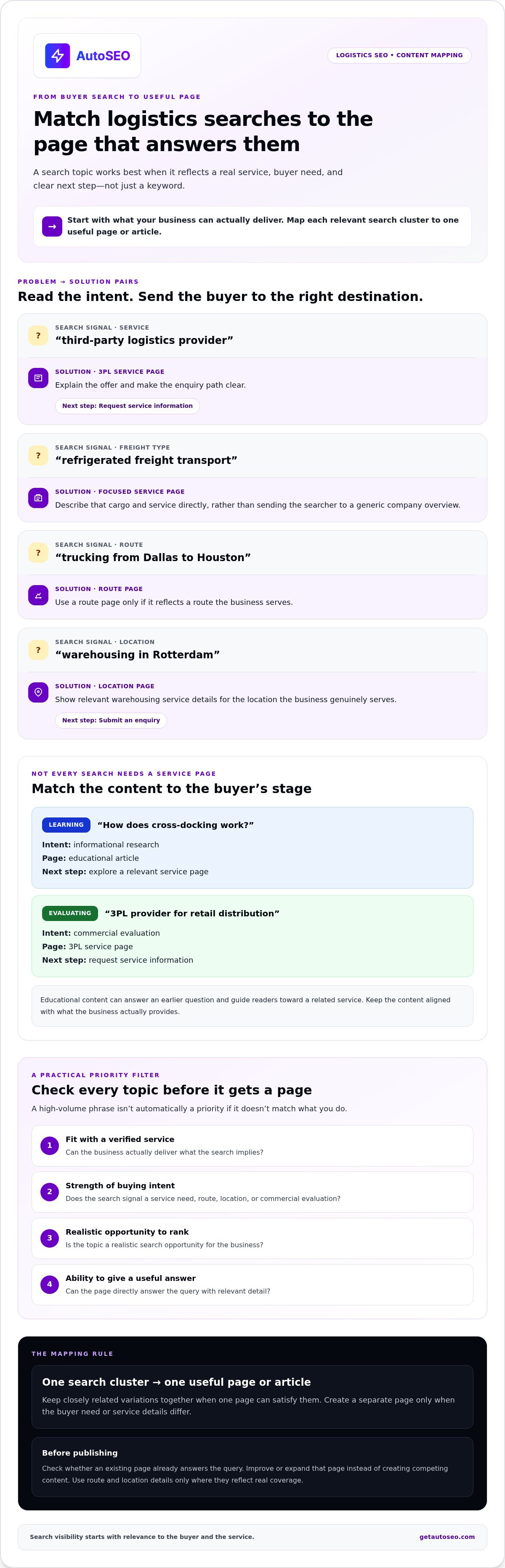
- Group keywords by buyer intent, then map each cluster to one useful service page or article to keep your content focused.
- Compare SEO workflows by logistics expertise, content quality, consistency, oversight, backlink activity, and reporting, not rankings alone.
- Prioritize technical fixes and track qualified enquiries alongside visibility to see whether SEO is contributing to business outcomes.
- Consider how automated publishing can support an ongoing plan, including 1 expert article daily and backlink building.
Why SEO for Logistics and Transportation Companies Starts with Buyer Search Intent
Logistics SEO improves a company’s visibility when potential customers search for relevant services, routes, locations, and supply chain solutions. The goal isn’t to attract every visitor. It’s to connect the right buyer with a page that answers their need and makes the next step clear. Relevant organic visibility can turn buyer searches into qualified logistics enquiries.
Shippers, procurement teams, and supply chain managers often research providers before making contact. They may begin with a specific challenge, compare service options, and then assess companies that match their requirements. A useful starting point is understanding the breadth of the field, including the What is Logistics? overview, then reflecting your own services and expertise in the pages buyers can find.
That distinction matters for seo for logistics and transportation companies. Someone searching for “how does freight consolidation work?” is likely learning. A person searching for “LTL freight carrier Chicago to Atlanta” has named a service, route, and location. Both searches can matter, but they call for different content and next steps.
Which logistics searches signal commercial intent?
Service-specific searches usually show stronger buying intent than broad educational queries. Modifiers help reveal what the searcher needs: a service identifies the job, a route narrows the movement, a location identifies the market, and an industry or cargo type adds operating context. Match each cluster to a page that answers it directly.
- Service: “third-party logistics provider” should lead to a 3PL service page explaining the offer and enquiry path.
- Freight type: “refrigerated freight transport” belongs on a page focused on that cargo and service, not a generic company overview.
- Route: “trucking from Dallas to Houston” can map to a route page if it reflects a route the business serves.
- Location: “warehousing in Rotterdam” should lead to a location-specific warehousing page with relevant service details.
Early-stage searches need a different response. An article explaining freight forwarding or warehouse fulfilment can help a reader understand an option, then guide them toward a related service page. Keep the content aligned with what the business actually provides. A page should answer the query, not repeat keywords without adding useful detail.
Why referrals alone leave search demand uncaptured
Referrals and existing relationships remain valuable. Search supports them; it doesn’t replace them. A referred prospect may still look up your company, verify its capabilities, or compare it with alternatives. A buyer without a referral may follow a similar research path, starting with a problem and narrowing the options through service, route, cargo, and location searches.
Make that path easy to follow. A clear service page helps buyers assess fit. A relevant location or route page addresses operational scope. Useful educational content answers earlier questions and gives readers a reason to explore related services. Together, these pages help your business appear during research and give prospective customers a stronger basis for shortlisting it.
How to Build a Logistics SEO Keyword and Content Strategy
Start with what the business can actually deliver. List verified services, cargo types, customer segments, locations, and trade lanes. Then collect the language buyers use for each, including service names, operational questions, and problems they need to solve. Research can also surface relevant industry topics; for transportation context, use authoritative sources such as the U.S. Department of Transportation, and turn useful information into clear, original guidance.
A logistics keyword map assigns each search topic to one page or article. This helps buyers find relevant answers and prevents multiple pages from competing for the same query. For seo for logistics and transportation companies, prioritize topics by four checks: fit with a verified service, strength of buying intent, realistic opportunity to rank, and ability to give searchers a useful answer. A high-volume phrase isn’t automatically a priority if it doesn’t match what you do.
Map service, route, and industry keywords to pages
Build distinct clusters for each verified service, such as freight modes, 3PL, or warehousing. Add route and location modifiers only where they reflect real coverage. Match buying queries to service pages and educational questions to articles. Keep closely related variations together when one page can satisfy them; create a separate page only when the buyer need or service details differ.
| Query | Intent | Page type | Next step |
|---|---|---|---|
| “3PL provider for retail distribution” | Commercial evaluation | 3PL service page | Request service information |
| “How does cross-docking work?” | Informational research | Educational article | Explore a relevant service page |
| “Warehousing in [served location]” | Local service search | Location page | Submit an enquiry |
Treat the examples as templates, not claims about your coverage. Replace bracketed locations with places the business genuinely serves. Before publishing, check whether an existing page already answers the query. Improve or expand that page instead of creating a near-duplicate.
Plan content that supports logistics buyers
Choose article topics from real buyer questions: service comparisons, process explanations, cargo considerations, or operational challenges relevant to your expertise. Give every article a defined audience, search intent, and next step. Link it to the closest matching service page so readers can move from learning to evaluating a provider. A repeatable schedule helps organize research, production, and publishing without losing the business-specific focus.
Review the map as services and priorities change. AutoSEO combines business-specific research with automated publishing and backlink building, including 1 expert article daily. For teams planning a repeatable content workflow, explore automated SEO publishing as one way to support consistent execution.
How to Compare Logistics SEO Approaches Beyond Rankings
Rankings show only part of the picture. For seo for logistics and transportation companies, the right workflow also needs logistics relevance, reliable publishing, credible backlink activity, and reporting that connects organic visibility with qualified enquiries. Compare how the work gets done, who owns each decision, and how much time your team must commit.
Use the matrix as a starting point, not a promise about every provider or setup. Agency-led and in-house workflows vary, while automation can support repeatable execution. In every model, someone must ensure content accurately reflects your services, operating context, and expertise.
| Approach | Expertise and oversight | Consistency and effort | What to evaluate |
|---|---|---|---|
| Agency-led | External specialists may guide strategy and production; your team supplies operational knowledge and review. | Can provide a defined workflow, with coordination and approvals still requiring attention. | Logistics understanding, review process, publishing ownership, backlink practices, and transparent reporting. |
| In-house | Your team holds direct business context and editorial control. | Work competes with other responsibilities; output depends on available capacity and process. | Research skills, subject-matter access, production time, technical support, and measurement ownership. |
| Automated | Research and production steps can be systematized; business-specific review remains important. | Designed to make repeatable publishing less operationally demanding. | Research relevance, content quality, editorial checks, backlink activity, and reporting clarity. |
Assess content quality, consistency, and operational fit
Inspect examples for accuracy, originality, and specificity. Does the content distinguish the company’s actual services from generic logistics advice? Can it explain a buyer’s operational question without inventing capabilities? Identify who researches, writes, reviews, and publishes each piece. A dependable process can reduce manual coordination, but no workflow should promise rankings or leads simply because it produces content consistently.
Industry context can sharpen editorial judgment. Resources from the Council of Supply Chain Management Professionals can help teams follow supply chain topics and frame relevant questions. Use sources to inform useful content, not to substitute for the company’s own expertise.
Evaluate backlinks and visibility across search platforms
Backlinks are links from other sites that can act as trust signals. Evaluate whether link-building activity is relevant and transparent, rather than judging it by volume alone. Look for a clear explanation of how links support the site and fit into the wider SEO plan.
Measure visibility in Google alongside discovery in ChatGPT and Perplexity, without assuming one platform’s performance predicts another’s. AutoSEO combines business-specific research, 1 expert article daily, and backlink building. Consider whether this automated workflow fits your operating needs, and explore automated SEO publishing as one option.
How to Implement and Measure a Logistics SEO Plan
Turn the strategy into a managed sequence, not a loose list of SEO tasks. For seo for logistics and transportation companies, the order matters: first establish what is working, then remove barriers, publish against mapped topics, and review outcomes. This keeps technical fixes, content, and reporting connected to commercial goals.
- Set a baseline. Record current organic visibility, visits to priority landing pages, and enquiries attributed to organic search. Note which services and topics each page targets.
- Fix high-impact barriers. Check whether important pages can be crawled and indexed, then address broken internal links, duplicate pages, and mobile usability problems.
- Map and improve pages. Match priority queries to existing pages or identify genuine content gaps. Clarify page titles, headings, structure, and internal links so visitors can find the information they need.
- Publish and connect content. Create useful material for priority topics and link relevant articles to service pages. Make the next step clear without forcing it.
- Review and refine. Compare results by service and search intent. Use evidence to adjust page content, internal links, and the next round of technical work.
Use consistent definitions for SEO metrics and terms when reviewing reports, so everyone understands what each measure says about visibility, engagement, and enquiries.
Prioritize technical and local SEO improvements
Start with access and usability. Search engines need to crawl and index the pages that matter, while potential customers need a clear experience on mobile and desktop. Check that key pages load correctly, use a logical heading structure, and link to related services. Resolve duplicate or outdated pages that could confuse visitors or divide attention between similar URLs.
Keep business details consistent across your website and relevant local profiles. Build a location page only when it provides distinct, accurate value, such as information about a genuine facility or service area. Thin pages that simply swap one place name for another add little to a buyer’s decision.
Track outcomes and refine the plan
Use a compact scorecard. Track impressions and clicks for priority topics, relevant landing-page engagement, service-page visits, and completed enquiry actions. If possible, label or record enquiries by the service they concern, so the team can distinguish useful demand from general browsing.
Impressions are a leading indicator of visibility; qualified enquiries are a commercial outcome. Neither tells the whole story alone. A page can gain impressions without attracting suitable buyers, while a small number of relevant enquiries may signal strong service-page fit. Review performance regularly by service and intent, then prioritize changes that address a clear gap. A consistent publishing workflow can help keep planned content moving.
How AutoSEO Supports Logistics SEO on Autopilot
A strategy only creates value when the work keeps moving. AutoSEO is an AI-powered SEO platform for businesses seeking visibility in Google, ChatGPT, and Perplexity. It provides 1 expert article daily and backlink building, giving logistics teams a repeatable content and trust-building workflow to consider alongside their own SEO plan.
Before planning content, AutoSEO’s initial AI research examines the business, its customers, and competitors. That research informs business-specific topic and keyword planning. For a logistics company, useful editorial context includes its actual services, cargo types, customer needs, and operating expertise. The goal is relevance at scale, not generic volume.
What an automated SEO workflow can take off your plate
Daily article delivery creates a consistent production rhythm without requiring your team to start each topic from scratch. Backlink building is a separate part of the workflow, intended to help build trust signals around the site. These activities support ongoing SEO execution, but they don’t guarantee rankings, traffic, or enquiries.
Automation works best when the content remains grounded in how the business operates. Your logistics expertise helps ensure that an article about warehousing, freight, or supply chain challenges reflects real services and answers buyer questions accurately. Use the same standard for every piece: it should serve a defined audience and search need, and contain details that a generic draft would miss.
How to decide whether AutoSEO fits your logistics business
Consider AutoSEO if your team wants ongoing content and backlink activity, and needs a repeatable way to support it. Compare the workflow against your current capacity: can your team sustain research, writing, and link building while handling daily operations? Business-specific research can inform topic planning, while your subject expertise helps keep the finished content connected to your real capabilities.
Customer examples provide context, not a promise of logistics-specific results. Martin Bonauer of Real Estate Switzerland reports gaining a first customer from a published article. Alexandra Truta of MiniCRM.one praises article quality and formatting. Use these examples to understand customer experiences, then judge the workflow against your own content and measurement needs.
Use the plan in this guide to set priorities, then choose a workflow that supports consistent action and clear measurement. Put your SEO on autopilot with AutoSEO.
Make Your Next SEO Move Count
The strongest next step is to connect SEO with the people closest to customer questions. Sales and operations teams hear which services buyers compare, what information is missing, and where expectations need clarity. Use those insights to keep your content grounded in real conversations, then review whether the pages attract the right enquiries. That feedback loop gives seo for logistics and transportation companies a practical way to stay relevant as buyer needs and service priorities evolve.
Consistency is easier when execution doesn’t depend on finding spare hours for every task. AutoSEO combines automated content production with backlink building, giving logistics businesses an ongoing workflow to consider as they put their plan into action.
Customer examples offer perspective on the service: Martin Bonauer of Real Estate Switzerland reports gaining a first customer from a published article, while Alexandra Truta of MiniCRM.one praises article quality and formatting. These are individual customer experiences, not a promise of the same result for every business.
Choose a focused next step, keep the work tied to commercial outcomes, and build momentum from there. Put your SEO on autopilot and move your growth plan forward.
Frequently Asked Questions
Is SEO worth it for a logistics or transportation company?
Yes, SEO can be worth the effort if buyers search online for services and routes your business genuinely provides. It’s most useful when potential customers research providers before deciding whom to contact. For seo for logistics and transportation companies, value comes from attracting visitors whose needs match your capabilities, not simply increasing sessions. Review whether enquiries reflect suitable cargo, lanes, and service requirements, then use that fit to guide future investment.
How long does SEO take to work for a logistics company?
There’s no fixed timeline because progress depends on competition, site condition, content quality, and the website’s authority. A site with technical barriers may need foundational repairs before target pages can gain traction. Track changes over time and use early signals to identify what needs attention, while recognizing that rankings and enquiries can take time to develop.
Can SEO help a freight company get more quote requests?
Yes, SEO can help put relevant freight information in front of buyers who are considering a shipment, though it can’t guarantee quote requests. A page for a specific freight service can explain the cargo it handles, relevant operating details, and how to request a quote. Make the enquiry path easy to find on mobile, and ask the sales team whether incoming requests match the freight, route, and customer profile the business wants to serve.
What keywords should a logistics company target?
Target phrases that reflect what the company provides and what buyers need to solve. Service terms identify offerings; location and trade-lane modifiers narrow geography; industry terms describe the customer context; problem-based queries surface operational needs. For example, a company might research searches combining its verified freight service with a served city or cargo category. Exclude phrases that imply capabilities, destinations, or cargo handling outside its actual business.
Does local SEO matter for trucking and logistics companies?
Local SEO matters when buyers search for trucking, warehousing, or logistics options in places the company genuinely serves. Keep business details accurate and consistent across the website and relevant local profiles, so prospects can identify the right location or operation. A location page should help local buyers understand the service available there, rather than repeating a template with only the place name changed. Focus on markets tied to real operations.
Can AI-generated content rank for logistics searches?
AI-generated content can support search visibility when it’s useful, accurate, original, and relevant to the buyer’s question. Review every article for unsupported claims about cargo, routes, handling, or service capabilities, and add practical expertise that a generic draft would miss. AutoSEO provides 1 expert article daily and backlink building, but publishing volume alone doesn’t ensure rankings. Editorial review should protect accuracy and make each piece worth a logistics buyer’s time.
How should a logistics company measure SEO success?
Measure visibility and engagement as indicators, then judge commercial performance by qualified enquiries and conversions. Track which landing pages attract relevant visitors, whether they explore service information, and whether they complete an enquiry action. In a CRM, record the service or route associated with each organic enquiry and whether it progresses. This reveals whether SEO is drawing suitable demand, even when total traffic rises without a matching increase in business opportunities.


