

Winning People Also Ask visibility takes more than adding an FAQ. Google’s boxes often show several questions related to a query, so using AI for optimizing People Also Ask starts with finding questions that match search intent, then answering them clearly in useful, crawlable content.
A People Also Ask result can put an answer in front of searchers before they reach a standard result. But search is changing: content now needs to serve traditional search and AI-generated answers, not just one format.
Learn how to use PAA data to map intent, choose worthwhile questions, and write direct answers for both search experiences. We’ll also cover page structure, credible expertise, and performance monitoring. The goal is a repeatable process for turning real questions into useful content.
Key Takeaways
- Use recurring People Also Ask questions to uncover search intent and prioritize content topics that connect to your audience’s needs.
- Structure each page around clear questions, direct answers, and useful depth to make its content easier to understand across search experiences.
- Track new questions and shifts in intent so your content strategy stays aligned with what people want to know.
- Combine strong SEO fundamentals with consistent, high-quality content production to build visibility in traditional and AI-powered search.
Using PAA data to map search intent for AI and traditional search
People Also Ask (PAA) questions reveal what searchers want to know next. Group them by intent, such as learning a process, comparing options, or solving a problem. Then connect each group to a page that can answer it fully. This turns a broad keyword into a practical content map for search engines and large language models.
Search behavior also changes the value of a click. According to Pew Research Center, US adults clicked a traditional search result in 8% of visits that included an AI summary, compared with 15% of visits without one. Treat PAA visibility as one discovery path, not a substitute for useful pages that earn visits and build trust.
Build a question map with a simple workflow:
- Collect PAA questions for a target keyword and group similar questions by intent.
- Choose the question that best matches your audience and make it a descriptive H2 or H3.
- Answer directly beneath the heading, then add context, examples, or evidence that makes the answer valuable.
For example, a page about email marketing could use “How do you write a welcome email?” as a heading. Answer with the first practical step, then add relevant guidance rather than padding. Question headings help readers scan and make it easier for search systems to identify which passage addresses each need.
To optimize existing pages, compare their headings and answers with relevant PAA questions. Fill gaps with direct, accurate responses while keeping the page’s useful expertise. Update details when the answer or search intent changes.
AI-generated content can include inaccurate claims, generic answers, or repetition. Before publishing, review every response for factual accuracy, audience relevance, and useful detail.
To assess visibility in AI tools, test consistent questions about your topic and record any brand or page mentions. Segment AI-platform referral traffic in analytics, and monitor branded searches alongside organic clicks. Together, these signals help distinguish visibility from visits and show which question-led pages need improvement.
How do you create content that serves both PAA and AI search?
Start with recurring questions, not isolated keywords. Group variations about the same task, obstacle, or decision. For example, questions about choosing a password manager may point to themes such as security, device compatibility, and pricing. Plan content around those themes, giving each page a distinct purpose instead of publishing overlapping pages. AI for optimizing People Also Ask can help surface patterns, but verify questions against actual search behavior.
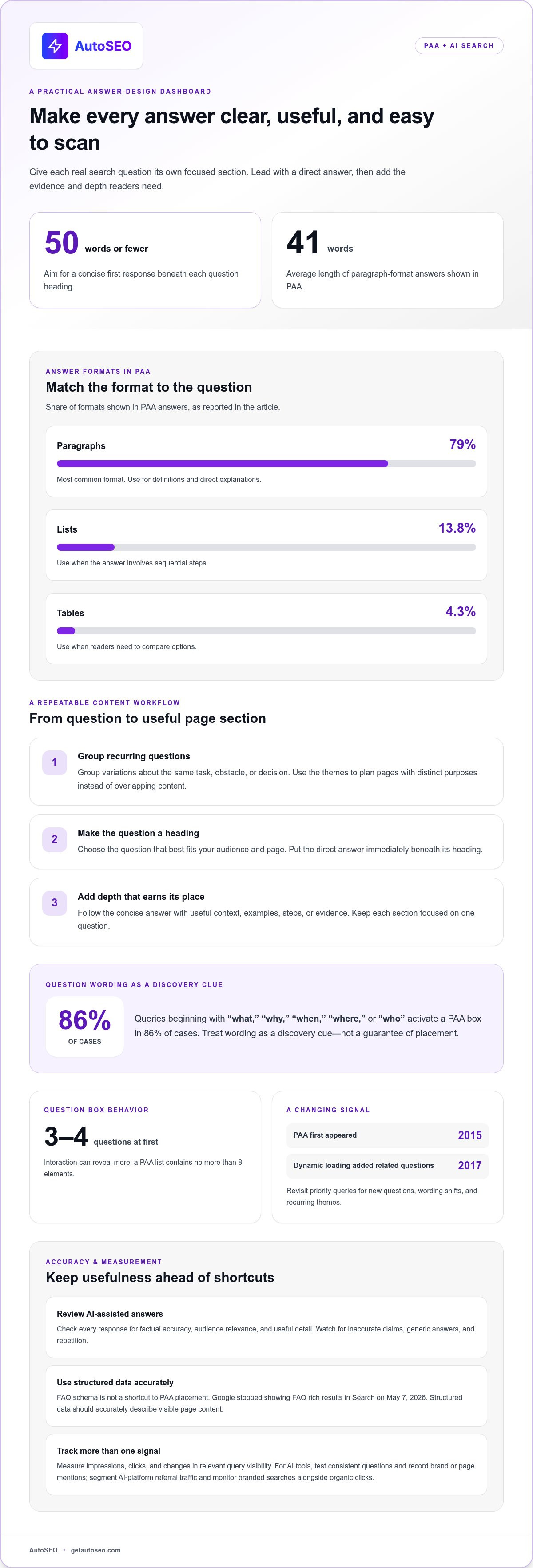
Give each question its own heading and answer it directly underneath. Keep the first response concise, ideally within 50 words, then add context, steps, or examples for readers who need more depth. This format helps people scan and gives search systems a clear passage to extract. Keep each section focused on one question, and support factual claims with relevant evidence.
Choose the response format that fits the answer. Paragraphs account for 79% of formats shown in PAA answers and average 41 words. Lists represent 13.8%, while tables account for 4.3%. Use a paragraph for a definition, a list for sequential steps, and a table when readers need to compare options. Clear formatting supports organic visibility without sacrificing usefulness.
FAQ sections can organize genuine customer questions, but FAQ schema isn’t a shortcut to a PAA placement. Google stopped showing FAQ rich results in Search on May 7, 2026. Use structured data only when it accurately describes visible page content, then measure performance through impressions, clicks, and changes in relevant query visibility.
Review question data for repeated subtopics. If several questions ask about account security, cover setup, recovery, and common risks across connected pages. Link those pages so readers can move from a quick answer to deeper guidance. For AI for optimizing for People Also Ask, use this topical map to identify gaps, then add original expertise rather than repeating generic answers.
Need a repeatable publishing workflow? Explore an automated SEO content platform to support consistent production while you focus on accuracy, expertise, and quality at scale.
How does Google pick the questions in the box?
Google’s People Also Ask box surfaces questions related to a search query and its intent. It usually shows three or four questions at first, and interaction can reveal more; a PAA list contains no more than eight elements. The feature first appeared in 2015, and dynamic loading has added related questions as users interact since 2017. These changes make the box a moving signal, not a fixed editorial checklist.
Prioritize relevant questions that match your page’s subject, audience, and language. Search queries beginning with “what,” “why,” “when,” “where,” or “who” activate a PAA box in 86% of cases. That makes question wording a useful discovery cue, not a guarantee of a specific position. Compare each candidate’s search intent and keyword difficulty, then focus on questions your page can answer with clear expertise. Search volume helps estimate demand, but relevance should decide whether a question belongs in your content plan.
Monitor changes by revisiting priority queries and noting new questions, shifts in wording, and recurring themes. For example, a home-insulation guide may need an update if questions shift from material types to installation or maintenance. Add emerging questions to an editorial backlog, then decide whether they merit a new page, a section, or a refresh. Structured data can describe page content, but it cannot replace relevance or a direct answer.
To measure PAA visibility, record whether each priority page appears for its target query, along with its search position, impressions, and clicks. Review the same queries regularly and compare changes with page updates and referral traffic. Search Console assigns links within one AI Overview the same reported position, while query-refinement links from AI features count as neither clicks nor impressions.
Track AI citations separately. Ask relevant AI tools priority questions, record whether your brand or pages appear, and note the cited sources. Compare those observations with branded-search trends and analytics segments for AI referrals. This gives you a practical view of visibility in search results and AI answers, even when no single metric captures every interaction.
SEO and generative engine optimization strategies
To support visibility in search engines and AI answers, strengthen the page behind each response. Google requires a page to be indexed and eligible to appear with a snippet before it can become a supporting link in an AI Overview. Check crawlability, mobile usability, and page speed, and make sure the page answers its target query clearly.
Authority matters, but ranking first isn’t the only path to a PAA appearance. Only 13% of sites featured in PAA boxes rank in the top three organic results for the query, while 74% don’t rank on the first page. Use keyword research to find relevant questions competitors overlook, then add original insights, expert context, or proprietary data that gives readers something beyond a generic generated answer.
Strengthen the signals around your content. Add a visible author biography that demonstrates relevant expertise, cite reputable evidence, and link related pages internally. Earn quality backlinks to useful resources. These steps help search systems understand the topic and assess the authority behind the page’s claims.
What are the best AI tools for optimizing content for People Also Ask? Use AI to group question themes and draft content briefs, alongside PAA monitoring, analytics, and human fact-checking. A useful setup identifies intent, finds gaps, and measures results without treating generated text as ready to publish.
Make the workflow measurable. Track whether priority pages are indexed, receive organic impressions, and get cited in AI answers. Use consistent prompts with relevant AI systems and record mentions over time. Review which pages appear, which passages are cited, and where other results provide more specific evidence. Refresh content when facts or search intent change.
Put those steps into a repeatable publishing process. Automate your SEO content workflow to keep quality and scale working together.
AutoSEO: Automated SEO Platform Subscription
AutoSEO’s Automated SEO Platform Subscription suits businesses ready to turn search insights into a consistent publishing process. The recurring subscription delivers 30 SEO-optimized articles per month and 100 Domain Authority worth of backlinks, supporting ongoing organic visibility across Google and AI search. Use the PAA questions and intent patterns identified in this article to guide content priorities, then review published pages for accuracy and relevance.
This approach suits teams that want SEO content production and backlink building handled through an automated platform instead of managing every task manually. AutoSEO provides a daily expert-written SEO article with built-in backlinks. No platform can guarantee a particular PAA placement or search ranking.
Visit AutoSEO to explore the Automated SEO Platform Subscription.
Turn search questions into your next growth opportunity
Make question research part of your regular planning. Choose priority topics, review how search intent develops, and use those changes to guide what you publish or update. AI for optimizing People Also Ask works best as decision support: let automation surface patterns, then apply human judgment to accuracy, expertise, and audience value.
Keep the standard clear: every answer should meet a real need, every page should add value, and every update should have a purpose. This discipline helps content stay relevant as search changes, without chasing every new feature or repeating existing information.
If you’re ready to build a consistent process around SEO automation, discuss your strategy with AutoSEO. Start with a clear priority, keep the quality bar high, and move forward with confidence.
Frequently Asked Questions
What Is The People Also Ask Section on Google, & How Do You Rank In It?
People Also Ask is a Google Search feature that displays related questions and expandable answers. To target it, create a useful page that answers a relevant question accurately and makes the answer easy to find. Treat inclusion as a visibility opportunity, not a guaranteed ranking. Start with a close match between the question, the page, and the searcher’s need.
How do I get into People Also Ask now?
Choose a question that fits the page’s purpose, then answer it with specific, trustworthy information. For example, a page about choosing a project management method could explain how to decide between approaches, rather than adding unrelated questions to broaden coverage. Review live results for your target query and update the page if the questions or intent change.
How do you answer People Also Ask inside your content?
Write answers readers can understand without decoding jargon or searching elsewhere. For “What does crawlability mean?”, define the term first, then explain why it matters to a site owner. Add relevant context or an example after the direct answer. Check the facts and remove claims the page cannot support with reliable evidence.
How do you appear in People Also Ask?
Build a page that demonstrates expertise, rather than a short response designed only to capture a search feature. Cite credible sources for factual claims, show the author’s relevant experience, and link to related material on your site. Keep the technical foundations sound too: search engines must access and understand the page before it can compete for visibility.
What is People Also Ask (PAA) and how does it work in Google Search?
PAA is an interactive Google Search feature that surfaces questions related to a query. Selecting a question expands its answer and may reveal more related questions. Google may sometimes answer a PAA question with its own AI rather than content sourced directly from a website. Clear, accurate page content remains valuable, even when the displayed answer doesn’t come from your site.
How can AI tools identify PAA questions and search intent?
AI tools can group question lists into themes such as comparison, setup, or troubleshooting, then help connect each theme to a likely search need. Give the tool a specific topic and audience, and ask it to group questions without inventing evidence. Check the results against actual search results and your subject expertise before deciding which questions belong in your content plan.


