

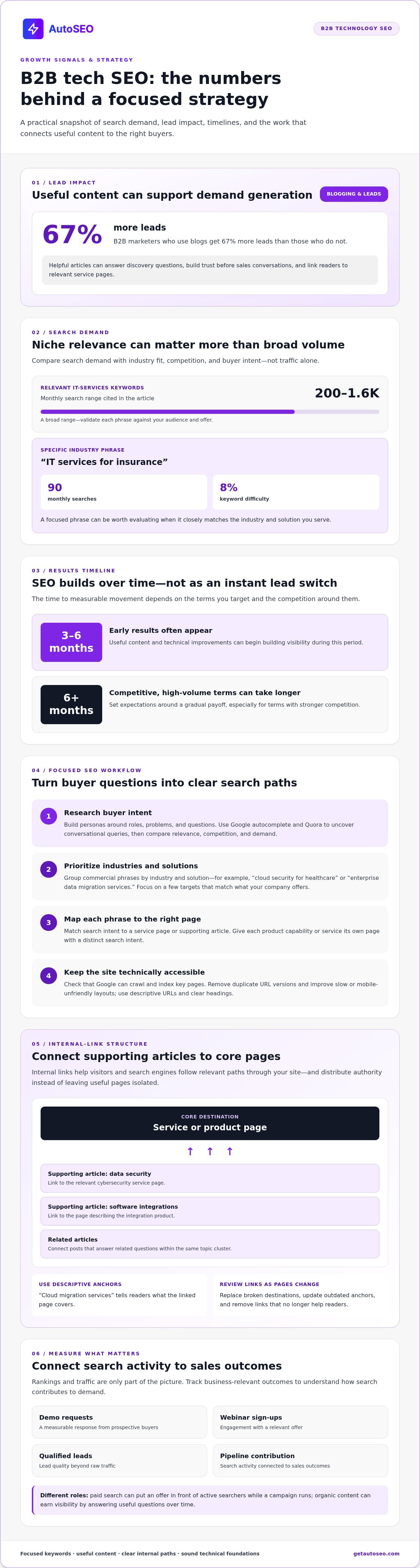
SEO for B2B technology companies is a long-term growth channel, not an instant lead switch. Early results often appear within 3 to 6 months, while competitive, high-volume terms can take 6 months or more. The strongest approach combines industry-focused keywords, useful content, clear internal links, and a technically sound website.
That timeline can feel slow when your sales team needs qualified demand now. But B2B technology buyers research complex solutions before they speak with sales, so useful search content can build visibility and trust throughout discovery, not just capture ready-to-buy leads.
This guide explains how SEO differs for technology companies, which strategies help attract the right audience, and how internal links connect content to key pages. You’ll also learn what affects the path from publishing to measurable results, so you can set a realistic timeline and prioritize work that compounds.
Key Takeaways
- Focus keyword research on a small set of industries, matching each target phrase to buyer needs and the technology solutions you offer.
- Link supporting articles to relevant pillar pages so visitors and search engines can follow clear paths through your site.
- Build authority with relevant backlinks, thoughtful guest contributions, and descriptive anchor text that tells readers what a linked page covers.
- Set expectations around a gradual SEO payoff: early movement may appear within 3 to 6 months, while competitive, high-volume terms can take longer.
1. What are the most effective B2B SEO strategies?
B2B technology buyers research software vendors through search results, comparison pages, product documentation, and customer examples. They assess whether a solution fits their technical needs, industry, and approval process before taking action. Build personas around each buyer’s role, problem, and questions, then create pages that answer those questions clearly.
SEO for B2B technology companies starts with keyword research tied to buyer intent, not traffic alone. Use Google autocomplete and Quora to uncover conversational queries, then compare relevance, competition, and search demand. Relevant IT-services keywords can range from 200 to 1.6K monthly searches, while “IT services for insurance” has 90 monthly searches and a keyword difficulty of 8%.
Long sales cycles and niche products call for focused research. Group commercial phrases by industry and solution, such as “cloud security for healthcare” or “enterprise data migration services.” Prioritize a few industry targets, then map each phrase to a service page or supporting article. Choose lower-competition topics that match what your company offers, rather than chasing broad terms that attract the wrong buyers.
Technical issues can prevent useful content from appearing in search results. Check that Google can crawl and index key pages, remove duplicate URL versions, and improve slow or mobile-unfriendly layouts. For SaaS and enterprise software sites, use descriptive URLs, clear headings, and direct answers to product questions. Give each product capability or service its own page with a distinct search intent.
SEO and content marketing support lead generation by meeting buyers at different research stages. Publish articles for discovery questions, then connect them to service pages with clear next actions, such as requesting a demo or signing up for a webinar. B2B marketers who use blogs get 67% more leads than those who do not. Useful content can also attract backlinks and build trust before buyers contact sales.
2. Internal linking
Internal links connect related pages on your website and give search engines paths to discover them. For a B2B technology site, link a blog post about data security to the relevant cybersecurity service page. This helps visitors move from an informational answer toward a commercial page that matches their intent. It also distributes authority across your site instead of leaving useful pages isolated.
Start with a simple map: put each core service or product page at the center, then connect relevant supporting articles to it. Use descriptive anchor text, such as “cloud migration services,” rather than vague phrases like “click here.” Make sure every link fits both its sentence and destination. A focused SEO strategy makes the next step clearer for visitors and search engines alike.
Talk to sales, product, support, and engineering teams to uncover the questions customers actually ask. Sales can identify objections before a demo; support can flag recurring setup problems; product and engineering can explain features accurately. Turn those insights into article topics, then link each post to the most relevant core page. For example, an article about software integrations can link to the page describing the integration product.
Blogging supports internal linking when each post strengthens a wider topic cluster. Link related posts when they answer connected questions, while making the core page easy to reach from supporting content. This structure helps readers find useful information and can guide them toward a conversion, such as requesting a demo.
Backlinks come from other websites; internal links connect pages you control. A guest post may earn a backlink to a useful resource, while links within your own articles help visitors explore related pages. Review links as pages change: replace broken destinations, update outdated anchors, and remove links that no longer serve readers. An agency or in-house team can apply the same practical check during a content audit.
3. How does B2B SEO differ for tech companies?
B2B tech SEO must explain complex products to multiple decision-makers. A security engineer, finance lead, and procurement manager may evaluate the same platform differently. Build pages that address each role’s concerns, then use keyword research to match technical detail with commercial intent. A clear page structure helps buyers assess fit without decoding vague claims.
Backlinks can build authority when they come from relevant technology publications, industry associations, and trusted partner sites. Offer original research, expert commentary, or practical product insights that give publishers a reason to cite your work. Guest posts can also introduce your expertise to a new audience. Choose relevant publications, contribute genuinely useful material, and link naturally to a supporting resource.
Anchor text should describe the destination, not force a keyword into every link. For example, use “enterprise security checklist” when linking to that resource. Vary the wording and avoid repetitive exact-match anchors. Competitor research can reveal opportunities: review other sites’ rankings, backlink profiles, and keyword performance, then identify relevant topics or authoritative sources they have overlooked.
SEO and paid search play different roles in lead generation. Paid search can put an offer in front of active searchers while a campaign runs; organic content can earn visibility by answering useful questions over time. Track more than rankings and traffic: measure demo requests, webinar sign-ups, qualified leads, and pipeline contribution to connect search activity with sales outcomes.
Build E-E-A-T through named subject-matter experts, accurate technical explanations, citations, and real examples. Avoid duplicate pages that target the same intent, and review copied or outdated content before publishing. For thought-leadership blogs, the recommendation is to have at least 80% written by humans. AI can support production, but expert review must preserve accuracy and distinct insight.
4. SEO timelines for technology companies
For technology companies, first SEO results often take 3 to 6 months to appear. Web Choice says early traffic and conversion movement may show around three months after starting. Competitive, high-volume search terms typically take six months or more, according to Web Choice. Treat these windows as milestones, not a reason to judge progress by rankings alone.
Early visibility depends on your site’s starting point and the work required. A technical issue blocking important pages can delay discovery until it is fixed. A newer site also needs time to build useful content and authority. Establish a baseline before optimization: record organic traffic, indexed pages, keyword positions, and conversion actions.
Measure progress in stages. First, confirm that priority pages can be crawled and indexed. Next, monitor impressions, search positions, and organic visitors for target topics. Then connect those visits to demo requests, webinar sign-ups, and qualified pipeline. Optimist says a strong B2B SEO program should produce measurable pipeline impact within 2–3 months, a separate milestone from broader ranking growth.
Search demand and competition shape how quickly pages gain traction. A focused page about a specific software use case may perform sooner than a broad, competitive category page. After substantial changes, track each page’s title, content, links, and technical setup. Compare results over time instead of treating a temporary ranking shift as a final outcome.
Use regular reviews to turn data into action. If impressions rise but visitors don’t click, improve the title and description. If traffic grows without conversions, align the page more closely with the audience’s needs and next step. If priority pages remain undiscovered, review crawl access and internal links. This process makes progress measurable and clarifies what to optimize next.
AutoSEO: Automated SEO Platform Subscription
AutoSEO’s Automated SEO Platform Subscription suits technology teams that want a consistent content and backlink workflow without handling every publishing task manually. The platform automatically generates and publishes one SEO-optimized article daily and builds backlinks, supporting ongoing visibility while your team focuses on product, sales, and customer work.
The subscription includes 30 SEO-optimized articles per month and backlinks worth 100 Domain Authority. Use it when your team has selected its audience and topics but needs recurring execution to maintain organic growth. It supports your keyword priorities and internal-link structure, while accurate product knowledge and technical improvements remain essential. To explore the platform, visit AutoSEO online.
Turn your SEO plan into a repeatable growth process
Turn SEO from isolated tasks into a repeatable process. Assign ownership for publishing, technical reviews, and lead tracking. Make every new page support a defined buyer need and a clear business objective. Consistent execution helps your team learn which topics attract the right audience and where the next improvement will matter most.
A focused approach to seo for B2B technology companies also needs room to adapt. Review what visitors do after landing, which questions sales teams hear repeatedly, and where prospects stop engaging. Use those signals to refine your content priorities instead of producing pages without a clear purpose.
If you’re ready to put that process into action, explore how AutoSEO can support your ongoing SEO work. Explore your SEO next steps and keep building a search presence that serves your business goals. Start with a clear priority, then move forward with focus.
Frequently Asked Questions
How does B2B SEO differ for tech companies?
B2B SEO for technology companies must serve technical evaluators and commercial decision-makers. A platform page can explain integration requirements for IT, while an implementation overview addresses operations leaders’ adoption concerns. Organize evidence so each group can validate fit independently, then provide a clear route to a shared next step, such as a technical demo. This reflects committee-led buying rather than single-person consumer research.
Why is website speed or page speed important?
Page speed affects whether visitors stay long enough to understand your offer. Visitors to technology product or service sites expect pages to load within 3 seconds before moving to another search result. Test key landing pages on mobile and desktop, then review image sizes, scripts, and third-party widgets. A fast product page makes it easier for prospects to explore specifications and take action.
How often should you update website content for SEO?
Update a page when its information, product details, or search intent changes, rather than following an arbitrary schedule. For example, revise a software integration guide when the supported workflow changes, and refresh a comparison page when its alternatives or evaluation criteria become outdated. Keep a content log noting the page, the change, and the reason, then monitor performance after meaningful revisions.
What are the most effective B2B SEO strategies?
Match each important buyer question to the page best suited to answer it. Before creating anything new, decide whether a service page, product page, or educational resource fits the query. Make the page specific, useful, and easy to navigate. Track demo requests and qualified inquiries alongside search visibility, so your strategy reflects business impact, not just page visits.
What is B2B SEO?
B2B SEO is the work of improving a business website’s visibility for searches made by organizations evaluating products or services. It helps potential buyers discover relevant expertise, understand a solution, and move toward a business conversation. For a SaaS company, this might mean making a page about workflow automation useful to teams comparing ways to manage recurring operational tasks.
What is Search Engine Optimization (SEO)?
Search Engine Optimization (SEO) is the practice of improving web pages so search engines can discover, understand, and present them for relevant searches. It includes technical accessibility, helpful content, clear organization, and credibility signals. A well-structured product page, for example, explains its purpose in plain language and makes related information easy for readers and search engines to find.


