

The cheapest SEO tool can become the most expensive if your team pays for features it rarely uses. To assess the ahrefs cost for startups, match the plan you’re considering to the research tasks your team needs, then weigh that recurring expense against your budget and runway.
It’s reasonable to want dependable SEO data without letting software costs crowd out product development, hiring, or other priorities. The right decision depends on how actively your team will use the tool, which capabilities fit your workflow, and whether the expected value justifies the ongoing spend. This guide will help you set a practical budget, distinguish essential needs from nice-to-haves, and decide when a paid tool makes sense. You’ll also learn how to use free options and keep SEO moving if a subscription doesn’t fit your startup’s current stage.
Key Takeaways
- Set a clear monthly SEO-tool budget, then match it to the research tasks your startup actually needs.
- Compare Ahrefs plan features against your workflow so you’re not paying for capabilities your team won’t use.
- Use free SEO tools to cover early-stage basics, and identify the point where their limits start slowing your work.
- If your priority is consistent SEO execution rather than managing another tool, consider how an automated platform could fit your workflow.
Ahrefs cost for startups
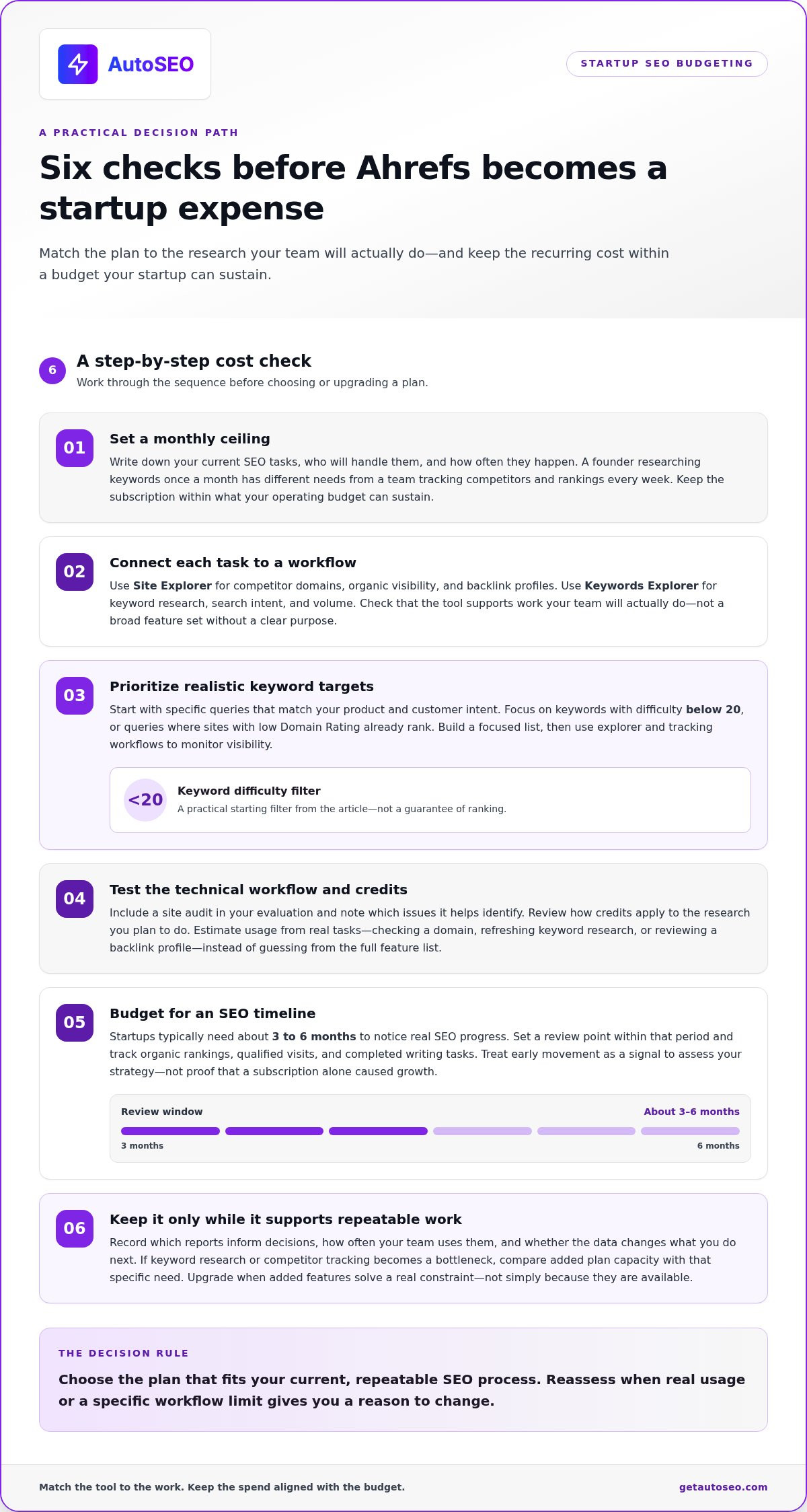
- Set a monthly ceiling before comparing Ahrefs plans. Write down your startup’s current SEO tasks, who will handle them, and how often they happen. A founder researching keywords once a month, for example, has different needs from a team tracking competitors and rankings every week. Keep the subscription within what your operating budget can sustain.
- Map each task to a specific workflow. Use Site Explorer to assess competitor domains, organic visibility, and backlink profiles. Use Keywords Explorer for keyword research, search intent, and volume. This helps you see whether the SEO tool supports work your team will actually do, rather than paying for a broad feature set without a clear purpose.
- Prioritize keywords your startup can realistically target. Start with specific queries that match your product and customer intent. A practical filter is keyword difficulty below 20, or keywords where sites with low Domain Rating already rank. Build a focused list first, then use the tool’s explorer and tracking workflows to monitor whether those terms gain visibility.
- Test the technical workflow before upgrading. Include a site audit in your evaluation and note which issues it helps identify. Review how credits apply to the research you plan to do. Estimate usage from real tasks, such as checking a domain, refreshing keyword research, or reviewing a backlink profile, rather than guessing based on the full feature list.
- Budget around a realistic SEO timeline. Startups typically need about 3 to 6 months to notice real progress from SEO. Set a review point within that period and track organic rankings, qualified visits, and completed writing tasks. Treat early movement as a signal to assess your strategy, not proof that a subscription alone caused growth.
- Keep the subscription active only while it supports a repeatable process. Record which reports inform decisions, how often your team uses them, and whether the data changes what you do next. If keyword research or competitor tracking becomes a bottleneck, compare the next plan’s added capacity with that specific need. Upgrade when the added features solve a real constraint, not simply because they are available.
Ahrefs pricing
- Start with Ahrefs’ current plan comparison and record each plan’s listed price and billing period. Don’t rely on an old screenshot or a third-party summary. For a fair comparison, calculate the monthly equivalent of an annual option only if Ahrefs displays annual billing. Keep the billing period beside each amount so you don’t confuse a monthly payment with a yearly total.
- Match each plan’s included limits to your startup’s actual workflow. Check which research and reporting tasks are covered, then note any limits that could affect regular use. A founder doing occasional competitor research, for example, may need less capacity than a team producing frequent keyword reports. The listed price matters, but so does what the plan lets you do.
- Review how Ahrefs explains usage, credits, and any extra charges before choosing a tier. Note which actions consume credits and estimate expected activity based on recent work. If your team researches a small keyword list each week, compare that pattern with a heavier workflow involving repeated domain checks. This turns an abstract plan comparison into a practical cost estimate.
- Separate essential features from those you might use later. List the tasks your team needs now, such as backlink analysis or site audits, and compare them with the capabilities shown for each plan. Don’t pay for a higher tier just because it offers more options. Choose the lowest plan that supports your current process, then identify the specific workflow that would justify an upgrade.
- Calculate the full subscription commitment for your budget period. Include the stated billing cadence and any applicable taxes or charges shown at checkout. Compare that amount with your SEO-tool budget, not with hypothetical agency or hiring costs. If your startup needs predictable monthly spending, for example, prioritize a plan whose payment schedule fits that cash-flow requirement.
- Set a review trigger before starting a subscription. Choose a business milestone, such as launching a content program or assigning keyword research to a teammate, and assess the plan against that work. Track whether Ahrefs informs real decisions about content, competitors, or technical fixes. If usage stays low, reassess the tier. If a clear limit blocks active work, evaluate an upgrade based on that constraint.
Ahrefs free
- Start with the work, not the software. As a planning estimate, 90% of early-stage startup SEO can be handled with free tools and founder time. Use that as a reason to test a lean workflow before adding another subscription, not as a promise that every startup can avoid paid research tools. List the SEO tasks you can complete independently.
- Use Google Search Console to review your site’s performance in Google Search. Look at the queries bringing impressions and clicks, then compare them with the pages gaining visibility. Turn a clear gap into an action, such as improving a page that appears for relevant searches but attracts few clicks. Track the change in a simple spreadsheet.
- Build a focused keyword list before paying for extensive research. Start with customer questions, sales conversations, and the language already appearing in Search Console. Group terms by intent, such as learning about a problem or comparing solutions. Choose a topic your startup can answer with useful, original content instead of collecting keywords without a publishing plan.
- Review competing pages manually when you need context. Search Google for a target query, note the formats and topics of the pages that rank, and identify what your own page could explain more clearly. This won’t replace a dedicated explorer or backlink analysis, but it can help a founder assess search intent and shape an initial content brief without a paid tool.
- Run a basic technical review with free tools already available to your team. Check that important pages load, work on mobile, and are accessible through site navigation. Record issues and assign each one an owner. A free workflow works best when someone acts on its findings, rather than treating a dashboard or checklist as the SEO work itself.
- Set a clear trigger for reconsidering paid software. Revisit the decision when manual competitor reviews take time away from publishing, or when your team needs repeatable keyword and backlink analysis. Compare the task causing friction with the paid tool’s relevant capabilities. Keep using free SEO tools for needs they already handle effectively.
AutoSEO: Automated SEO Platform Subscription
AutoSEO is an Automated SEO Platform Subscription for startups that want consistent SEO execution without managing every task manually. It publishes one SEO-optimized article daily and builds backlinks, helping maintain a steady content and link-building workflow. The subscription provides 30 SEO-optimized articles per month and 100 Domain Authority worth of backlinks.
Consider this approach if your main constraint is producing content and building backlinks consistently, rather than accessing another standalone research tool. It complements your SEO workflow; it doesn’t replace Ahrefs when you specifically need its research features.
Explore AutoSEO at getautoseo.com to see whether its automated approach suits your startup.
Make Your Next SEO Move Deliberate
Your next decision shouldn’t be about collecting more dashboards. Choose a workflow your team can sustain, then review whether it supports your growth priorities. Whether Ahrefs’ cost for startups fits your budget depends on how your team will use its insights and turn them into useful pages and stronger organic visibility.
Set a review point, define the outcomes you want to track, and keep the next step manageable. If consistent content and backlink execution is your main constraint, explore AutoSEO’s daily SEO article and backlink service.
Contact AutoSEO to discuss your SEO needs and choose a practical path forward. Your startup can build a focused SEO process one clear decision at a time.


