

The content bottleneck is killing your growth. Manual article creation is slow, expensive, and fails to deliver the volume needed to dominate search rankings. You’re trapped in a cycle of high costs and slow results. The solution is clear: ai generated articles for seo. But you’re right to be skeptical. Most AI content is robotic, risks Google penalties, and creates more editing work than it saves.
This guide changes that. We cut through the noise to deliver a proven system for generating high-quality, SEO-optimized content at an unprecedented scale. You will learn how to automate your content engine, drive a relentless stream of organic traffic, and put your rankings on autopilot-without compromising on quality or fearing penalties. It’s time for a strategy that actually works.
Key Takeaways
- Google's official stance is clear: they reward helpful content, not human authors. Learn how to create AI articles that meet their quality standards.
- Understand the critical difference between using AI as a manual writing assistant and deploying a true autopilot system for content at scale.
- Implement a proven quality control framework for ai generated articles for seo to ensure they are valuable, helpful, and built to rank.
- Discover why high-quality content is only half the battle and how automated backlinks provide the authority needed to dominate search results.
The Core Question: Does Google Penalize AI-Generated Articles?
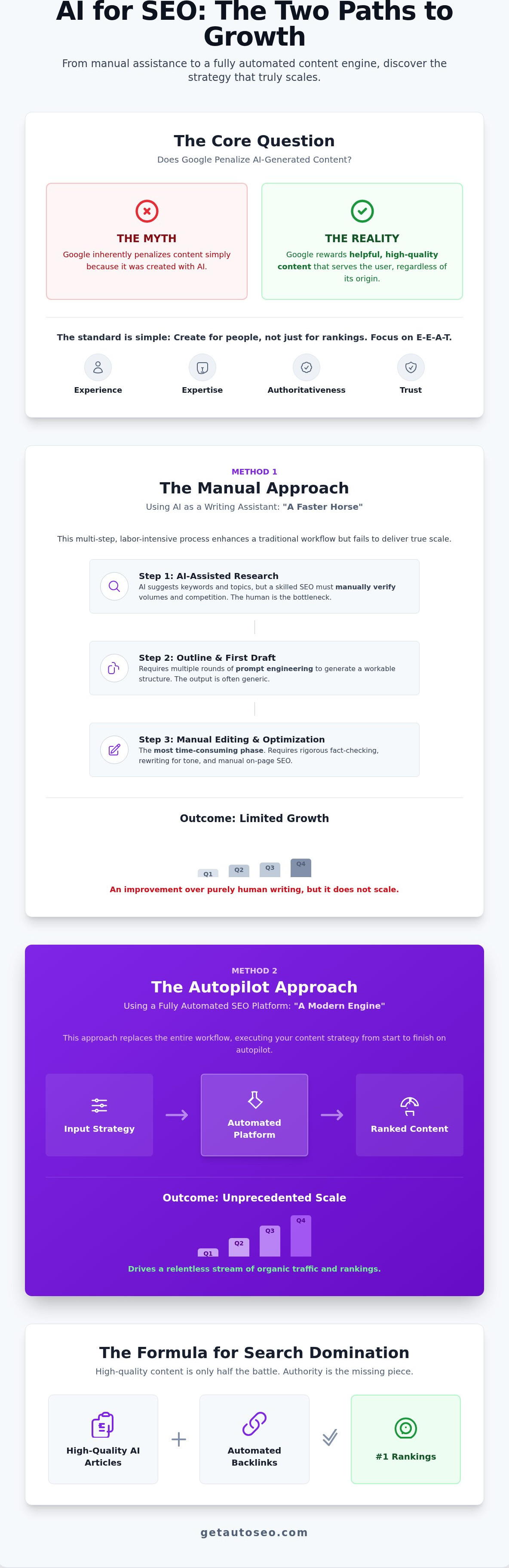
Let's address the primary concern immediately: No, Google does not inherently penalize content because it was created with AI. The official guidance is clear and direct. Google rewards high-quality, helpful content that serves the user, regardless of how it was produced. The penalty myth stems from a misunderstanding of the core issue-it was never about the tool, but always about the quality of the final output.
Google’s ranking systems are designed to elevate content demonstrating strong signals of Experience, Expertise, Authoritativeness, and Trust (E-E-A-T). Far from detracting from this, a strategic AI workflow amplifies it. You can leverage AI to structure complex topics, synthesize data, and build a comprehensive foundation. The human expert then layers on unique insights, first-hand experience, and critical verification. This is how you achieve both quality and scale.
Deconstructing Google's Helpful Content System
Google defines "helpful content" as content created for people, not primarily for search engine rankings. The system is designed to demote articles that exist only to capture keywords without providing real value. When used correctly, AI does the opposite. It allows you to automate the tedious parts of content creation so you can focus on producing genuinely helpful, user-centric articles that answer questions thoroughly and efficiently.
AI Spam vs. AI for SEO: A Clear Distinction
It is critical to distinguish between low-quality AI spam and strategic AI-powered content. The difference lies not in the use of Natural Language Generation technology, but in the intent and process behind it.
- AI Spam: This is the auto-generated, keyword-stuffed, and often nonsensical text designed to manipulate rankings. It offers zero value and is precisely what Google’s systems target.
- AI for SEO: This is a sophisticated process. It involves deep research, strategic outlining, and using AI as a powerful drafting assistant, followed by rigorous human editing, fact-checking, and optimization.
Method 1: The Manual Approach (Using AI as a Writing Assistant)
Most marketers use AI as a supercharged assistant. This approach speeds up content creation but remains a fundamentally manual, multi-step process. It enhances a traditional workflow rather than replacing it. You get a faster horse, not a modern engine for growth.
This method delivers better output than basic AI tools, but it is labor-intensive and fails to deliver true scale. Let's break down the typical workflow for a single article.
Step 1: AI-Assisted Keyword Research and Topic Clustering
Your process starts with strategy. You can prompt an AI to analyze SERPs for a target keyword, identify user intent, and suggest long-tail variations. It can even generate topic cluster ideas to build authority. However, the AI's output is just a suggestion. A skilled SEO must still manually verify search volumes, assess competition, and make the final strategic decisions. The human expert remains the bottleneck.
Step 2: Generating Outlines and First Drafts
With a target keyword selected, you move to structure. You prompt a tool like ChatGPT to create a detailed, SEO-optimized outline. After several rounds of refinement-known as prompt engineering-you get a workable structure. You then use that outline to generate the first draft. This step saves hours of writing time, but the output is often generic and requires significant human intervention to become valuable.
The application of AI as a writing assistant is expanding beyond marketing content, with specialized tools like Briefwizard emerging to help users create other types of formal documents and letters.
Step 3: Manual Editing, Fact-Checking, and Optimization
This is the most critical and time-consuming phase. A human editor must rewrite sections for tone, clarity, and brand voice. They must rigorously fact-check every claim, as AI models can "hallucinate" incorrect information. This human oversight is essential for creating helpful, reliable content. In fact, Google's official guidance confirms the focus is on content quality, not its method of production. Finally, you manually add internal links, optimize meta tags, and format the post. This approach to ai generated articles for seo is an improvement, but it does not scale.
Method 2: The Autopilot Approach (Using a Fully Automated SEO Platform)
Using AI as a writing assistant is a step forward, but it still requires your constant input, management, and a collection of separate tools. The next evolution in content strategy moves beyond assistance to complete automation. Instead of juggling keyword research tools, AI writers, and your CMS, a single integrated platform can execute your entire SEO content strategy from start to finish.
This is not about replacing a single task. It is about replacing the entire complex workflow. This is SEO on autopilot.
Automated Research and Content Strategy
An automated platform eliminates guesswork. The system performs a deep analysis of your business, your website, and your top competitors. It identifies high-opportunity keywords and topic clusters that you can realistically rank for. Based on this data, it generates a comprehensive, long-term content plan designed for one purpose: to capture organic traffic.
Daily Article Generation and Publishing
Consistency is the engine of SEO success. An automated system delivers this by generating and publishing one expert-level, fully formatted article directly to your blog every single day. This relentless consistency builds topical authority faster than any manual process ever could. It’s the most efficient way to use ai generated articles for seo to transform a new site into a content-rich authority in its niche.
The True Meaning of Scale
Scaling your content shouldn't mean sacrificing quality. True scale is the ability to produce hundreds of high-quality articles that all meet a strict, consistent standard. Automation enforces this quality control relentlessly. As industry analysis in Forbes highlights, the strategic application of AI-Generated Content And SEO Marketing is what separates effective growth from mere digital noise. This is how you achieve both quality and scale-a combination that actually works.
See how automated content can transform your SEO.
Quality Control: How to Ensure AI Articles Actually Rank
The primary objection to AI content isn't the technology-it's the output. The market is flooded with low-effort articles that fail to rank. But the debate is framed incorrectly. Google doesn't care if a machine wrote your content. It only cares if your content delivers value. The new standard isn't about passing a Turing test; it's about passing the user-intent test. This is the quality control that matters.
Start with a Data-Driven Content Plan
High-ranking content is never an accident. It’s the direct result of a strategic plan. Every article must target a specific keyword with clear business intent, answering a question your customers are actually asking. An automated system ensures this happens every time. Instead of publishing random posts, you build a cohesive content engine where each piece supports a larger goal: driving organic traffic that converts.
Structure for Readability and Snippets
Even the best information fails if it's presented as a wall of text. Structure is non-negotiable for both users and search engines. A rank-worthy article is built for scannability:
- Clear, descriptive headings (H2s, H3s) to guide the reader.
- Short paragraphs that get straight to the point.
- Bulleted lists to break down complex ideas into digestible points.
- Integrated FAQs to capture valuable SERP features like "People Also Ask."
This format makes content easy for humans to digest and simple for Google to crawl, index, and feature.
Build Topical Authority and Brand Voice
Generic, robotic content kills authority. A superior AI system avoids this by training on your specific brand voice, ensuring consistency across hundreds of articles. More importantly, it focuses on building deep content hubs. By creating a dense network of interlinked articles around core topics, you signal undeniable expertise to search engines. This is how you use ai generated articles for seo to achieve both quality and scale-the foundation of an SEO strategy that actually works.
The Missing Piece: Why AI Articles Need Automated Backlinks
You have unlocked the power of AI to produce high-quality content at scale. But publishing content is not enough. The internet is flooded with articles, and simply adding more to the pile guarantees nothing. To achieve meaningful organic traffic, your content needs authority. Without it, even the best ai generated articles for seo will remain invisible to your target audience.
Authority is the currency of search engines. It's how Google decides which content to trust and promote to the top of its results. This trust isn't earned through content alone; it's built through external validation from other reputable sites in the form of backlinks.
The Symbiotic Relationship Between Content and Links
Think of SEO as a two-part equation for success. Neglecting either part results in failure. The relationship is simple but non-negotiable:
- Content gives Google a reason to rank you. It provides the keywords, topics, and information that answer a user's query.
- Backlinks give Google a reason to trust you. They act as votes of confidence, signaling that your content is valuable and authoritative.
Without great content, links have nothing to point to. Without links, great content has no authority to rank. You need both, working in perfect sync, to dominate competitive keywords.
Automating Authority at Scale
This is where a true SEO automation platform changes the game. AutoSEO doesn’t just stop at content creation. Our system immediately begins building relevant, high-quality backlinks to your new articles, creating a powerful growth loop. New content gets published, it instantly starts earning authority, and that authority boosts the ranking potential of your entire site.
This seamless integration turns your content production into a predictable engine for growth. Instead of waiting months for results, you get faster, more sustainable ranking improvements. This is SEO on Autopilot-a complete system that pairs world-class content with the authority it needs to perform. Stop just publishing content. Start ranking it.
Start your $1 trial to get AI articles and backlinks today.
The Final Verdict: Automate Your Way to the Top
The debate is over. Google rewards high-quality, helpful content, regardless of its origin. The key takeaway is that success with ai generated articles for seo isn't about the tool-it's about the system. Content without authority is invisible. This is why even perfectly optimized articles fail to rank without the second critical component: a powerful backlinking strategy that signals trust and relevance to search engines.
You can spend months trying to build this system manually, or you can activate it instantly. AutoSEO is the all-in-one platform engineered for results. We don't just give you content; we give you a complete growth engine. One expert article published daily, automatically. 100 DA of high-quality backlinks built for you, consistently. This is how you achieve quality and scale, a combination that puts your SEO on autopilot. Stop guessing and start dominating.
Ready to see the system that actually works? Put Your SEO on Autopilot with a $1 Trial. Your future of effortless organic growth is one click away.
Frequently Asked Questions
How much editing do AI-generated SEO articles typically require?
The level of editing depends entirely on the quality of the AI platform. Basic AI writers often produce generic content that needs heavy revision for facts, tone, and SEO. In contrast, advanced automated SEO platforms create articles that are 95% ready to publish. Your role shifts from writer to strategic reviewer, making minor tweaks to brand-specific language or adding a unique case study. The goal is minimal intervention for maximum output.
Can AI-generated articles really rank on the first page of Google?
Absolutely. High-quality AI generated articles for SEO rank on page one when they meet user intent and follow search best practices. Google rewards helpful, well-structured content, regardless of its origin. The key is using an AI system engineered for SEO-one that integrates keyword research, competitor analysis, and proper structure. This isn't about simply generating text; it's about engineering content for performance at scale, delivering results that actually work.
What is the difference between an AI writer and an automated SEO platform?
An AI writer is a tool. It executes a single task: generating text based on a prompt. You still handle all the complex SEO work-keyword research, outlining, optimization, and internal linking. An automated SEO platform is a complete system. It manages the entire content workflow from strategy and keyword clustering to writing, optimizing, and publishing. It puts your content strategy on autopilot, moving beyond simple text generation to drive measurable organic growth.
How do you avoid plagiarism and ensure originality in AI content?
Reputable AI content platforms have built-in plagiarism detection. They don't copy from existing sources; they synthesize information from vast datasets to generate statistically unique content. To guarantee originality, always run the final draft through a dedicated plagiarism checker like Copyscape. The best systems consistently produce content with over 99% originality, eliminating this concern and allowing you to publish with confidence and at scale.
How long does it take to see SEO results from AI-generated articles?
The timeline for SEO results is the same for AI-generated and human-written content, typically 3-6 months. The advantage of AI is speed and consistency. You can publish high-quality content at a scale that is impossible for human teams. This increased velocity of publishing valuable articles can accelerate your timeline for ranking and traffic growth. More high-quality content published faster means quicker authority and better results.
Can AI write in a specific brand voice or for a niche industry?
Yes. Modern AI platforms are designed for customization. You can train the AI on your specific brand voice using style guides, existing content, and detailed instructions. For niche industries, you provide the AI with subject matter expertise, key terminology, and target audience data. The AI then adapts its output to match your precise requirements. This transforms the AI from a generic writer into a specialized content creator for your exact business needs.