

A strong portfolio alone won’t win local searches. SEO for architects and design firms works best when location-specific service pages, an accurate Google Business Profile, relevant backlinks, and clear performance tracking work together. These elements help prospective clients move from a local search to your projects and services.
Your work deserves to be seen, but making it discoverable can mean juggling scattered marketing tasks. This guide covers practical ways to improve local visibility, earn links from relevant sources, and track website traffic and search rankings.
Learn how to strengthen your local presence, make project pages easier to find, and use performance data to decide what to improve next. The steps focus on actions you can apply to your firm’s website and measure over time.
Key Takeaways
- Create location-focused service and project pages, then keep your Google Business Profile accurate and complete.
- Match each page to a clear search intent and use relevant phrases naturally in service descriptions and project copy.
- Build relevant backlinks by keeping firm details consistent across architecture directories and seeking links from project features or award organizations.
- Track search rankings, impressions, clicks, and website visits over time to identify which pages and topics deserve attention next.
Local SEO and Google Maps listings for architecture firms
Local SEO helps nearby clients find an architecture practice through Google Search and Maps. Build location-specific pages, keep business listings accurate, and invite clients to leave honest reviews.
Meaningful SEO progress can take three to six months. Lead generation depends on whether relevant local searches bring people to your pages and whether visitors can take a clear next step.
Avoid inaccurate listings, copied city pages, and keyword stuffing. These mistakes weaken trust and make it harder for prospective clients to understand where you work.
-
Add Project Locations for Local Searches
Add the city, region, and country to a project page when those details accurately describe the work. For example, a residential architect can include a completed home’s location in the project heading and description. This connects the project with geographic searches and gives visitors useful context. Don’t name locations where your firm has no relevant project or service presence.
-
Set Up Local Business Listings
Complete your Google Business Profile with the firm’s correct name, address, phone number, services, and website. Compare those details with every other business listing you manage. Consistent information helps Google and potential clients recognize the same architecture practice across platforms. Use relevant service phrases, such as residential architecture, in website headings and service pages, not repeatedly in every listing.
-
Gather Local Reviews
Invite clients to leave an honest review after a suitable project milestone, such as completion. Reviews can help prospective clients understand your communication, design process, and project experience. Respond professionally to feedback on Google and other listings, addressing specific points without disclosing private project details. Never write or buy reviews, or pressure clients to use particular phrases.
How to Track Your Architecture Website’s SEO Performance?
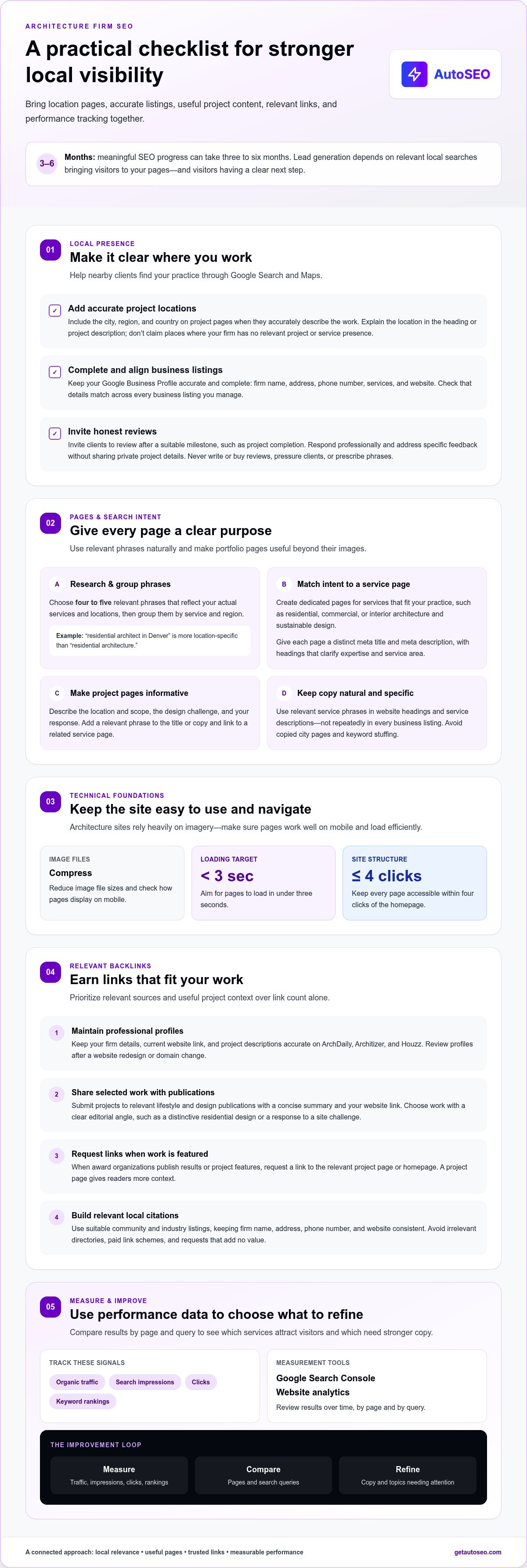
Optimize each portfolio page with a relevant search phrase, project location, scope, and a clear explanation of the design challenge and response. For technical SEO, prioritize compressed images, mobile usability, fast loading, and a clean site structure that keeps every page within four clicks of the homepage.
- Research keywords that reflect your actual architecture services and locations. Compare a phrase such as “residential architect in Denver” with a broader term like “residential architecture.” Longer, location-specific searches can signal clearer intent and less competition. Build a focused list of four to five relevant keywords or phrases, then group them by service and region. This gives each page a distinct purpose.
- Match one search intent to each service page. Create dedicated pages for residential architecture, commercial architecture, interior architecture, and sustainable design when these services fit your practice. Add a distinct meta title and meta description to every page. Use descriptive headings to clarify your expertise, service area, and the next step for visitors.
- Make each project page useful beyond its images. Name the location and scope, identify the design problem, and explain your solution. Include a relevant keyword in the project title or copy, then link to a related service page. Descriptive project details help search engines understand the work and help prospective clients assess its relevance.
- Track organic traffic, search impressions, clicks, and keyword rankings with Google Search Console and website analytics. Compare results by page and query to see which services attract visitors and which need stronger copy. Architecture websites rely heavily on images, so compress image files and check how pages display on mobile. Aim for loading under three seconds and keep pages accessible within four clicks of the homepage.
Building backlinks through social profiles and architecture directories
Architecture firms can earn backlinks by sharing useful project information with relevant directories, publications, and award organizations. Prioritize links that fit your work and audience, rather than focusing on link count alone.
Build online authority by linking to your website from accurate professional profiles and submitting strong projects to design publications. When award-giving organizations feature your work, ask them to link to your homepage or the relevant project page.
- Update your architecture profiles on ArchDaily, Architizer, and Houzz. Make sure each profile names the correct firm and links to its current website. A complete project description helps visitors understand the work before clicking through. Review profiles regularly, especially after a website redesign or domain change.
- Submit selected projects to relevant lifestyle and design publications. Include a concise project summary and your firm’s website link in the submission. Choose work with a clear editorial angle, such as a distinctive residential design or a response to a specific site challenge. Relevant coverage can introduce your firm to new readers and earn a useful backlink.
- Follow up with award-giving organizations when they publish results or project features. Request a link to the relevant project page or homepage so readers can explore the work directly. A project page provides more context than a general homepage link. Keep your request focused on making the featured project easier to find.
- Build local backlinks and citations through suitable community and industry listings. Keep the firm’s name, address, phone number, and website consistent across profiles. This helps people recognize the same architecture firm across listings and supports discovery through Google Search. Avoid irrelevant directories, paid link schemes, and repeated requests for links that add no value.
Tracking website traffic and search rankings
Track more than rankings. Use a consistent reporting process to connect search visibility with qualified visits, project inquiries, and new clients.
- Record organic clicks, impressions, and query positions in Google Search Console. Compare queries with landing pages to see which services attract searchers. A residential design page might gain impressions but few clicks, suggesting its title or description needs work. Review search terms alongside the pages they lead to, rather than treating the numbers in isolation.
- Use Google Analytics to see what visitors do after arriving. Check which organic landing pages lead to contact-form submissions, phone inquiries, or portfolio views. Set up relevant conversion events so reports distinguish meaningful actions from general traffic. If a project page attracts visits but few inquiries, improve its next step or link it to a related service page.
- Include image search in your performance reviews. Architecture firms can receive hundreds of thousands or even millions of impressions through Google Images. Compare image impressions and clicks with visits to the associated project pages. Clear project context helps you assess whether image visibility is reaching people interested in your firm’s work.
- Build a report that compares rankings, traffic, and leads by service and location. Track relevant queries across the firm’s target region, then note shifts in competition and listing visibility. Keep the reporting format consistent so changes are easy to spot and decisions follow evidence. To keep SEO work moving alongside measurement, explore automated SEO support.
AutoSEO: Automated SEO Platform Subscription
AutoSEO’s Automated SEO Platform Subscription is a fit for architecture firms that need a consistent publishing and backlink workflow alongside their SEO tracking. The subscription provides 30 SEO-optimized articles per month and backlinks with 100 Domain Authority worth. Use that publishing capacity to build useful coverage around your services, project types, and target locations, then assess performance through search visibility, site traffic, and inquiries. This approach suits firms ready to maintain ongoing SEO activity without handling every content task manually. It complements, rather than replaces, accurate project pages, local listings, and meaningful performance measurement. The next step is to consider whether automated publishing and backlink building fit your firm’s priorities. Contact AutoSEO to learn more about the platform.
Make Your Next SEO Move Count
Turn useful insights into a steady working habit. Choose one improvement supported by your performance data, assign it an owner, and set a clear time to review its impact. You might refresh a project page, strengthen an inquiry path, or create content around a service clients already ask about. Consistent action makes SEO more manageable and keeps your website aligned with the firm’s priorities.
A durable approach to SEO for architects and design firms connects visibility with business goals. Look beyond rankings: are the right people finding your work, and does your website help them take a meaningful next step? Learn from those signals and refine your approach as your services and portfolio evolve.
If ongoing SEO tasks compete with project work, AutoSEO’s automated platform can support a more consistent workflow. Contact AutoSEO to discuss your SEO and decide whether automation fits your firm’s next stage of growth. Build momentum one focused improvement at a time.
Frequently Asked Questions
What Is SEO for Architects?
SEO for architects and design firms helps prospective clients discover a practice through relevant online searches. It connects services, portfolio work, and design expertise with the needs people express in search engines. A homeowner planning an addition, for example, needs different information from a developer considering a commercial project. Pages tailored to those needs help visitors assess whether your practice fits their goals.
What is SEO?
SEO, or search engine optimization, improves a website’s visibility in unpaid search results. It combines useful information for readers with a clear structure that search engines can understand. For an architecture practice, this might mean explaining how you work with clients, what information helps shape a project brief, and how your design approach responds to practical constraints.
What SEO strategies work best for architects and design firms?
A useful approach to SEO for architects and design firms combines helpful content with a website that supports prospective clients. Explain your design process and answer questions that arise in early discussions, such as how a brief takes shape. Use project examples to show your thinking, not just the finished building. Review audience behavior and improve pages that attract mismatched inquiries.
How do architecture firms choose SEO keywords for their services and locations?
Choose phrases that reflect your firm’s work and the language prospective clients use. Compare a service phrase like “home addition architect” with a location-based phrase such as “residential architect in Denver.” Review the results for each query: service pages, project portfolios, or informational guides can signal different search needs. Match each phrase to a page that clearly answers that need.
What local SEO steps help architecture firms appear in Google Maps and local searches?
Make your firm’s location, services, and contact details clear wherever prospective clients encounter your practice online. Create location pages only when they offer useful local context, such as a relevant project or service detail. Don’t duplicate one page across cities by changing only the place names. Consistent details help visitors understand where your firm works and which page best fits their project.
How should architecture firms optimize Google Business Profile?
Keep your Google Business Profile accurate and complete, with the firm’s correct business details and relevant services. Choose a category that reflects your practice and make sure the contact information matches your website. Add current updates that help potential clients understand your work and focus. Review the profile whenever business details change, so searchers see reliable information before deciding to visit or get in touch.


