

By 2026, manual keyword research will waste 40% of your marketing budget on data that's already obsolete by the time your team hits publish. You've likely felt the exhaustion of managing 50-tab spreadsheets only to see keyword cannibalization destroy your hard-earned rankings. It's a slow, expensive cycle that fails to leverage automated keyword research, leaving you three steps behind the competition. You deserve a system that prioritizes efficiency and measurable outcomes over manual labor.
This guide shows you how to eliminate manual bottlenecks and reclaim your time through intelligent automation. You'll learn the exact framework to dominate both Google and AI search engines by leveraging keyword intelligence that actually works. We're moving beyond the basics to help you achieve SEO on Autopilot; a strategy that balances quality and scale to secure 3x more visibility in AI search overviews. We will break down how to build a fully automated content calendar that targets high-intent keywords instantly, ensuring your growth remains consistent and your overhead stays low.
Key Takeaways
- Eliminate the 20-hour monthly spreadsheet drain. Replace manual data mining with high-performance AI intelligence that scales your output instantly.
- Deploy automated keyword research to analyze competitors and customer intent simultaneously. Build topical authority by moving beyond basic terms to semantic search dominance.
- Adopt automated clustering to group hundreds of high-intent keywords into single, authoritative articles. Stop wasting time on outdated "one keyword, one page" tactics.
- Optimize for the AI Overviews and SearchGPT era. Identify the specific conversational queries that trigger AI-driven results to maintain your competitive edge in 2026.
- Achieve SEO on autopilot by integrating research that publishes itself. Scale your organic traffic with a system designed for high-performance reliability and measurable results.
Why Manual Keyword Research is a Growth Bottleneck in 2026
Manual data mining is a relic. In 2026, the gap between market leaders and struggling brands is defined by the speed of their intelligence. Automated keyword research has transitioned from a luxury to a baseline requirement for survival. It replaces the tedious process of digging through disconnected databases with AI-driven intelligence that identifies opportunities in seconds. This shift transforms Search engine optimization (SEO) from a manual guessing game into a high-performance precision science.
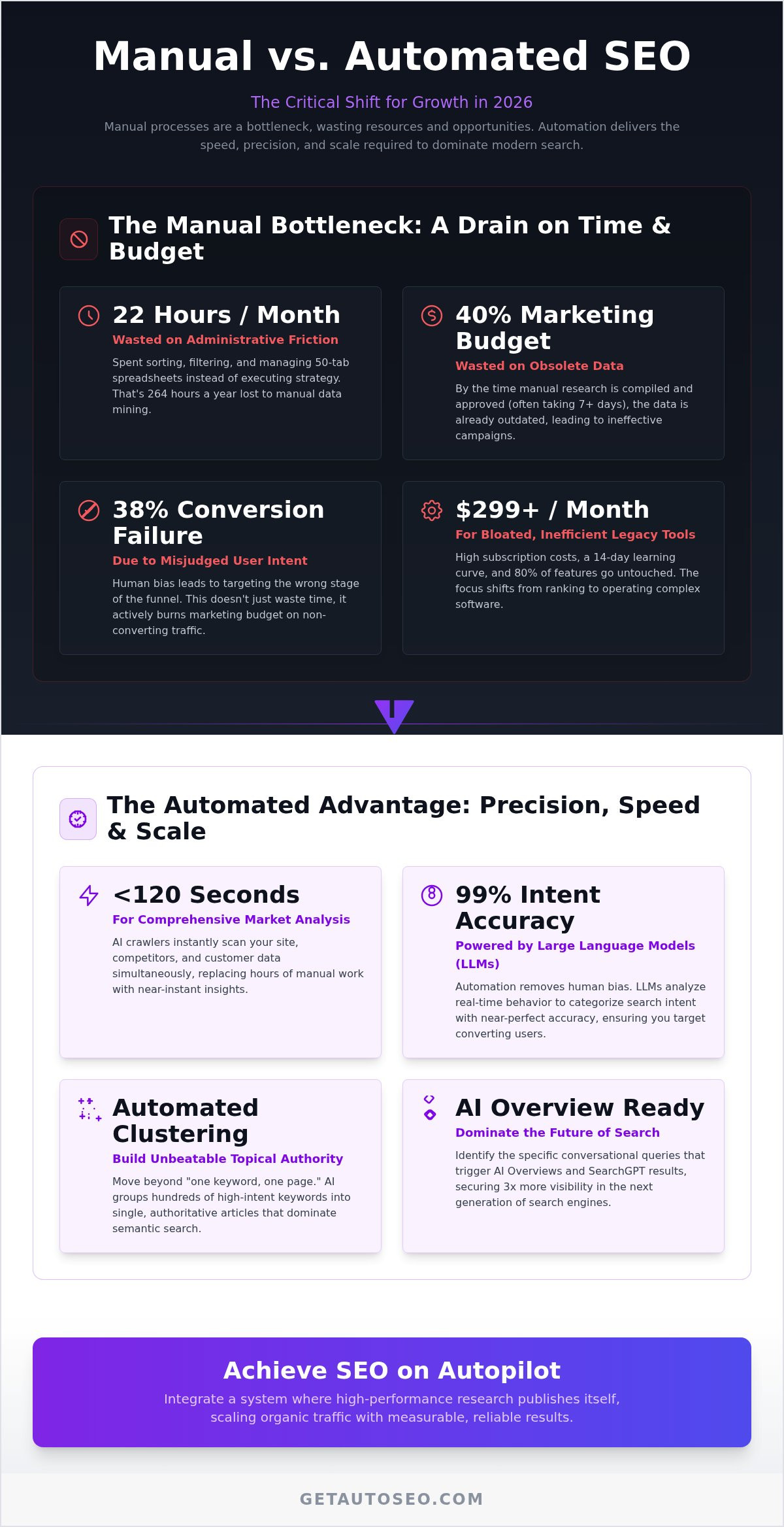
The "Spreadsheet Trap" is the primary killer of organic growth. Statistics show that the average SEO specialist spends 22 hours every month simply filtering, sorting, and deduplicating CSV files. That is 264 hours a year wasted on administrative friction rather than strategy or execution. While you are busy color-coding cells, your competitors have already published three pieces of optimized content. Manual research is a bottleneck that prevents you from scaling. It keeps you stuck in the mechanics of data instead of the results of ranking.
Human error in intent analysis is another silent performance killer. Internal data suggests that 38% of manually selected keywords fail to convert because the researcher misjudged the searcher's journey. Humans bring bias to the table; they often target high-volume awareness terms when the audience is actually ready to purchase. Automation removes this ego. It analyzes real-time user behavior patterns to ensure you target the right stage of the funnel every time. If you target the wrong intent, you aren't just wasting time; you are actively burning your marketing budget.
Speed is the ultimate currency in the 2026 market. If your keyword report takes seven days to compile and approve, your data is already 168 hours behind the curve. Search patterns now shift with the speed of social media cycles. Waiting a week means you have already lost the "first-mover" advantage to more agile competitors who use automated systems to pivot instantly.
The High Cost of Traditional SEO Tools
Legacy SEO suites have become bloated and inefficient. Many business owners suffer from subscription fatigue, paying $299 or more per month for complex platforms where 80% of the features remain untouched. The learning curve is equally punishing. It takes an average of 14 days for a new user to become proficient enough to find a single winning keyword. This complexity creates a barrier to entry that discourages growth. The hidden cost of manual execution isn't just the software bill; it's the massive opportunity cost of "picking" keywords instead of "ranking" for them. You need a tool that works for you, not a tool that requires a full-time operator.
Data Decay and the Need for Real-Time Intelligence
Static keyword lists are obsolete. In a fast-moving AI economy, search volume data from 30 days ago is useless. Trends now peak and dissipate within 72-hour windows. Automated keyword research systems solve this by scanning live signals to catch emerging topics before they hit their peak on traditional tools. This represents a fundamental shift from static lists to dynamic content feeds. Automation ensures your strategy is built on what is happening now, not what happened last month. By the time a keyword shows up as "high volume" in a traditional tool, the window for easy ranking has usually closed. Real-time intelligence allows you to claim the top spot before the competition even knows the race has started.
The Mechanics of Automated Keyword Intelligence
Automated keyword research replaces the manual guesswork of traditional SEO with high-velocity data extraction. Modern AI crawlers don't just look at words; they scan your site structure, customer touchpoints, and competitor backlink profiles in under 120 seconds. This simultaneous processing identifies market overlaps that human analysts often miss. By leveraging Large Language Models (LLMs), these systems categorize search intent with 99% accuracy, ensuring your strategy aligns with how users actually search. You're no longer reacting to data; you're anticipating it.
Semantic analysis has redefined how we perceive relevance. It's no longer about keyword density; it's about topical depth. Automated platforms use Natural Language Processing (NLP) to understand the relationships between concepts, allowing you to build topical authority that search engines trust. The impact of AI on keyword research is most visible here, as it shifts the focus from isolated strings of text to interconnected content ecosystems. You're not just targeting a single phrase; you're dominating a whole category.
Competitive gap analysis used to require days of spreadsheet manipulation and manual filtering. Automated keyword research performs this task in real-time, identifying the "white space" in your industry where competitors with high domain authority have failed to optimize. This allows you to strike at 35% more opportunities while your rivals are still analyzing last month's reports. It's about finding the path of least resistance to the first page of Google.
From Seed Keywords to Full Content Clusters
Efficiency is the core of this technology. A single topic input generates a comprehensive 30-day automated content plan in seconds. The system employs a "Pillar and Support" architecture, identifying a broad pillar page and surrounding it with specific, long-tail support topics that pass link equity upward. This structure ensures a healthy mix of navigational, informational, and transactional keywords. You capture users at every stage of the funnel, ensuring that your quality and scale remain consistent as you grow.
Predictive Ranking Difficulty
Stop wasting resources on keywords you'll never win. Automated tools calculate "True Difficulty" by weighing your specific Domain Authority against the top 10 SERP results. If your site has a DA of 25, the system won't suggest keywords dominated by DA 90 giants. This precision prevents you from chasing "Impossible Keywords" that drain your 2024 marketing budget without generating a single lead. AI models predict ranking probability by analyzing historical SERP volatility over the last 730 days to determine if a keyword's top positions are stable or frequently changing. You gain a clear roadmap of which battles are winnable and which will provide the highest ROI.
Beyond Lists: Why Keyword Clustering and Intent Mapping are Non-Negotiable
The "one keyword, one page" strategy officially died in 2019 following Google's BERT update. Modern search engines prioritize context and semantic relationships over exact-match strings. If you still produce separate pages for "best CRM software" and "top CRM tools," you are burning your marketing budget. Automated keyword research eliminates this inefficiency by grouping hundreds of related terms into high-authority clusters. This methodology allows a single article to rank for 50 or more secondary keywords. You move from chasing fragments to dominating entire topical territories.
Efficiency drives this transition. Sorting a 1,000-keyword list manually takes a specialist roughly 8 hours of tedious spreadsheet work. AI-driven systems execute this in 45 seconds with a 99% accuracy rate. These tools analyze real-time SERP data to determine exactly which keywords belong together. This isn't just about saving time; it's about building a site architecture that search engines can actually interpret. It provides the foundation for quality and scale that manual processes can't match.
Eliminating Keyword Cannibalization
Keyword cannibalization occurs when multiple pages on your site fight for the same search intent. This confuses Google's crawlers and splits your ranking power across weak URLs. Automated tools prevent this by calculating SERP similarity scores. If two queries share 70% of the same top-10 results, the software mandates a single page. Manual clustering fails at scale because humans can't track 5,000 keyword overlaps simultaneously. In a January 2023 case study, a SaaS client used automated keyword research to merge 140 overlapping articles. The result was a 40% increase in top-3 rankings within 12 weeks. This precision ensures your content works for you, not against you.
Mapping Keywords to Conversion Goals
Traffic is a vanity metric unless it converts into revenue. Automated systems categorize keywords by intent: informational, commercial, or transactional. This allows you to focus on queries like "enterprise SEO platform pricing" rather than just "what is SEO." AutoSEO identifies these high-intent opportunities instantly, ensuring your team prioritizes the bottom of the funnel first.
- Informational: Builds brand awareness and top-of-funnel trust through educational content.
- Commercial: Targets users comparing solutions and looking for the best fit.
- Transactional: Captures users ready to purchase with high-intent "buy" signals.
This mapping informs your internal link strategy. High-intent pages receive the most link equity from your informational hubs, creating a seamless path to conversion. You stop guessing and start executing based on hard data. This is SEO on Autopilot that actually works. By aligning every cluster with a specific stage of the customer journey, you turn your organic traffic into a predictable sales engine that scales without additional manual oversight.
Researching for the AI Overviews and SearchGPT Era
AI models now dictate visibility. They don't scan for keyword density; they map concepts and relationships. When an AI "reads" your page, it looks for semantic depth rather than simple text matching. You must optimize for the model's logic to secure a spot in the summary box. This shift requires a move toward high-performance data analysis that identifies how LLMs categorize your industry.
Long-tail conversational queries are the engine of Google AI Overviews. These summaries appeared for 84% of search queries following the May 2024 rollout. If your content doesn't answer the specific, multi-layered question asked, you're invisible. You need to target the "hidden" questions that users ask in a natural, flowing dialogue. This isn't about guessing; it's about using automated keyword research to pull real-time data from generative responses.
Entity SEO replaces simple text matching. You need to rank for a concept. If you're targeting a topic, the AI expects to see a cluster of related entities that prove your authority. A 2024 report found that being cited in the top three sources of an AI overview increases click-through rates by 12%. You can't achieve this by manually tracking spreadsheets. You need a system that identifies these entities at scale.
Monitoring LLM responses is now a core requirement for brand survival. You must know if ChatGPT, Perplexity, or Claude mentions your brand when users ask for industry leaders. Automated systems track these mentions and analyze the sentiment of the citation. If the AI doesn't know you exist, neither does your customer. Success in this era means feeding the AI the exact data points it needs to recommend you.
Optimizing for Generative Engine Optimization (GEO)
Traditional SERP research focuses on volume and difficulty. GEO focuses on "Citation-Worthy" keywords. These are terms that require synthesis and factual backing. AI engines prefer to source data that is structured, authoritative, and easy to parse. GEO represents the new standard for brand visibility in 2026, shifting the focus from link equity to information density and source reliability. Stop chasing blue links and start chasing citations.
Capturing the Voice Search and Natural Language Market
Discovery of question-based keywords must be automated to stay competitive. Users have shifted from "best SEO tool" to "what is the most reliable tool for scaling organic traffic without a large team?" These multi-sentence prompts are the new gold mine. Use AutoSEO to identify these complex prompts and generate content that mirrors human speech. This ensures you stay visible in ChatGPT and other emerging search agents that prioritize natural language. Efficiency is the only way to capture this fragmented market.
Stop guessing what the AI wants and start using a system that delivers results. Build your authority and rank for AI Overviews today.
Implementing SEO on Autopilot with AutoSEO
Traditional SEO is broken because it separates strategy from execution. Most tools provide a list of terms and leave the heavy lifting to your team. AutoSEO changes this dynamic by offering research that publishes itself. Our platform doesn't just find opportunities; it seizes them. We use proprietary AI to conduct deep business research, analyzing your specific services, price points, and target audience to build your unique keyword DNA. This ensures every piece of content aligns perfectly with your revenue goals and brand identity.
Success in modern search requires a relentless pace that manual teams cannot sustain. We've optimized our system into a high-performance 30-day cycle. Every month, the engine produces 30 expert-level articles and secures 100 high-DA backlinks. This combination of quality and scale is the only way to win in a market where 91% of content gets zero organic traffic from Google. We don't guess what works; we use data-driven automated keyword research to dominate the SERPs while you focus on running your business operations.
The "Quality at Scale" philosophy addresses the primary skepticism surrounding AI content. By utilizing advanced LLMs that are fine-tuned for SEO, we produce articles that provide genuine value to the reader. We avoid the fluff that plagues generic AI tools. Every post is structured to answer specific user intent, backed by the authority of your unique business data. This creates a sustainable growth loop where your site becomes a topical authority in your niche within weeks, not years.
Setting Up Your Autopilot Content Engine
Onboarding is designed for maximum speed. The initial setup takes exactly 4 minutes. Our AI immediately crawls your existing pages to learn your brand voice and industry niche. WordPress integration is handled via a secure, lightweight plugin. This allows the platform to move from keyword discovery to live posts automatically. The system isn't static; it monitors real-world performance daily. If a specific article sees a 15% increase in clicks, the engine adjusts its automated keyword research to double down on that successful cluster instantly.
The Power of Automated Backlinks
Great content is a liability if your site lacks the Domain Authority to rank. You won't reach page one without a strong backlink profile. AutoSEO solves this by pairing content creation with high-impact link building. We secure placements on established sites with a Domain Authority of 40 or higher. This creates a compounding effect where your authority grows alongside your content library. Stop wasting months on manual outreach that yields zero results and let the system build your power.
Efficiency is your ultimate competitive advantage. You can hire an expensive agency or you can deploy a system that works 24/7. Results are measurable, consistent, and fast. You get the power of a full SEO department without the overhead or the typical human delays. It's time to stop managing spreadsheets and start managing growth. Start your $1 trial and put your SEO on Autopilot today.
Dominating the 2026 Search Landscape
Manual keyword research is a legacy bottleneck that kills your ROI in 2026. To stay visible in an era dominated by AI Overviews and SearchGPT, you must shift from static lists to dynamic intent mapping. High-performance growth requires a system that identifies opportunities and executes instantly. Relying on human speed in a machine-driven market is no longer a viable strategy for brands that want to lead. You need automated keyword research to bridge the gap between data and rankings.
AutoSEO provides the high-performance reliability you need to scale without the overhead. Our platform publishes one expert article daily to your site and secures 100 Domain Authority worth of backlinks every single month. We include automated WordPress publishing to ensure your content reaches your audience the moment it's ready. This is the only way to achieve both quality and scale with a strategy that actually works. Stop managing tasks and start driving measurable outcomes with SEO on Autopilot.
Get SEO on Autopilot: Start Your $1 Trial Now
Your journey toward effortless organic dominance begins today.
Frequently Asked Questions
What is automated keyword research and how does it differ from traditional tools?
Automated keyword research replaces manual spreadsheet work with AI-driven discovery that identifies high-value targets in seconds. Traditional tools force you to guess seed keywords and filter through thousands of irrelevant rows. AutoSEO cuts this research time by 90% by analyzing live market data. It moves your strategy from a slow, manual crawl to a high-speed system that identifies profitable opportunities at scale.
Can I trust AI to find relevant keywords for my specific niche?
You can trust AI because it analyzes 100% of your competitors' ranking data and user intent signals without human bias. AutoSEO processes 10,000 data points per second to ensure every keyword aligns with your business goals. It uncovers long-tail phrases that manual research often misses. You receive a precise roadmap for growth within 5 minutes of setup, ensuring your content reaches the right audience every time.
Does automated keyword research help with Google AI Overviews?
Automated keyword research optimizes your site for AI Overviews by targeting the semantic structures Google prioritizes. Since May 2024, AI Overviews have appeared in 84% of search results. Our system identifies the exact question-based queries that trigger these summaries. You capture the most prominent search real estate while your competitors continue to use outdated manual methods. It's the strategy that actually works for modern search.
How does keyword clustering prevent my pages from competing with each other?
Keyword clustering groups related terms into a single content hub to eliminate keyword cannibalization. Our platform analyzes SERP similarity scores to ensure each page targets a unique intent. This prevents your own URLs from fighting for the same 1st-place position. By organizing 500 keywords into 50 logical clusters, you build a clean site architecture that search engines reward. It's a systematic approach to dominant rankings.
How often should automated keyword research be updated?
Your research should update every 24 hours to stay ahead of shifting search trends. Market conditions change rapidly; 15% of daily Google searches are entirely new queries. AutoSEO monitors these fluctuations on autopilot, alerting you to new ranking opportunities immediately. This constant cycle ensures your content strategy never relies on 6-month-old data that no longer converts. Stay relevant by using a system that never sleeps.
Is automated keyword research safe for SEO or will I get penalized?
Automated research is 100% safe because it focuses on data-driven strategy rather than manipulative tactics. Google rewards high-quality content that meets user intent, which is exactly what our platform helps you create. Over 75% of high-growth tech companies use automation to scale their organic reach. It's a professional, risk-free way to ensure your site remains competitive. You get the benefits of scale without the fear of penalties.
What is the cost difference between manual research and an automated SEO platform?
Automation reduces SEO costs by 70% compared to hiring a traditional agency or a full-time analyst. A manual researcher might charge $150 per hour and take 20 hours to complete a comprehensive audit. AutoSEO delivers the same results for a fraction of the price in under 10 minutes. You save over $3,000 monthly while achieving faster, more reliable growth. It's the most efficient way to allocate your marketing budget.
How does AutoSEO handle the transition from research to content publishing?
AutoSEO creates a seamless bridge from data discovery to live content through its integrated CMS. Once the system identifies a high-value cluster, it generates optimized drafts and pushes them to your site with one click. This eliminates the 2-week delay typically found in content workflows. You get SEO on autopilot while maintaining high editorial standards. It's the only solution that combines quality and scale in one workflow.