

What if growing Shopify traffic depended less on doing more SEO and more on building a workflow that keeps the right work moving? Automated SEO for ecommerce can help stores publish consistently, strengthen authority, and track which pages attract relevant visits. But automation alone won’t make pages useful or rankings predictable.
If SEO keeps slipping behind inventory, fulfillment, and customer service, the challenge is familiar. It’s not just producing content. It’s deciding which collection and product pages need attention, creating genuinely helpful material, and keeping technical checks and authority-building from fading during a busy week. With shoppers using AI tools alongside search engines, accurate, useful information needs to be easy to understand and find.
This guide shows how to build a repeatable Shopify SEO workflow for 2026. You’ll learn what to systematize, how to prioritize pages and topics, where human review protects quality, and which measures help reveal whether organic visits are relevant. We’ll connect content, backlink building, and measurement into one practical system. The goal is sustainable progress, not a promise of rankings or sales.
Key Takeaways
- Automated SEO for ecommerce works best as a quality-controlled workflow connecting useful store pages, helpful content, authority-building, and measurement.
- Use customer, business, and competitor research to find relevant topics, then prioritize pages before creating and publishing content.
- Compare DIY workflows, standalone tools, and automated content-plus-backlink services by research relevance, editorial review, publishing effort, and authority-building.
- Use the 30-day plan as a practical template: establish a traffic and store-action baseline, then organize SEO work without expecting guaranteed results.
- AutoSEO supports ongoing SEO activity with 1 expert article daily and backlink building.
What automated SEO for ecommerce does for Shopify traffic
Automated SEO for ecommerce is the repeatable use of software and workflows to support search research, content planning and production, publishing, and authority-building, while people set priorities and protect quality. For a Shopify store, the aim is to make useful pages easier for relevant shoppers to discover, not to generate traffic for its own sake.
Organic search can lead different shoppers to different destinations. Someone comparing types of running shoes may need a category page that clearly explains the available options. A shopper searching for a particular shoe feature may be better served by a relevant product page. Someone still learning how to choose may benefit from an educational article that answers the question and points to useful next steps. Matching the page to the search intent gives each visit a clearer purpose.
That’s why automation should connect activity across the store, not simply produce more pages. Research can surface questions shoppers ask. Planning can match those questions to existing or new pages. Content workflows can help maintain a publishing rhythm, while backlink-building activity can support the site’s wider authority. These tasks fit within the broader practice of Search Engine Optimization (SEO), which includes on-page, off-page, and technical work. The value comes from making that work repeatable and relevant.
Which Shopify store tasks are suitable for automation?
Start with tasks that follow a consistent process: gathering customer and competitor insights, organizing search topics, creating content plans, preparing drafts, coordinating publishing, and supporting backlink-building workflows. For example, research might reveal that shoppers need guidance on choosing a product category. A workflow can turn that insight into a planned article and identify a related collection page for readers ready to compare options.
Keep human judgment in the loop. Store owners decide which categories support business priorities, whether claims accurately reflect the products, and whether a page gives shoppers a useful next step. Automation can reduce repetitive coordination, but it can’t guarantee that a search engine will index a page, rank it, or send buyers.
Why traffic quality matters more than traffic volume
A rise in visits means little if people land on pages that don’t answer their query. Check the connection between search intent and destination. Informational searches should lead to genuinely helpful explanations, while searches with clear product or category intent should lead to pages that make relevant options easy to assess. Informational visits can introduce shoppers to a store without producing an immediate purchase, so judge them by whether they support discovery and lead to meaningful next steps.
Track relevant organic landing-page visits alongside store actions, such as movement from an article to a related category or product page. Review patterns by page and query, then improve mismatches. This turns automated SEO for ecommerce into a learning loop: attract the right searchers, give them a useful experience, and use their behavior to decide what deserves attention next.
How an automated ecommerce SEO workflow moves from research to publishing
A repeatable workflow turns scattered SEO tasks into a clear production system. It connects store knowledge to shopper questions, gives each page a defined purpose, and builds in review before publication. Automation can handle recurring steps, but people still decide what matters and whether the finished content is accurate and useful.
Turn store knowledge and search intent into a content plan
Start with what the store knows: its products, customer needs, differentiators, and common questions before purchase. Group topics by shopper intent, then match each one to the right destination, such as a category page, product page, or educational article. Competitor research can reveal questions other stores haven’t answered well. Use those gaps to shape original content, not to copy another store’s pages.
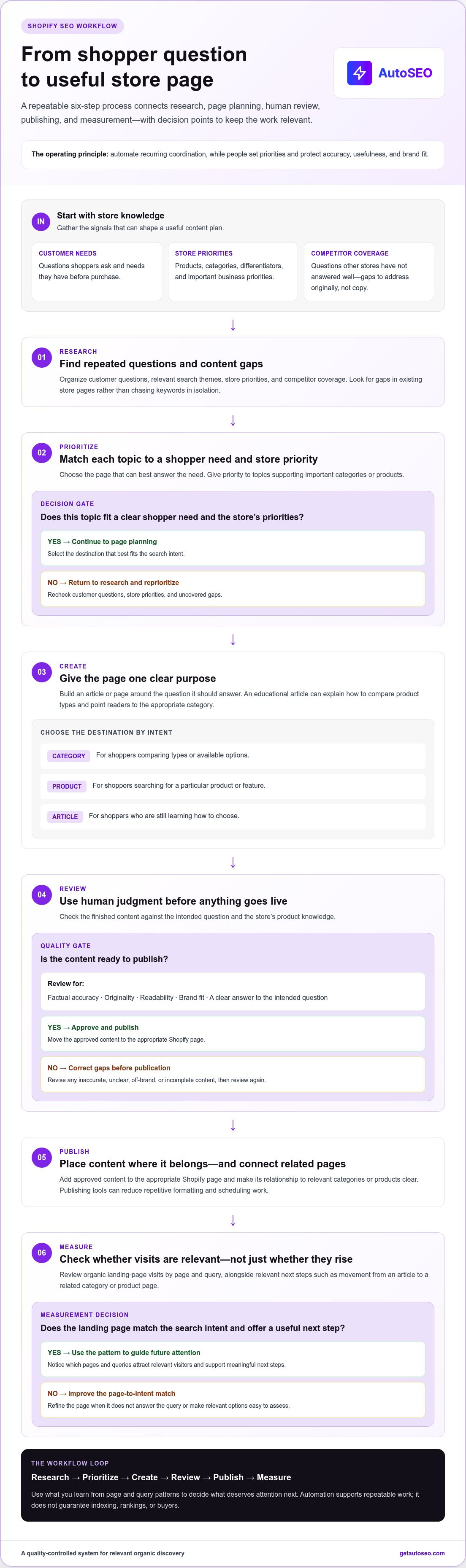
Move each topic through six connected steps:
- Research. Gather customer questions, relevant search themes, store priorities, and competitor coverage. Look for repeated questions and gaps in existing store pages rather than chasing keywords in isolation.
- Prioritize. Rank ideas by relevance to the store, the shopper need, and the page that can best answer it. Give priority to topics that support important categories or products.
- Create. Build an article or page around one clear purpose. For example, an article can explain how to compare product types, then direct readers to the appropriate category without repeating its product descriptions.
- Review. Check factual accuracy, originality, readability, brand fit, and whether the content answers the intended question. Correct gaps before the page goes live.
- Publish. Add approved content to the appropriate Shopify page and make its relationship to relevant categories or products clear. Publishing tools can reduce repetitive formatting and scheduling work.
- Measure. Review how the page performs in organic search and whether visitors take relevant next steps. Use those observations to refine the page or inform future topics.
Create and publish content with quality checks
Give every article a distinct role in the store’s content plan. Before publishing, verify product references and claims, remove copied or repetitive passages, and check that the structure is easy to scan. Shopify’s Shopify SEO Guide offers platform-specific guidance to consider alongside your workflow. Automated preparation can save time, but editorial accountability stays with the store.
Keep the system practical: document who approves content, what must be checked, and which page each topic supports. For example, a review checklist can cover product accuracy, search intent, internal links, and whether the article adds information that existing pages lack. This makes quality easier to maintain as publishing scales, without treating automation as a shortcut around judgment. For ongoing SEO activity, see the automated SEO platform.
How to assess automated SEO tools without sacrificing content quality
The right setup doesn’t just produce more SEO output. It helps your store publish relevant work consistently without losing the product knowledge and editorial judgment that make content trustworthy. Assess each option against four practical questions: does it use relevant research, support quality checks, reduce publishing effort, and contribute to authority-building? The best fit depends on which parts of the work your team can sustain.
Use this comparison to identify where the workload sits:
DIY workflow: Your team selects topics, creates and reviews content, and manages publishing. Research relevance can be high because store staff bring direct product knowledge, but the process takes hands-on time. Authority-building also needs to be planned and carried out separately.
Standalone tools: These can support specific tasks such as keyword research, content organization, or technical checks. They may reduce preparation time, but your team still needs to connect the outputs, review content, handle publishing, and organize authority-building activity.
Automated content-plus-backlink service: This approach combines ongoing content activity and backlink building. Evaluate whether the content reflects your store and customer context, what editorial review remains your responsibility, and how the workflow fits your publishing process. Automation can reduce repetitive work, but it doesn’t remove the need for oversight.
What quality signals should an ecommerce team look for?
Check whether content reflects your business, customers, and competitive context, rather than repeating a target phrase. A useful article has a clear structure, answers a real shopper question, and adds information that existing store pages don’t already provide. Review backlink-building as well: the goal is credible authority-building, not a raw count of links. Search Engine Journal’s Edge SEO Automations in E-commerce explores how automation can support ecommerce SEO work.
When should people retain control of SEO decisions?
Keep people responsible for strategic priorities, product descriptions and claims, and subjects where accuracy or nuance matters. Before publishing, check facts against the store’s current information, confirm the page serves its intended audience, and make sure its tone fits the brand. Publishing more often isn’t a substitute for these checks. Automation can make quality easier to deliver at scale, but search visibility and commercial results aren’t guaranteed.
With automated SEO for ecommerce, assess the system by the quality of its inputs and outputs, not by how much it can publish. Research should inform the work, review should catch errors, and the store should retain control of decisions that require expertise. Choose a setup that makes consistent, useful SEO activity manageable without treating automation as a replacement for business knowledge.
30-Day plan to get more Shopify store traffic
Use this 30-day sequence as a planning template, not a promised timeline for rankings or traffic growth. The goal is to establish a clear starting point, focus your effort, and create a review loop your store can continue using. Before changing pages, record a baseline so later decisions rely on evidence rather than impressions.
Capture three views of your current organic performance:
- Landing pages: Note which category, product, and educational pages receive organic visits.
- Relevant queries: Identify the searches bringing visitors to those pages, and whether the intent matches the content.
- Store actions: Track meaningful next steps, such as moving from an article to a related category or product page.
Keep the same measures for your later review. Short-term changes can fluctuate, so treat the baseline as a reference point, not a verdict on the strategy.
Weeks one and two: establish priorities and publish useful content
Start by reviewing existing pages for search intent, usefulness, and overlap. If two articles answer the same question, decide whether one should be updated or whether their purposes can be made distinct. Then choose one coherent topic cluster tied to a relevant store category. For example, a shop selling home coffee equipment might organize content around choosing a brewing method, with each article addressing a separate question and linking naturally to a suitable category or product page.
During the first two weeks, turn unanswered shopper questions into a focused plan. Assign each topic a purpose and destination before drafting. Improve an existing page where it already fits; create a new article only when it adds information that the store’s current pages don’t provide. Give every piece a clear path to relevant store content, then review facts, readability, and brand fit before publishing. This keeps automated SEO for ecommerce connected to the shopper journey instead of disconnected content output.
Weeks three and four: strengthen authority and review signals
Continue publishing useful content while treating backlink building as a separate authority-building activity. Keep the focus on relevance and credibility, rather than treating link volume as the measure of progress. Review organic landing-page activity against your baseline, along with the queries attracting visitors and the store actions they take. Don’t overread a brief change. Look for practical signals: a page earning relevant visits, a query leading to a mismatched destination, or an article that needs a clearer connection to a category.
At the end of the plan, decide what to refine next. You might strengthen internal paths between related pages, improve a page that attracts the wrong intent, or develop the next unanswered question in the cluster. Record the decision and the reason behind it. That makes the next cycle more focused and easier to repeat, even when daily store operations compete for attention.
If consistent content and backlink building are the hardest parts to sustain, explore SEO automation for consistent content and backlink building as one way to support ongoing work.
How AutoSEO supports automated SEO for ecommerce
For a store that has set its priorities and quality checks, AutoSEO offers a way to keep SEO activity moving. Its AI-powered SEO subscription provides 1 expert article daily and backlink building. That combination brings content production and authority-building into an ongoing workflow, rather than leaving both tasks to compete with daily store operations.
These activities support different parts of the system. Articles can address relevant questions and help shoppers discover your store, while backlink building supports your site’s wider authority. Neither activity replaces decisions about which topics matter to your business, whether a page is accurate, or how you’ll measure relevant visits and store actions. Keep those decisions connected to your ecommerce priorities.
What AutoSEO contributes to an ongoing ecommerce workflow
AutoSEO’s AI-powered research examines your business, customers, and competitors to inform its content approach. That gives ongoing article production context beyond a schedule alone. The service combines a steady article cadence with backlink building as a separate trust-building input. This helps make SEO work more consistent, with less of the process dependent on someone finding spare time to restart it.
Consistency still needs direction. Align article topics with the customer questions and categories your store has chosen to prioritize. Then assess whether each piece is relevant, accurate, and useful before treating publication volume as progress. This is the core of automated SEO for ecommerce: systematize repeatable work while keeping business judgment in control of what deserves attention.
How customer feedback supports the case for consistent SEO
Customer experiences offer useful context, but they aren’t a guarantee of the same outcome for every business. Alexandra Truta of MiniCRM.one praised AutoSEO’s article quality and formatting. That feedback speaks to the content experience, not a promise that every article will rank or attract a particular level of traffic.
Martin Bonauer of Real Estate Switzerland reported acquiring a first customer from a published article. It’s an individual account of what happened in that business, not a forecast for a Shopify store. Ecommerce teams can use testimonials as context, then evaluate their own organic landing pages, relevant queries, and store actions over time.
Use automation to make ongoing work more manageable, not to outsource accountability. Your team still defines priorities and checks that published content serves shoppers. AutoSEO supports the cadence with 1 expert article daily and backlink building, but it doesn’t guarantee rankings, traffic, or sales. Explore AutoSEO to see how its ongoing SEO activity can support your store’s workflow.
Make your next SEO cycle more consistent
Growth comes from a system your store can keep running, not a burst of publishing that fades when operations get busy. Choose one priority area, set a clear measure of useful progress, and make the next round of work easier to plan and review. That gives your team a practical way to improve automated SEO for ecommerce while keeping decisions grounded in shopper needs.
Automation can take recurring work off your plate, but your store’s expertise remains essential. Keep shaping the priorities, checking the content, and learning from the signals that matter to your business. The goal is a dependable workflow that supports sustainable growth, without treating search visibility or sales as guaranteed outcomes.
Ready to make ongoing SEO activity easier to sustain? Explore AutoSEO and put ecommerce SEO on autopilot. Take the next step with a process built to support consistent work, and keep building momentum one useful improvement at a time.
Frequently Asked Questions
What is automated SEO for ecommerce?
Automated SEO for ecommerce uses repeatable workflows to support research, content creation, publishing, and backlink building. For example, a store might organize questions about choosing a product, then plan a helpful page for each distinct need. Automation can make recurring tasks easier to manage, but store owners should still verify product details and decide whether each page deserves to exist. The aim is useful, consistent work, not guaranteed rankings.
Can SEO be automated for a Shopify store?
Yes, a Shopify store can use automation to support recurring SEO tasks. A practical starting point is organizing research or preparing a publishing schedule, while keeping product details and strategic decisions under human control. For example, automation may help coordinate content about a category, but the store team should ensure descriptions match the products currently sold. Use automation to reduce repetitive effort, then check that each output fits the actual store.
How do I get more organic traffic to my Shopify store?
Improve the pages that best answer the searches your potential customers make. Review product and category descriptions for details shoppers need to compare options, such as materials, dimensions, or intended use when those details apply to your products. Make sure educational content offers a useful route to related store pages. Organic visits can come from different stages of a buying decision, so assess whether landing pages attract relevant shoppers, not just more sessions.
Is AI-generated SEO content good for ecommerce?
It can be useful if it gives shoppers accurate, distinctive information that isn’t already repeated across the store. Before publishing an AI-assisted draft, check every product reference against current store information, remove unsupported claims, and ask whether the article answers a real customer question. For instance, an article comparing product types should explain meaningful differences, not simply repeat the same keyword. A polished format alone doesn’t make content valuable.
What ecommerce SEO tasks should I automate first?
Start with the recurring task that creates the clearest bottleneck. If topic ideas sit in scattered notes, organize research and planning first. If approved content waits for formatting, streamline the publishing process instead. Keep decisions about business priorities and product accuracy with your team. After introducing a workflow, check whether it makes the task more consistent without creating extra correction work. That practical test helps you choose the next task to systematize.
How long does ecommerce SEO take to increase traffic?
There’s no reliable universal timeline for an increase in organic traffic. Search visibility depends on factors such as competition, site history, technical conditions, page quality, and demand for the topics you cover. Avoid judging a strategy by a brief change in visits. Track relevant landing pages and search queries consistently, then look for patterns over time. Treat any fixed ranking or traffic timeline as an estimate, not a guaranteed outcome.


