

Consulting firms earn search visibility by targeting the problems their best clients need solved, then publishing useful content that answers those searches. Strong SEO for consulting businesses starts with identifying five to ten recurring client problems from the past year and building relevant service pages and articles around them. Publishing one thought-leadership piece monthly gives potential clients a consistent way to discover your expertise.
Good advice alone won’t bring leads if it doesn’t match what people are searching for. Connect the right keyword and useful content to a clear next step, so visitors can see how your consulting work fits their needs.
This guide explains how to choose keywords, create content that matches search intent, and build a practical SEO plan. You’ll learn how search visibility can support lead generation over time and what to prioritize first.
Key Takeaways
- Start keyword research with five to ten problems your best clients faced in the past year, then connect each problem to a relevant service or solution page.
- Match every article to a clear search intent. Use practical answers, examples, and evidence of your expertise to make content useful to potential clients.
- Build a focused publishing plan around specific audiences and long-tail searches. Consistent SEO content can help generate measurable leads over time.
- Strengthen your site with problem-focused articles, case studies, and dedicated service pages so prospects can understand your expertise and take the next step.
- Measure progress through qualified organic traffic and leads, not rankings alone. Search visibility can support business growth by connecting your expertise with people actively seeking solutions.
1. How Can Consulting Businesses and Firms Effectively Get Started with SEO?
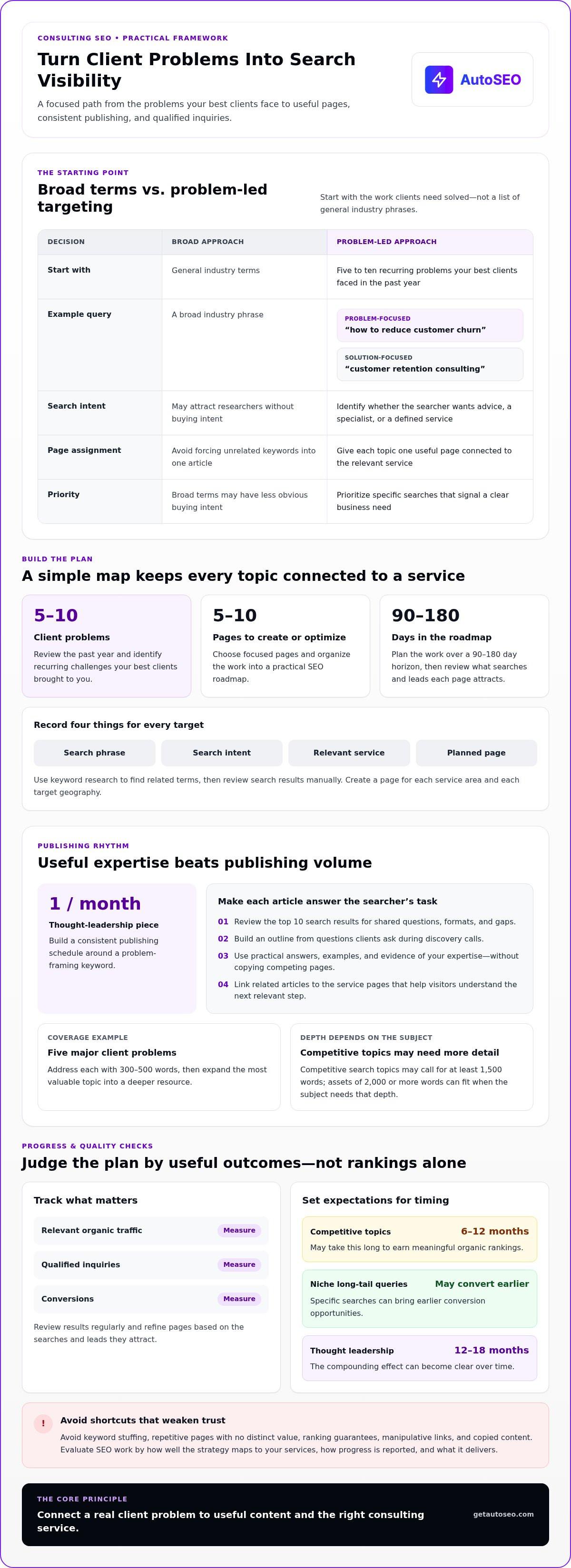
Start with problems, not a list of broad industry terms. Review the previous year and identify five to ten problems your best clients brought to you. For a strategy consultant, these might include unclear market positioning, stalled growth, or a weak go-to-market plan. Each problem suggests a different search intent and content opportunity.
Build a keyword map that connects each problem to the service that solves it. A problem-focused query might be “how to reduce customer churn,” while a solution-focused one could be “customer retention consulting.” Consider whether the searcher wants advice, a specialist, or a defined service. Then assign each topic to one useful page instead of forcing unrelated keywords into a single article.
How should a consulting business choose SEO keywords and target services? Match keywords to actual expertise, client problems, and the consulting services you want to grow. Create one page for each service area and each target geography, then use keyword research to shape supporting articles.
Use a keyword research tool to generate related terms, then review search results manually. Record the phrase, intent, relevant service, and planned page in a simple spreadsheet. Prioritize specific searches that signal a clear business need over broad terms that attract researchers without buying intent. A focused seo strategy should also include five to ten pages to create or optimize and a roadmap spanning 90–180 days.
Plan one thought-leadership piece monthly around a problem-framing keyword. A consistent schedule builds topical depth, but useful expertise matters more than publishing volume. Review each page against its target search intent, then update it when the service, examples, or audience needs change. The compounding effect of thought leadership can become clear after 12 to 18 months.
How much does SEO for a consulting business cost in the United States? Cost depends on the project’s scope and is provided after a quote request; key factors include technical work, content volume, competition, and ongoing link-building needs. Compare proposed work by deliverables, reporting, content standards, and ownership, not price alone.
What SEO mistakes and Google policy risks should consulting businesses avoid? Avoid keyword stuffing and repetitive pages that add no distinct value. Evaluate SEO work by how well the strategy maps to your services, how progress is reported, and what it delivers. Be wary of ranking guarantees and tactics based on manipulative links or copied content.
Measure progress through relevant organic traffic, qualified inquiries, and conversions, not rankings alone. Competitive topics may take 6–12 months to earn meaningful organic rankings, while niche long-tail queries may convert earlier. Review results regularly and refine pages based on the searches and leads they attract.
2. Creating high-quality content that meets search intent
Start every article with the searcher’s task. Review the top 10 search results for your target keyword, then note their shared questions, formats, and gaps. If results explain how to reduce customer churn, develop a practical guide with diagnostic steps, decision criteria, and examples. Don’t copy competing pages. Use the review to understand what readers need and add your own consulting expertise.
Build a clear outline from questions clients ask during discovery calls. For example, a pricing strategy consultant might cover margin analysis, pricing models, and common implementation risks. Address five major client problems with 300–500 words each, then expand the most valuable topic into a deeper resource. Competitive search topics may call for at least 1,500 words; long-form assets of 2,000 or more words can fit when the subject needs that depth.
Make each page easy for people and search engines to interpret. Use a short URL that describes the topic, such as /customer-retention-strategy. Give the page one clear H1, organize supporting points with descriptive H2 headers, and use navigation labels that match your service areas. Connect related articles and service pages with useful internal links. These steps help visitors move from an educational answer to the relevant consulting service.
Show expertise through specific evidence, not broad claims. Explain the method behind a recommendation, identify who should use it, and clarify its limits. A case study can describe the client’s starting challenge, the work performed, and the result without revealing confidential details. CFA, PMI, and ISO certifications can demonstrate technical proficiency and professional standards when relevant to your consulting field. Keep credentials accurate and place them beside the expertise they support.
Readable writing improves usability. Edit for a Grade 9 reading level or lower, define specialized terms, and replace abstract claims with examples. A consultant writing about operational efficiency could show how a process map exposes duplicated approvals. Comprehensive content gives a reader enough context to act; short pages that repeat generic advice rarely answer a complex consulting question fully.
Useful assets can earn backlinks from authoritative websites. Publish original research, an infographic, or a statistics roundup that gives industry writers a reason to cite your work. Support claims with evidence and make the asset easy to reference. Outreach is more effective when it explains why a specific finding or resource suits the recipient’s audience.
To maintain a steady publishing process, consider an automated SEO content workflow that supports consistent article development while you focus on subject-matter accuracy.
3. How do I do keyword research for my consulting practice?
Use keyword research to connect prospects’ searches with the problems your consulting practice solves. Start with one service, such as leadership coaching, and list the questions buyers ask before hiring. Group phrases by intent: learning about a problem, comparing approaches, or finding a consultant. This helps you create content for each stage of the decision.
Look for specific queries that reveal a need. A business owner searching “how to improve employee retention” may want guidance, while “employee retention consultant” signals interest in professional help. Create pages for distinct services and supporting articles for related questions. Avoid a separate page for every phrase: overlapping pages can compete with one another instead of strengthening your search visibility.
Give each keyword group a useful next step. An educational article could offer a relevant assessment or invite readers to discuss their challenge. A service page should explain the audience, scope, approach, and process, then provide a clear contact form. Ask only for useful qualification details, such as the business challenge and preferred contact method. A straightforward path makes it easier to move from reading to conversation.
SEO works as a long-term lead-generation strategy, not an instant campaign. Consistent SEO publishing can help build visibility and support lead generation over time. Independent consultants should set SEO goals six-to-18 months ahead, then review progress regularly. Competitive topics can take longer to build traction; niche long-tail queries may bring qualified inquiries earlier.
How should consulting firms measure SEO performance and lead generation? Track organic visits to priority service pages, inquiry submissions, qualified leads, and the queries that bring visitors to those pages. Compare results over time, then connect lead quality and booked work to the pages that generated each inquiry.
Use a regular measurement cycle: check which target pages attract relevant organic traffic, inspect their search queries, and review the resulting inquiries. If a page gets visits but few leads, compare its promise with the service and call to action. If inquiries are unqualified, refine the keyword focus or clarify who the service is for. This helps a consulting firm attract better-fit opportunities, not just more sessions.
Keep the strategy tied to commercial priorities. A solo consultant with limited capacity may focus on one high-value service and its strongest buyer-intent queries. A growing firm may build separate paths for several practice areas. Either way, choose keywords that reflect your expertise, audience, and desired work.
4. FAQ: Why should I use expert SEO consulting services to grow my business?
Why use expert SEO guidance? An experienced SEO professional can connect technical issues, search intent, and business goals in one practical plan. For a consulting firm, that means prioritizing pages that support its positioning instead of chasing traffic that never becomes a qualified inquiry. A clear strategy also helps the team measure progress and decide what to improve next.
What content should a consulting business create? Build a mix of problem-focused articles, service pages, and case studies. An article can explain how to address a specific operational challenge; a service page can show how your firm handles it. Include three case studies that describe the client problem, your approach, and the outcome. Together, these formats demonstrate expertise and help prospects understand whether your services fit.
How do case studies support authority? They turn broad claims into evidence. Describe the starting position, the work completed, and the business result, using details you can share responsibly. A case study about a supply-chain project, for example, could explain the bottleneck and the reasoning behind the recommended changes. Link it to the relevant service page so readers can move from proof to a clear next step.
How long does an SEO consulting project take? SEO consulting projects typically last 3 to 6 months, although scope and campaign size affect the work. That period can cover an audit, keyword priorities, technical recommendations, and content planning. A focused project may establish direction, but it doesn’t automatically provide the publishing and ongoing optimization needed to maintain momentum.
How do ongoing SEO services differ? Ongoing campaigns can continue from six months to many months or years. They allow a business to publish new content, update existing pages, monitor search performance, and respond as services or audience needs change. A consulting firm can choose a defined project for a specific need, or ongoing support when it needs sustained execution.
What should an SEO professional be responsible for? Agree on deliverables before work begins. Responsibilities may include analyzing technical issues, mapping target queries to pages, recommending content improvements, and reporting on traffic and qualified leads. The consultant should explain priorities in plain language and identify which tasks require input from your team, such as providing case study details or reviewing specialist claims.
How should I judge whether the work is useful? Review progress against the original goals, not a single ranking. Check whether priority pages attract relevant visitors, inquiries fit your services, and case studies help prospects understand your expertise. Use those findings to refine upcoming content and optimization priorities.
Should a consulting business use an SEO agency, freelancer, or in-house team?
Choose based on your project’s scope and compare the proposed work, reporting, content standards, and ownership. Ask how the strategy maps to your services and reject ranking guarantees.
5. How SEO consulting can improve business visibility and revenue
SEO can support revenue by connecting a consulting firm with people already searching for its expertise. The path involves appearing for a relevant query, earning a click, demonstrating fit, and turning interest into a qualified conversation. A ranking alone doesn’t establish commercial value. The goal is visibility that attracts prospects suited to your services.
Tie each priority page to a business outcome. A leadership consultant might target searches about executive team alignment, then guide visitors to a service page or case study. Track organic visits, inquiry submissions, qualified leads, and sales conversations from that page. This helps show whether visibility is contributing to the pipeline, rather than treating traffic as the end result.
A Terakeet study cited in the research reports customer acquisition costs with a good SEO strategy are 87 percent lower than with paid search. That comparison highlights a potential efficiency advantage, not a guaranteed outcome for every consulting firm. Results depend on whether content attracts the right audience, the site converts visits, and the business can serve incoming demand.
Consider the mechanics through an illustrative scenario: a consulting website receives 1000 monthly sessions and converts 50 visitors into leads at a 5% opt-in rate. They’re assumptions for illustration, not a forecast. Measure your own lead sources and project values to judge commercial impact.
Local visibility can support consultants serving a defined geography. Google reports that 30% of mobile searches are related to location. To improve local search relevance, maintain an accurate Google Business Profile, choose categories that reflect your consulting work, and keep business details consistent across your website and profile. Add a dedicated page for each target geography, with specific expertise and client examples rather than duplicated location copy.
How do consultants improve local SEO and Google Business Profile rankings? Keep your Google Business Profile accurate, with relevant categories, service details, and contact information, and align it with your website. Publish useful location-specific content and earn genuine client reviews. These signals help prospective clients assess relevance and trust.
Use a reporting cycle to establish what works. Review performance by service page, location, and query. If a page gains impressions but few clicks, improve its title and search-result description. If it attracts clicks but no qualified inquiries, sharpen the service explanation and next step. Consulting firms investing in SEO today may have a measurable organic lead pipeline by their second year.
Build a repeatable publishing process to support visibility across priority services and locations. Explore an automated SEO publishing workflow to keep quality content moving while you focus on client work.
AutoSEO: Automated SEO Platform Subscription
AutoSEO is an Automated SEO Platform Subscription for consulting businesses ready to make SEO execution more consistent. The subscription provides 30 SEO-optimized articles per month and 100 Domain Authority worth of backlinks. That can support firms that have chosen priority services and topics but need a steady publishing process to build organic visibility. It’s designed for ongoing SEO activity, not a one-time content purchase or manual consulting engagement. Use the content to address real prospect questions, and assess whether the topics align with your expertise and business goals. To explore the subscription, contact AutoSEO.
Turn Search Visibility Into Your Next Growth Priority
Make SEO part of business planning, not an isolated marketing task. Decide which consulting work you want to grow, who you want to reach, and how you’ll judge search’s contribution. Set aside time to review progress and adjust priorities as your business evolves.
Effective SEO for consulting businesses depends on a clear link between your expertise and the clients you want to serve. Keep that connection central as you choose topics, assess opportunities, and build a process your team can sustain. If ongoing execution is the obstacle, AutoSEO’s Automated SEO Platform Subscription may fit your workflow.
Ready to decide on your next move? Contact AutoSEO to discuss your SEO and identify an approach that fits your goals. Start with a focused plan, keep learning from the results, and build visibility with purpose.
Frequently Asked Questions
What is SEO for consultants?
SEO for consulting businesses helps prospective clients discover a consultant’s expertise through relevant search results. It brings a firm’s website content, service information, and technical setup in line with the questions buyers ask. For example, a cybersecurity consultant could create a page explaining how the firm assesses vendor risk, helping qualified prospects understand its approach before making contact.
How long does it take for SEO to generate leads for a consulting firm?
Measurable leads from consistent SEO content usually begin around six to nine months, though niche searches may convert earlier. A consultant targeting a specific need, such as nonprofit fundraising strategy, may attract a prospect sooner than a firm targeting a broad, competitive phrase. Track inquiries by landing page so you can distinguish early signs of demand from general search traffic.
How Can Consulting Businesses and Firms Effectively Get Started with SEO?
Check whether your website makes your specialty and next step obvious. Open the homepage as a first-time visitor and see whether you can quickly identify who the firm helps, what problem it addresses, and how to inquire. Then review service pages for missing details, outdated examples, or unclear calls to action. Fixing these gaps gives later SEO work a stronger destination.
How do I do keyword research for my consulting practice?
Pair client language with your service expertise. Review sales-call notes and proposals, then record the phrases prospects use to describe their challenges. If clients ask how to prepare for a merger, for example, investigate related searches and separate informational questions from requests for specialist help. Match each intent to a suitable page, and don’t choose a keyword only because it sounds popular.
Should you invest time and money in SEO?
Invest when your target clients use search to research problems and your business can turn relevant visits into conversations. Consider the value of a new client, your capacity to take on more work, and the time available for content and site improvements. If your offer or audience is still changing, clarify those choices first. SEO works best when pages reflect a stable, specific business focus.
What Are the Most Common SEO Mistakes That Consulting Firms Should Avoid?
Consulting firms should avoid generic articles that could describe any provider, near-identical pages for similar services, and measuring success only by ranking position. Each page needs a distinct audience and purpose. Separate operational strategy content from leadership consulting when the services solve different problems. Make sure every article also guides readers toward a relevant next step.
What are the pros and cons of SEO for a consulting firm?
SEO can make a firm’s specialist knowledge easier to find and attract prospects already researching relevant problems. Useful pages can continue to draw attention after publication. The trade-off is ongoing effort: firms need to develop accurate content, maintain their websites, and adapt as client needs and search competition change. If time is limited, choose a manageable scope and prioritize commercially relevant expertise.
What is SEO?
SEO, or search engine optimization, means improving a website’s relevance, accessibility, and usefulness so search engines can present it for suitable queries. It includes page organization, technical accessibility, content quality, and signals that help people assess credibility. A clearly structured service page, for example, gives visitors and search systems a better understanding of its audience and offering.


