

Quality backlinks without cold outreach can come from existing relationships, unlinked brand mentions, competitor research, and original content worth citing. The practical answer to how to get quality backlinks without outreach is to create something genuinely useful and make it easy for relevant sites to find and reference. Assess each link by its relevance, context, source quality, and likelihood of remaining live.
It’s easy to focus on link counts, but a link from an unrelated or low-quality page may be less valuable than a relevant citation that supports your expertise. Aim for links that make sense to readers and strengthen your site’s authority over time.
This guide explains how to find opportunities through existing relationships, reclaim brand mentions, learn from competitors’ backlinks, and create resources worth citing. It also offers a practical framework for assessing link quality and durability, so you can focus on opportunities with real potential.
Key Takeaways
- Start with people and organizations that already know your work, then identify natural reasons they might cite a useful page.
- Turn unlinked brand mentions into potential backlinks by finding the original page and making the next step clear.
- Use competitor backlink patterns to spot gaps, then create a more useful resource instead of copying what already exists.
- Build original assets that offer evidence, practical guidance, or a fresh perspective others can reference.
- Prioritize links that fit the topic, appear in meaningful context, and come from trustworthy pages; AutoSEO’s subscription automates SEO publishing and backlink building for ongoing work.
Earning links through existing business relationships
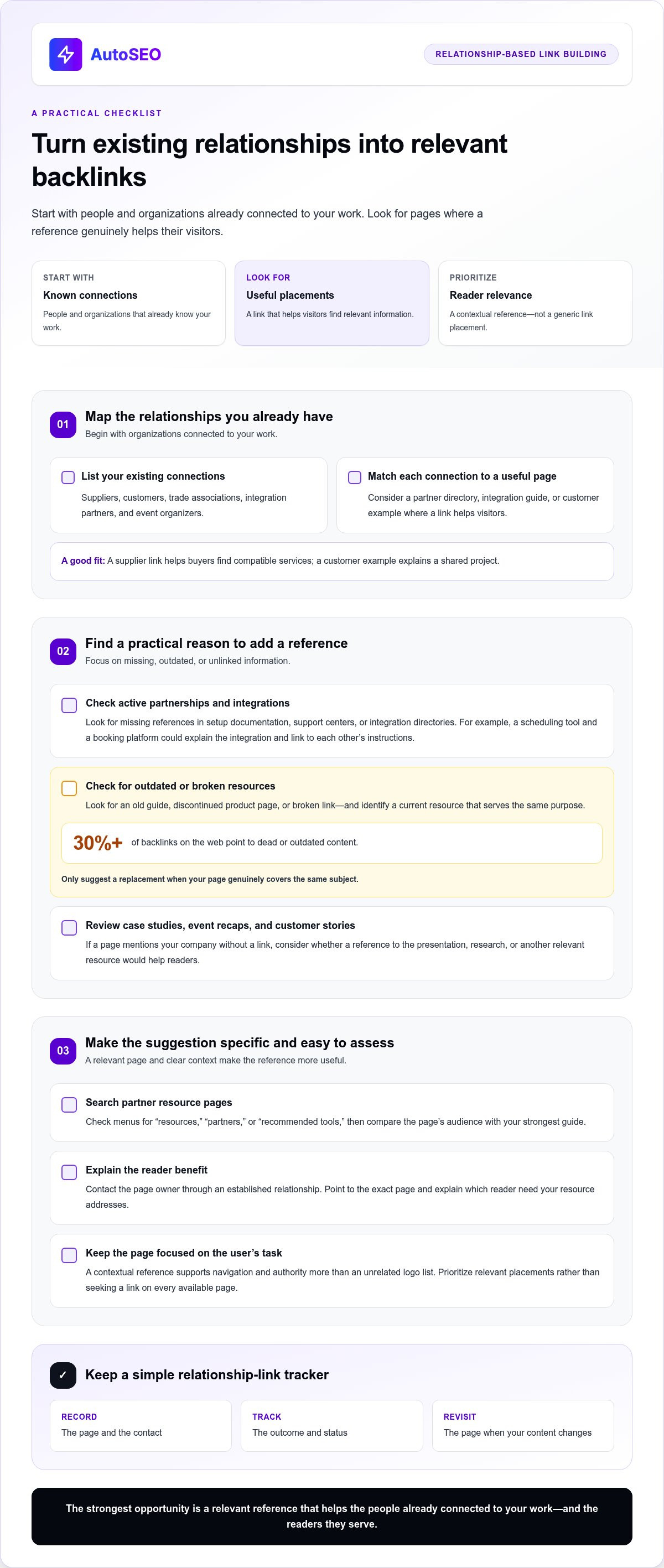
- Map the organizations already connected to your work: suppliers, customers, trade associations, integration partners, and event organizers. For each relationship, look for a relevant page where a link would help visitors, such as a partner directory or integration guide. A supplier link makes sense when it helps buyers find compatible services. A customer example is useful when it explains a shared project. Prioritize relevant placements rather than seeking a generic link on every available page.
- Review active partnerships and integrations for missing references. If your software connects with a partner’s platform, suggest a useful link in its setup documentation, support center, or integration directory. For example, a scheduling tool and a booking platform could each explain how the integration works and link to the other’s instructions. Keep the page focused on the user’s task. A contextual reference helps with navigation and authority more than an unrelated logo list.
- Check partner and supplier pages for outdated resources. Over 30% of backlinks on the web point to dead or outdated content, so an old guide, discontinued product page, or broken links can create a practical replacement opportunity. Find the page that no longer works, then identify a current resource that serves the same purpose. A replacement is useful only if your page genuinely covers the subject. Don’t pitch a product page as a substitute for a detailed how-to guide.
- Look for unlinked mentions in partner case studies, event recaps, and customer stories. If a page names your company without linking, consider whether a link would help readers reach the referenced resource. A shared webinar recap, for example, might link to the presentation or relevant research. Ask your existing contact who manages the page to add the reference where it fits. This is a relationship-based update, not a mass request for placements.
- Find resource pages maintained by associations, vendors, and integration partners. Search their site menus for terms such as “resources,” “partners,” or “recommended tools,” then compare each page’s audience with your strongest guide. Send the page owner a concise, specific suggestion through your established contact. Explain which reader need your resource addresses and where it fits. Track the page, contact, and outcome in a simple spreadsheet, and revisit it when your content changes.
Reclaiming unlinked brand mentions
- Start with a consistent list of brand names, product names, leaders, and common misspellings. Search engines can surface public pages, while media-monitoring tools can find mentions across news and industry sites. Search an exact company name alongside terms such as “review,” “case study,” or “interview.” Record each page, its author, publication date, and whether it links to your site. This keeps your mention audit organized and helps separate relevant opportunities from unrelated name matches.
- Review each result before requesting a link. Confirm that the page names your business accurately and that a useful destination exists, such as the study or product discussed. An unlinked mention in a detailed case study may be a stronger fit than a passing reference in a general roundup. A survey found 80.9% of SEO professionals believed unlinked brand mentions influence organic rankings. Treat that as a reason to monitor mentions, not as proof that every mention earns a link.
- Contact the page owner through an existing relationship or the publication’s appropriate editorial channel. Point to the exact mention, then suggest a relevant page readers can use to learn more. Keep the request factual: identify the reference and explain how a link would improve context. Don’t demand specific anchor text or imply an obligation. If the page already links to a suitable destination, mark the mention as resolved rather than creating unnecessary friction.
- Track brand mentions in AI-generated answers as well as traditional search results. Muck Rack’s analysis found that 82% of AI citations came from earned media sources. Its 2025 survey also found 61% of PR professionals were tracking or planning to track AI citations as a KPI, while 67% believed LLM visibility would soon become part of standard PR measurement. Record the answer, prompt, cited source, and mention context. Then check whether the cited page links to your site.
- Prioritize mentions that support a useful reader journey, then revisit important pages periodically. A news article, expert interview, or partner case study can remain valuable after publication if its facts and links stay current. If a mention points to a broken link, provide the page owner with the working destination and explain the mismatch. Keep a simple log of the page, contact, status, and follow-up. For a consistent publishing cadence alongside this work, explore automated SEO content workflows.
Competitor content and the Skyscraper Technique
Organic backlinks take time because publishers must find and choose to cite useful content. Buying backlinks or using automated link schemes risks spammy placements, little referral traffic, and potential SEO harm.
Analyze Competitor Backlink Sources
- Choose a competitor whose audience and subject matter overlap with yours. Enter its domain or a specific page into a backlink analysis tool, then export referring pages. Start with pages that link to several competitors; repeated sources can reveal industry directories, editorial resources, or recurring content needs. A competitor’s deleted pricing page had over 3,000 referring domains, showing how one URL can attract broad linking.
- Review each linking page, not just its authority score. Note the article topic, link placement, anchor text, and whether the link appears naturally within useful content. Distinguish editorial citations from profile pages, scraped listings, and unrelated guest post placements. A relevant source explaining a product category may offer a real opportunity; a page linking to every competitor without context may offer little value.
- Group the strongest sources by why they link. A resource page may cite a practical guide, while a news article may reference original data. Check whether the competitor’s linked page is current, accessible, and genuinely useful. Understanding these link sources can reveal a content gap to address, rather than encouraging you to copy a competitor’s backlink list without knowing why each link exists.
Replicate Competitor Backlink Opportunities
- Match each promising source to a specific improvement you can make. If a publication links to a basic checklist, create a more complete version with clearer steps, updated examples, and original insights. The Skyscraper Technique works through added value, not word count alone. A longer page that repeats the same points gives editors little reason to cite it.
- Check whether the source still links to the competitor and whether its page remains relevant. If the cited resource is outdated or broken, create a current alternative that meets the same reader need. Then make it easy to find through your site navigation, relevant articles, and social channels. Organic discovery can build over time as readers find, use, and reference the improved resource.
- Prioritize opportunities that fit your expertise and audience. Don’t buy a link just because a competitor has one, and avoid automated schemes that generate unrelated profile links or mass placements. Free backlink sites that let anyone add links may contain spam, bring no traffic, and potentially harm SEO. A focused resource with a clear use case gives publishers a more credible reason to link naturally.
Creating original content that earns citations and backlinks
Guest posts and directory listings can earn useful links when they serve readers and meet the site’s standards. Internal links help visitors and crawlers find your strongest resources, while digital PR gives publishers a reason to cite original findings.
- Choose a question your audience needs answered, then create a resource with evidence others can cite. Original survey results, an industry benchmark, or a clear local guide gives journalists and editors a concrete reference. Editorial.link found 12% of surveyed SEO professionals ranked linkable assets as the most effective link-building method. Make the asset specific enough to be useful beyond your own website.
- Build a citation magnet around data you can explain and reproduce. State the research method, sample, limitations, and date, then present the key finding in a chart and plain-language summary. BuzzStream reported that 95% of practitioners use data as their primary digital PR campaign format. For example, a local business could publish a transparent comparison of service availability across its region.
- Use digital PR to share a genuinely newsworthy finding, not just a sales announcement. A regional cost analysis or original consumer survey may interest trade publications and local newsrooms. Editors can cite the data in their coverage, creating editorial links and referral traffic. Make the source page easy to quote, with a concise finding, attribution details, and supporting methodology.
- Strengthen the asset with internal links from relevant pages. Link a service-area guide to the research it supports, and connect a related article to the full dataset. These links help readers navigate your site and clarify each page’s context. They don’t create external backlinks by themselves, but they make a valuable resource easier for visitors and publishers to find.
- Claim accurate local citations in directories customers actually use. Keep your business name, address, phone number, and category consistent across listings. A chamber of commerce directory or recognized local association can provide useful referral visibility when its audience matches yours. Avoid mass-submission directories that accept every listing without review. Relevance and editorial standards matter more than the number of profiles.
- Assess guest posts as editorial contributions, not link containers. A strong guest article answers the publication’s readers’ needs and earns a contextual citation to a supporting resource. Backlinko’s 2019 content study had 19,000 backlinks, demonstrating how a useful asset can attract references at scale. An alternative is publishing the original research on your own site, then making its findings easy to cite.
Evaluating backlink relevance, trust, context, and persistence
Assess each backlink by topic fit, placement, source quality, and lasting usefulness. A practical link-building strategy favors relevant websites and meaningful context over raw quantity.
-
Find Relevant Target Websites
Search for websites that serve the same audience or cover closely related topics. Review their recent articles, resource pages, and editorial standards before treating them as prospects. Read the last 5-10 articles to understand subject matter, depth, and tone. Semrush and similar backlink tools can help identify linking domains, but inspect the actual pages. Avoid sites whose topics have no natural connection to your readers.
-
Evaluate Backlink Quality and Context
Open the linking page and check whether the link supports a specific claim or next step. A citation inside an article about your subject is more relevant than a link buried in an unrelated footer. Look for clear editorial purpose, useful content, and a credible website with a history of ranking for related topics. Avoid sites with toxicity scores in the 60-100 range, and reject links surrounded by spam.
- Check the destination and link attributes. Confirm the link points to the correct, working page, not a broken URL or a redirect to unrelated content. Note whether the link is marked sponsored or nofollow, as these attributes affect how search engines treat it. A relevant citation can still send qualified traffic and help readers, even if it doesn’t pass ranking signals in the same way as a standard followed link.
- Assess the page itself, not just its domain score. Check whether journalists or subject experts contribute, whether articles answer real questions, and whether the website links out selectively. A high authority metric cannot make an irrelevant placement valuable. For example, a specialist article citing your original research provides stronger context than a generic profile listing that mentions your brand without explaining its relevance.
- Track persistence with a simple record of the linking page, destination, anchor, and review date. Revisit key links to confirm the source page still loads and your citation remains in context. A deleted article or changed URL can erase referral value. Compare link quality and resulting visits over time, rather than chasing a growing count. For an automated SEO workflow that supports consistent publishing and backlink building, start building SEO on autopilot.
AutoSEO: Automated SEO Platform Subscription
AutoSEO’s Automated SEO Platform Subscription supports ongoing organic growth with SEO-focused articles and backlinks. It suits businesses that want consistent content and link building without managing every task manually.
Use the methods in this guide to assess relevance and quality, then build a publishing rhythm that supports your backlink strategy. AutoSEO provides 30 SEO-optimized articles per month and backlinks worth 100 Domain Authority through its subscription.
Visit getautoseo.com to explore AutoSEO.
Make Link Earning Part of Your Next Growth Cycle
The most useful next step is to make link earning a repeatable habit. Set a regular time to review new mentions, changes in competitor content, and pages on your site that need more visibility. Record what you learn, choose one practical improvement, and use your next review to see whether it created a better resource or revealed a relevant opportunity.
That steady approach makes how to get quality backlinks without outreach less about chasing isolated placements and more about building assets and relationships that keep attracting attention. Focus on relevance and reader value, then adapt as your strongest pages and audience needs change.
AutoSEO’s Automated SEO Platform Subscription can support businesses that want an ongoing SEO workflow. To explore whether it fits your goals, contact AutoSEO about your SEO.
Start with one focused improvement and build from there. Consistent progress compounds.
Frequently Asked Questions
What Makes a Backlink ‘Quality’ in 2026?
A quality backlink comes from a trustworthy website and appears in a relevant, useful context. Check whether the linking page serves the same audience, explains the subject accurately, and gives readers a reason to follow the link. A domain score alone can’t establish value. Also review the page’s outbound links, editorial standards, and continued availability. A link that meets a real reader need is stronger than an unrelated placement.
How can beginners get backlinks?
Beginners can start with one method that matches their existing strengths, such as publishing a practical guide or improving a partner resource. Make a list of potential opportunities, complete five to 10 attempts, then assess which actions produced useful links or attention. This small test helps build a repeatable process before investing more effort. Track the source page and link context, not just the total number of backlinks.
How has link building evolved in 2026?
Link building now needs to support visibility in both traditional search and AI-generated answers. Muck Rack’s analysis found that 82% of AI citations came from earned media sources. That makes credible coverage and easily verifiable information valuable beyond a conventional backlink count. Build pages that clearly answer questions, identify their evidence, and are useful to publishers. Track relevant citations and brand references alongside links to understand where your expertise appears.
What are the best ways to earn quality backlinks without outreach?
Focus on opportunities where people already encounter your work: existing partners, brand references, industry resources, and content that answers a specific question. To learn how to get quality backlinks without outreach, make your resource easy to find through your site structure and relevant channels. Then monitor whether publishers cite it independently. Record which topics attract references so you can develop more useful assets instead of repeating tactics that don’t work.
How can original research and data attract backlinks organically?
Original research gives writers evidence they can use to support a claim. Present a clear finding, explain how you gathered the data, and make the underlying context easy to understand. BuzzStream reported that 95% of practitioners use data as their primary digital PR campaign format. For example, a business could publish anonymized customer trends with a transparent method, giving industry writers a distinct fact to cite rather than another general opinion.
What types of linkable assets earn backlinks without promotion?
Useful assets include original datasets, calculators, detailed glossaries, visual explainers, and practical templates. Choose a format that solves a recurring task for a defined audience. A water-heater replacement cost article has more than 900 backlinks, illustrating how a focused answer can attract references. Make your asset easy to cite by keeping its key finding visible, labeling charts clearly, and maintaining the page when details change.
How can broken link building work without contacting site owners?
Finding a broken link can reveal a missing resource, but replacing the dead page on your site doesn’t change the link on someone else’s website. Without contacting the site owner, publish a useful alternative and make it discoverable through related pages, search, and existing networks. The publisher must still choose to update its page. Treat this as a content-discovery opportunity, not an automatic link replacement.
How do unlinked brand mentions become backlinks, and does that require outreach?
An unlinked mention becomes a backlink when the page editor adds a clickable link to a relevant page on your site. You can identify the mention and suggest an appropriate destination, but that request is outreach. An editor may add a link independently, but you can’t control that. Prioritize references where a link would give readers useful context rather than asking for a link on every mention.


