
SEO takes months, not days. Google says achieving significant success in search typically takes 4-12 months, which helps explain why SEO takes so long: search engines need time to discover changes, assess relevance, and compare your site with others competing for the same queries.
It’s frustrating to invest in better content and technical fixes without seeing an immediate rise in rankings. Early movement takes time, and an indexed page doesn’t automatically rank highly. The good news is that progress can appear before a page reaches the top positions.
This article explains how competition and search intent affect the timeline, which technical issues can hold pages back, and how backlinks and domain history shape a site’s ability to build authority. You’ll also learn which early signals to track, so you can judge progress by more than a single ranking check.
Key Takeaways
- Set expectations by keyword difficulty: low-competition terms may move sooner, while highly competitive rankings can take years.
- Compare your page with the intent and depth of the results already ranking; targeting the wrong need can stall progress even when the content is well written.
- Resolve crawl, indexing, and internal-linking problems so search engines can find pages and understand how they connect.
- Track query expansion, crawl activity, and early ranking movement as progress signals, rather than judging the work by one keyword alone.
- Build relevant, high-quality backlinks over time; a domain’s history and authority can influence how quickly it earns trust.
Expected SEO ranking timelines by keyword competition
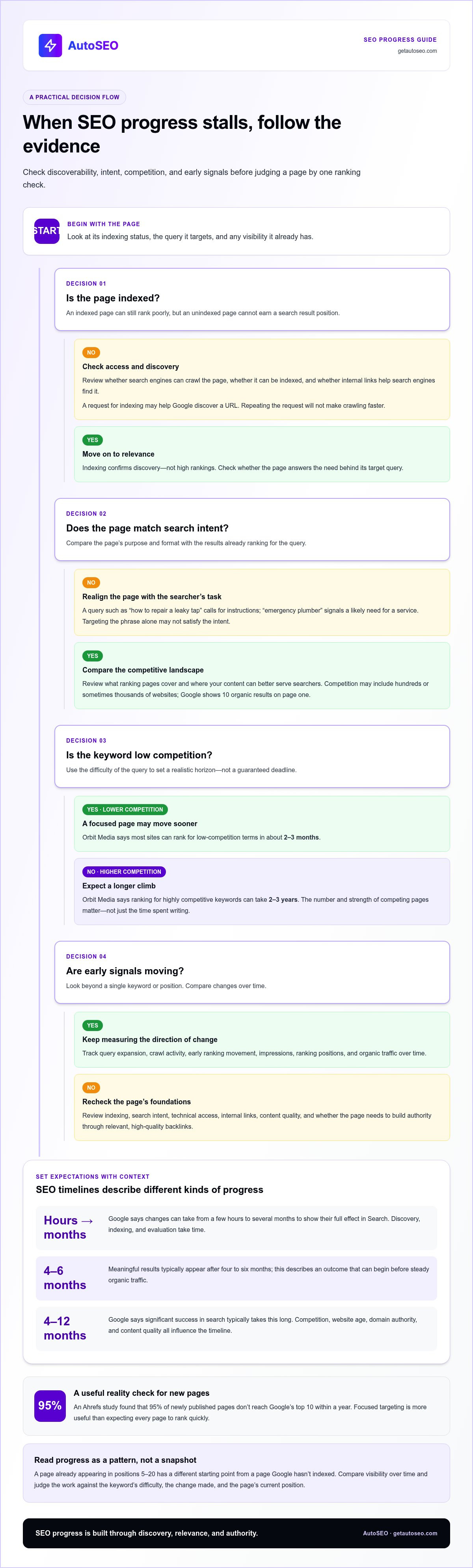
An SEO timeline depends partly on how difficult a keyword is to win. Meaningful results typically appear after four to six months, while Google says significant success in search typically takes 4-12 months. These ranges describe different outcomes: an early ranking movement can happen before a page earns steady organic traffic. Competition, website age, domain authority, and content quality all influence how quickly traction develops.
Low-competition keywords give a focused page more room to gain visibility. Orbit Media says most sites can rank for these terms in about 2-3 months. Highly competitive keywords demand a longer horizon: Orbit Media says ranking for them can take 2-3 years. The difference reflects the number and strength of pages already competing for attention, not simply the time spent writing one article.
Use the keyword’s competition to set a practical expectation. A relevant, well-structured page targeting a specific query may move sooner than a broad page targeting a heavily contested term. Even then, ranking depends on whether the page satisfies the search intent and earns authority. Businesses commonly begin to see traction after 4 to 12 months, with website age, domain authority, competition, and content quality shaping that timeline.
SEO changes take time to appear in search results. Google says changes can take from a few hours to several months to show their full effect in Search. A new article may take days or weeks to be discovered and indexed, and indexing alone doesn’t guarantee a ranking. Technical fixes, internal links, content, and backlinks may take weeks or months to influence rankings as search engines recrawl and reassess pages.
That delay explains why a published update may not produce an immediate change in position. Google offers no way to force an instant update to a changed page. A request for indexing may help Google discover a URL, but repeating the request won’t make crawling faster. For example, after correcting a page’s content and internal links, allow time for discovery, indexing, and evaluation before judging its search performance.
Track progress against the keyword’s difficulty and the change made. A low-competition page can show movement within Orbit Media’s 2-3-month range, while competitive rankings may require the longer 2-3-year horizon. Compare impressions, ranking positions, and organic traffic over time. If a page stays invisible, review whether it’s indexed, whether it matches the query, and whether its technical access or authority is holding it back.
Keyword competition and search intent
Competition, search intent, and a site’s starting position shape how quickly it can achieve valuable SEO results. Together, they help explain why SEO takes so long for some pages and moves faster for others.
Competition and Starting Position
A starting position is a page’s current visibility for a keyword, which indicates how much ground it must gain. A page already ranking around positions 5-20 has a different opportunity from one Google hasn’t indexed. Review existing positions before setting targets; improving a visible result may require different work than establishing relevance and visibility from scratch.
Why New Websites Take Longer to Rank
New websites have less established content and visibility for search engines to assess. A common question is why SEO takes so long for a new website to rank in Google: it must build relevance and authority while competing against established pages. An Ahrefs study found that 95% of newly published pages don’t reach Google’s top 10 within a year. This makes focused targeting more useful than expecting every page to rank quickly.
Competition affects the work required to earn a position. Valuable search rankings can be contested by hundreds or sometimes thousands of websites, while Google shows 10 organic results on page one. Established competitors may already have pages that address a query clearly and earn links. Compare ranking pages to identify what they cover and where your content can better serve searchers.
Search intent is the reason behind a query. Someone searching “how to repair a leaky tap” wants instructions, while “emergency plumber” signals a likely need for a service. A page may target the right phrase but answer the wrong need. Compare your content’s format and purpose with the search results, then align it with the task the searcher wants to complete.
Budget and resources affect how consistently a business can address competition. A small team may need to prioritize relevant keywords instead of creating pages for every topic at once. Strong targeting gives each page a distinct search purpose, while time for content updates and earning links supports that focus. Spread your effort too thinly, and important pages may remain underdeveloped.
Use competition and starting position together when choosing keywords. A page already appearing in positions 5-20 may offer a nearer opportunity than a new page pursuing a broad term. Prioritize queries where your content can match intent, then build a consistent plan. A consistent SEO execution workflow can help keep that work moving.
Technical SEO issues that can delay results
Technical SEO can delay results when search engines can’t crawl, index, or interpret key pages. Fixes may show movement in days to weeks, depending on crawl frequency. Google says SEO changes can take from a few hours to several months to show their full effect in Search.
Initial Website Audits and Technical Fixes
A technical audit checks whether search engines can access, understand, and index a website’s important URLs. It matters because blocked pages, broken links, and confusing structure can keep valuable content out of search results. During the first 30 days of an SEO programme, recommended tasks include checking crawling and indexing, auditing the site, and evaluating competitors.
Start with Google Search Console to review indexing and crawl reports, then check key pages directly. Set up Google Analytics 4 and Google Search Console as part of the first 30 days. Look for accidental noindex directives, duplicate URL versions, broken internal links, and pages that lack a clear path from the site’s navigation.
Technical Fixes and Ranking Improvements
Technical fixes remove barriers that prevent search engines from discovering or processing pages. A change may take days to weeks to affect rankings, depending on how often Google crawls the affected URLs. Even after a page is corrected, Google needs to recrawl and assess it before its position can reflect the improvement.
The first four weeks of SEO work may involve discovery, crawling, and technical cleanup. Prioritize issues affecting important URLs: restore access to blocked pages, repair broken links, and clarify which version of a page should be indexed. Then monitor crawl and indexing status to see whether Google can process the corrected structure.
Internal links help search engines discover pages and understand how topics relate. For example, a service page linked from a relevant guide is easier to find than one buried without contextual links. Review your site structure and connect related pages with descriptive anchor text. Clear internal links also help visitors find useful information.
Technical quality matters to people as well as crawlers. A confusing menu, slow-loading page, or layout that breaks on a phone can make information harder to use. Test important pages on mobile and desktop, follow each navigation path, and fix errors that interrupt access. These improvements support a clearer experience, but they don’t replace relevant content.
Measure each fix against the problem it addresses. If a page was blocked, check whether it becomes crawlable and indexed. If you changed internal links, inspect whether search engines can discover the destination. Record the affected URLs and changes. Google’s recrawl and evaluation take time, so distinguish confirmed technical repairs from later ranking outcomes.
Early indicators of SEO progress
SEO progress often appears in stages, not as an immediate jump to the top of Google. During the first 1 to 3 months, query expansion and early ranking movement can show that search engine optimization is gaining traction. A page appearing for more relevant searches is an early signal, even before organic traffic grows consistently.
Check Google Search Console for impressions, clicks, and queries associated with each important URL. Rising impressions show that Google is displaying a page more often, while new queries can reveal broader visibility. Compare the same page over time, and separate branded from non-branded searches to see whether optimization is reaching new audiences.
- More queries: A guide about bookkeeping begins appearing for related searches beyond its main target keyword.
- Impression growth: Google Search Console shows the page entering more search results, even if clicks remain low.
- Ranking movement: A page moves closer to page one for relevant terms, signaling improved visibility.
- Better engagement: Organic visitors reach a service page from an informational article and explore related content.
Quick wins can happen within the first 90 days, but they don’t show the full impact of an SEO program. A month can reveal crawl, indexing, snippet, or early ranking changes on some pages. Use those signs to spot movement, not to judge the complete value of the work after a short period.
To accelerate progress, focus on pages that already have relevant impressions. First, compare the query with the page’s content and confirm the answer matches search intent. Next, strengthen the title and description so they accurately represent the page. Then connect it to related content with descriptive internal links. These steps align relevance, structure, and discovery.
Prioritize quality over publishing pages without a clear purpose. For example, a product page should explain the product and help visitors take the next step; a how-to article should answer the task directly. Search engines can better match each page when its topic, headings, and content serve a consistent intent. This focus helps attract useful organic visits instead of impressions from unrelated searches.
Track a small set of indicators for each target URL: indexing status, impressions, relevant queries, ranking direction, and organic clicks. Review the same measures consistently instead of reacting to daily movement. If impressions rise but clicks don’t, improve the result’s title and description. If relevant queries remain absent, refine the page’s topic and intent before adding more content.
Backlink profiles and domain history
Backlinks and domain history shape how quickly a website can build authority. Ahrefs found that the average age of domains in Google’s top 10 results is around two years or more. Domain age is only one part of the broader picture, and new sites can build visibility over time.
How long does link building take to affect search rankings? Search engines need time to discover and assess new backlinks, then weigh them alongside relevance and other ranking signals. Links can support visibility, but their effect depends on the pages they point to and the authority those pages help establish.
A backlink is a link from another website to yours. Relevant links from trusted websites can strengthen a page’s authority; quantity alone doesn’t show whether a backlink profile is useful. For example, a link from a publication covering your industry may fit your topic better than an unrelated link, even if both point to the same page.
Review each link’s source, topic, and destination. Ask whether the linking page is relevant to your business and whether the destination answers a useful question. A profile made up of unrelated links may offer less meaningful support than links that naturally connect to your subject. Prioritize relevance and quality instead of chasing a high link count.
Domain history adds context. A site with a longer record may already have links, recognized topics, and pages that appear in search results. Ahrefs’ finding about domains in Google’s top 10 highlights how established websites often occupy valuable positions. A new domain must build its own history through useful content and credible references.
Internal links support discovery, but they play a different role from backlinks. Links between your own pages help search engines find URLs and understand how topics connect. For example, a detailed guide can link to a related service page, creating a clear path for visitors and crawlers. Internal links don’t replace external endorsements.
Assess the full profile before adding more links. Identify which pages attract external links, whether those links fit the page’s subject, and which important pages lack internal connections. Then publish useful material that gives relevant sites a reason to reference it. This creates a stronger foundation for organic traffic than treating link acquisition as a numbers race.
Build authority consistently with quality content and relevant backlinks. Put SEO execution on autopilot to support steady publishing and backlink growth.
AutoSEO: Automated SEO Platform Subscription
AutoSEO’s Automated SEO Platform Subscription is a practical fit for businesses that need consistent content and backlink activity without managing each task manually. It automatically generates and publishes 30 SEO-optimized articles per month and builds backlinks, supporting an ongoing approach to organic growth. That steady output can help keep SEO work moving while rankings develop, though it doesn’t make search engines rank pages instantly.
Use an automated approach when publishing consistently and building authority are difficult to maintain alongside daily business work. The subscription focuses on recurring SEO execution, rather than a one-time content purchase. If you want to see whether this approach suits your workflow, visit AutoSEO’s website.
Make your next SEO move count
SEO is easier to manage when you treat each change as a decision, not a guess. Understanding why SEO takes so long helps set a realistic direction, but your next move should depend on what your own pages show. Choose a priority, define the signal you want to improve, and make that work a consistent part of your growth plan.
Keep the focus on business value. More visibility matters when it reaches the right audience and supports a meaningful next action. Use what you learn from search performance to refine your priorities, strengthen the pages that matter, and build a process your team can sustain.
If you’re ready to make SEO execution more consistent, contact AutoSEO about your SEO. The right next step is the one that helps you keep moving with clarity and purpose.
Frequently Asked Questions
How Long Does SEO Take to Work?
SEO often needs four to six months to produce meaningful results, while Google says significant success in search typically takes 4-12 months. Early signs, such as new impressions or movement for specific queries, may appear before traffic or leads grow. Set a baseline for organic clicks, conversions, and priority keywords, then compare performance over time. This shows whether the work is gaining traction beyond a single ranking change.
FAQs: How Long Does SEO Take?
There isn’t one timeline for every site because SEO outcomes develop in stages. A page may be discovered before it ranks, and ranking movement may come before business results. Track those stages separately: confirm the page appears in search, monitor whether it earns relevant impressions and clicks, then assess whether visitors take valuable actions. This makes the timeline easier to interpret than treating SEO as a single date when results arrive.
How Long Do SEO Changes Take to Show Results?
Google says SEO changes can take from a few hours to several months to show their full effect in Search. A revised title may appear sooner than a change that depends on crawling, indexing, or broader evaluation. Record the date and URL for each major update. Then compare that page’s impressions and clicks over time instead of assuming every change should produce an immediate ranking increase.
How Long Does SEO Take?
SEO can take months to build meaningful visibility. Orbit Media says most sites can rank for low-competition keywords in about 2-3 months, while highly competitive terms can take 2-3 years. These are different levels of challenge, not fixed deadlines. To set useful expectations, separate achievable niche queries from broad targets, then judge progress against the competition and the business outcome each keyword is meant to support.
How long do SEO changes take to take effect?
A change affects search after Google discovers and processes the updated page, then reevaluates it. Google provides no way to force an instant update. Requesting indexing may help with discovery, but repeated requests won’t make crawling faster. After updating a page, confirm that it works as intended and monitor how it appears in search. A submitted indexing request isn’t proof that rankings have changed.
How long does it take for SEO to pay for itself?
SEO typically takes 6 to 12 months to reach break-even and produce a positive return on investment. Calculate payback by comparing SEO-related costs with revenue attributed to organic search, using a consistent measurement period. Include qualified leads and completed sales, not just visits. For example, a traffic increase without conversions may indicate that the landing page, offer, or audience targeting needs attention before SEO can deliver a stronger return.
How long until I see real revenue growth?
Significant revenue gains from SEO typically materialize between 6 and 12 months, while a consistent increase in organic leads generally takes three to six months. Leads and revenue can move on different schedules because visitors still need to convert. Track organic sessions alongside form submissions, calls, and sales. If traffic rises but sales don’t, examine whether the pages attract potential customers and make the next business step clear.
Should I stop SEO if it’s not working?
Don’t stop based on one flat ranking report. First, identify where progress is breaking down. Check whether key pages are indexed, whether impressions or relevant queries are increasing, and whether organic visitors convert. If traffic comes from the wrong searches, refine targeting and page content. If visibility is absent, investigate technical access and competition. Use your findings to adjust priorities or execution instead of repeating work that isn’t advancing business goals.


