

AI search is changing what visibility means. Generative engine optimization (GEO) helps make a business’s content easier for AI systems to find, understand, and reference in answers. A generative engine optimization platform for a small business can support this work by creating and publishing clear, accurate content. Traditional SEO focuses on visibility in search results, and both approaches can work together.
Choosing a platform takes more than comparing AI features. Consider what it helps you do, how it tracks visibility in AI answers, and whether its workflow suits your business. GEO is not a replacement for useful content or a shortcut to guaranteed mentions.
This guide explains how GEO differs from traditional SEO and what small businesses and startups should assess when comparing platforms. It covers content quality, monitoring, and automation, helping you choose an approach that supports both AI search visibility and organic traffic.
Key Takeaways
- See how GEO complements traditional SEO by helping AI systems find and reference useful, accurate business content.
- Learn what GEO means in practice and how AI visibility can be assessed through brand mentions and website citations.
- Identify platform features that matter for small businesses, including relevant prompt data, practical monitoring, and content workflows.
- Understand how automation can support a consistent publishing strategy while keeping quality and accuracy in focus.
1. GEO compared with traditional SEO
Traditional SEO targets visibility in search results, rankings, and organic clicks. GEO helps make a business’s content easier for language models to understand and cite in generated answers. The goals overlap, but the signals differ: a page can earn search traffic without appearing in an AI answer. GEO-Bench tests webpage changes against roughly 10,000 queries to measure citation visibility.
Strong GEO content starts with a direct answer, then backs it up with useful detail. Expert quotes and links to reputable sources can provide context and support authority. Traditional SEO also depends on useful pages that match customer intent. Clear structure and accurate information help with both. For example, a service page can answer a common customer question before explaining the service.
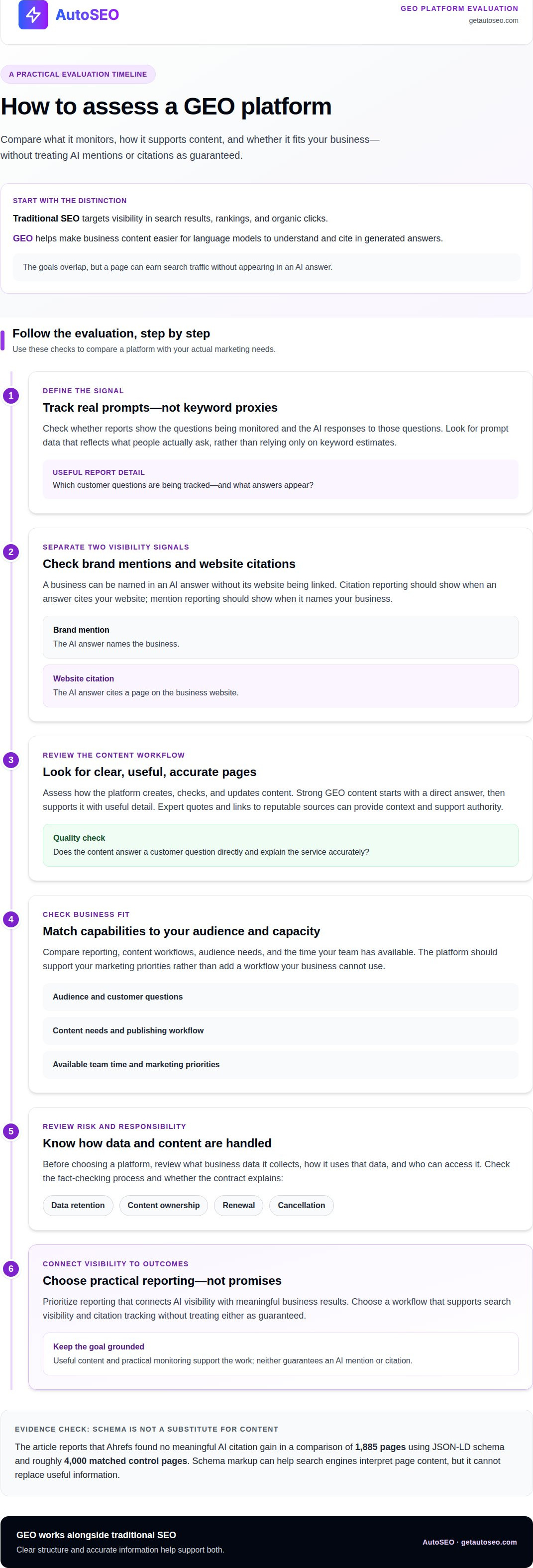
A generative engine optimization platform for small business teams should track real user prompts, brand mentions, and website citations, not just keyword proxies. Compare reporting, content workflows, and how each platform fits your marketing priorities. Schema markup can help search engines interpret page content, but it can’t replace useful information. Ahrefs found no meaningful AI citation gain in a comparison of 1,885 pages using JSON-LD schema and roughly 4,000 matched control pages. The right generative engine optimization platform for small business owners should turn these signals into practical next steps.
- Prompt tracking: Confirm reports show the questions and AI responses being monitored.
- Citation reporting: Look for visibility into when AI answers cite your website or mention your business.
- Content workflow: Review how the platform creates, checks, and updates pages for accuracy.
- Business fit: Match its capabilities to your audience, content needs, and available team time.
To manage privacy, accuracy, and contract risks, review what business data a platform collects, how it uses that data, and who can access it. Check its fact-checking process and whether the contract explains data retention, content ownership, renewal, and cancellation.
Choose a workflow that supports search visibility and AI citation tracking without treating either as guaranteed. Prioritize reporting that connects visibility to meaningful business results.
2. What is generative engine optimization (GEO)?
Generative engine optimization helps AI systems find, understand, and reference a business in generated answers. For local companies, that means clear information about services, locations, and customer needs. According to Yext’s 2026 Consumer Search Behaviors Report, 47% of U.S. adults used AI to find a local business in the past month. That makes AI answers a relevant discovery channel alongside Google search.
Local visibility depends on accurate, consistent business details. A neighborhood plumber, for example, should describe the areas served, common repairs, and how customers can request service. LocalBusiness schema markup can specify a business’s name, address, phone number, hours, service area, and profile links. Structured details help search systems interpret a page, while useful explanations give models context for matching a business to a local question.
AI visibility tracking should distinguish a brand mention from a website citation. A chatbot might name a bakery without linking to its site, or cite its menu page as a source. Both signals matter, but they represent different kinds of visibility. Track which local questions prompt a mention, whether the AI cites a relevant page, and whether the cited information accurately describes the business.
Cost-conscious monitoring can begin with free Google Business Profile and Google Search Console data, alongside manual checks in AI tools. Ask five realistic customer questions once a month, such as which nearby shop sells a specific product. Record the answers, mentions, and cited sources, then compare them over time. If a paid platform fits your needs, assess which AI models and locations it covers, how it reports citations, and whether its data reflects actual customer prompts rather than keyword estimates.
Choose monitoring that connects local visibility with useful outcomes, such as calls or qualified inquiries. For businesses that also need a consistent publishing workflow, explore an automated SEO workflow as a way to support ongoing content production.
3. GEO for small businesses and startups
Startups need focused coverage, not a library of generic posts. A generative engine optimization platform for small business teams can help organize content around a specific customer problem, such as how a scheduling app reduces missed appointments. The team can connect that topic to product details and supporting articles, giving ChatGPT and other models useful context about what the company does and whom it serves.
Professional GEO work can begin with an audit of existing pages, FAQs, and customer conversations. For example, sales calls at a software startup may reveal recurring questions about setup, integrations, or billing. A GEO specialist can turn those questions into structured, easy-to-read content and identify gaps across the site. This builds on existing knowledge rather than starting from scratch.
Content clusters help small brands build depth around a few high-value subjects. A bookkeeping startup might connect a service page with articles about monthly reconciliation, expense records, and preparing reports. Each page should address a distinct customer need and link naturally to related information. Schema can describe relevant business details, but it cannot replace accurate explanations or useful examples.
To make professional GEO manageable, define a narrow first phase. A provider can prioritize core service pages, customer questions, and a publishing workflow before expanding into other topics. When choosing a generative engine optimization platform for small business growth, compare the work included, such as planning, production, review, and visibility tracking. Automation can reduce repetitive tasks, while expert oversight helps keep claims aligned with the product.
Set a baseline before making changes. A professional can record whether ChatGPT and other AI tools mention the brand, cite its pages, or describe its services accurately. Tracking should connect visibility to business signals such as qualified inquiries or demo requests. As the company learns which topics attract the right prospects, it can prioritize those questions and build stronger coverage.
4. Generative engine optimization and AI search
AI search tools such as ChatGPT and Perplexity generate responses using multiple signals rather than presenting only a ranked list. A strong Google position can support discovery, but it does not ensure that an AI answer will mention the same business. GEO helps make expertise, services, and evidence easier for systems to interpret. For a dentist, that could mean dedicated pages covering emergency care, insurance, and location details.
Ranking and citation are different outcomes. A page may rank for “same-day appliance repair” while an AI response cites another source. A GEO provider should track brand mentions, cited URLs, and the prompts that trigger each result. This separates AI visibility from traditional search performance and reveals which customer questions lack useful answers.
Authority also depends on consistent information. If a company describes its service area differently on its website and business profiles, systems may struggle to identify the correct details. A professional can align business descriptions, organize supporting pages, and connect claims to credible sources. For example, a software company can support a product claim with documentation explaining how a feature works.
AI answers can change as models and source pages change, so a single screenshot offers limited insight. Track a defined set of customer prompts over time, then review whether responses name the business, cite relevant pages, and describe its offering accurately. Perplexity and ChatGPT may return different sources for similar prompts, making platform coverage and repeatable reporting important selection criteria.
Choose an approach that strengthens discoverability across search and AI answers, without treating ranking as proof of citation. Build a consistent SEO publishing workflow to keep useful, authoritative content moving.
AutoSEO: Automated SEO Platform Subscription
AutoSEO is a practical next step for small businesses that need consistent SEO content and backlink building without managing every task manually. Its Automated SEO Platform Subscription delivers 30 SEO-optimized articles per month and 100 Domain Authority worth of backlinks. This recurring workflow can support a broader content presence for search engines and AI systems.
Use it when your business is ready to publish regularly and wants SEO production automated. The platform is designed to help scale content output while maintaining a focus on quality.
Contact AutoSEO to discuss whether its automated SEO platform fits your growth priorities.
Turn GEO into a focused growth plan
Make AI visibility part of a broader growth system, not a separate experiment. Choose a generative engine optimization platform for small businesses that suits your publishing capacity and business goals. Then focus the work on questions that signal real buying intent. A steady process makes it easier to identify topics that deserve deeper coverage and content that needs refinement.
Keep measurement practical. Connect changes in AI mentions and citations to outcomes your business values, such as qualified inquiries or product interest. Use those insights to refine content priorities over time. The goal is not to chase every new model or prompt, but to build a dependable foundation that helps customers understand why your business is relevant.
AutoSEO can help businesses seeking an automated approach to SEO publishing. Contact AutoSEO to discuss GEO and identify a practical next step for your growth plan.
Frequently Asked Questions
What is generative engine optimization (GEO)?
GEO helps AI systems recognize a business as a relevant source for customer questions. For example, a dog groomer can publish clear information about coat types, appointment options, and care services. This gives AI tools specific context for answering related prompts, rather than leaving them to rely on a brand name alone.
Can a small local business really compete with big brands in AI search?
Yes. A local business can be a strong match for a specific local need, even when larger brands have broader reach. A neighborhood bakery that clearly explains custom cake options and pickup areas may answer a more relevant prompt than a national chain. GEO work should highlight real local expertise and accurate business details.
Can smaller businesses benefit from GEO?
Yes. GEO can help smaller businesses make specialized knowledge easier for customers and AI tools to find. A startup that answers detailed questions about its niche can give prospects useful information before a sales call. The strongest results come when content addresses genuine customer needs and supports the business’s wider marketing goals.
Conclusion: Which GEO Service Offers the Best Value?
The best fit depends on your main execution gap. If your team needs ongoing SEO publishing and backlink building, AutoSEO’s Automated SEO Platform Subscription provides daily articles and backlink building. Compare the work with the outcomes you need, such as stronger content coverage or a more consistent publishing process. Choose an approach that supports sustained work, not just a feature list.
Does a small business need a big team for professional GEO?
No. A small team can use professional GEO support without building a dedicated department. The business provides its product knowledge, customer questions, and approval of important claims. A platform can handle repeatable content tasks. For example, a founder can share common sales objections so content addresses the questions prospects actually raise.
What should small businesses look for in a GEO platform?
Look for useful prompt tracking, clear reporting on AI mentions and citations, and a content workflow that suits your team. Check whether reports connect visibility with qualified leads, including through CRM records. Review how the platform handles business data, content accuracy, and subscription terms. Choose capabilities that address current needs rather than features you will not use.


