

The more powerful SEO platform isn’t automatically the better fit. In the MarketMuse vs. Surfer SEO comparison, choose based on the work you need to move forward: planning content and topic clusters, or optimizing individual drafts. The right choice depends on whether your bottleneck is deciding what to publish and how topics connect, or improving pages through an SEO-focused writing workflow.
Both priorities matter when you’re building organic traffic, and the best workflow should fit your team rather than add complexity. This comparison looks at content planning, team fit, ease of use, workflow, and setup. You’ll see which option better supports topic strategy, which suits hands-on draft optimization, and how to choose based on your publishing process. The goal is a clear decision, not another tool that slows production.
Key Takeaways
- Choose a platform around your main bottleneck: mapping content opportunities or optimizing drafts for search.
- Match the workflow to your publishing volume and team capacity, so planning and execution stay manageable as content grows.
- Compare how each approach fits your existing process and what setup it requires before committing to a new workflow.
- If you want to automate ongoing SEO content production, AutoSEO’s Automated SEO Platform Subscription is a next step to consider.
Content planning and topic clusters
MarketMuse and Surfer SEO support different stages of a content strategy. MarketMuse fits research-led planning: map a topic, find gaps across existing pages, and turn priorities into content briefs. Surfer SEO fits page-level optimization: work on a target keyword and improve a draft using search-result patterns. Both can inform an editor, but they answer different planning questions.
Start with an inventory. Group pages by topic, identify overlap, then decide whether to refresh, combine, or create content. For example, a student platform like DormWay planning resources around academic scheduling could consolidate related posts into one pillar page and add targeted articles to address gaps while giving the cluster structure. A site with more than 100 published pages can also benefit from auditing existing content before expanding its inventory.
For enterprise content strategy, connect each cluster to a business topic and assign a role to every page. MarketMuse’s research and gap-analysis approach supports site-wide planning; Surfer SEO’s optimization workflow helps editors refine individual pages. In one example, a SaaS site with 300 blog posts saw a 15% organic traffic decline. That kind of inventory makes diagnosing overlap and outdated coverage more useful than adding pages blindly.
When comparing AI writing, consider how generation connects to each tool’s main workflow. MarketMuse centers on research, topic planning, and briefs; Surfer SEO centers on drafting and page-level optimization. In either case, use the editor to add accurate expertise and keep the final content useful, not merely optimized.
Integrations and content management should fit your publishing stack. Match your CMS and editor to each tool’s workflow, then assess whether briefs and optimized drafts can move into publishing without unnecessary reformatting.
| Option | Planning focus | Best-fit task |
|---|---|---|
| MarketMuse | Topic research and content gaps | Build clusters and briefs |
| Surfer SEO | Search-result-led optimization | Refine a target page |
| Combined workflow | Inventory plus page improvement | Plan first, then optimize |
Choose MarketMuse for inventory-led planning, Surfer SEO for draft-level optimization, or combine both if your process needs both stages.
Choosing tools based on publishing volume and team size
The MarketMuse vs. Surfer SEO decision starts with your team’s main bottleneck. MarketMuse aligns with research, planning, and content inventory; Surfer SEO focuses on optimizing individual pages. Choose based on whether your team needs to prioritize what to publish or improve drafts already in progress.
Each approach has limitations when it doesn’t match the work. Inventory planning won’t solve immediate draft-editing needs, while page-level suggestions won’t provide the same planning-first perspective. Neither replaces editorial judgment: writers still need to assess search intent, accuracy, and whether recommendations serve readers.
Publishing volume helps make the choice concrete. Picture a site with 200 published blog posts. Its team can first decide whether it needs to organize existing material or optimize specific pages. MarketMuse suits planning-led work; Surfer SEO fits teams that already have target pages and want structured editing suggestions.
Team capacity matters too. A content team or agency with five or more people managing 50 or more pages per month needs clear ownership for research, writing, and approvals. Establish a repeatable handoff, then see which tool fits the steps your team actually performs. Smaller teams can focus on the task consuming the most effort.
Let your goals guide the comparison. Enterprise teams may prioritize inventory management and topic coverage across a large site. Teams focused on improving existing drafts may prefer a page-centered process. A useful workflow should account for who researches, edits, and approves each piece.
Use a real topic to test the process. Track how each option supports planning, writing, and review, then compare the results with your team’s needs. A MarketMuse vs. Surfer SEO comparison is most useful when it reflects your publishing workflow, not just a feature checklist. Choose the tool your team can use consistently without unnecessary handoffs.
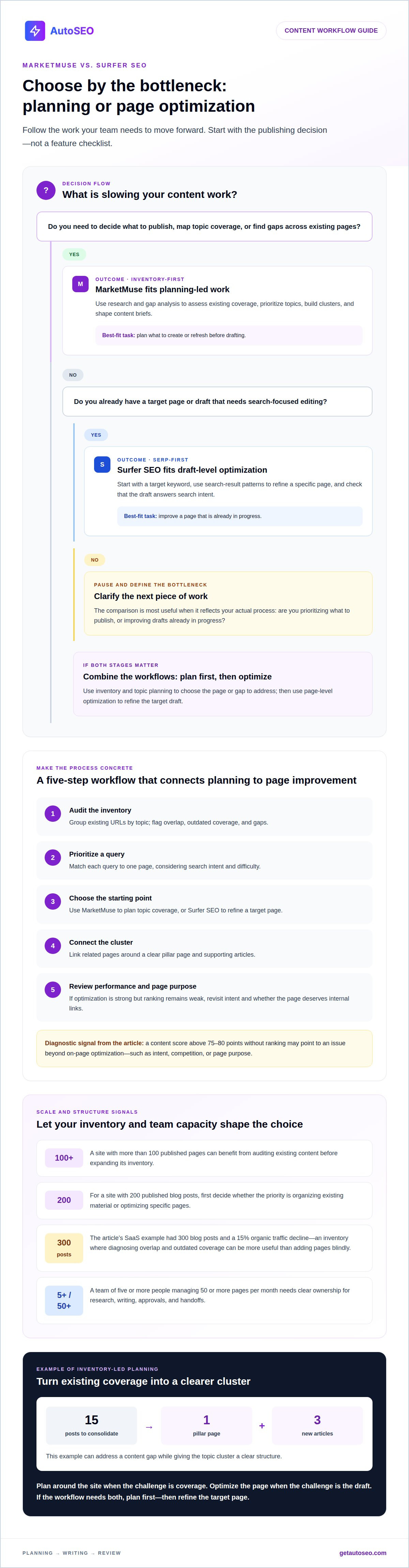
SERP-first versus inventory-first workflows
A SERP-first workflow starts with a target query. The editor reviews current search results, identifies recurring topics, and shapes a page to meet the query’s apparent needs. Surfer SEO fits this page-led process: use its optimization guidance to improve a specific draft, then check whether the page clearly answers the search intent.
An inventory-first workflow starts inside the site. MarketMuse supports research and content planning by helping teams assess existing coverage, identify gaps, and prioritize topics before drafting. For an enterprise site, this can reveal whether a proposed article adds a distinct resource or repeats an existing page.
Each approach answers a different question. SERP-first asks, “What should this page include to compete for this query?” Inventory-first asks, “What does the site already cover, and what is missing?” For example, a content score above 75-80 points without ranking may signal a problem beyond on-page optimization. The next step is to examine intent, competition, and whether the page deserves internal links.
Use this workflow to avoid optimizing pages in isolation:
- Audit the inventory. Group existing URLs by topic and flag overlap, outdated coverage, and gaps.
- Prioritize a query. Match each query to one page, considering search intent and difficulty.
- Choose the starting point. Use MarketMuse to plan coverage across topics, or Surfer SEO to refine a target page.
- Connect the cluster. Add internal links between related pages, with a clear pillar page and supporting articles.
- Review performance. If optimization is strong but ranking remains weak, revisit intent and page purpose.
Google’s search landscape also keeps changing: 15% of its daily queries have never been made before. That makes a rigid keyword list less useful than a workflow that combines current SERP signals with a maintained content inventory. Use SERP-first when a defined query and draft need refinement; use inventory-first when your priority is site-wide coverage. Teams with both needs can plan from the inventory, then optimize selected pages against their target queries.
Ease of use and setup time
Setup depends less on the tool name than on the workflow you need. MarketMuse starts with research and content planning, so teams should define their topic inventory and priorities first. Surfer SEO starts closer to a target page, making it a more direct fit when writers already have a keyword and draft. Neither has a fixed setup time: the number of pages, roles, and review steps determines the work.
For a practical comparison, run an existing article through each process. In MarketMuse, begin with a topic and identify the research needed for a useful brief. In Surfer SEO, open a draft, review optimization suggestions, and decide which edits fit the search intent. Compare how clearly writers understand the next action, not just how quickly they reach a score.
Personalized difficulty settings and content scores can guide writing, but they don’t replace editorial judgment. Treat a score as a prompt to review coverage, structure, and clarity. If an article appears well optimized but still doesn’t rank, for example, revisit its purpose and authority rather than automatically adding terms. This keeps a simple engine metric from driving unnecessary changes.
Use this setup sequence to make the comparison fair:
- Choose one real topic. Use a keyword your team already plans to cover.
- Prepare the same input. Give both workflows the same draft or planning goal.
- Track the steps. Note where writers need help, approvals, or extra context.
- Review the output. Compare the brief, suggestions, and edits against reader needs.
- Decide who owns each task. Assign research, writing, and final review before scaling.
A team with a defined process can adopt either approach more smoothly than one still deciding who owns research or editing. MarketMuse better supports a planning-led setup; Surfer SEO offers a page-focused path for writers refining drafts. Choose the workflow that matches your process, then document its steps before rolling it out across more topics.
AutoSEO
AutoSEO is a natural next step if you’ve chosen a content strategy but need help executing it consistently. Its Automated SEO Platform Subscription automates SEO content production and backlink building, helping small businesses maintain ongoing organic search activity. It suits teams that want to move beyond planning and page-by-page optimization toward a recurring publishing workflow.
MarketMuse and Surfer SEO help teams plan or optimize content; AutoSEO automates daily SEO articles and backlink building. It’s relevant when consistent publishing is the main operational bottleneck, rather than choosing between research-led planning and SERP-led editing.
If you’d like to discuss whether AutoSEO fits your publishing workflow, contact AutoSEO.
Turn your tool choice into consistent execution
A tool decision matters only when it improves how your team plans and publishes. Use the MarketMuse vs. Surfer SEO comparison to make a clear choice, then define how it fits your actual workflow. Assign ownership for research, writing, editing, and publishing so useful insights turn into action instead of remaining in a dashboard.
Keep the process adaptable. Search priorities shift, content inventories change, and teams take on new publishing demands. Review how your workflow handles those changes, and adjust steps that slow production or weaken quality. A clear operating rhythm gives your team a stronger foundation for growing organic visibility without unnecessary complexity.
If ongoing SEO execution is the next challenge, AutoSEO can help move content work forward through automation. Contact AutoSEO to discuss your content workflow and choose a practical next step for your team.


