

HR tech buyers don’t discover every solution through referrals. SEO for human resources (HR) tech helps consulting firms and software companies reach buyers as they research recruiting, payroll, learning, and workforce platforms. It works by matching useful content to what buyers are looking for, making that content easier to find, promoting it, and tracking how it performs in search.
That takes more than adding keywords to a product page. Buyers need clear answers that connect their challenges with the right service or software, while search engines need relevant, well-structured content to understand each page. Consistent publishing and performance monitoring help teams see what attracts qualified organic traffic and where content needs work.
Learn how to shape an SEO strategy around HR buyer intent, optimize pages and articles, promote content, and measure search performance. The sections below explain what effective SEO involves for HR consultants and software providers, and how automation can help maintain useful content consistently.
Key Takeaways
- Map search topics to the HR platforms buyers need, from applicant tracking and payroll to learning and workforce management.
- Use focused, long-tail content to connect HR consulting expertise and software capabilities with higher-intent buyer searches.
- Improve pages with clear titles, headings, useful content, image alt text, and responsive design, then promote and monitor performance.
- Match content to the buyer’s stage and questions so search visibility can support discovery, evaluation, and the next step.
SEO for HRIS, ATS, payroll, and workforce platforms
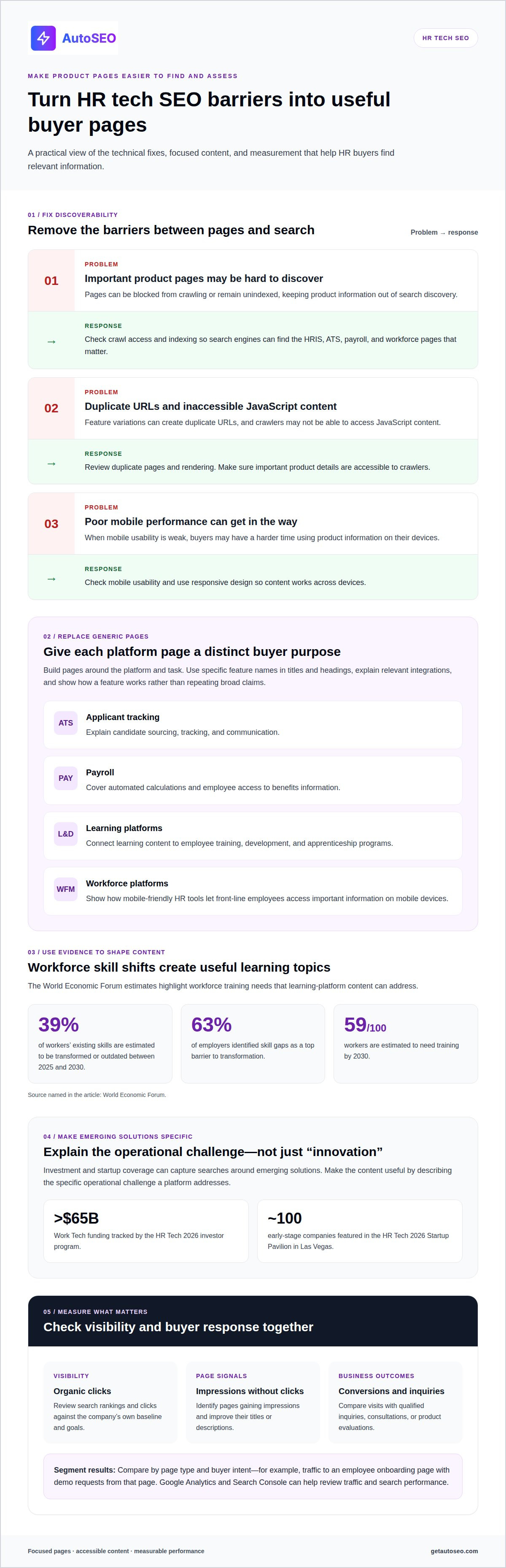
Technical SEO problems can make HR technology pages difficult for search engines to find. Common issues include blocked or unindexed product pages, duplicate URLs for feature variations, JavaScript content crawlers cannot access, and poor mobile performance. Check crawl access, duplicate pages, rendering, and mobile usability so important product information can be discovered.
Build distinct pages around each platform and buyer task. An applicant tracking system page can explain candidate sourcing, tracking, and communication. A payroll page can cover automated calculations and employee access to benefits information. Describe relevant integrations with existing software, and use specific feature names in page titles and headings. HRIS, ATS, payroll, and workforce platform pages should address different buyer needs rather than repeat one generic product description.
Connect learning content to workforce skills. The World Economic Forum estimated that 39% of workers’ existing skills would be transformed or outdated between 2025 and 2030. It also found skill gaps were the top barrier to transformation for 63% of employers. Create useful pages explaining how learning platforms, such as WestNet LMS, support employee training, development, and apprenticeship programs. The World Economic Forum estimated that 59 out of every 100 workers would need training by 2030. These topics help HR buyers understand how software can support workforce planning and learning goals.
Investment and startup coverage can capture searches around emerging solutions. The HR Tech 2026 investor program tracked more than $65 billion in Work Tech funding. HR Tech 2026 in Las Vegas featured roughly 100 early-stage companies in its Startup Pavilion. Explain how a platform addresses a specific operational challenge instead of relying on broad claims about innovation or revenue. For front-line workforce technology, show how mobile-friendly HR tools let employees access important information from mobile devices. Specific examples make product pages more useful to both buyers and search engines.
SEO benefits for HR consulting firms and HR software companies
For an HR consulting firm, search visibility connects its expertise with organizations seeking help on a defined workforce challenge. A firm serving a specific region can target location-based searches and keep its business details consistent across its website and Google Business Profile. A consultant focused on talent planning can publish pages about that service. Long-tail keywords make pages more specific and can attract visitors with clearer needs than broad searches. SEO for human resources (HR) tech helps put focused pages in front of relevant buyers.
SEO and paid search support lead generation in different ways. Paid search advertises an HR software offer to searchers, while SEO develops organic visibility through relevant pages and ongoing content. Teams can use both and compare qualified inquiries, conversions, and acquisition patterns to guide investment. Connect each landing page to a clear next step, such as requesting a product demonstration or discussing a consulting engagement.
How much does SEO cost for an HR tech company? The cost depends on the scope. Key factors include technical complexity, content volume, competition, and geographic targeting. A regional consultancy needs a different approach from a software platform targeting several buyer groups. Define the audience, priority pages, and outcomes to track. Search analytics can then show whether organic visits lead to qualified inquiries, talent-related consultations, or product evaluations.
Content optimization, promotion, and performance monitoring
For HR technology, useful content needs clear structure, accurate claims, relevant promotion, and performance measurement. Each step helps buyers find and assess information about an employee product or service.
Content optimization
Build each page around one buyer need, such as employee onboarding or benefits access. Use the target topic naturally in the title, headings, body text, and meta description. Add descriptive image alt text and responsive design so content works across devices. Use examples that show how a feature works instead of repeating broad claims about innovation or acquisition outcomes.
When describing regulations and product claims, state data-protection practices accurately and distinguish capabilities from outcomes. Don’t imply that a platform complies with a specific regulation unless its documentation supports that claim.
Traffic, rankings, and conversions
HR tech SEO benchmarks should measure progress against the company’s own baseline and goals. Monitor organic clicks, search rankings, and conversions, then segment results by page type and buyer intent. For example, compare traffic to an employee onboarding page with demo requests from that page. This shows whether visibility attracts relevant visitors and whether content supports the next business step.
Use Google Analytics and Search Console to review traffic and search performance. Track changes over time, identify pages gaining impressions without clicks, and improve their titles or descriptions. For pages that attract visits but few inquiries, assess whether the content answers buyer questions and makes the next action clear.
Promotion extends the reach of a strong page. Share an HR technology guide through relevant company channels, link to it from related product pages, and use insights from sales conversations to refine its examples. Review results regularly, update outdated details, and strengthen sections that attract search impressions but little engagement. This cycle connects content quality with measurable performance.
HR tech buyer questions and search intent
HR decision-makers search differently as they define a problem, compare options, and select software. Early research may focus on reducing payroll administration or improving employee engagement. Later searches often name a product category, integration, or implementation need. Create content for each stage instead of directing every visitor to the same sales page.
Topics that attract HR decision-makers include payroll workflows, employee onboarding, training programs, performance management, and workforce analytics. Answer practical questions directly: how does a feature work, which teams use it, and what information does it provide? For example, an article about employee self-service can explain how employees access pay stubs or request time off. Clear answers help organizations assess relevance before a product discussion.
Build content around distinct intent groups. A buyer comparing payroll platforms needs feature explanations and integration details. A leader exploring employee engagement needs approaches for feedback and performance conversations. A regional HR consultancy or employment service, such as ICSPayroll, can create pages about compliance and payroll for organizations in its service area. Give each page one primary purpose, supporting examples, and a relevant next step.
Search intent also reveals what evidence buyers need. Product pages can explain how HR technology supports a specific workflow, while comparison guides can outline decision criteria without unsupported claims of superiority. Case examples should identify the challenge, solution, and outcome only when those details are documented. This keeps content useful and credible during evaluation.
Map each buyer question to a content format, such as a feature page, implementation guide, or FAQ. Then connect related pages so readers can move from a problem to a relevant solution. Build a consistent HR tech content program to address buyer searches with useful pages and articles.
AutoSEO
AutoSEO is a practical option for HR tech businesses that need consistent search visibility. Its Automated SEO Platform Subscription delivers daily SEO articles and builds backlinks, helping businesses publish around topics such as payroll, recruiting, and workforce software. The automated approach is suited to teams that want ongoing content publishing without handling every task manually.
Use it when your strategy needs ongoing execution alongside clear priorities for HR buyer topics. The platform can support publishing and promotion, while your team supplies business context that keeps content relevant to your software or consulting expertise.
For a straightforward discussion about your HR tech SEO needs, contact AutoSEO.
Turn Search Strategy Into Consistent Execution
Turn your HR tech priorities into a focused publishing plan. Choose the buyer groups and business goals that matter most, then align each piece of content with a real question those buyers ask. A consistent process makes SEO for human resources (HR) tech easier to manage and helps your team see what deserves attention next.
Execution takes time away from product, sales, and workforce priorities. AutoSEO’s automated approach can help businesses keep SEO activity moving while they focus on their core work. Use the Automated SEO Platform Subscription as a next step if ongoing execution fits your needs.
Contact AutoSEO to discuss HR tech SEO and identify a practical direction for your search strategy. Start with a clear audience, build around useful answers, and keep improving from what performance shows. Your next step can be focused, measurable, and manageable.
Frequently Asked Questions
How Does SEO Work for HR Consulting & HR Software Businesses?
SEO connects HR organizations with relevant consulting or software pages through search results. The work typically includes assessing site accessibility, identifying buyer topics, and organizing pages by service, product, and audience. For example, a consultancy can build separate pages for workforce planning and recruiting support. Software providers can make product details easier to find and track which pages lead to meaningful inquiries.
What is SEO for HR tech companies?
SEO for HR tech companies means improving how their expertise and software appear in organic search. It includes technical site improvements, content planning, page optimization, and performance monitoring. The aim is to help buyers find answers that match their needs, whether they’re researching a product category, evaluating a provider, or looking for a specific HR capability.
Which SEO keywords do HR tech buyers search for?
Buyers use search phrases tied to their role, task, and organization. Examples include “payroll software for distributed teams,” “applicant tracking system for growing companies,” and “HR consultant for workforce planning in North America.” Strong keyword choices reflect the audience and actual product capabilities. Specific searches can indicate whether someone wants general information, a solution comparison, or a provider.
How do SEO professionals build an SEO strategy for HR software and HR tech?
Start by mapping target buyers to the software or services that address their needs. Assess site structure, search demand, existing content, and technical barriers, then prioritize pages around business goals. A strategy might separate content for HR leaders, recruiters, and payroll teams. Regular performance reviews help refine priorities as buyer interests and product messaging evolve.
How do SEO professionals optimize product and category pages for HR tech companies?
Give each page a distinct purpose and explain its relevance to the buyer. A category page can clarify the problem a software type addresses, while a product page can describe specific capabilities, intended users, and supported integrations. Improve titles, headings, internal links, and calls to action. Clear distinctions help prevent similar pages from competing for the same searches.
How can an SEO provider measure SEO ROI and qualified leads for HR tech companies?
Connect organic visits to actions such as demo requests, consultation inquiries, and sales-qualified opportunities. Define a qualified lead using criteria such as target organization, relevant need, and buying intent. Then compare organic-sourced pipeline or revenue with SEO investment over a consistent reporting period. Attribution should distinguish leads that started through search from those where organic content supported evaluation.


