
The Google Sandbox isn't a mandatory rite of passage; it's a penalty for those who refuse to adapt to the speed of 2026. While most founders wait six months for their first organic visitor, you can force Google to take notice by leveraging high-frequency content and intelligent automation. You're likely searching for how to get traffic to a new website fast because you've seen the alternative. With Google Ads costs rising 12.88% year-over-year to an average of $5.42 per click, traditional paid traffic is becoming a luxury most new businesses can't afford.
It's frustrating to watch your site sit in total obscurity while your manual SEO checklist grows. You shouldn't have to spend 40 hours a week on content creation just to stay relevant. This guide reveals the exact roadmap to bypass traditional delays and scale your organic visibility using a system that actually works. We'll show you how to deploy high-frequency content and automated authority-building to secure consistent daily visitors on autopilot. It's time to stop waiting for growth and start engineering it.
Key Takeaways
- Bypass the Google Sandbox. High-frequency publishing forces search engines to index and rank your new domain without the typical six-month delay.
- Learn how to get traffic to a new website fast by targeting low-hanging fruit keywords that competitors consistently ignore.
- Offload the 20-hour manual SEO grind to a system that actually works. Automation removes the friction of content creation and outreach.
- Build a high-authority backlink profile on autopilot. It's the most efficient way to establish trust with AI search algorithms in 2026.
- Implement a five-step roadmap to scale toward 10,000 monthly visitors. Ensure your site is crawl-ready and optimized for maximum performance.
Why New Websites Struggle with Traffic (And the 'Speed' Trap)
Most founders mistake a temporary spike for genuine momentum. If you are looking for how to get traffic to a new website fast, you must distinguish between a fleeting "injection" of visitors and sustainable organic growth. A viral post might bring 1,000 people today, but if your analytics return to zero tomorrow, you haven't built a business; you've just rented attention. True speed in 2026 is about accelerating the timeline to consistent, daily visitors who arrive through Search engine optimization (SEO).
New domains face the "Google Sandbox" reality. This isn't a formal penalty, but a period of observation where search engines evaluate your reliability. Google is cautious. It won't rank a site that publishes three articles and then goes silent for a month. Some owners try to bypass this by buying cheap bot traffic. This is a fatal mistake. Modern AI filters detect non-human patterns instantly, and once your domain is flagged for manipulation, your long-term ranking potential is effectively dead. In 2026, the only way to signal authority quickly is through a high-frequency, high-quality content strategy that proves you're an active expert in your niche.
The Trust Gap: Why Google Ignores New Sites
Every new website starts with a Domain Authority of zero. You're a stranger in a crowded room. The Trust Gap is the period between site launch and consistent indexing where Google monitors your publishing frequency and content quality before granting high rankings. Traditional manual outreach for backlinks is the slowest way to bridge this gap. Waiting weeks for a single guest post response is a relic of the past that keeps your traffic stuck at zero.
Paid Ads vs. Organic: The Cost of Speed
Pay-Per-Click (PPC) offers instant visibility, but it comes with a heavy price tag. With the average Google Ads CPC reaching $5.42, a new business can burn through a monthly budget in hours without seeing a single lead. This creates a "traffic addiction" where your visitors vanish the moment you stop paying. A smarter hybrid approach uses SEO automation to build a permanent traffic-generating asset. While ads can provide an initial spark, you need a system that scales your organic reach so you aren't reliant on ever-increasing ad costs to survive. High-performance SEO isn't just about being found; it's about owning your audience instead of renting it from a platform.
The Three Pillars of Rapid Organic Growth in 2026
Rapid growth isn't a mystery. It's a math problem. Traditional strategies suggest publishing one high-quality post per week, but in 2026, that's a recipe for stagnation. If you want to know how to get traffic to a new website fast, you must embrace three core pillars: volume, topical authority, and AI search optimization. These pillars work together to signal to search engines that your new domain is an active, reliable, and comprehensive resource.
Topical authority is the new gold standard. Search engines no longer rank isolated pages; they rank entities that demonstrate deep knowledge of a specific niche. You must cover every sub-question your audience asks to prove your expertise. While Google's SEO Starter Guide provides the foundational rules, the modern shortcut involves saturating your niche with high-frequency content that answers user intent across the entire buyer journey.
Volume Wins: The Math of Daily Publishing
Publishing 30 SEO-optimized articles per month creates 30 different entry points for traffic. Compare this to a manual schedule of four articles per month. The math is clear. Higher volume allows you to capture thousands of long-tail keywords that competitors ignore because they're too busy chasing high-volume, high-competition terms. These long-tail queries often have higher conversion intent and are easier to rank for instantly.
Internal linking acts as the connective tissue for this volume. By linking your daily articles together, you pass authority from your growing pages to your newer ones. This accelerates the indexing process and helps Google understand the relationship between your content pieces, further solidifying your topical dominance. It's a self-reinforcing loop that builds momentum without requiring manual oversight.
Winning the AI Search Game
The fastest shortcut to brand awareness in 2026 is getting cited by ChatGPT and Google AI Overviews. These platforms prioritize content that is "AI-readable." This means your writing must be data-dense, use clear claims, and follow a logical structure that LLMs can parse instantly. Using ai for seo allows you to optimize for these shifts in real-time, ensuring your site remains visible as algorithms evolve.
Finally, automated authority building bridges the final gap. You need a backlink profile that signals reliability to AI search engines without the fatigue of manual outreach. By pairing high-frequency content with an automated SEO system, you can secure the 100 DA worth of links needed to push your new site out of the sandbox and into the top of the search results.
Manual SEO vs. Automation: Why Speed Requires Scale
Manual SEO is a trap for the ambitious business owner. It is a full-time job masquerading as a marketing task. If you're trying to figure out how to get traffic to a new website fast, you've likely realized that manual labor doesn't scale. A single expert article takes hours to research, write, and format. Multiply that by the thirty articles a month required for rapid growth, and you've lost your entire work week to a keyboard. Speed in 2026 requires a level of volume that human effort alone cannot sustain without massive, expensive teams.
Consistency is the primary ranking factor Google uses to judge a new domain's reliability. Manual efforts are inconsistent by nature. Business priorities shift, and SEO is often the first thing to suffer. Automation doesn't take sick days or hit a "Burnout Phase." It ensures your site is updated daily, which is the only way to shorten the observation period search engines impose on new sites. While traditional agencies charge heavy monthly fees for a handful of posts, an automated platform delivers the volume needed for speed at a fraction of the cost.
The Hidden Costs of Manual Content
Researching a niche and formatting for search intent takes an average of four to six hours per post. For a new site owner, this is the danger zone. Most people quit after month two because the manual effort is too high for the initial reward. This is where ai content creation changes the trajectory of your business. It allows you to scale quality without scaling your overhead. You can maintain a relentless publishing schedule that forces search engines to index your pages faster than your competitors.
Backlink Building on Autopilot
Manual outreach is a numbers game with a 3% success rate. Sending hundreds of emails to secure a single guest post is a waste of human potential. Understanding what is link building in 2026 means recognizing it as a technical signal that must be automated to be effective. You need links to signal reliability to AI search engines instantly. While Moz's Beginner's Guide to SEO outlines the importance of authority, automation is the only tool that can build it at the speed required for a new domain to survive. By automating your link profile, you remove the fatigue of outreach and focus on conversion.
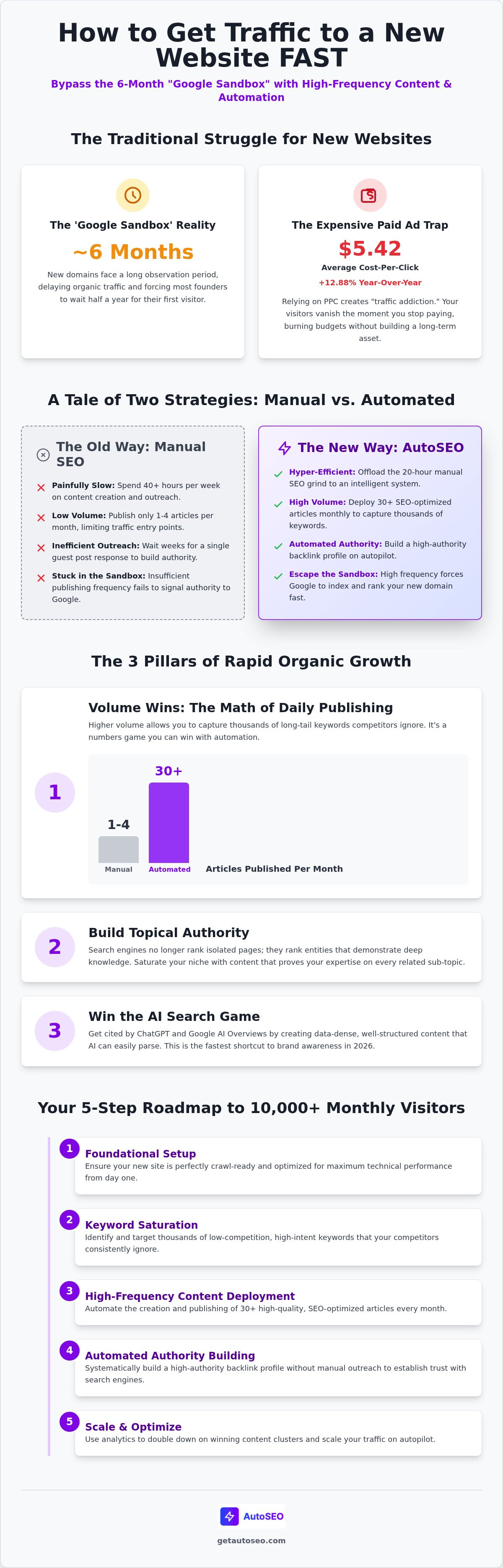
Your 5-Step Roadmap to 10,000+ Monthly Visitors
Scaling a new domain requires more than just effort; it requires a sequence of high-performance actions. If you're investigating how to get traffic to a new website fast, you need a roadmap that prioritizes impact over busywork. This five-step system is designed to compress years of traditional growth into months by focusing on the technical and authority signals that search engines value most in 2026.
- Step 1: Technical Foundation. Ensure your site is crawl-ready and optimized for Core Web Vitals.
- Step 2: Deep Keyword Research. Identify the low-hanging fruit keywords that offer high intent with minimal competition.
- Step 3: Content Explosion. Launch a 30-day daily publishing sprint to flood your niche with relevant answers.
- Step 4: Authority Injection. Secure your first 100 points of Domain Authority through automated, high-quality link building.
- Step 5: Analysis and Pivot. Use real-time data to double down on the clusters generating the most impressions.
Phase 1: Setting the Stage for Speed
Technical SEO is the gatekeeper of your traffic. A "crawl-ready" site is the non-negotiable prerequisite that ensures search engine bots can discover, navigate, and index your content without technical friction. You must pass the 75th percentile of user thresholds: Largest Contentful Paint (LCP) at or under 2.5 seconds, Interaction to Next Paint (INP) at or under 200 milliseconds, and a Cumulative Layout Shift (CLS) under 0.1. Without these benchmarks, your content won't rank regardless of its quality. Integrating your site with seo automation platforms allows you to maintain these standards while you focus on scaling your content output.
Phase 2: The Content and Authority Sprint
Topical authority is built through clusters, not isolated posts. Group your keywords into tight themes to show search engines you've mastered a specific subject. This creates a "Snowball Effect" where your daily articles and steady backlinks compound over the first 90 days. As you publish, don't just watch your rank for a single term. Track your total impressions and indexing speed. These are the lead indicators that Google is beginning to trust your domain. When you pair this volume with an automated authority injection, you bypass the typical sandbox delays and start capturing visitors while your competitors are still stuck in the planning phase.
Ready to stop guessing and start growing? Automate your roadmap today and watch your organic traffic scale on autopilot.
Get Traffic on Autopilot with AutoSEO
You've seen the roadmap. Now you need the engine to drive it. AutoSEO is the first platform that truly automates every pillar of growth discussed in this guide. If you're serious about how to get traffic to a new website fast, you must stop doing the manual work yourself. Our platform handles the heavy lifting by managing your research, expert writing, and daily publishing cycles. We effectively remove the human bottleneck that kills most new websites before they ever see their first 1,000 visitors.
Authority building is traditionally the most exhausting part of the process. AutoSEO replaces manual outreach with an automated, "Done For You" link-building system. We secure 100 Domain Authority worth of backlinks for your site without you sending a single email. This signals reliability to AI search engines and Google instantly. This is why small business seo is finally a level playing field for new domains. You get the power of a full-scale agency for the price of a single subscription.
The 'Set It and Forget It' SEO Strategy
The setup process is designed for speed. You provide your business analysis, and the platform begins working in minutes. Our seamless WordPress integration means your first article is published almost instantly. AutoSEO acts as your 24/7 content team. It never hits a writer's block or outreach fatigue wall. You can focus on scaling your business operations and closing leads while your organic traffic grows in the background. It is high-performance growth without the manual overhead.
Why Automation is the 'Phrase That Actually Works'
Skepticism about AI-generated content is natural, but AutoSEO is the "phrase that actually works" because it pairs quality with scale. We don't just churn out generic text. We engineer data-dense, authority-building articles that satisfy both human readers and AI search algorithms. Having an expert article published every single day gives you a massive competitive advantage. You'll cover more keywords and build more topical authority in a month than most competitors do in a year.
Stop waiting for the Google Sandbox to expire. Our $1 Trial allows you to test the system and see real-time results without a long-term commitment. It is the risk-free way to start your growth journey. Activate your account today and watch your new website's traffic scale on autopilot.
Dominate Your Niche with Automated Speed
In 2026, the gap between zero visibility and a thriving domain is bridged by volume and velocity. You've seen the roadmap; now it's time to execute. Manual SEO is a relic that costs too much time and money for the modern founder. By shifting to a system that prioritizes high-frequency publishing and automated authority, you finally solve the problem of how to get traffic to a new website fast. Success is no longer about one-off hacks. It's about a consistent, daily signal that forces search engines to recognize your site as a leader.
Our platform delivers 30 SEO-optimized articles every month and builds 100 DA worth of backlinks automatically. This is the only way to scale expert-level content that actually works without sacrificing your schedule or your budget. You don't need to be an SEO expert to win; you just need the right tools to automate the process. The path to 10,000 monthly visitors is clear and accessible.
The tools for rapid growth are ready. You just need to activate them. Start growing your traffic for just $1 with AutoSEO and secure your place at the top of the search results. Your competitors are waiting for the sandbox to end; you can choose to bypass it today.
Frequently Asked Questions
How long does it take to get traffic to a new website?
Traditional manual SEO typically requires six to twelve months to generate significant results. However, high-frequency publishing and automated authority building can shorten this window to ninety days. By flooding your niche with daily articles, you force Google to index and trust your domain faster than traditional methods allow. This aggressive approach bypasses the observation phase and secures visibility instantly.
Can I get traffic for free without using paid ads?
Organic search is the most sustainable way to get traffic without a daily ad spend. While Google Ads costs have increased by 12.88% year-over-year, organic SEO builds a permanent asset that doesn't disappear when your budget stops. You don't pay for clicks; you invest in a system that generates visitors on autopilot through high-quality content and authority signals. It's the only way to build long-term value.
Is AI-generated content safe for Google rankings in 2026?
Google prioritizes helpful, high-quality content regardless of how it's produced. In 2026, AI-generated content is safe and effective as long as it provides expert-level insights and data-dense information. The key is using a platform that pairs quality with scale to ensure every article meets search intent and signals reliability. This method actually works because it focuses on user value rather than just raw output.
What is the fastest way to get backlinks for a new site?
Automation is the only way to secure high-authority backlinks at speed. Manual outreach yields a success rate of roughly 3%, which is far too slow for competitive niches. Using an automated system to build 100 Domain Authority worth of links bypasses the fatigue of manual emails and provides the instant authority signals search engines require. This creates a foundation of trust that allows your content to rank higher.
How many articles should I publish per week to see results?
You should aim for seven articles per week to maximize growth. Publishing 30 articles per month creates more entry points for traffic and builds topical authority faster than the traditional one-post-per-week model. This high-frequency approach signals to search engines that your website is an active and authoritative resource in your niche. Volume is the primary driver for rapid indexing and consistent visitor growth.
Do I need to be a technical expert to use SEO automation?
You don't need technical expertise to leverage modern SEO automation tools. These platforms are designed for small business owners who value efficiency over manual labor. The system handles complex tasks like keyword research, formatting, and WordPress integration, allowing you to focus on running your business while the software manages your growth. It's a professional solution that removes the technical barriers to entry for everyone.
How do I track if my traffic is high-quality or just bots?
Track engagement metrics like bounce rate, time on page, and conversion goals to verify traffic quality. High-quality organic traffic consists of real users searching for specific solutions. Avoid cheap traffic injections that provide raw numbers without engagement, as these bots can damage your domain's long-term ranking potential and credibility. Genuine growth is measured by how many visitors actually interact with your site's content and offers.
What is the best way to get traffic to a new website fast?
The most effective method for how to get traffic to a new website fast is by combining high-frequency content with automated authority building. This dual-pronged strategy ensures you cover all relevant search queries while simultaneously signaling trust to Google. By using an autopilot system, you bypass the labor-intensive barriers of traditional SEO and scale your visitors instantly. It is the most reliable roadmap for 2026.