

What if more SEO traffic isn’t the answer to your lead problem? If visitors aren’t turning into enquiries, the issue may be the system behind the traffic. Learning how to get consistent leads from seo starts with connecting the right search demand to content that earns trust and gives qualified visitors a clear next step.
It’s frustrating to invest in content and link-building without knowing what’s driving actual enquiries. And rankings alone don’t show whether your SEO is reaching people who need what you offer. The key question is: what needs to work together for SEO to generate leads consistently?
This guide breaks down a repeatable approach. You’ll learn how to find high-intent searches, create useful content that demonstrates expertise, build authority steadily, and make conversion paths clear. You’ll also see how to measure organic visits against meaningful enquiries, so you can improve what works instead of relying on sporadic effort. The goal is a sustainable SEO process that attracts relevant prospects and turns more of that attention into measurable leads.
Key Takeaways
- Define consistent SEO leads as a repeatable flow of relevant prospects, not identical enquiry totals every month.
- Map content to search intent, from early research questions to searches signaling readiness to act.
- To understand how to get consistent leads from seo, track visibility, conversions, and lead quality as separate measures.
- Prioritize pages closest to customer decisions, then strengthen supporting content, authority, and conversion paths.
- Automation can sustain the process: AutoSEO delivers 1 expert article daily and trust-building backlink generation, without guaranteeing rankings or leads.
Why SEO Leads Feel Inconsistent, and What Consistency Actually Means
You publish a useful article, organic visits rise, and then the enquiries fail to appear. That gap is frustrating, but it doesn’t automatically mean SEO has failed. Search visibility, visits, enquiries, qualified leads, and customers are different stages of a pipeline. A page can perform well at one stage and still need work at the next.
Consistent SEO leads don’t mean receiving the same number of enquiries every month. They mean having a repeatable process that attracts relevant searchers and gives them a clear path to take action. If you’re evaluating how to get consistent leads from seo, measure progress across the whole journey, not by rankings alone. SEO can support customer acquisition, but no publishing schedule or ranking position guarantees traffic, enquiries, or sales.
Think of the stages as a sequence:
- Visibility: Your pages appear for relevant searches.
- Organic sessions: Searchers click through to your website.
- Conversion actions: Visitors submit a form, book a call, or take another meaningful step.
- Qualified leads: Those enquiries fit your offer and have a genuine need.
- Customers: Some qualified leads proceed to a purchase.
This basic distinction matters because each stage calls for a different response. Strong visibility with few visits may point to a mismatch between the search and your result. Visits without enquiries may suggest a weak next step or a page that doesn’t build enough confidence. What is Search Engine Optimization? offers a useful foundation for understanding the work behind search visibility, but lead generation also depends on what happens after someone reaches your site.
What counts as a lead from organic search?
A lead is a measurable action that starts a potential business conversation. Depending on your sales process, that could be an enquiry, a booked call, a submitted quote request, or another action that signals interest. Form volume alone doesn’t show lead quality. Assess each lead by fit, need, and readiness: does the person match your ideal customer, have a problem you can solve, and show intent to take a next step? Track the organic source and eventual outcome so you can see which pages attract useful prospects, not just submissions.
Why rankings alone do not create a reliable pipeline
A broad query may bring visitors seeking general information, not people looking to buy. Match each page to the searcher’s immediate need, then make the next action relevant. Someone comparing solutions may need a clear explanation of differences; someone ready to act may need a direct route to enquire. Even relevant demand won’t convert reliably if the page lacks trust, the website is difficult to use, or follow-up is slow. Rankings create an opportunity, not a pipeline by themselves.
Build an SEO Content System Around Search Demand and Buyer Intent
Consistent content starts with customer demand, not a calendar full of unrelated keywords. Build coverage around the problems your ideal customers need to solve, then shape each page to match what they’re trying to do. This gives searchers a useful next step and gives you a plan you can review and improve.
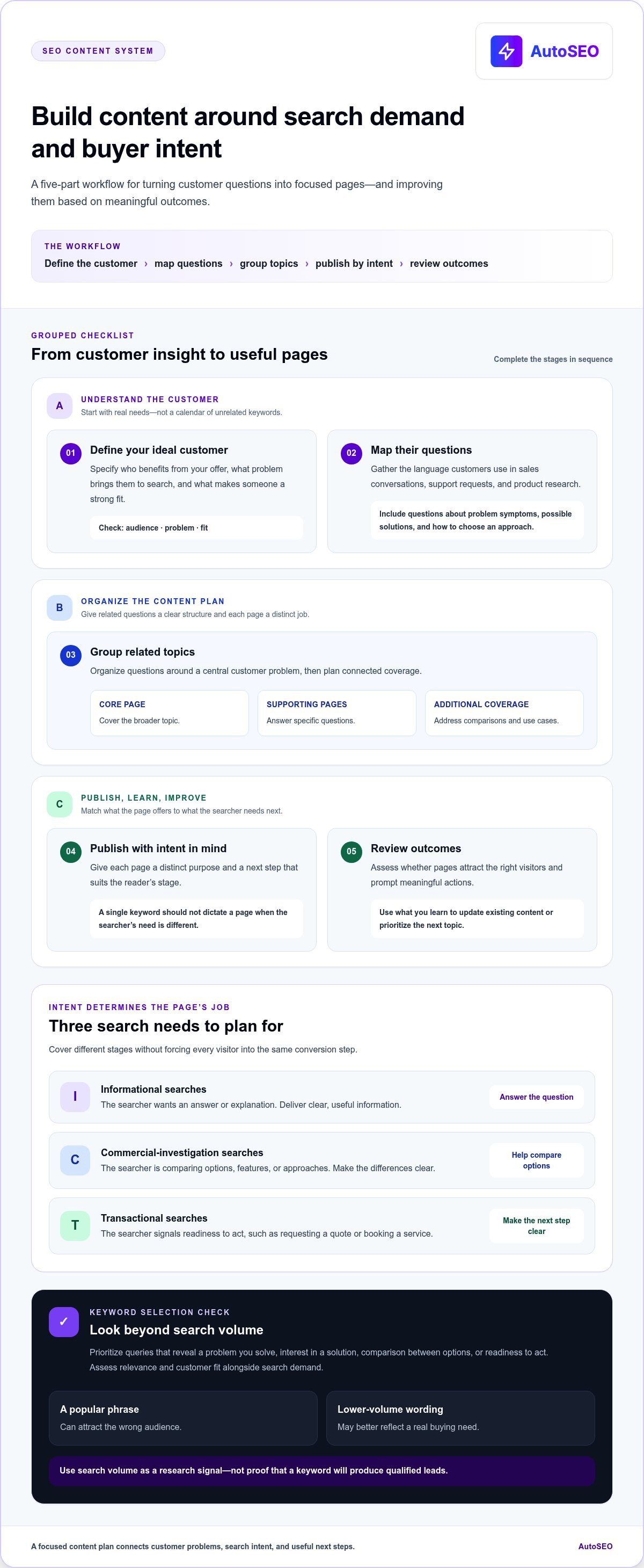
Use this workflow to turn research into a focused publishing system:
- Define your ideal customer. Specify who benefits from your offer, what problem brings them to search, and what makes someone a strong fit.
- Map their questions. Gather the language customers use in sales conversations, support requests, and product research. Include questions about symptoms of a problem, possible solutions, and how to choose an approach.
- Group related topics. Organize questions around a central customer problem. Plan a core page for the broader topic and supporting pages for specific questions, comparisons, or use cases.
- Publish with intent in mind. Give each page a distinct purpose and a next step that suits the reader’s stage. A single keyword shouldn’t dictate a page if the searcher’s need is different.
- Review outcomes. Assess whether pages attract the right visitors and prompt meaningful actions. Use what you learn to update existing content or prioritize the next topic.
Intent helps determine what each page should deliver. Informational searches seek an answer or explanation. Commercial-investigation searches compare options, features, or approaches. Transactional searches signal readiness to take action, such as requesting a quote or booking a service. A coherent content plan covers these needs without forcing every visitor into the same conversion step. For a broader foundation, connect this planning to practical small business SEO guidance.
Choose keywords that can lead to a business conversation
Prioritize queries that reveal a problem you solve, interest in a solution, a comparison between options, or readiness to act. Then assess relevance and customer fit alongside search demand. A popular phrase can attract the wrong audience; lower-volume wording may better reflect a real buying need. Treat search volume as a research signal, not proof that a keyword will produce qualified leads.
Create content that moves readers toward a useful next step
Match the page’s depth and call to action to its intent. Answer the question directly, use clear examples, and provide evidence that supports your guidance. Then connect related pages with descriptive internal links that address a likely next question. Semrush’s Modern SEO Best Practices can help inform your standards for useful, search-focused content.
A repeatable system makes planning easier to sustain. If you want to support that process with an automated SEO platform, explore AutoSEO’s automated SEO platform as one option for maintaining content activity.
Turn Organic Traffic into Leads: Conversion, Trust, and Measurement
Relevant organic traffic creates an opportunity. It doesn’t complete the sale. A visitor still needs to understand what you offer, trust that it fits their situation, and find a simple way to take the next step. If those pieces are missing, a well-ranked page can attract prospects and still produce few useful enquiries.
Separate performance measures by what they tell you. This makes it easier to identify whether the issue is visibility, the page’s conversion path, or the quality of leads coming through.
| Measure type | Examples | What it tells you |
|---|---|---|
| Visibility | Impressions, rankings, organic landing-page visits | Whether searchers can find and reach your pages |
| Conversion | Form submissions, booked calls, relevant clicks | Whether visitors take a meaningful next step |
| Lead quality | Fit, stated need, sales progress, eventual outcome | Whether those actions become genuine opportunities |
These measures work together, but they’re not interchangeable. Impressions and rankings help diagnose reach; they aren’t business results on their own. A page may earn visibility for a broad query yet attract visitors with no need for your offer. Conversely, fewer visits may still matter if they come from well-matched searchers who become qualified prospects.
Which SEO lead-generation metrics deserve attention?
Review qualified organic leads and conversion actions alongside relevant landing-page visits. Track the landing page, organic source, action taken, and whether the enquiry met your qualification criteria. Where your tracking allows, compare performance by page and search intent. If a page gets visits but no actions, inspect its promise and next step. If it gets enquiries that rarely fit, revisit the targeting and qualification process.
How do trust and page experience influence conversion?
Make the offer, intended audience, and next step clear where visitors are deciding what to do. Support claims with accurate evidence and explain what happens after someone responds. Then test the experience: headings should make the page easy to scan, mobile layouts should remain usable, and forms should request only information needed to start the conversation. Remove friction, and qualified visitors can act with greater confidence.
For a practical review, follow each organic enquiry through the same path:
- Landing page: Record the page that first brought the visitor in.
- Source and intent: Capture the organic source and, where available, the search context.
- Conversion action: Note the form, call booking, or other meaningful action.
- Lead outcome: Mark whether the enquiry fits, progresses, or becomes a customer.
This answers a central question about how to get consistent leads from seo: SEO can attract prospects, but the website and sales process must convert them. If pages attract the right audience but enquiries stall, improve clarity, trust, and follow-up before simply publishing more content. Measure the full journey, then focus effort on the point where qualified prospects drop away.
A Practical Workflow for Making SEO Lead Generation Repeatable
A repeatable SEO process replaces disconnected tasks with a clear operating cycle. Start with pages closest to a customer decision, then improve the supporting content and technical foundations around them. This keeps effort tied to business priorities without assuming rankings or leads will arrive on a fixed schedule.
Use this cycle to decide what to do next:
- Diagnose. Review organic landing pages, search visibility, conversion actions, and qualified lead outcomes. Look for the point where potential customers drop off.
- Prioritize. Select pages and topics closely connected to your core offer. Address high-impact barriers before adding more activity.
- Publish. Create or update useful pages that answer real customer questions and match their search intent.
- Strengthen authority. Build relevant connections to important pages through internal links and a steady approach to earning backlinks. A focused link-building process supports this work.
- Convert. Make each page’s offer and next step clear, then remove avoidable barriers to taking action.
- Refine. Use performance and lead-quality evidence to decide what to improve, expand, or pause in the next cycle.
Prioritize work by lead impact and execution effort
Begin with decision-stage pages that explain your offer or help prospects choose a solution. Check that search engines can access them and visitors can understand and use them. A broken route, unclear page structure, or confusing next step can undermine otherwise strong content. Rank tasks by their likely effect on valuable pages and the effort required, then work through a manageable sequence instead of launching disconnected initiatives at once.
Once priority pages are clear, strengthen the process behind them. SEO automation can help make recurring work more consistent, while editorial review keeps content relevant to customer needs. Treat automation as process support, not a shortcut around useful content or careful measurement.
Review results and improve the next cycle
Set a regular review cadence that suits your publishing and sales process. At each review, compare organic visits, conversion actions, qualified leads, and page-level performance. Look for patterns rather than reacting to every short-term fluctuation. If a page attracts relevant visitors but few enquiries, revisit its clarity and conversion path. If leads don’t fit, reassess its topic and audience.
Customer questions, search intent, and business priorities can change. Update pages when their information no longer answers the need, and use lead outcomes to shape the next content and authority-building priorities. Keep a simple record of the decision, the change made, and the result to assess later. That feedback loop is the practical foundation of how to get consistent leads from seo: focus, measure, and refine without promising a fixed outcome.
Ready to make recurring SEO work easier to sustain? Explore AutoSEO’s automated SEO platform as part of your repeatable workflow.
Scale Consistent SEO Leads with Automation, Without Losing Quality
Automation helps when valuable SEO work keeps slipping behind daily demands. A steady publishing and backlink-building process can support search visibility, but activity alone won’t guarantee rankings, leads, or a particular timeline. The system still needs relevant topics, useful content, and ongoing attention to what your audience needs.
AutoSEO’s workflow is designed to support that consistency. It researches a business, its customers, and competitors to inform content, then delivers 1 expert article daily. After initial setup, articles can be published automatically to WordPress. Trust-building backlink generation is also part of the service. Together, these recurring activities can make it easier to maintain momentum without relying on sporadic manual effort.
What should an automated SEO workflow handle?
A useful workflow connects research, content production, publishing, and authority-building. AutoSEO uses business, customer, and competitor research to shape its content approach, and includes backlink building without promising a particular link quantity or result. Martin Bonauer of Real Estate Switzerland reported acquiring a first customer from a published article. That’s an individual customer outcome, not a typical result or a guarantee.
Automation is most effective when it supports a clear strategy rather than replacing one. Keep priority topics connected to the audience and problems your business can serve. Review pages and lead outcomes regularly, then adjust direction if the content attracts the wrong visitors or misses an important customer question.
How can businesses protect quality while scaling content?
Set a quality bar before increasing publishing volume. Each article should address a genuine audience need, match the searcher’s intent, and provide an appropriate next step. Check factual accuracy, use a clear structure, and make explanations specific enough to be useful. Sensitive topics need particular care: avoid unsupported claims and ensure content stays within appropriate expertise. Automation can support scale, but quality comes from relevance and accuracy.
- Relevance: Tie each topic to a real customer question or business need.
- Accuracy: Review factual claims and handle sensitive subjects responsibly.
- Usability: Structure content clearly so readers can find and act on the information.
- Performance: Use page and lead data to refine the next round of work.
That balance is central to how to get consistent leads from seo. Automation can sustain publishing and backlink activity; it can’t control how search engines rank a page, whether the right prospects find it, or whether they convert. Treat publishing frequency as process support, then measure whether the content contributes to qualified enquiries. Consistency creates a stronger operating rhythm, not a guaranteed outcome.
If that system fits your goals, put SEO on autopilot with AutoSEO and support a more consistent approach to content and backlink building.
Make Your Next SEO Move Count
Consistent growth doesn’t come from chasing every keyword or publishing without direction. It comes from choosing a focused next step, learning from what happens, and improving the system as your business and customers evolve. That’s the practical answer to how to get consistent leads from seo: make each action part of a process you can sustain and measure.
Start by identifying one opportunity with a clear connection to your ideal customer. Decide what you want that page or process to achieve, then use real performance and enquiry data to guide the next move. Progress may take time, and results aren’t guaranteed, but a deliberate system gives you a stronger basis for making decisions than sporadic effort.
AutoSEO helps businesses keep SEO activity moving through automated content and backlink building. Martin Bonauer of Real Estate Switzerland reports gaining a first customer from a published article, an individual outcome rather than a promise of typical results.
Put SEO on autopilot with AutoSEO and build a more consistent process for your next stage of growth. Start focused, keep improving, and give your SEO system room to work.
Frequently Asked Questions
Can SEO generate consistent leads on its own?
No. SEO can bring potential customers to your site, but your offer, sales process, and follow-up influence whether they become customers. For example, if someone submits a detailed enquiry and doesn’t receive a useful response, organic visibility can’t recover that opportunity. Treat SEO as one part of acquisition: connect relevant search content with a clear conversion route, then make sure your team can handle and follow up on incoming interest.
How long does it take for SEO to generate leads?
There’s no reliable fixed timeline. Results depend on factors such as your site’s current visibility, competition for relevant searches, content relevance, and how quickly search engines discover and assess changes. Avoid setting expectations around a guaranteed month or ranking date. Instead, record a baseline and check for meaningful movement in indexed pages, relevant impressions, and qualified enquiries. These indicators can help distinguish early progress from business outcomes that haven’t arrived yet.
What type of SEO content generates the most leads?
Content closest to a customer’s decision often has strong lead potential, but the best format depends on what searchers need. A service page can explain who the offer is for and how to enquire. A comparison page can help prospects weighing alternatives, while a detailed case study can show how a real problem was addressed. Choose topics based on customer questions and business fit, then give each page a next step that suits its purpose.
How do I measure leads from SEO?
Connect website analytics with your lead or customer records. For each enquiry, capture the first organic landing page, the conversion action, and its later status, such as qualified, closed, or not a fit. Use consistent labels so reports don’t split the same source into several categories. Review the path from page visit to business outcome, and compare pages over comparable periods rather than judging success from a single week or isolated ranking change.
Can AI-generated content help a business get SEO leads?
Yes, AI can help produce SEO content, provided the process prioritizes usefulness and accuracy over volume. Give each draft a clear audience, purpose, and search intent. Review claims against reliable information, add relevant business expertise, and remove generic passages that don’t help readers make a decision. Content should be edited before publication, especially on sensitive subjects. AI can support production, but publishing more pages alone doesn’t ensure search visibility or enquiries.
Do backlinks matter for SEO lead generation?
Yes. Relevant backlinks can help search engines and readers discover your site and can contribute to its perceived authority. Focus on links that make sense in context, such as a relevant publication referencing a useful resource, rather than pursuing volume without regard to relevance. Backlinks support visibility, but they don’t replace strong pages or a clear conversion path. Track whether the pages you strengthen attract the right visitors and contribute to qualified business conversations.


