

Passive backlinks are built through active work. If you’re searching for how to get passive link acquisition, the answer isn’t to publish a page and wait. Outreach takes time, and not every article gives other sites a reason to cite it. The goal is to create something genuinely useful, then make it easy for the right people to discover.
That can reduce the need to chase every link manually, but it doesn’t make the process effortless. Strong linkable assets earn citations because they offer original evidence, practical tools, clear expertise, or insight worth referencing. They may also need focused promotion and regular updates before links begin to accumulate.
This guide explains how to identify content with citation potential, build and maintain linkable assets, and promote them effectively. You’ll also see how automation can support a consistent SEO workflow while keeping backlinks built through a service distinct from editorial links earned independently. Automation can keep work moving, but it can’t guarantee citations, rankings, or traffic.
Key Takeaways
- Learn how to get passive link acquisition by choosing assets that answer questions publishers and practitioners need to reference.
- Compare research, guides, visual assets, tools, expert interviews, and news-led content by evidence, effort, audience, and upkeep.
- Use a repeatable workflow to validate demand, publish clearly, promote selectively, and review results.
- Make personalized outreach an initial discovery aid, not a substitute for content worth citing.
- See how consistent SEO activity can complement editorial link earning, including AutoSEO’s 1 expert article daily and backlink building.
How to Get Passive Link Acquisition Without Expecting Zero Effort
Passive link acquisition describes the ongoing earning phase: someone discovers a useful asset, decides it supports their work, and links to it without being asked for that specific citation. The asset might be a clear explanation, a practical reference, or evidence that helps a writer support a point. A link earned this way is an editorial choice made by another publisher.
That differs from a backlink built through a service. A service can support link building as part of an SEO workflow, but that activity is not the same as an independent publisher choosing to cite your asset. Both can contribute to SEO, but they have different origins and should be tracked separately. Understanding backlinks as one part of broader search engine optimization helps keep the goal in perspective: build relevant visibility, not just a higher link count.
What makes link acquisition passive?
The earning phase becomes passive only after the asset is published and discoverable. Instead of relying on a new one-to-one pitch for every placement, a useful resource can attract unsolicited citations from people who find it through search, references, or sharing. That outcome depends on earlier research, production, publication, and promotion, as well as maintenance when facts or audience needs change.
Why passive does not mean automatic
A useful page can remain unseen if it has no clear path to its audience. Competition matters too: publishers have alternatives, and they cite assets that fit the subject, answer the question, and add value to their own work. Relevance is specific. A detailed resource for practitioners may be a poor citation for a general audience, even if the content is accurate.
To understand how to get passive link acquisition, treat discoverability as part of the asset, not an afterthought. Make the page easy to understand, cite, and revisit. Use a descriptive title, explain who it serves, and provide clear evidence or practical value. Then promote it selectively to relevant people who may benefit from it. That initial distribution can help the right audience find the resource, but it can’t make an unremarkable page cite-worthy.
Passive link acquisition is the ongoing earning of relevant links when people independently discover and choose to cite a useful asset.
- Earned editorial links: A publisher independently chooses to reference your page.
- Service-built backlinks: Links are built through a service as part of its delivery.
- Shared requirement: Relevance matters, but neither approach guarantees rankings or traffic.
No content format, promotion plan, or automation process guarantees links, rankings, or traffic. The practical aim is to create an asset with a clear reason to be cited, make it findable by the right audience, and keep it useful over time. Start by choosing a format that fits the question you want to answer and the people most likely to reference it.
Build Linkable Assets That Give Publishers a Reason to Cite You
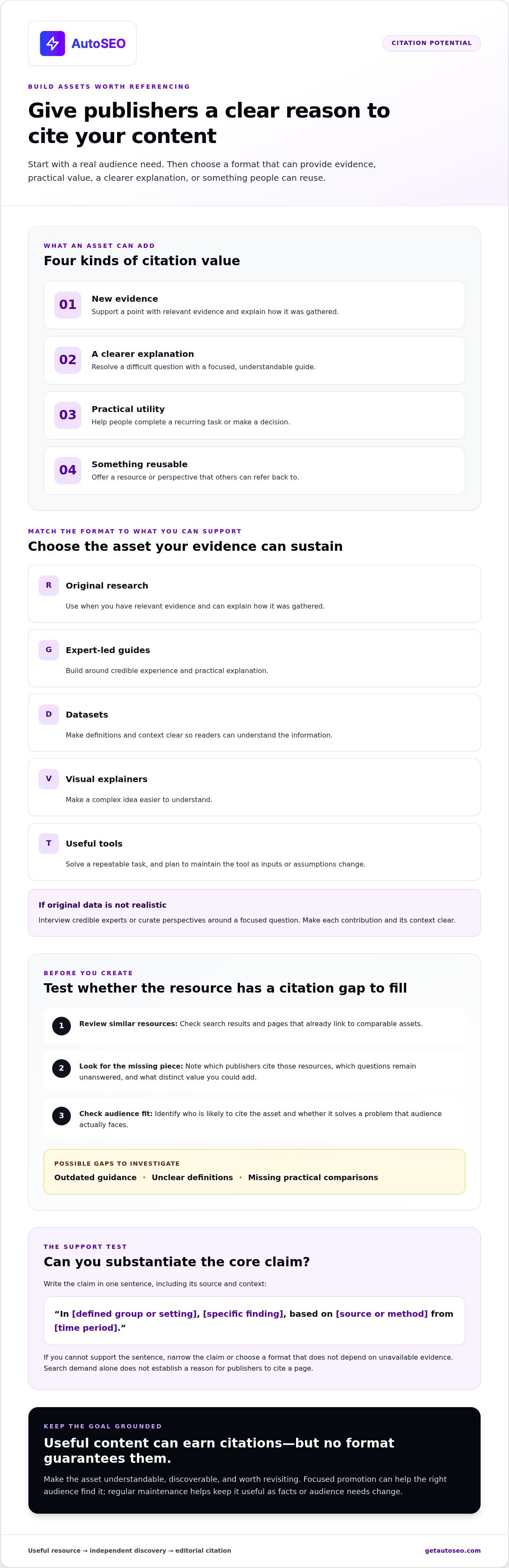
Start with a question a specific audience needs answered, not just a keyword with search demand. Consider what a journalist might need to substantiate a story, what a researcher may want to reference, or what practitioners need to make a decision. Then identify what your asset can add that existing sources don’t: new evidence, a clearer explanation, practical utility, or a resource people can reuse.
That focus separates a citation asset from content that merely fills a publishing calendar. A guide can earn references if it resolves a difficult question clearly. A dataset can help if its source and collection method are transparent. A tool can be useful if it solves a recurring task. No format earns links by default. The asset must meet the audience’s need.
Choose an asset format that fits your evidence
Match the format to what you can support. Original research makes sense when you have relevant evidence and can explain how it was gathered. Expert-led guides work when their value comes from credible experience and practical explanation. Datasets need clear definitions and context; visual explainers should make a complex idea easier to understand. Useful tools offer repeatable utility, but require upkeep as inputs or assumptions change.
If original data isn’t realistic, don’t manufacture a research angle. Interview credible experts or curate perspectives around a focused question, making each contribution and its context clear. Before building, identify the likely citing audience and the types of sources that might reference the asset. A resource for operations teams, for example, should solve a problem those practitioners actually face, not chase broad attention.
Check citation potential before you create
Review search results and pages that already link to similar resources. Note which publishers cite them, what questions remain unanswered, and whether your asset could add something distinct. The gap might be outdated guidance, unclear definitions, or a lack of practical comparison. Search demand alone doesn’t show that publishers have a reason to cite your page.
Write the asset’s core claim in one sentence, with its source and context: “In [defined group or setting], [specific finding], based on [source or method] from [time period].” Treat this as a test, not decoration. If you can’t support the sentence, narrow the claim or choose a format that doesn’t depend on unavailable evidence.
The word “acquisition” has different meanings in different fields. Acquisition Definitions describes the term in a government procurement context; here, it refers to attracting relevant editorial citations through useful content. To connect this work to the wider discipline, explore what link building means. A consistent publishing workflow helps keep useful resources in circulation, and SEO automation for ongoing publishing can support that execution without replacing the evidence, relevance, or audience fit that make an asset worth citing.
Compare Passive Link Acquisition Strategies Before Choosing One
Choose an asset format based on the citation need you can meet, the evidence you can support, and the effort you can sustain. A data study can attract attention, but it’s a poor choice without reliable data and a transparent method. A clear guide may be more valuable if readers need an accurate explanation they can reference. The strongest format answers a real audience need credibly, rather than simply looking impressive on a content calendar.
Use this comparison to match the format to your resources and likely citing audience. Effort and maintenance are relative: a small, focused resource can be easier to sustain than a broad asset built without a clear owner.
| Format | Evidence needed | Production effort | Likely citing audience | Maintenance burden |
|---|---|---|---|---|
| Original research | Traceable data and a clear method | High | Journalists, researchers, analysts | High if findings change |
| Practical guide | Reliable sources and subject expertise | Medium | Practitioners, educators, publishers | Medium as guidance evolves |
| Visual asset | Accurate information and clear presentation | Medium | Writers and educators explaining a complex topic | Low to medium |
| Tool | Sound logic, useful inputs, tested outputs | High | Practitioners with a recurring task | High as requirements change |
| Expert interview | Relevant expertise and accurate attribution | Medium | Industry writers and practitioners | Low, unless advice dates quickly |
| News-led content | A verifiable development and timely context | Medium to high | Journalists and industry commentators | High because relevance fades |
When original data is the strongest option
Research can be a strong choice when you can explain where the data came from, how it was collected, and what it can and can’t show. Transparency lets readers assess the finding instead of repeating a number without context. Repackaging widely available statistics adds little citation value unless you contribute a useful comparison or analysis.
Date findings and state the limits of the evidence. Before publishing, decide what would trigger a review or update. Without that plan, a once-useful insight can become a misleading reference.
When guides, visuals, or tools fit better
Use a guide when the audience needs a dependable explanation, not another dataset. Choose a visual when it makes a process or relationship easier to grasp and reference. Build a tool only when it solves a defined, recurring user need and someone can maintain its logic. A neglected calculator can lose credibility faster than a concise guide.
Expert interviews and curated roundups can add useful perspectives when original research isn’t realistic. Keep the question focused, identify contributors clearly, and distinguish their opinions from established evidence. For teams producing content at scale, AI content creation for SEO can support editorial consistency, but choosing the right format still requires judgment. To decide how to get passive link acquisition, prioritize the asset you can make credible, relevant, and maintainable.
Use a Repeatable Process to Publish, Promote, and Maintain Linkable Content
A repeatable workflow turns a promising asset into a resource people can find, evaluate, and reference. It also makes it easier to spot where the process is stalled. Use these steps to move from audience need to ongoing review:
- Validate the need. Define the audience, the question the asset answers, and the kind of publisher or practitioner likely to cite it. Check whether existing resources leave a useful gap.
- Create the asset. Choose a format your evidence and resources can support. Make its central value clear, and show sources, methods, or expert credentials where relevant.
- Publish clearly. Use a descriptive title, logical structure, and a stable page URL. Make the asset easy to understand and cite, with its key evidence and context visible.
- Promote selectively. Share it with a focused group of relevant publishers or practitioners. Personalized outreach can introduce the resource, but it can’t replace a strong reason to cite it.
- Review and maintain. Track referring domains, link relevance, referral visits, and any updates needed. Use what you learn to improve the asset or refine future topics.
This sequence can become part of a broader SEO automation workflow for business growth. For specialized practices such as accounting firms seeking comprehensive marketing support, platforms like Ape-X Generation provide structured growth systems that align client acquisition with long-term visibility. Automation can support repeatable publishing and SEO activity; editorial links still depend on independent decisions by other publishers.
Promote an asset without making outreach the whole strategy
Build a focused list of people who cover the topic or use the resource in their work. In each message, explain why the asset fits their audience and point to the specific evidence, explanation, or utility they may find useful. Avoid generic requests for a backlink. A relevant response can reveal whether your framing is clear; a citation can show that the resource served its intended purpose. Neither outcome is guaranteed.
Measure outcomes and refresh the asset
Review new links for relevance and confirm that they point to the intended page. Look beyond total link counts: referral visits can indicate whether a citation brings engaged readers, while link context helps you assess whether the asset is being referenced for the right reason. Update dated findings, broken references, and explanations when their underlying information changes.
Link volume counts placements; useful link acquisition prioritizes relevant citations that connect the right audience to a resource worth referencing. To build an ongoing publishing and backlink-building workflow, explore AutoSEO’s automated SEO platform. Consistent execution supports the work, but it doesn’t guarantee editorial citations, rankings, or traffic.
Combine Earned Links with SEO Automation for Consistent Growth
Editorial link earning is one part of an SEO program, not a substitute for consistent execution. A useful asset may earn an independent citation when a publisher chooses to reference it. Ongoing content and backlink building can support broader SEO activity by keeping work moving between those editorial decisions. The approaches can complement each other, but they are not interchangeable.
Where automation fits, and where earned links differ
AutoSEO provides 1 expert article daily together with backlink building. This supports a regular publishing and link-building workflow. Editorial citations remain separate: another publisher must discover an asset, judge it relevant, and choose to cite it. Automated activity can support consistency, but it can’t make that independent choice or guarantee passive links, rankings, or traffic.
This distinction matters when setting goals and reviewing results. Track backlinks built through the service separately from editorial citations. Measure editorial citations by whether an external publisher independently references your content. Separating the two gives you a clearer view of the activity and of what the audience chooses to cite.
Build a realistic long-term operating model
Pair useful, carefully maintained linkable assets with ongoing content and backlink building. The assets give journalists, researchers, and practitioners something distinctive to reference; consistent publishing helps sustain your wider SEO program. Review performance over time, then use what you learn to improve future content and keep existing resources accurate.
AutoSEO focuses on visibility across Google and AI-driven search platforms. That’s a direction for the SEO workflow, not a promise that any article will be recommended, cited, or ranked. The same discipline applies: publish material with a clear audience and purpose, maintain it, and assess outcomes without treating a single metric as proof of success.
Customer feedback offers specific examples, not universal forecasts. Alexandra Truta of MiniCRM.one praises AutoSEO’s article quality and formatting. Martin Bonauer of Real Estate Switzerland reports acquiring a first customer from a published article. These attributed experiences illustrate what customers have reported; they don’t guarantee the same result for every business.
To understand how to get passive link acquisition, combine active execution with realistic expectations. Automation can help sustain content production and backlink building, while editorial link earning depends on an asset’s merit and relevance, and on other publishers’ choices. Build for quality and scale, but judge the program by the work completed and the evidence you observe, not by promised outcomes.
Explore SEO on autopilot to see how automated publishing and backlink building can support a consistent SEO workflow.
Turn Your Next Citation Opportunity Into a Working Asset
Choose one question your audience still struggles to answer. Make it the starting point for a resource with a clear purpose, a credible point of view, and a reason to remain useful after publication. Then set a review date. That simple commitment keeps your linkable content connected to real needs as your market and search behavior evolve.
The practical answer to how to get passive link acquisition is to build assets worth finding, then give them the ongoing attention that keeps them accurate and relevant. You don’t need to make every link depend on a manual pitch, and you shouldn’t expect a page to earn citations simply because it exists. Set a sustainable publishing rhythm, learn from the signals you observe, and improve the work over time.
Make consistent SEO execution easier to sustain. Put SEO content and backlink building on autopilot with AutoSEO, and keep your focus on creating resources your audience can trust and publishers may choose to cite.
Frequently Asked Questions
What does passive link acquisition mean?
Passive link acquisition means earning links over time because people find and reference useful content. The citations may happen without a separate pitch for each link, but the work starts earlier. For example, a clear industry glossary might be linked by writers explaining unfamiliar terms. You still need to create the resource, make it discoverable, and review it when terminology or audience needs change.
Can you get backlinks without outreach?
Yes, publishers can discover an asset and link to it without receiving an individual pitch. That’s more likely when the resource is useful to a defined audience and easy to find through relevant channels. A selective introduction to a few practitioners or writers can help surface a new page. Treat that message as distribution, not a request that can replace the asset’s value or compel a citation.
How long does passive link acquisition take?
There’s no universal timeline, and links aren’t guaranteed. A resource may be discovered quickly by an active community, or take longer to reach publishers who cover its topic. Competition affects whether other sources are easier to find, while audience relevance and asset quality shape whether someone chooses to cite yours. Review discovery and referral signals over time rather than setting an unsupported deadline for link growth.
What type of content earns passive backlinks?
Original research can provide evidence; a practical guide can clarify a complex process; a visual can make an explanation easier to share; and a tool can help with a recurring task. Expert resources can also offer attributable insight. For example, a simple glossary may serve writers covering technical terms. No format earns links by itself. Choose one that meets a real audience need and gives a publisher a credible reason to reference it.
Are automated backlinks the same as editorial links?
No. A backlink built through a service comes from that service’s link-building activity. An editorial link is an independent publisher’s decision to reference a specific asset. These are different acquisition paths, even if both point to your site. Keep their sources distinct in your reporting so you can evaluate each channel accurately. Neither type should be treated as proof of a particular ranking increase or traffic outcome.
How can I tell whether a passive link-building asset is working?
Review which relevant referring domains cite the asset, whether each link points to the intended page, and whether referrals bring visitors. Check the page itself too: an outdated explanation or broken source can weaken its usefulness even if links remain. Link counts alone don’t show audience fit or business impact. Compare the resource’s citations and referral activity with its purpose, then decide whether it needs a content update or clearer distribution.


