

What if you could grow organic traffic without writing every page yourself? Learning how to get organic traffic without writing content starts with a useful distinction: you can delegate or automate production, but your site still needs useful pages that search engines and AI platforms can discover and understand.
If time is tight, publishing more can feel like the only path to growth. It isn’t. Existing pages may have untapped potential, while technical improvements, a clearer site structure, and relevant backlinks can strengthen visibility without you drafting another article. The key is to focus on work that improves usefulness, not just volume.
This guide shows you how to find opportunities in the content and site you already have, improve the foundations that help pages get found, and build authority through relevant links. You’ll also see how to choose a production model and use a repeatable workflow to balance quality with scale. The goal is practical: reduce your writing workload while giving your organic growth strategy the useful pages and signals it needs.
Key Takeaways
- To learn how to get organic traffic without writing content, start by auditing pages and search queries already earning impressions before planning new topics.
- Prioritize updates that make a page more useful and align its title and headings with what it actually answers.
- Compare owner-written, delegated, and automated production by review needs, consistency, and quality at scale, not speed alone.
- Use a repeatable workflow: audit, prioritize, improve, build relevant backlinks, then measure and refine.
- AutoSEO supports delegated publishing with 1 expert article daily, backlink building, and automated publishing to WordPress.
How to Get Organic Traffic Without Writing Every Page Yourself
You can stop drafting every page yourself, but you can’t remove the need to provide useful information. If you’re exploring how to get organic traffic without writing content, separate the work of writing from the value your site must deliver. For example, a service page can attract relevant visits when it clearly explains what the service does, who it is for, and what a visitor should do next. Improving that page may be more useful than publishing a new blog post.
Organic traffic is traffic from unpaid listings in search results. Organic search results are distinct from paid advertisements, but appearing in them doesn’t guarantee visits, leads, or sales.
Think of “no new writing” as an opportunity to improve what already exists, not as a way to avoid providing information. Search visibility depends on whether a page is relevant to a search, accessible to search engines, and competitive with other results. Track impressions, visits, and meaningful business actions over time to see whether your changes are helping.
Can a website grow without publishing new articles?
Yes. An existing page may serve its purpose better when it answers visitors’ questions clearly, uses headings that make its sections easy to scan, and accurately describes the service or product. That’s an update to an existing URL, not a new page. For instance, you could clarify and reorganize a service page with vague explanations while keeping its address unchanged.
Technical fixes can help search engines access and understand a page. Internal links help visitors find related information, while relevant backlinks can point to the page from other sites. These are supporting signals, not substitutes for useful information. If a page doesn’t address the searcher’s need, technical improvements alone won’t make it valuable.
What does “without writing content” mean in practice?
It can mean improving existing pages instead of producing new articles, delegating research or drafting, or using automation to support a repeatable publishing process. Delegation shifts the workload, but you still need to decide what the business should say and ensure the final page is accurate.
- Delegate topic research, outlines, drafts, or updates to existing pages.
- Use automation to support repeatable research, article production, and publishing workflows.
- Provide subject expertise and review claims, examples, and brand fit before publication.
Whatever the workflow, set a clear standard: each page should address a genuine audience need, represent the business accurately, and meet your quality requirements. Automation can reduce hands-on writing and make consistent production easier. Speed alone doesn’t make a page relevant or trustworthy. Keep editorial oversight in the process, then use performance data to decide what to refine.
Which SEO Levers Can Increase Organic Traffic Without New Writing?
Start with a page that already serves a clear purpose. Improving a relevant page can be more practical than commissioning another one, especially if it already earns search impressions. Then check whether search engines can access it, related pages link to it, and reputable sites reference it. These actions can support relevance and discoverability, but none guarantees higher rankings or traffic.
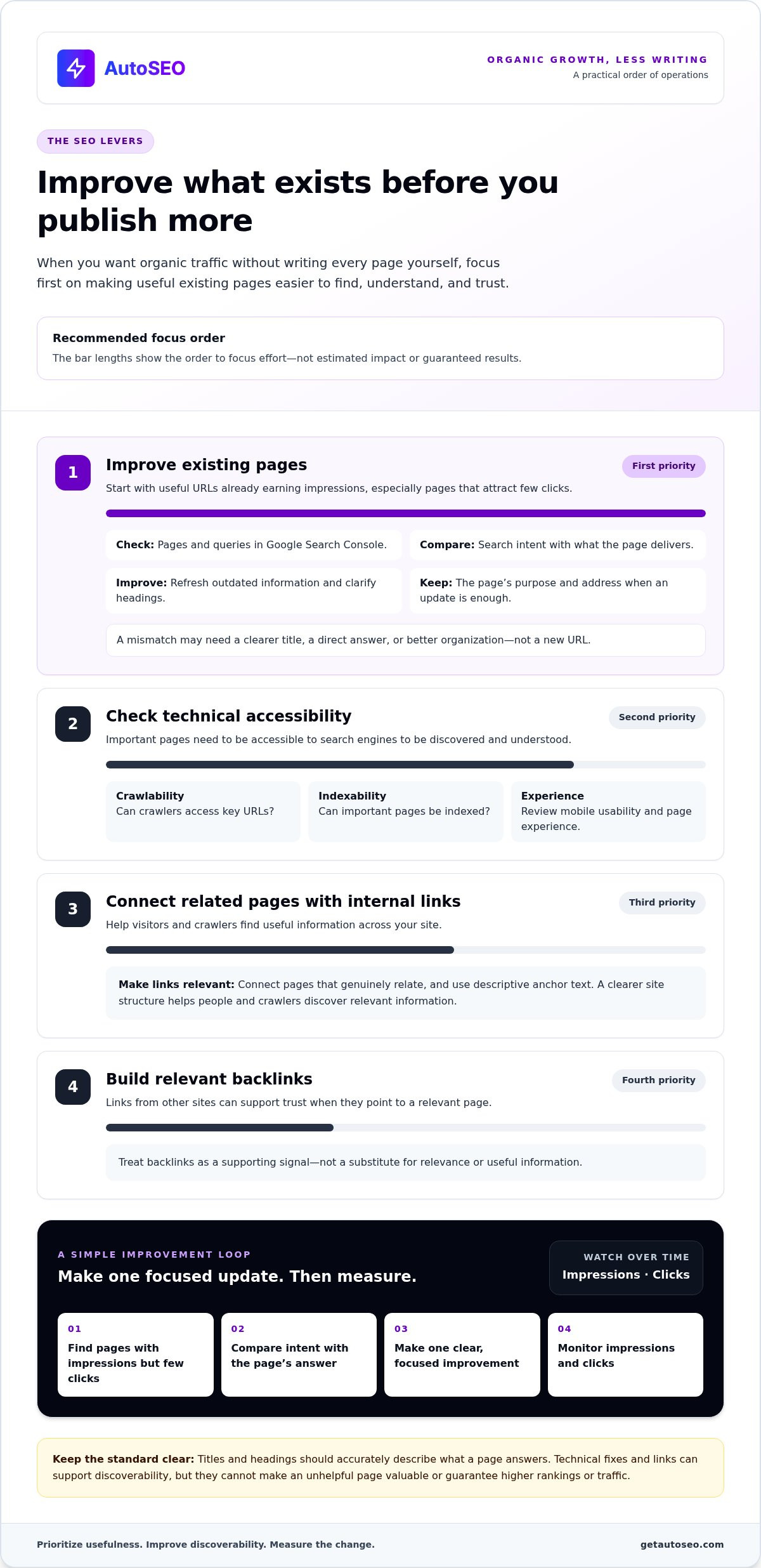
Use this order to focus your effort:
- Existing pages: Improve useful URLs before adding pages that cover the same need.
- Technical accessibility: Check that important pages can be crawled and indexed, and review mobile usability and page experience.
- Internal links: Connect related pages so visitors and crawlers can find useful information across your site.
- Backlinks: Build relevant links that can support trust, without treating links as a substitute for relevance.
Keep every change aligned with the page itself. A title or heading should describe what the page actually answers, not promise information it doesn’t contain. This is the practical core of how to get organic traffic without writing content: make existing information easier to find and more useful before expanding the site.
Improve existing pages before commissioning new ones
In Google Search Console, review pages and queries that already show impressions but attract few clicks. Compare the search intent with what each page delivers. Refresh outdated information, clarify headings, and make key answers easier to locate while preserving the page’s purpose. If two URLs seem to target the same intent, consider consolidating them only when the content and performance data support that decision.
A mismatch may call for a clearer title, a more direct answer, or better organization, not a new URL. Make one focused update at a time and monitor changes in impressions and clicks. This keeps the work measurable and helps you avoid rewriting pages based on guesswork.
Use technical SEO, internal links, and backlinks strategically
Check whether important URLs are indexable and accessible to crawlers. Review mobile usability and page experience as part of site maintenance, and verify current search-engine guidance before treating any technical recommendation as a requirement. Use descriptive anchor text for internal links and connect pages that genuinely relate. This helps users and crawlers discover relevant information and makes your site structure clearer.
Backlinks can indicate that other sites consider a page worth referencing. Focus on relevant, legitimate links rather than volume or shortcuts. A link can support a useful page, but it can’t make an irrelevant page satisfy a search. For businesses building a repeatable SEO process, an automated SEO workflow can support ongoing publishing alongside these foundational improvements.
Writing Content Yourself vs Delegating or Automating It
The right production model depends on your capacity, the expertise each topic requires, and how consistently you need to publish. Owner-written content offers direct control and firsthand knowledge, but it competes with other business priorities. Freelance or agency-supported production can add capacity, though it still requires clear briefs, coordination, and review. Automation can make the workflow more repeatable, but the output still needs to meet your standards.
Compare each approach on four factors:
- Time: Owner-written work uses internal hours. Delegation and automation can reduce drafting effort, but briefing and reviewing remain part of the process.
- Control: Writing in-house gives you direct oversight. External support and automated workflows need clear guidance to capture your expertise and brand accurately.
- Consistency: A defined production process makes publishing easier to sustain, whether the work is handled internally, delegated, or automated.
- Review: Every model benefits from checks for accuracy, relevance, audience fit, and alignment with the page’s purpose.
Judge the result by quality and scale, not speed alone. A fast draft that misses the audience’s question creates editing work, not a useful asset. Human oversight matters most when content makes specific claims about your business, addresses a sensitive subject, or depends on firsthand experience. No production model guarantees rankings, recommendations in AI search, or customer acquisition.
When does delegating content production make sense?
Delegation is worth considering when you have a clear backlog of relevant topics, limited internal writing capacity, or a publishing schedule you can’t maintain. It works best when the writer has useful business context, understands the audience, and follows an editorial process. You can provide customer insights, product details, and expert review while someone else handles research, drafting, or updates. This approach to AI content creation can reduce hands-on writing without removing editorial responsibility.
How should businesses evaluate automated SEO content?
Look beyond how quickly a workflow produces pages. Check whether its research reflects your business and customers, whether topics match real search intent, and whether subject-matter input and factual review are part of the process. Confirm that the publishing workflow supports your site and editorial standards. These are practical ways to assess SEO automation as part of a strategy, rather than as a shortcut for generating pages.
Automation should follow a clear plan: choose relevant topics, define what each page needs to answer, and review the result before publication. Disconnected pages can add volume without building a useful resource for readers. The goal is a repeatable system that frees production time while keeping every page accurate, purposeful, and consistent with your business.
A Practical Plan to Grow Organic Traffic With Less Writing
Start with evidence, not a blank content calendar. Pages already receiving impressions can reveal where your site is relevant but could better meet a searcher’s needs. Use this workflow to focus limited time on changes you can track, rather than assuming a new blog is always the best first move.
- Audit: Review existing pages and search queries in Google Search Console. Note relevant impressions, clicks, and changes over time.
- Prioritize: Select pages with a clear audience need and a practical opportunity to improve. Consider business relevance alongside search visibility.
- Improve: Check each page’s accuracy, clarity, headings, internal links, and calls to action. Make updates that strengthen its existing purpose.
- Build relevant links: Connect related pages on your site, then pursue appropriate backlinks that genuinely reference your business or expertise.
- Measure and refine: Review performance consistently, keep changes that support meaningful outcomes, and adjust pages that still miss the audience’s intent.
Search Console impressions and clicks can help prioritize updates. They show which queries already surface your pages and where searchers choose to click.
How do you find opportunities in pages you already have?
Compare query and page data in Search Console. Look for relevant searches that generate impressions but few clicks, or pages whose results have changed over time. Then define one primary audience need for each priority URL. Check whether the page answers that need directly, uses clear headings, includes accurate information, links to related resources, and offers visitors a useful next step.
Don’t rewrite a page simply because its performance fluctuates. First identify a likely gap, such as unclear wording or missing detail, and make a focused change. This keeps the page’s purpose intact and makes it easier to assess what changed.
How should you track progress without chasing vanity metrics?
Track relevant organic visits and meaningful actions, such as enquiries or purchases, where conversion tracking allows. Google Search Console can show search impressions and clicks. Use Google Analytics 4 alongside it, when configured, to assess on-site visits and tracked actions. Rankings and total traffic provide context, but neither proves that the right audience is arriving or taking action.
Define what counts as a qualified visit or valuable conversion before reviewing results. Tracking may be incomplete, attribution can be imperfect, and low activity can make patterns harder to interpret. Review performance consistently, such as monthly, and compare like-for-like periods where useful. Treat the data as a guide for decisions, not a promise of when results will appear.
A focused process makes how to get organic traffic without writing content more manageable: improve what already earns visibility, strengthen relevant connections, and use performance data to choose the next action. If you want to automate regular SEO work, explore AutoSEO’s automated SEO platform.
How AutoSEO Helps Businesses Publish Without Writing Every Article
You can apply the earlier steps yourself and automate the ongoing production that keeps a content plan moving. AutoSEO is an automated SEO platform that reduces the owner’s writing workload through research, expert article production, backlink building, and automated publishing to WordPress. It gives businesses a repeatable way to work toward visibility across Google, ChatGPT, and Perplexity without personally drafting every article. It supports the process, but does not guarantee a traffic outcome.
What does AutoSEO automate?
AutoSEO provides 1 expert article daily, so business owners spend less time producing drafts themselves. Its backlink building supports the wider visibility strategy, but backlinks don’t guarantee rankings. The aim is to connect regular, researched publishing with link building instead of producing disconnected pages for volume alone. For businesses considering how to get organic traffic without writing content, this combination offers a way to scale production while keeping the focus on useful, relevant information.
- Article production: A consistent supply of expert-written articles reduces the need to draft every page in-house.
- Backlink building: Links support the broader SEO effort without replacing useful pages or guaranteeing search results.
- Publishing: Articles can be published to WordPress through an automated publishing workflow.
The practical test is whether the content fits the business and its audience. Scale matters, but so does quality. Research and editorial judgment help keep production connected to real customer needs.
How can a business start with an SEO autopilot workflow?
Start with context. AutoSEO’s research covers the business, its customers, and its competitors, informing a content plan around relevant topics. That foundation matters: automation works best when it follows a clear direction, not when it generates pages without a defined audience or purpose. The approach connects research with ongoing article production and backlink building.
Automated publishing to WordPress supports a repeatable workflow and reduces the manual steps involved in getting articles onto the site. Businesses can still apply editorial oversight to ensure the information reflects their expertise and brand. This is the core of a done-for-you SEO workflow: automate routine production while retaining business context and quality control.
Automation doesn’t remove the need to monitor performance or improve pages as the business changes. It gives the work a consistent engine. Research guides the plan, articles address relevant topics, backlinks support visibility, and publishing keeps execution moving. The result is a structured way to reduce hands-on writing, not a promise of rankings, recommendations, or new customers.
Explore AutoSEO to see how an automated SEO workflow can support your publishing process.
Make Your Next SEO Move Sustainable
You don’t need to choose between doing every SEO task yourself and stepping away from quality control. Set a clear operating model: decide which business insights need your input, which routine tasks can be automated, and how you’ll review progress. That structure turns how to get organic traffic without writing content into a practical way to protect your time while keeping growth efforts connected to real customer needs.
Choose one next step and make it repeatable. You might assess a priority page or introduce automation to support your publishing process. The aim isn’t to publish for the sake of activity. It’s to build a system you can maintain and improve as your business evolves.
If you’re ready to reduce hands-on work and put a consistent SEO process in motion, explore AutoSEO. Make room for the work only you can do, with a publishing process built to keep moving.
Frequently Asked Questions
Can I get organic traffic without publishing new content?
Yes. Existing pages can gain search visibility when they better match what people are looking for. For example, refine a service page so its main answer is clear, its information is current, and related pages link to it. Check that search engines can access the URL and build relevant backlinks where appropriate. These steps don’t guarantee visits. If your site has no useful page for a topic, you’ll need to create or delegate one.
Is it possible to get SEO traffic without writing blog posts?
Yes. Blog posts aren’t the only pages that can meet search needs. Depending on the business, visitors may be looking for a service description, product details, a location page, or a practical resource. A software business, for instance, might answer a specific feature question on a product page. Review the pages you already have before starting a blog, and choose formats that fit your audience and offering.
Can backlinks alone increase organic traffic?
Backlinks may help search engines discover pages and can act as trust signals, but links alone don’t ensure rankings or visits. A link pointing to a thin, inaccessible, or unrelated page is unlikely to address what a searcher needs. Assess the source and topic relevance of each link alongside the usefulness of the destination page. Avoid treating link counts or authority scores as proof that traffic will grow.
How can I improve Google rankings without rewriting an entire page?
Make targeted changes first. Compare the page with the search query it should serve, then review its title, headings, factual accuracy, internal links, and accessibility. If the page is broadly useful but its key answer is buried, clarify that section instead of replacing the whole page. Record the query and page performance before editing, then assess relevant impressions and clicks afterward. No individual edit guarantees a ranking gain.
How long does it take to see organic traffic from SEO changes?
There’s no universal timeline. Search engines need to revisit changes, and outcomes can vary with competition, query demand, site history, and the size of the update. Record a baseline before making changes, then compare relevant impressions, clicks, and tracked conversions over time. Keep notes on what changed and when to interpret patterns more carefully. Publishing more often by itself doesn’t establish when traffic will appear.
Can AI write SEO content without human review?
AI can support research and content production, but human review helps catch errors and ensure a page reflects the business, audience, and search intent. Check names, product details, claims, and examples against reliable source information before publishing. Sensitive or high-stakes subjects need careful specialist oversight, and content should never be treated as medical advice or a basis for self-diagnosis. Automation can streamline work, but it doesn’t guarantee search performance.


