

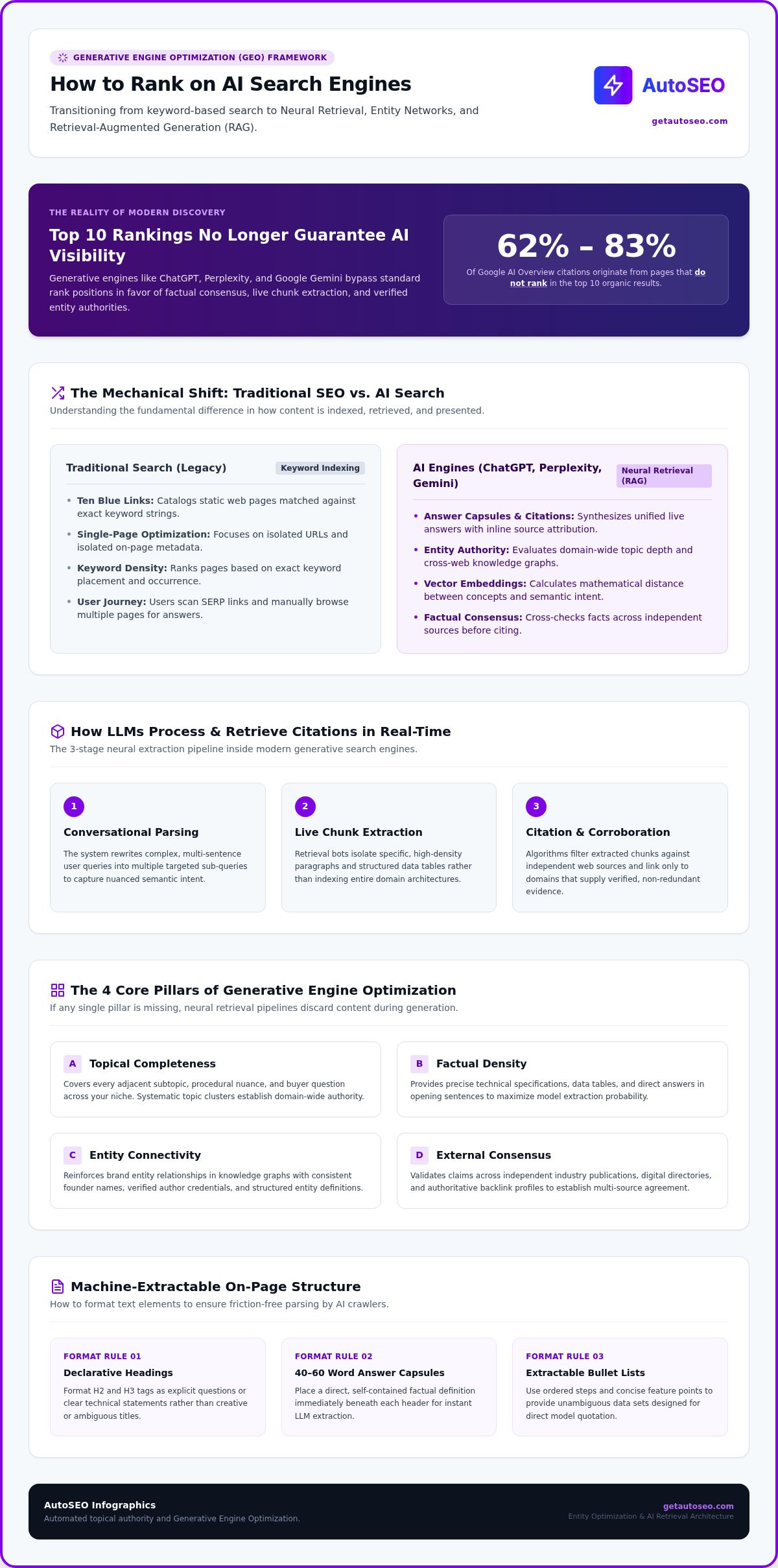
Between 62% and 83% of Google AI Overview citations come from pages that do not even rank in the top ten organic results. Ranking first on Google no longer guarantees that generative engines will recommend your business. If you want to master how to rank on ai search engines, isolated keyword plays won't cut it anymore. Modern AI models cite connected entity authorities, not standalone web pages.
You already feel the impact. Traditional organic clicks are declining, and deciphering how retrieval-augmented generation models select citation sources consumes engineering resources you can't afford to waste. Watching competitors earn prime conversational citations while your high-effort content gets bypassed is a massive operational headache.
This guide shows you how to optimize your digital footprint so ChatGPT, Perplexity, and Google Gemini cite your brand as the definitive answer. We'll break down the exact retrieval criteria powering AI engines in 2026, implement a practical optimization framework, and show you how to automate topical authority at scale.
Key Takeaways
- Understand the fundamental shift from keyword matching to retrieval-augmented generation and discover how to rank on ai search engines by optimizing for neural retrieval algorithms.
- Structure content with self-contained answer capsules and dense factual statements that large language models can parse, verify, and quote instantly.
- Transition your strategy from single-page ranking factors to domain-wide entity authority to earn conversational citations across ChatGPT, Perplexity, and Gemini.
- Execute a repeatable visibility audit to uncover topical blind spots where competitive brands currently capture generative engine citations.
- Leverage automated daily publishing and verified authority backlinks to build the comprehensive knowledge graph required for lasting AI search dominance.
How AI Search Engines Rank and Retrieve Content in 2026
Generative Engine Optimization (GEO) governs modern digital discovery. Unlike traditional search that catalogs static web pages against keyword strings, conversational platforms use neural networks to synthesize live answers. Learning how to rank on ai search engines requires understanding this mechanical shift. When a user enters a complex prompt, engines deploy a retrieval-augmented generation architecture to pull real-time web documents into the model's active reasoning window.
The engine converts queries and web content into multidimensional vector embeddings. Instead of counting keyword instances, the system evaluates mathematical distance between concepts. The platform retrieves content chunks that match the semantic intent of the query, filters them for factual consensus, and synthesizes a direct response. If three authoritative sources agree on a technical specification, the model reports it confidently. If your site offers conflicting or vague information, the model omits your domain entirely.
The Shift from Ten Blue Links to Generative Answers
The traditional click path is gone. Users no longer scan pages of blue links to find solutions. Instead, ChatGPT Search, Perplexity, and Google Gemini generate self-contained answer capsules featuring inline source citations. Detailed prompts require rich, contextual answers that resolve edge cases immediately.
- Conversational parsing: Systems rewrite multi-sentence user queries into multiple targeted sub-queries.
- Live chunk extraction: Retrieval bots isolate specific paragraphs rather than indexing entire domain structures.
- Citation selection: Algorithms link out only to domains that supply verified, non-redundant evidence.
How LLMs Evaluate Entity Authority and Fact Density
Language models don't read websites like humans do; they parse them as entity networks. Knowledge graphs map the functional relationships between your brand, your verified authors, and your core industry topics. High factual density directly improves extraction probability. When your content contains precise specifications, structured data tables, and direct answers within the opening sentences, models ingest those passages without friction.
Corroboration dictates visibility. An isolated claim on an unverified blog carries near-zero weight in vector retrieval. AI engines cross-reference facts across independent industry publications, digital directories, and authoritative backlink profiles. Winning consistent citation real estate requires deep topical coverage and persistent verification across the wider web. That's the formula that dictates how to rank on ai search engines today.
The Core Pillars of Generative Engine Optimization (GEO)
Winning organic placement now depends on Generative Engine Optimization. While legacy search prioritized isolated keywords, conversational engines evaluate how completely your domain answers an entire discipline. Establishing how to rank on ai search engines requires four operational pillars: topical completeness, factual density, entity connectivity, and external consensus. Miss one, and neural retrieval pipelines discard your content during generation.
Structuring Content for Machine Information Extraction
Language models extract text fragments that deliver direct answers. Long narrative setups dilute semantic clarity. Structure your pages to make automated parsing frictionless:
- Declarative headings: Format H2 and H3 tags as explicit questions or clear technical statements.
- Answer capsules: Place a direct, 40 to 60-word factual definition immediately beneath each header.
- Extractable bullet lists: Use ordered steps or concise feature points to provide unambiguous data sets for model quotation.
Establishing Topical Depth and Brand Entities
An isolated pillar page won't convince neural models of your authority. You must cover every adjacent subtopic, procedural nuance, and buyer question across your niche. Scaling this volume manually exhausts internal teams quickly. Exploring how systematic AI content creation scales topical authority systematically allows you to publish the exhaustive topic clusters modern search engines demand.
Every piece of content must reinforce your brand entity. Maintain identical founder names, corporate credentials, and brand definitions across your site. When AI models crawl your domain, clear internal entity relationships establish your brand as a recognized topical source.
Schema Markup and Technical Signals AI Crawlers Require
Structured data provides direct semantic cues to LLM crawlers. Deploy valid JSON-LD schema across your domain to eliminate parsing ambiguity:
Organizationschema defining your official corporate entities, founders, and authoritative social profiles.ArticleandTechArticlemarkup validating author credentials and publication dates.FAQPageschema mapping explicit questions to clean text answers.
Ensure your robots.txt file permits modern web crawlers. Never block user agents like OAI-SearchBot or PerplexityBot if you want your content indexed for real-time citations. Combine clean server-side rendering with rapid page speeds to ensure retrieval agents ingest your content before query execution timeouts occur. If you want to dominate these technical signals and topical networks without manual labor, explore AutoSEO to automate your site's content and backlink authority.
Traditional Search Optimization vs AI Engine Optimization
Legacy SEO was built on direct keyword matching. You identified a search phrase, placed it into critical page tags, and acquired links to push that specific URL up the SERP. Generative Engine Optimization flips this approach entirely. AI search platforms evaluate your domain's broad semantic coverage, entity authority, and conceptual accuracy across a topical vertical. Mastering how to rank on ai search engines requires shifting your focus from individual web addresses to comprehensive, brand-level expertise.
The operational divide between legacy search and generative engines centers on three mechanics:
- Targeting: Legacy SEO optimizes for exact strings; GEO targets semantic entities and intent variations.
- Evaluation: Legacy algorithms score individual URLs; AI engines assess entire entity graphs.
- Success metrics: Legacy tracking measures SERP position; GEO tracks inline citation frequency and share of model.
Modern teams rely on advanced AI for SEO workflows to handle this shift smoothly without inflating headcount.
Keyword Density vs Semantic Entity Coverage
Keyword stuffing breaks modern retrieval systems. Neural algorithms use semantic vector spaces to map conceptual relationships, not text frequency. Repeating a phrase signals thin content to large language models.
Instead of optimizing a page solely for "enterprise cloud storage pricing," you must build semantic coverage around total cost of ownership, migration overhead, data egress fees, and SLA guarantees. Address the surrounding problem framework thoroughly. When an engine evaluates your text, dense conceptual relationships prove actual domain expertise.
Traditional Backlink Profiles vs AI Citation Authority
Links remain vital, but generative engines evaluate them through a verification lens. In traditional search, high link counts could brute-force poor content into top positions. Generative engines use external references to confirm internal facts. When authoritative sites link to your domain within relevant conceptual contexts, language models accept your factual claims as verified truth.
Executing proven link building strategies gives your brand the verifiable trust foundation neural networks demand. Alongside live hyperlinks, models actively track unlinked brand citations across directories, media sites, and industry discussions. This multi-layered digital footprint tells the engine that your business is an established authority. That is precisely how to rank on ai search engines with lasting impact.
Step-by-Step Blueprint to Rank on ChatGPT, Perplexity, and Gemini
Executing an effective strategy requires an actionable, repeatable workflow. Relying on guesswork leaves your domain invisible while competitors capture conversational answers. Here is the operational framework for how to rank on ai search engines by aligning your digital assets directly with generative extraction criteria.
Auditing Your Current AI Citations and Prompt Prominence
Start by identifying your baseline visibility across target platforms. Query ChatGPT, Perplexity, Google Gemini, and Claude with 20 to 30 buyer-intent and informational prompts specific to your sector.
- Map citation winners: Document which competitor URLs appear in the response source cards.
- Analyze source gaps: Check whether cited URLs are direct comparison pages, documentation docs, or third-party reviews.
- Catalog missed entities: Pinpoint specific questions where your brand is omitted entirely from conversational summaries.
Publishing High-Velocity Content Clusters Consistently
Language models favor dynamic sources that continually resolve long-tail inquiries. Building deep topical authority demands rapid, structured production. Deploying modern SEO automation systems allows your team to publish comprehensive articles daily on WordPress without draining internal bandwidth.
Make sure every published piece features original data points, clear problem-resolution frameworks, and unambiguous operational steps. High publication volume tells web crawlers that your entity actively maintains modern industry coverage, directly improving your citation frequency across conversational engines.
Optimizing Content Format for Direct Machine Extraction
Structure your text so neural parsers can isolate answers in milliseconds. Lead with declarative statements under 50 words right after your subheadings. Models extract these self-contained blocks directly into live responses.
Implement raw HTML comparison tables to present feature breakdowns, specifications, and workflows clearly. Tabular formats provide machine-readable relationships that vector models translate into synthesized answers without interpretation errors. Anchor your brand name directly to distinct methodologies to ensure proper attribution during retrieval.
If you want to bypass manual publishing bottlenecks and scale this framework effortlessly, start your $1 trial with AutoSEO to automate daily expert publishing and high-authority backlinks.
Automate Your AI Search Dominance with AutoSEO
Manual execution is the single greatest bottleneck in modern search optimization. Traditional agencies burn months assembling fragmented briefs, while internal teams struggle to draft technical content consistently. If you want to master how to rank on ai search engines, manual workflows won't cut it. You need relentless publishing cadence paired with verified domain authority. You need a streamlined system built specifically for neural retrieval models.
AutoSEO provides an Automated SEO Platform Subscription designed to turn this labor-intensive process into a hands-off growth channel. It handles technical formatting, topical depth, and citation building so your brand captures conversational answers automatically.
Scaling Daily Content Production Without Manual Bottlenecks
AI search crawlers require comprehensive coverage across hundreds of adjacent concepts. A single monthly post can't establish that level of authority. AutoSEO solves this by publishing one expert, structured article directly to your WordPress environment every single day.
- Targeted semantic breadth: Saturate long-tail queries and technical questions across your industry before competitors notice them.
- Extraction-first formatting: Every article includes clear answer capsules, valid schema structures, and clean data tables built for LLM ingestion.
- True quality and scale: Maintain strict editorial consistency and technical accuracy completely on autopilot.
Building Systematic Backlink Authority on Autopilot
Publishing content is only half of the challenge. Retrieval-augmented generation engines cross-check your claims against the wider web before recommending your business. AutoSEO builds that external validation automatically by allocating 100 Domain Authority worth of monthly backlinks to your domain.
This automated backlink network delivers the independent third-party verification that engines like ChatGPT, Gemini, and Perplexity require. You avoid manual outreach campaigns, expensive agency retainers, and unpredictable vendor outcomes. You get SEO on Autopilot that actually works, positioning your brand as the definitive source across conversational search.
Stop falling behind legacy methods. Launch your $1 trial with AutoSEO today and discover how to rank on ai search engines with a fully automated, high-performance platform.
Take Command of Generative Search in 2026
Generative search models reward connected entity authority, not fragmented keyword tactics. Winning direct citations across ChatGPT, Perplexity, and Gemini demands structured factual answers, comprehensive topical depth, and verified third-party validation. Mastering how to rank on ai search engines comes down to executing these signals with relentless consistency.
You don't need an expensive agency or endless manual writing sprints to lead your niche. AutoSEO provides automated keyword research and topical clustering, one expert article published daily directly to your WordPress site on autopilot, and 100 Domain Authority worth of high-quality backlinks built every month. It delivers the exact quality and scale neural algorithms require to trust and cite your domain.
Stop watching competitors capture your organic market share. Start your $1 trial of AutoSEO to dominate AI search on autopilot and turn generative discovery into your most dependable growth engine.
Frequently Asked Questions
How do AI search engines like ChatGPT and Perplexity decide which websites to cite?
AI search engines select sources using semantic relevance, factual density, and cross-web verification during retrieval-augmented generation. When a user prompt triggers a live search, retrieval agents look for concise passages that directly answer the inquiry. The system cross-references candidate text against authoritative indexes. Pages featuring structured schema, clean answer capsules, and corroborated statistics earn the citation over generic marketing copy.
Can traditional SEO tactics help my website rank in generative AI answers?
Traditional SEO tactics establish necessary technical baseline hygiene, but keyword optimization alone will not earn generative citations. Fast load speeds, mobile responsiveness, and clean site architecture ensure AI bots can crawl your pages. However, mastering how to rank on ai search engines requires moving beyond keyword counts toward conceptual depth, entity corroboration, and modular formatting that neural networks can parse easily.
What is Generative Engine Optimization (GEO) and how does it differ from traditional SEO?
Generative Engine Optimization (GEO) is the process of structuring web content so large language models can extract, verify, and cite it within conversational responses. Traditional SEO optimizes single URLs to capture clicks from static blue links. GEO focuses on domain-wide topical completeness, entity authority, and factual consensus, ensuring models recognize your brand as the definitive source across an entire industry.
How long does it take for a brand to begin appearing in AI search responses?
Brands typically begin earning conversational citations within four to twelve weeks of establishing aggressive topical depth and third-party verification. Real-time bots like PerplexityBot index and test new content rapidly. However, neural networks require repeated confirmation across external domains before recommending your business consistently. Maintaining a continuous publishing cadence significantly compresses this adoption window.
Does publishing content every day hurt SEO quality or help AI engine discovery?
Daily publishing accelerates AI engine discovery, provided each article maintains strict factual density and semantic structure. Neural networks actively favor domains with exhaustive topical coverage across technical subtopics. Publishing one expert article daily builds the interconnected knowledge base required for machine authority, making it one of the most effective strategies for how to rank on ai search engines at scale.
Why are external backlinks still essential for ranking on AI-driven search engines?
External backlinks serve as independent verification layers that language models evaluate before quoting digital sources. Neural models don't rely on self-published claims without validation. When high-authority domains link to your content, they confirm your domain's credibility to neural retrieval agents. A strong backlink footprint proves your data is accurate, reliable, and safe for conversational citation.


