

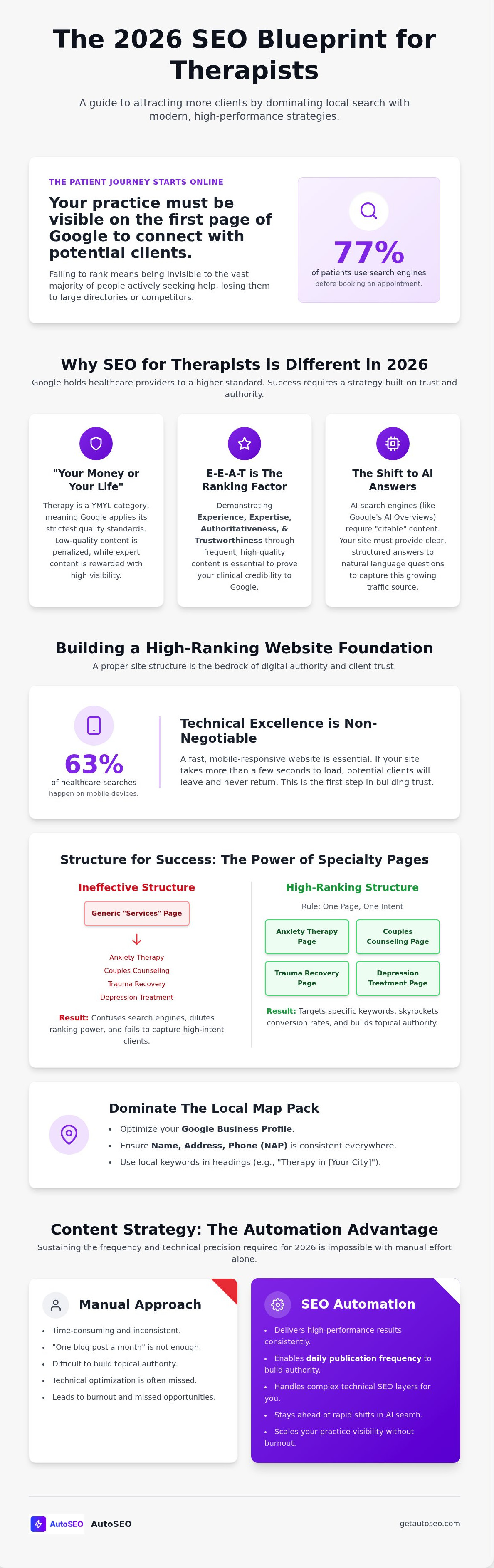
77% of patients use search engines before they ever book an appointment with a healthcare provider. If your practice isn't visible on the first page, you're effectively invisible to the majority of your potential clients. You likely already feel the pressure of competing against massive therapy directories and the high costs of traditional marketing agencies. It's a frustrating cycle of limited time and technical confusion. Mastering seo for therapists and private practices is no longer optional; it's a requirement for sustainable growth in 2026.
You deserve a professional online presence that builds trust without requiring you to spend hours on manual content creation. This guide provides the exact blueprint to dominate local search results and attract more clients through automated SEO strategies that actually work. We'll show you how to achieve high-performance visibility and secure a steady stream of inquiries on autopilot. It's time to stop struggling with jargon and start leveraging the power of modern automation to scale your practice efficiently.
Key Takeaways
- Understand why Google categorizes therapy sites as YMYL and how to build high-level trust through expert content.
- Learn to structure your website using dedicated Specialty Pages to capture high-intent local traffic effectively.
- Discover why daily publication frequency is the secret to dominating seo for therapists and private practices in the competitive 2026 landscape.
- Optimize for the rise of AI-powered search by answering natural language queries and providing direct, authoritative solutions.
- Scale your practice's visibility without burnout by offloading complex technical SEO and content creation to high-performance automation.
Why SEO for Therapists is Different in 2026
SEO isn't a technical chore; it's a trust-building engine. In 2026, effective Search Engine Optimization (SEO) acts as a digital vetting process for potential clients. Google doesn't just rank websites. It audits clinical credibility. This is critical because therapy falls under the "Your Money or Your Life" (YMYL) category. Google applies significantly higher standards to your content because the information you provide directly impacts a person's health and well-being. Traditional strategies like keyword stuffing are dead. Modern success requires topical authority. You must prove you're an expert across your entire niche, not just on a single services page. Most private practices struggle with seo for therapists and private practices because manual execution is impossible to sustain. You have clients to see. You don't have time for technical audits or daily writing. Automation solves this by delivering high-performance results without the manual labor.
The Role of E-E-A-T in Private Practice Rankings
Google's search quality guidelines emphasize E-E-A-T: Experience, Expertise, Authoritativeness, and Trustworthiness. For healthcare providers, this is the primary ranking factor. You need a consistent stream of high-quality content to satisfy these requirements. One blog post a month isn't enough to build authority in 2026. Frequent, expert-level publishing signals to Google that your practice is a reliable leader in the mental health space. This authority translates directly into higher rankings in local map packs. When your site demonstrates consistent expertise, Google gains the confidence to recommend you to local users. It's a direct path to more inquiries and fewer empty slots in your calendar.
The Shift from Google Search to AI Answer Engines
The search landscape has shifted toward AI-driven answers. Tools like Google AI Overviews and ChatGPT now provide direct responses to complex patient queries. To capture this traffic, your practice must be "citable." AI models look for clear, structured data and direct answers to common mental health questions. If your site isn't optimized for these natural language queries, you're missing out on the future of search. Seo for therapists and private practices now requires a strategy that balances human readability with machine-readable precision. Automation ensures your content stays ahead of these rapid technological shifts by publishing the high-quality, structured information these engines crave.
How to Build a High-Ranking Therapy Website Structure
Mapping Your Specialty Pages to Client Intent
Stop burying your expertise in a single "Services" page. This approach confuses search engines and dilutes your ranking power. You must implement the "one page, one intent" rule. Create dedicated pages for "Anxiety Therapy," "Couples Counseling," or "Trauma Recovery." Each page should address the specific pain points of that demographic. This structure allows you to target high-intent keywords that generic pages miss. When your content matches a user's specific search query, your conversion rates skyrocket. It turns a casual browser into a committed client.
Local SEO Essentials for Private Practices
Local visibility determines your practice's growth. You need to dominate the local map pack by optimizing your Google Business Profile. Ensure your Name, Address, and Phone (NAP) data is consistent across every directory. Use local identifiers in your H1 and H2 tags, such as "Depression Therapy in [City Name]." This signals your geographic relevance to Google's algorithm. All marketing efforts must also align with FTC advertising and marketing guidelines to ensure your digital presence remains compliant and professional. Consistency builds trust with both algorithms and humans.
Maintaining this level of technical precision is labor-intensive. Most practitioners lack the time to manage site speed, specialty page architecture, and local citations simultaneously. You can bypass the manual grind by using a platform that handles these technical layers for you. If you want to see how automation can streamline your growth, you can start your optimization journey today. Professional-grade structure shouldn't require a second career in web development.
Content Strategy: Manual Blogging vs. SEO Automation
Most private practice blogs are digital ghost towns. You likely started with enthusiasm, wrote three posts, and then ran out of time. This "Content Gap" is where growth stalls. In 2026, Google prioritizes fresh, expert-level information. Monthly blogging is no longer a viable strategy for seo for therapists and private practices. You need frequency to build authority. Modern patient-centric marketing for therapists focuses on meeting the client exactly where they are with high-quality answers. Automation allows you to bridge this gap without sacrificing your clinical hours.
Why Scale is the New Competitive Advantage
Scale is your most powerful weapon against large directories. When you publish daily, you build a competitive moat that manual bloggers cannot cross. 30 optimized articles per month create a massive footprint of topical authority. This cumulative effect signals to search engines that you are the definitive source in your area. Using AI content creation transforms your website into a 24/7 lead generation engine. It outworks the competition through technology.
Maintaining Clinical Authority with Automation
Practitioners often fear that automation compromises their professional voice. High-performance automation starts with deep research into your specific therapeutic niche and your local competitors. It ensures every article remains educational and professional. There's a stark difference between generic bots and high-quality automated SEO that actually works. You maintain authority while scaling reach. You don't have to choose between quality and quantity.
The myth that AI-generated content cannot rank in healthcare is debunked by the results. Google rewards content that satisfies user intent and demonstrates E-E-A-T. Automated systems excel at this because they never miss a technical detail or a structured data requirement. Seo for therapists and private practices is about efficiency. If you aren't using automation to scale your expertise, you're leaving your practice's growth to chance. You deserve a system that works as hard as you do.
Step-by-Step: Optimizing Your Practice for 2026 AI Search
AI search is no longer a future possibility; it's a current reality. In 2026, nearly half of all Google queries trigger an AI Overview. To win at seo for therapists and private practices, you must optimize for how these models ingest and recommend information. AI assistants prioritize content that provides immediate, authoritative answers to conversational questions. Instead of just targeting "therapist near me," you need to answer queries like "how do I know if I need trauma therapy?" or "what are the signs of burnout in healthcare workers?" This shift requires a technical precision that traditional blogging simply cannot match. You need a strategy that makes your practice "citable" by AI assistants.
How Can You Structure Content for AI Snippets?
AI assistants look for "snippet-ready" definitions. This means your content must be structured logically. Use H3 headings as direct questions. Follow them immediately with a concise, 40 to 50 word answer. This increases your chances of appearing in "People Also Ask" boxes and AI-generated summaries. Incorporating an FAQ section on every specialty page is a high-performance tactic. It captures long-tail traffic by answering the specific, conversational questions your potential clients are asking their phones. This structure provides the direct, clear answers that search engines crave in the age of generative search.
Schema markup is the hidden language of AI search. It allows you to explicitly define your clinical expertise, office location, and service areas. Without structured data, search engines have to guess what your practice offers. With it, you provide a clear roadmap that helps AI models categorize your practice correctly. This technical precision is what separates high-ranking practices from those that remain buried. You must ensure your technical foundation is as strong as your clinical expertise.
Building Domain Authority on Autopilot
Backlinks remain the primary trust signal for both traditional algorithms and AI models. An AI is more likely to cite your practice if other high-authority healthcare sites link to you. However, manual outreach is a massive time sink. Most busy therapists don't have forty hours a month to send cold emails to health bloggers. You need a solution that builds authority while you focus on patient care. An automated backlink builder solves this by securing high-DA links on your behalf. It builds the digital reputation you need to be seen as a leader in your field.
Winning in the AI era requires a combination of high-quality content and aggressive authority building. You can't afford to wait for the "perfect" time to start. The practices that dominate 2026 are those that embrace automation today. If you're ready to stop the manual grind and start seeing measurable growth, you should explore how automation can transform your practice. Professional-grade authority shouldn't require a second career in digital marketing.
Scaling Your Practice with AutoSEO
Scaling a private practice requires a fundamental shift from practitioner to business owner. You cannot grow if you're trapped in the manual grind of marketing. AutoSEO manages the entire ecosystem of seo for therapists and private practices on your behalf. It functions as a high-performance specialist that never sleeps. The platform publishes one expert article daily, ensuring your site remains fresh and authoritative in Google's eyes. It also builds 100 DA worth of backlinks every month to solidify your digital reputation. This systematic approach removes the guesswork from growth. It's the most affordable SEO for small business owners who need agency-level results without the agency-level price tag.
Setting Up Your SEO Autopilot
Getting started is seamless and requires zero technical expertise. The process begins with an initial deep research phase. The AI analyzes your specific therapeutic niche, your local competitors, and your unique clinical voice. It learns how you talk to your patients. Once the research is complete, the platform connects directly to your WordPress site for automated publishing. You don't have to format posts or find images. Everything happens behind the scenes. You stay in control by monitoring your progress through automated SEO reports. These documents provide clear, measurable data on your ranking improvements and traffic growth. You get the relief of offloading a difficult task to a superior tool.
From Invisible to In-Demand
SEO is a marathon, but automation accelerates the pace. Most practices see a significant shift in visibility within the first 90 days of consistent publishing and link building. As your site gains topical authority, your ranking for competitive local keywords will climb. You'll stop buried on page five and start appearing where clients are actually looking. Be prepared for the shift in your daily operations. As inquiries increase, your focus will move from finding clients to managing a growing waitlist. This is the measurable outcome of a strategy that actually works. You deserve a professional presence that reflects the quality of your care. Don't let technical confusion hold your practice back. You can start your $1 trial with AutoSEO today and put your practice's growth on autopilot.
Take Command of Your Local Search Dominance
You've seen how YMYL standards and the rise of AI answer engines have redefined the digital landscape. Success in 2026 requires more than just a basic website; it demands topical authority and a structure that speaks directly to client intent. But knowledge alone won't fill your calendar. You need a high-performance system that executes these strategies with precision. Mastering seo for therapists and private practices is about moving from manual effort to scalable results that actually work.
AutoSEO provides the relief of a fully managed solution. By publishing 30 expert articles and building 100 DA worth of backlinks every month, the platform creates a competitive moat around your practice. Full WordPress automation ensures your site stays fresh while you focus on patient care. It's time to stop struggling with technical jargon and start using a tool that delivers measurable growth. You can automate your private practice growth for just $1. Your practice's potential is limitless when you put your SEO on autopilot.
Frequently Asked Questions
Is SEO or social media better for therapists?
SEO is the superior choice for long term practice growth. Organic search drives 53% of healthcare website traffic, while 77% of patients use search engines before booking an appointment. SEO leads provide a 14.6% close rate, which is significantly higher than the 1.7% typical of outbound marketing. It builds a sustainable lead generation engine that doesn't require the daily burnout of social media management, although those looking to simplify their multi-channel presence can discover SocialPosterr to automate engagement and lead qualification.
How long does it take for a therapy website to rank on Google?
Most private practices see measurable ranking improvements within 90 to 180 days of consistent optimization. The timeline depends on your local competition and the frequency of your content updates. In the 2026 landscape, publishing daily expert articles accelerates this process. This frequency signals topical authority to Google much faster than the traditional approach of one or two blog posts per month.
Do I need to write my own blog posts for SEO to work?
You don't need to write every post yourself to achieve high rankings. Manual content creation is the primary cause of marketing burnout for clinicians. Modern automation handles deep research and daily publication on your behalf. This ensures your site maintains the high quality standards required for healthcare while allowing you to focus entirely on patient care. Technology now delivers quality at scale.
What are the best keywords for a private therapy practice?
The most effective keywords for seo for therapists and private practices are high intent, long tail phrases. Instead of generic terms, target specific queries like "trauma informed therapy in [City]" or "signs of burnout in healthcare workers." These conversational phrases match how potential clients interact with AI search engines. They capture users who are ready to book rather than those just browsing for general information.
For practices that integrate specialized wellness platforms like SRC4everyone LLC, targeting these specific remote stress-relief services can further differentiate your practice and attract clients seeking holistic energetic balancing.
Will AI-generated content hurt my therapy website rankings?
High quality automated content will not hurt your rankings. Google's March 2026 update specifically targets templated, low value content, not automation itself. The key is using a platform that conducts deep research and maintains clinical authority. Professional automation satisfies the strict E-E-A-T requirements for YMYL sites. It provides the structured, authoritative answers that modern search engines and AI assistants prioritize.
How much should a therapist spend on SEO services?
Industry data for 2026 shows that basic local SEO retainers typically range from $500 to $1,000 per month. Comprehensive strategies in competitive markets can reach $5,000 or more. Automation offers a disruptive alternative to these high agency costs. It delivers daily expert content and consistent backlink building at a fraction of the price. This makes high performance growth accessible for solo practitioners and small clinics.
Can I do SEO for my private practice myself?
You can manage basic SEO tasks, but scaling a practice manually is unsustainable. Effective optimization requires technical expertise in schema markup, site speed, and consistent backlink building. Most therapists lack the forty hours a month needed to compete with large directories. Automation allows you to offload these technical burdens. It provides the reliability of a high performance specialist without the manual labor.
What is the difference between local SEO and general SEO for therapists?
Local SEO focuses on capturing "near me" searches through your Google Business Profile and local citations. General SEO builds your overall clinical authority through expert content. A successful strategy for seo for therapists and private practices integrates both. You must dominate your immediate geographic area while proving to search engines that you are an expert in your therapeutic niche. Automation balances these two needs perfectly.