
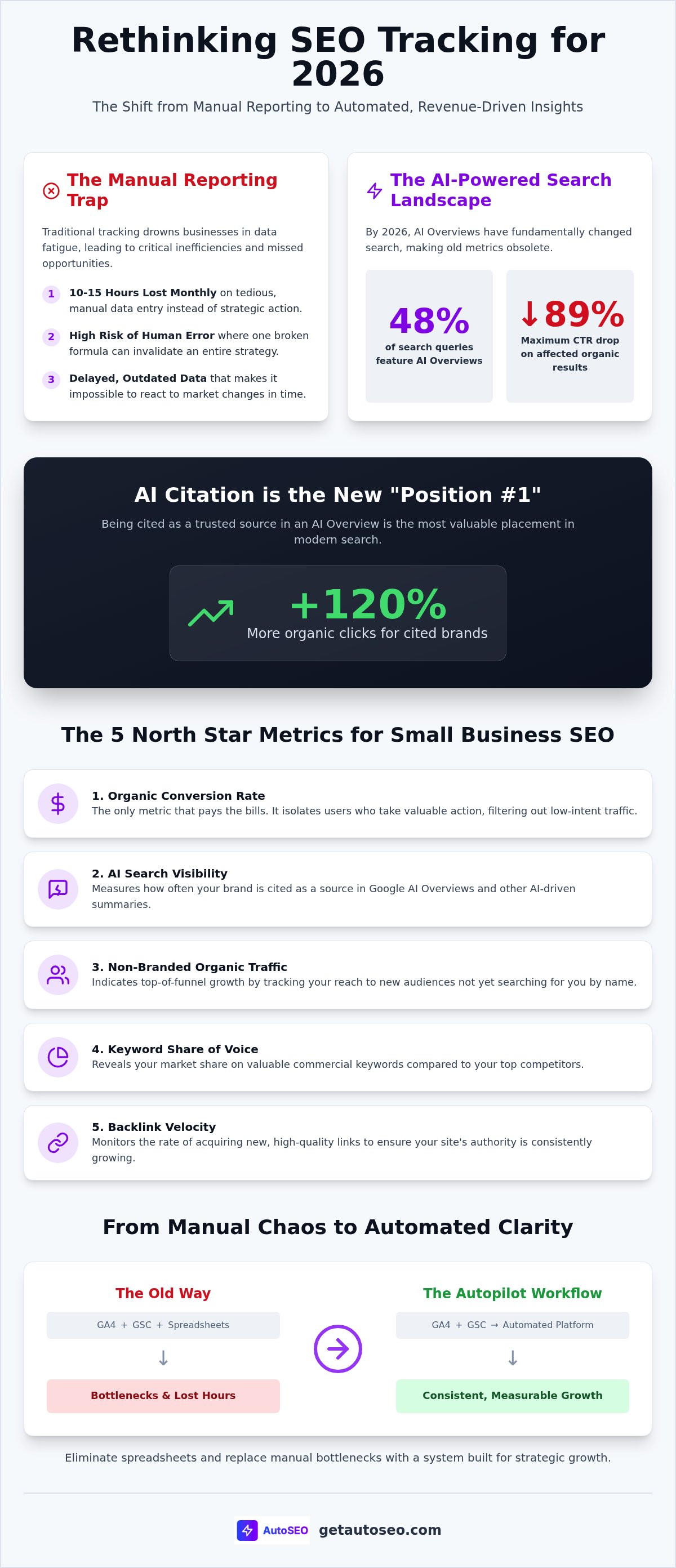
In 2026, Google AI Overviews dominate 48% of search queries. For many, organic click-through rates have crashed by as much as 89% on these results. Learning how to track seo results for small business is no longer about counting generic clicks; it's about measuring what actually works in a disrupted landscape. You need to know which keywords are driving revenue and which are simply vanity metrics.
You're likely exhausted from toggling between GA4, Search Console, and manual spreadsheets that fail to show a clear return on investment. Data fatigue is real. Spending hours on manual reporting instead of growth strategy is a recipe for stagnation. You deserve a clear, automated system that justifies every dollar of your SEO spend without the administrative burden.
This guide changes the narrative. We'll show you how to automate your SEO tracking to focus on the high-performance metrics that drive sales. From tracking AI Overview citations to using predictive analytics for cross-channel planning, you'll gain a reliable system that puts your reporting on autopilot. It is time to stop guessing and start using a tracking strategy that actually works at scale.
Key Takeaways
- Eliminate manual spreadsheets to stop the data fatigue trap and reclaim hours spent on administrative tasks.
- Prioritize North Star metrics like organic conversion rates and AI search visibility to measure results that impact your bottom line.
- Master how to track seo results for small business by automating Looker Studio reports that integrate GA4 and Google Search Console seamlessly.
- Identify high-value keywords and use content decay alerts to pivot your strategy for maximum efficiency.
- Scale your growth using an autopilot SEO workflow that replaces manual bottlenecks with consistent, measurable performance.
Why Traditional SEO Tracking Fails Small Businesses
Traditional tracking methods are broken. Most small business owners fall into the "Data Fatigue" trap. They track 50 different metrics because a generic tool suggested it. This is worse than tracking nothing. When you drown in data, you lose the ability to see the signal. You spend your weekends staring at charts instead of closing deals. Efficiency requires focus, not more spreadsheets.
The 2026 search environment is ruthless. Google AI Overviews now appear on approximately 48% of all search queries. This shift has caused organic click-through rates to drop by as much as 89% on certain terms. If you're still relying on old-school Search Engine Optimization (SEO) tracking, you're measuring a ghost. You need a system that identifies high-performance outcomes, not just position numbers. Modern monitoring must be fast, automated, and revenue-centric.
The Cost of Manual Reporting
Manual spreadsheets are the silent killer of growth. Think about the hours you lose every month. You pull data from GA4, export from Search Console, and try to stitch it together in Excel. This process is slow. It's prone to human error. By the time you finish your report, the data is cold. You've already missed the opportunity to pivot. In a market where organic CTR can fluctuate instantly, delayed data is a liability you can't afford.
- Lost Productivity: Small business owners often lose 10 to 15 hours a month on manual data entry.
- Inaccuracy: One broken cell in a spreadsheet can invalidate an entire quarter of strategy.
- Missed Windows: You can't react to a May 2026 core update if your report isn't ready until June.
Vanity vs. Value: What Actually Matters
Ranking first for a high-volume keyword feels good. It's a vanity metric. If that ranking doesn't lead to a conversion, it's a waste of resources. Sanity metrics focus on revenue. In 2026, you must prioritize visibility in AI summaries and the conversion quality of the traffic that does click through. High-performance businesses don't care about "impressions" that don't pay the bills.
Understanding how to track seo results for small business requires a shift to a results-driven mindset. You need to know which specific keywords are driving sales, not just traffic. Stop chasing rankings and start chasing ROI. Automation provides the clarity needed to see which efforts are actually working at scale. It's about moving the needle, not just filling up a dashboard with pretty colors.
The 5 North Star Metrics for Small Business SEO in 2026
Forget general traffic numbers. In 2026, the metrics that matter have shifted. High-performance businesses prioritize data that correlates directly with growth. Understanding how to track seo results for small business requires moving beyond the standard dashboard to focus on these five North Star metrics.
- Organic Conversion Rate: This is the only metric that pays the bills. It filters out the noise of casual browsers and focuses on users who actually take action.
- AI Search Visibility: With AI Overviews appearing on nearly half of all queries, you must track how often your brand is cited as a source in ChatGPT, Perplexity, and Google's AI summaries.
- Non-Branded Organic Traffic: This measures your reach to new, cold audiences who aren't yet searching for your business by name. It is the primary indicator of your top-of-funnel growth.
- Keyword Share of Voice: This metric reveals how much of the digital shelf you own compared to your competitors for your most valuable commercial terms.
- Backlink Velocity: Monitoring the speed at which you acquire new, high-quality links ensures your site's authority and trust signals remain competitive.
Efficiency is the goal. Transitioning to automated SEO reporting allows you to monitor these complex data points without manual labor. It ensures you spend your time executing strategy rather than formatting cells.
Measuring Visibility in the AI Era
In 2026, being cited as a source in an AI Overview is the new "Position 1." Research from Omnibound shows that cited brands receive 120% more organic clicks per impression than uncited brands on the same query. You must track these citations as a core KPI. Use tools that monitor LLM (Large Language Model) sentiment and brand mentions to ensure your content is being processed and recommended by AI engines. This is the foundation of Answer Engine Optimization.
The ROI of Organic Traffic
To justify your spend, you must connect Google Analytics 4 (GA4) events to specific SEO campaigns. This allows you to calculate a precise Customer Acquisition Cost (CAC) for organic visitors and compare it against your paid channels. Data from March 2026 indicates that visitors clicking through from AI Overviews convert at a rate 23 times higher than standard search results. Organic Conversion Rate is the ratio of SEO visitors to completed business goals. Switching to a platform that prioritizes automated SEO workflows ensures these high-value metrics are always at your fingertips, allowing you to scale what works instantly.
Step-by-Step: How to Automate SEO Reports in Looker Studio
Manual reporting is a relic. You need a live dashboard that updates while you sleep. Looker Studio is the industry standard for high-performance automation. It bridges the gap between raw data and actionable strategy. While Looker Studio Pro costs $9 per user as of July 2026, the core product remains free and powerful enough for most growing companies. A unified dashboard is the only way to escape the cycle of logging into multiple tools every morning.
Connecting GA4 and Search Console
Start by navigating to Looker Studio. Click "Create" and select "Data Source." Choose the Google Search Console connector first. Select your site property and the "Site Impression" table. Repeat this process for Google Analytics 4. Connecting these sources is the first technical hurdle in mastering how to track seo results for small business. You must see your search presence and your on-site behavior in one place.
To gain expert-level insights, use the "Blend Data" feature. Join your Search Console data with GA4 using "Landing Page" as the join key. This allows you to see which specific search queries lead to actual revenue. If you encounter connection errors, verify that your Google account has "Editor" permissions for both properties. Data mismatches often occur because Search Console uses a different time zone than GA4. Ensure your settings are synchronized to prevent skewed charts.
Designing Your One-Page Dashboard
A cluttered dashboard is useless. Build an "Executive View" that fits on a single screen. Use time-series line charts to monitor keyword ranking trends over time. This visualization makes it easy to spot the impact of Google's March or May 2026 core updates. Add a date range control at the top right of your report. This allows for instant month-over-month growth comparisons without editing the underlying charts.
- Top Performing Pages Table: Sort this by conversion rate. It reveals which articles are your heavy hitters.
- AI Citation Score: Create a custom field to track brand mentions in AI Overviews.
- Geographic Heatmap: Identify which regions are driving your high-quality organic traffic.
Automation isn't complete without scheduled delivery. Click the "Schedule delivery" icon in the top header. Set the frequency to weekly and choose Monday morning at 8:00 AM. You will start your week with a clear narrative of your business growth. You no longer have to go digging for answers. They arrive in your inbox, formatted and ready for review. This is the foundation of a results-driven strategy that scales without adding to your workload.
Analyzing the Data: When to Pivot Your SEO Strategy
Data without action is just noise. Your automated Looker Studio dashboard now provides the raw numbers. Your job is to translate those numbers into growth. Mastering how to track seo results for small business means knowing when your current content has reached its peak and when it's time to pivot. High-performance growth requires constant adjustment based on real-world performance. You must act on the signal, not the static.
Start by identifying your "Low-Hanging Fruit." These are keywords ranking in positions 4 through 10. They have high impressions but low click-through rates because they aren't in the top three spots. A small boost in authority or a content refresh can push these terms into the high-traffic zone. This is the most efficient way to see an immediate spike in revenue without launching entirely new campaigns.
Watch for content decay. Content decay is the silent killer of organic traffic. If a page that once drove 500 visitors a month now drives 100, it's decaying. Google's 2026 core updates reward fresh, high-quality information. If your traffic dips, your content is likely outdated or has been surpassed by more concise, AI-ready answers. Refreshing these pages is often more effective than writing new ones from scratch.
Spotting Keyword Opportunities
Open your Search Console data. Filter for keywords with high impressions but low clicks. These terms are appearing in search results, but users aren't clicking. This usually indicates a weak meta title or a lack of alignment with user intent. You can push these underperforming pages higher by adding internal links from your strongest "power pages." This transfers authority instantly and signals importance to search engines. It's a simple, logical move that maximizes your existing assets.
Competitive Benchmarking in 2026
You don't operate in a vacuum. You must track your competitor's backlink velocity. If they're gaining 20 high-quality links a month and you're gaining two, you'll lose ground. Analyze why competitors are winning specific AI Search queries. Are they providing more structured data? Are they cited more frequently in LLMs? For deeper strategy insights, consult our Small Business SEO: The Autopilot Guide. Use this data to justify increasing your automation level. Manual labor cannot keep up with the scale required to dominate in 2026. Start your $1 trial to see how automation can keep you ahead of the competition effortlessly.
Scaling Without Spreadsheets: The AutoSEO Advantage
Manual labor is the ultimate bottleneck for growth. If your primary focus is still on manually figuring out how to track seo results for small business, you're falling behind. Ambitious companies don't just observe data. They generate it at scale. Efficiency is the only way to survive the 2026 search landscape. You can't scale a business by spending 15 hours a month inside a spreadsheet.
AutoSEO provides a seamless transition from data fatigue to high-performance reliability. It delivers a true "SEO on Autopilot" experience. You gain built-in performance tracking that links directly to expert content creation and backlink building. This isn't a standalone tool that gives you more work. It is a partner that offloads the heavy lifting entirely. You get the data you need without the manual entry that kills your momentum.
Traditional methods require you to spot a trend and then spend weeks writing content or hunting for links. AutoSEO eliminates this lag. It uses AI-driven results to ensure your site remains a source of authority. You move from simply tracking results to guaranteeing growth through consistent, measurable output. By automating the two hardest parts of SEO, you ensure your authority grows even when you aren't looking at a dashboard. This is the difference between a tool and a complete solution.
Quality at Scale: The AutoSEO Promise
We deliver 30 SEO-optimized articles every month. This isn't generic filler. It is high-intent content designed to capture traffic and convert browsers into buyers. Our platform also provides 100 Domain Authority worth of backlinks to solidify your rankings and build long-term trust. The setup is a "Set and Forget" workflow. Once you're live, the system handles daily publishing to your WordPress site automatically. Learn more about how we act as your AI Content Creation: Your 24/7 SEO Writing Team.
The Future of Automated Growth
Automation is the only way to compete with larger corporate budgets in 2026. You don't need a massive team to win. You need a superior tool that values your time. AutoSEO levels the playing field by providing the quality and scale previously reserved for enterprise agencies. Data from 2026 shows that brands using automated workflows respond to algorithm updates 4 times faster than those using manual methods. Speed is your greatest competitive advantage.
You can see the impact for yourself without a major commitment. Start your SEO automation journey today with a $1 trial. Experience the relief of offloading your SEO to a system that actually works. Stop wasting time on spreadsheets and start focusing on the strategy that actually grows your business.
Master Your Growth with Intelligent Automation
The search environment of 2026 demands more than just basic monitoring. You've seen why manual spreadsheets act as a bottleneck and how North Star metrics like AI visibility provide the clarity you need. Mastering how to track seo results for small business is the first step toward reclaiming your time. You must transition from passive data collection to aggressive, strategic execution. High-performance growth is no longer about working harder; it's about working smarter through technology.
Reporting is only half of the equation. True scale requires a system that executes as well as it tracks. AutoSEO provides a complete solution with automated daily content publishing and a built-in high-authority backlink builder. We offer affordable SaaS pricing that puts enterprise-level power in the hands of ambitious small business owners. It is time to stop fighting the data and start leading the market with a tool that actually works.
Efficiency is your new competitive advantage. You don't have to navigate the complexities of modern search alone. Scale your SEO on autopilot with AutoSEO and watch your organic traffic reach new heights. Success is no longer a guessing game. It is a predictable outcome of the right automation.
Frequently Asked Questions
How often should a small business check its SEO results?
Perform a deep strategic review once per month to identify long-term trends and pivot your content plan. Weekly monitoring is sufficient for health checks to ensure there are no sudden ranking drops or technical errors. Checking your data every day is usually counterproductive. It leads to data fatigue and distracts you from the high-level execution that actually drives revenue.
What is the best free tool for tracking SEO for beginners?
Google Search Console is the most reliable free tool available for beginners. It provides direct data from Google regarding your site's impressions, clicks, and average keyword positions. You don't need a paid subscription to see exactly how users find you. Pairing this with a basic Looker Studio dashboard provides a professional-grade reporting system at zero cost.
Can I track my SEO results without using Google Analytics?
You can monitor search visibility using Google Search Console or third-party rank trackers. However, you won't know if that traffic is actually converting into customers without an analytics tool. Learning how to track seo results for small business effectively requires linking search queries to on-site actions. Without conversion tracking, you are only measuring traffic, not business growth.
How do I know if my SEO is actually driving sales and not just traffic?
Set up specific conversion events in GA4 to track actions like form submissions, phone calls, or product purchases. This allows you to filter your sales data by "Session Manual Source/Medium" to see exactly which customers came from organic search. High traffic is a vanity metric. You must prioritize the Organic Conversion Rate to ensure your SEO efforts are paying the bills.
What is a good organic click-through rate (CTR) for a small business?
A healthy average organic CTR across all keywords typically sits between 3% and 5%. If you rank in the top three positions, you should expect much higher rates. In 2026, AI Overviews have impacted these numbers significantly. You should now aim to be cited as a source within those AI summaries to capture high-intent clicks that convert at much higher rates than standard results.
How do I track if my business is showing up in ChatGPT or AI search?
Monitor your GA4 referral traffic for sources like "chatgpt.com" or "perplexity.ai" to see direct visits from AI interfaces. You can also use specialized visibility tools that track brand citations within Large Language Models. Being cited as a source in an AI summary is a critical KPI in 2026. It signals to search engines that your content is authoritative and trustworthy at scale.
Is Looker Studio free to use for small business reporting?
The core version of Looker Studio is free and provides all the functionality needed to build a results-driven dashboard. It allows you to automate how to track seo results for small business by connecting directly to GA4 and Search Console. While Looker Studio Pro costs $9 per user as of July 2026, most small businesses can achieve high-performance reporting without the paid tier.
How long does it take to see measurable results in my SEO reports?
Expect to see measurable movement in your reports within 3 to 6 months of consistent effort. Initial signals like increased impressions often appear within the first 30 days. However, significant revenue growth requires building authority through regular content publishing and backlink acquisition. Automation can accelerate this timeline by delivering the volume of high-quality signals search engines demand in 2026.