

If you have spent the last six months watching your rankings stay flat while AI Overviews now dominate 50% of US search queries, your current strategy isn't just slow; it's obsolete. It is frustrating to pay high agency fees for manual content that fails to move the needle. You are likely wondering exactly what to do when seo is not working and how to stop wasting your budget on stagnant results. The reality is that traditional, labor-intensive methods cannot keep pace with the May 2026 Core Update or the shift toward Generative Engine Optimization.
We understand the exhaustion that comes from zero transparency and the overwhelming manual labor of content writing. This article provides a high-performance diagnostic checklist designed to pivot your brand from SEO failure to automated growth. You will discover the precise reasons why your rankings are flat and learn a faster way to generate expert-level content and high-authority links. We are moving past the guesswork to deliver a predictable model for organic traffic that actually works. It is time to replace manual struggle with quality and scale on autopilot.
Key Takeaways
- Identify if your lack of movement is a temporary sandbox phase or terminal strategy decay caused by outdated manual processes.
- Solve the "Quality at Scale" problem by moving beyond single monthly posts to high-volume, expert-level content hubs.
- Use our diagnostic checklist to determine exactly what to do when seo is not working and how to reclaim your marketing ROI.
- Secure your brand presence in AI Overviews with a citation strategy that works for both Google and generative search engines.
- Offload the complexity of link building and publishing to a system designed for high-performance reliability and automated growth.
Diagnostic Checklist: Is Your SEO Strategy Actually Broken?
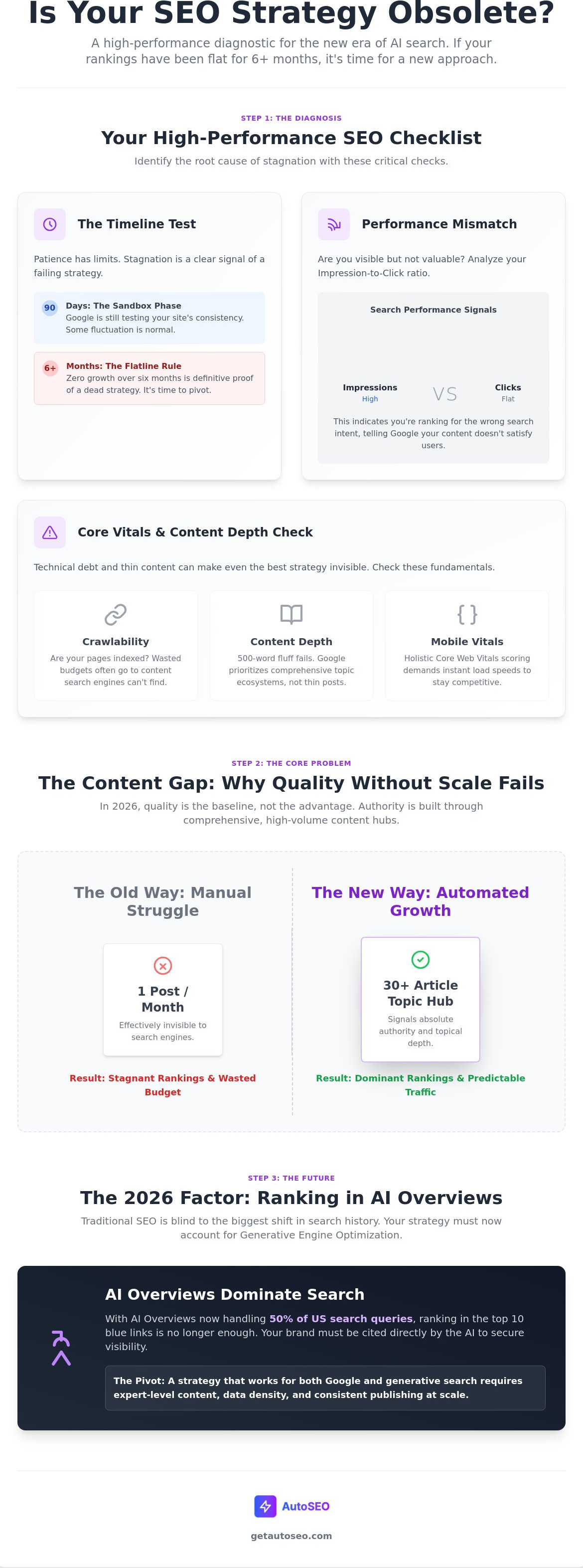
Stagnation is usually a symptom of a misaligned strategy rather than a lack of effort. Understanding the current state of Search Engine Optimization (SEO) requires recognizing that the rules shifted significantly after the May 2026 Core Update. You must first determine if you are simply in the Google Sandbox or suffering from Strategy Decay. The sandbox is a temporary observation period for new sites, while decay is a fundamental failure of your tactics to meet modern standards. Knowing what to do when seo is not working starts with a clinical audit of your performance metrics rather than blind persistence.
Analyze your Impression to Click ratio immediately. If your impressions are climbing but your clicks remain flat, you are likely ranking for the wrong search intent. This misalignment tells Google that your content doesn't satisfy the user, which eventually leads to a total loss of visibility. You should also verify if your site was impacted by the March 2026 Spam Update. This update specifically targeted scaled AI content abuse and low-quality automation. If your traffic dropped sharply during that window, you are likely dealing with an algorithmic penalty that requires a complete content pivot.
Step 1: The Timeline Test
Patience is a requirement, but it has limits. If your campaign is less than 90 days old, you are likely still in the testing phase where Google evaluates your consistency. However, we apply the Flatline Rule. Six months of zero growth is a definitive signal of a dead strategy. By 2026, the average ranking speed for high-performance content has accelerated. If you don't see incremental movement in long-tail keywords within 120 days, your current manual approach is failing to build the necessary momentum to compete.
Step 2: Technical Health vs. Content Depth
Technical debt kills even the best content. Run a 60-second crawlability check to ensure your pages are indexed and visible. Many businesses waste their budget on content that search engines cannot even find. Next, evaluate your content depth. Publishing 500-word fluff is a recipe for invisibility in a landscape that demands expertise. Google's 2026 algorithm prioritizes comprehensive topic ecosystems over isolated, thin posts. Finally, check your mobile vitals. With the new holistic Core Web Vitals scoring, your site must achieve instant load speeds to remain competitive. When you finally understand what to do when seo is not working, you stop chasing vanity metrics and start focusing on technical precision and quality at scale.
The Content Gap: Why 'Quality' Without Scale Fails
Many businesses fail because they believe "quality" is a substitute for volume. In the 2026 search landscape, one high-quality blog post per month is effectively invisible. Competitors are leveraging automation to dominate entire topic ecosystems while you struggle with a single pillar page. If you are trying to figure out what to do when seo is not working, start by measuring your topical coverage. Quality is now the baseline, not the competitive advantage. To win, you must deliver that quality at a frequency that signals absolute authority to search engines.
You cannot rank for a competitive term with a single isolated article. This is the Topic Authority trap. Google's March 2026 Core Update prioritized sites that demonstrate depth across an entire subject. You typically need 30 or more interconnected articles on a single pillar to move the needle. If your content library is thin, Google will favor larger, more comprehensive hubs even if your individual writing is superior. You should also analyze your keyword intent. Many brands waste budget targeting informational terms when they actually need transactional traffic to drive revenue.
Content decay is another silent killer of rankings. If your top-performing pages from last year are slipping, it's because they lack the fresh data density required by the May 2026 update. You must identify these fading assets and refresh them with updated facts and AI-optimized structures. Stagnant content tells the algorithm that your site is no longer a reliable source of current information.
Moving Beyond Surface-Level Content
Modern AI content creation must be expert-led and data-dense to survive Google's rigorous spam filters. Your high-intent keywords should focus on solving specific user pains and facilitating immediate action. Topic clusters are groups of related content pieces that collectively cover a broad subject area to establish comprehensive domain authority. By shifting focus to these clusters, you ensure that every article supports the ranking potential of the entire site.
The Consistency Requirement
Google rewards daily publishing patterns over sporadic bursts of activity. The math of search visibility is undeniable. A brand that publishes 365 expert articles per year will always outrank a competitor stuck at 12. Automation removes the writer's block bottleneck, allowing small businesses to compete with enterprise-level output. You can automate your content strategy to maintain a steady pulse of high-quality updates without the high cost of manual labor. This consistency builds the predictable organic growth that manual teams simply cannot replicate.
The Authority Wall: Why Your Backlinks Are Stagnant
Content is only 50% of the equation in 2026. You can publish expert articles daily, but without a strong backlink profile, you will hit an invisible ceiling. Verified data shows the #1 ranking position in Google has, on average, 3.8 times more backlinks than positions 2 through 10. If you are struggling with what to do when seo is not working, you are likely missing the authority required to compete for high-intent keywords. Content brings the relevance; backlinks bring the power.
Manual link building is the most expensive way to fail. We call this "Outreach Burnout." Traditional agencies charge thousands of dollars to send cold emails, often resulting in zero high-quality placements. This manual labor is slow, expensive, and unpredictable. You need a system that prioritizes quality over sheer volume. Toxic links from low-reputation sites can actually trigger penalties under the March 2026 Spam Update. Only high-DA links from established, niche-relevant sites move the needle for your rankings. For a deeper dive into modern strategy, read our autopilot guide to link building.
Diagnosing a Lack of Domain Authority
Compare your Domain Authority (DA) directly to the top three results for your target keywords. This "Link Gap" analysis reveals exactly how much authority you are missing. If your competitors have a DA of 60 and you are at 20, no amount of content will bridge that distance alone. You must also maintain a natural link profile. While high-DA "Do-Follow" links are the goal, "No-Follow" links from reputable sources still provide essential signals of a healthy, organic ecosystem to the algorithm.
Automated Link Building vs. Manual Outreach
The cost-per-link breakdown is staggering. A traditional agency might charge $500 or more for a single high-quality placement. High-performance automation can reduce that effective cost to a fraction of that price by streamlining the acquisition process. You can build 100 Domain Authority worth of links every month without sending a single manual email. This approach focuses on contextual backlinks from relevant niche sites. It ensures your site gains authority on autopilot while your team focuses on higher-level strategy. This is the only way to scale authority in a market where manual outreach has become a bottleneck for growth.
The 2026 Factor: Ranking in AI Search Overviews
Ranking in the top position on Google used to guarantee a flood of traffic. In 2026, that is no longer the case. Google AI Overviews now appear on approximately 48-50% of all US search queries. If you occupy the #1 organic spot but find your click-through rate is plummeting, you need to understand what to do when seo is not working in the age of generative search. The goal has shifted from simply ranking to being the cited source within the AI's response. You must transition your understanding of what is seo into a framework for AI Visibility.
Google's "AI Mode" has surpassed 1 billion monthly users, making Generative Engine Optimization (GEO) a non-negotiable part of your strategy. This involves high factual density and structured data that Large Language Models (LLMs) can parse instantly. A citation strategy is your new priority. When ChatGPT or Gemini provides an answer, they credit the sources that provide the most direct, authoritative data. To ensure your brand is the one cited, you must implement LLM-friendly formatting and schema markup that defines your content as the primary entity for a given topic.
Optimizing for LLMs (Large Language Models)
Optimizing for AI requires a "Summary First" approach. Answer the user's core question within the first 50 words of your article. Use natural language headers that mirror common AI prompts like "How do I" or "What is the best way to". This structure allows AI crawlers to extract your key insights without wading through fluff. Brand mentions on high-authority sites act as authoritative votes that convince AI engines your content is the most reliable source of truth.
Tracking Visibility in AI Search
Tracking your presence in AI Overviews is more complex than checking a standard keyword rank. You need to monitor your brand's sentiment within AI responses and ensure you aren't being excluded from the summary. If you are wondering what to do when seo is not working to capture zero-click searchers, the answer is to optimize for the summary itself. This requires a shift in how you measure success. High-performance brands prioritize being the cited authority over just occupying a list of links. Scale your AI-ready content to ensure you are the dominant voice in every generative response across the web.
The Pivot: Switching to SEO on Autopilot
Perform a manual SEO audit of your current workflow. Calculate the total hours your team spends on keyword research, drafting articles, and chasing backlinks. For most small businesses, this exceeds 40 hours of high-cost labor every month with no guarantee of results. This inefficiency is the root cause of stagnant rankings. Knowing what to do when seo is not working requires a definitive shift from manual tasks to intelligent systems that prioritize performance over process.
Traditional agencies operate on a high-ticket retainer model that relies on manual output. This model is too slow and expensive for the 2026 search environment. In contrast, done for you seo leverages automation to deliver results at a fraction of the cost. You can transition from a broken strategy to a daily publishing powerhouse in less than 24 hours. We eliminate the friction of content creation and link building to provide a solution that actually works.
The AutoSEO Advantage
Our platform handles the two most difficult aspects of search visibility without requiring your constant oversight. We publish one expert-led article directly to your WordPress site every single day. These aren't generic posts; they are data-dense assets designed to satisfy both Google and AI search engines. Simultaneously, we build 100 Domain Authority worth of backlinks every month on autopilot. Our AI-powered research identifies the high-intent keywords your competitors have overlooked, ensuring you capture traffic that converts into revenue.
Your 30-Day Growth Plan
Success in search is a result of consistent, high-quality output. Your first 30 days focus on establishing absolute topic authority through 30 expert articles. This volume signals to Google that your site is a primary entity in your niche. By the second month, we boost those rankings with automated, high-DA backlinks that bridge the authority gap discussed earlier in this guide. This systematic approach ensures predictable organic growth that manual teams simply cannot match. Start your $1 trial today to see our high-performance platform in action and stop wondering what to do when seo is not working.
Take Command of Your Search Performance
The 2026 search landscape moves too fast for manual execution. If your rankings are flat, you now have a diagnostic framework to identify whether you are facing technical debt, a content volume gap, or a lack of authority. Understanding what to do when seo is not working is the first step toward reclaiming your organic growth. You must move past the limitations of traditional agencies and embrace a model that combines quality and scale on autopilot.
AutoSEO provides the high-performance infrastructure you need to dominate both Google and AI search engines. With 30 expert articles published every month and 100 Domain Authority worth of backlinks included, you can finally offload the complexity of SEO to a system that delivers measurable results. Our platform operates on a no-contract basis, allowing you to cancel anytime. Stop guessing and start growing with the SEO platform that actually works. Try AutoSEO for $1.
You have the tools to pivot from failure to automated success. It is time to scale your brand with confidence and precision.
Frequently Asked Questions
Why is my SEO not working after 6 months?
Stagnation after half a year usually signals a failure in topical depth or authority. If you aren't publishing expert content daily, you likely haven't reached the "authority threshold" required to outrank established competitors. This flatline often indicates that your manual strategy is too slow to keep pace with the May 2026 Core Update. You need to increase your output volume while maintaining high factual density to signal relevance to the algorithm.
Can AI-generated content really rank on Google in 2026?
Google rewards high-quality content regardless of how it is produced. The March 2026 Spam Update specifically targeted "scaled content abuse," which refers to low-quality, repetitive fluff. High-performance AI content that provides unique perspectives and expert-level insights continues to dominate the SERPs. The key is using automation to achieve quality and scale simultaneously, ensuring every article satisfies Google's E-E-A-T requirements.
How do I know if my SEO agency is doing a good job?
Demand a "Link Gap" analysis and a clear "Impression to Click" ratio report. When deciding what to do when seo is not working with an agency, look for transparency in their link-building tactics. If they can't show you exactly how many high-DA links they've secured or why your rankings remain flat, their manual model is likely failing. Reliable partners provide measurable outcomes rather than vague promises about future growth.
What are the first signs of a Google penalty?
A sharp drop in traffic across all pages following a core update is the most common indicator. Check Google Search Console for manual actions or significant drops in indexed pages. If your impressions fall by 50% or more within a 48-hour window, you've likely been hit by an algorithmic suppression. This often happens to sites that rely on thin content or low-quality backlink profiles that don't meet 2026 standards.
Is link building still necessary for SEO in 2026?
Backlinks remain a top-three ranking factor because they act as votes of confidence from the web. Data shows the #1 ranking position has 3.8 times more backlinks than positions 2 through 10. While content brings relevance, authority is the power that pushes your site to the top. You can't bridge the authority gap with content alone; you need a consistent stream of high-DA, contextual links to compete.
How much should a small business spend on SEO monthly?
Focus on the return on investment rather than a fixed price point. Traditional manual retainers are often too expensive for small businesses because they carry high overhead costs for slow output. A better approach is to find a platform that automates content and links, providing enterprise-level results for a fraction of the cost. This allows you to scale your organic growth without draining your marketing budget on manual labor.
What is the difference between traffic and conversions in SEO?
Traffic measures how many people visit your site, while conversions measure how many take a specific action. Ranking for informational terms is a vanity metric if those visitors don't eventually buy. You must target transactional keywords and high-intent search queries to turn your organic visibility into revenue. A successful strategy balances broad topical authority with content that facilitates immediate user action.
How do I rank in Google AI Overviews?
Rank in AI Overviews by implementing the "Summary First" rule in your content. Provide a direct, factual answer to the user's prompt in the first 50 words of your article. Google's AI Overviews now appear on nearly 50% of US queries, so you must use entity-based schema and structured headers. This formatting ensures that Large Language Models can parse your data and cite your brand as the primary authority.


