
What if your best growth strategy isn't writing new content, but fixing what you already own? Most businesses watch their hard-earned rankings vanish as content decay sets in, yet they lack the budget to hire a fleet of editors for manual refreshes. With 86% of SEO professionals now integrating AI into their workflows, the old way of manual editing is officially obsolete. By leveraging ai seo content automation, you can stop the bleed and start scaling your updates without increasing your headcount.
You likely know the frustration of "score chasing" in manual SEO tools that still require hours of human intervention. It's time for a system that actually works. This guide reveals how to deploy AI-driven autopilot systems that identify decaying posts and optimize them for 2026 search standards instantly. We'll show you how to build a set and forget maintenance engine that recovers lost traffic and keeps your library at peak performance while you focus on high-level strategy.
Key Takeaways
- Identify how Google's 2026 algorithms prioritize freshness and current relevance to stop the steady decline of your legacy rankings.
- Discover how Natural Language Processing finds semantic gaps in your articles and automatically adds the context your competitors are using to outrank you.
- Eliminate the high cost of human editors by deploying ai seo content automation to handle the tedious work of refreshing old blog posts.
- Learn a 5-step implementation framework to connect your CMS to an autopilot system for seamless, hands-free content maintenance.
- Scale your organic traffic recovery by pairing automated content updates with high-authority link building for maximum search visibility.
Why Content Decay is Killing Your Rankings (and How AI Fixes It)
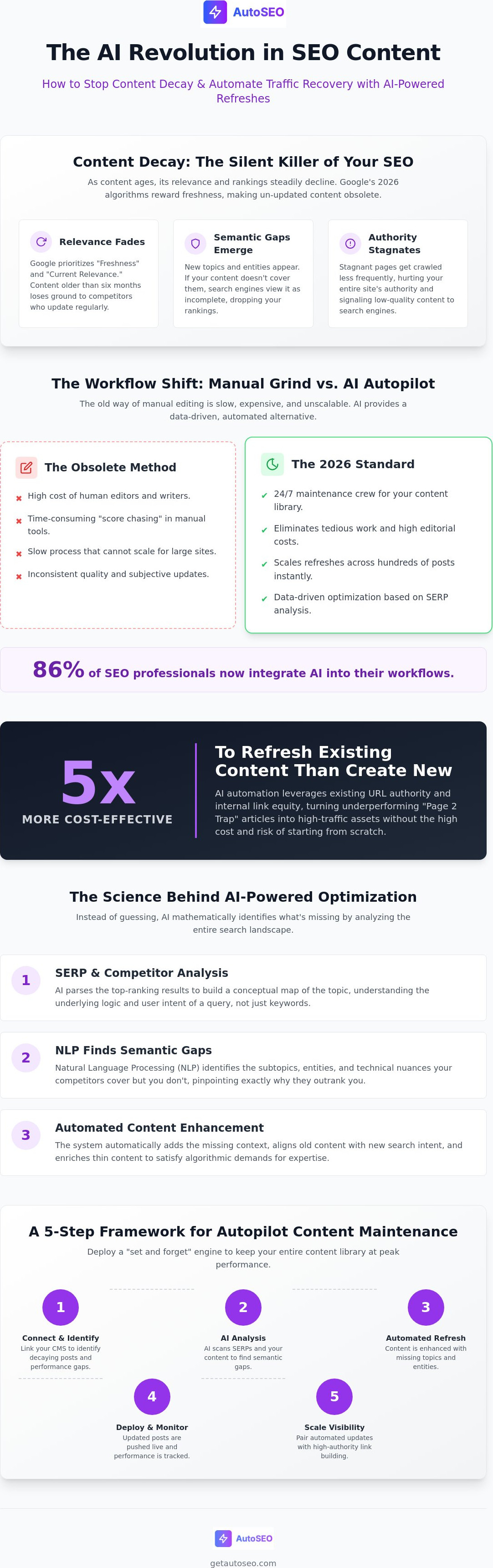
Content decay is the silent killer of organic growth. It's the steady, predictable decline of traffic as your once-relevant articles become obsolete. In 2026, Google's algorithms have shifted significantly. They now prioritize "Freshness" and "Current Relevance" above almost everything else. If your content hasn't been touched in six months, you're losing ground to competitors who update daily. This is where ai seo content automation becomes your competitive advantage. It acts as a 24/7 maintenance crew, ensuring your library never grows stale while you focus on high-level strategy.
Many of your pages are likely stuck in the "Page 2 Trap." These are high-potential URLs that rank between positions 11 and 20. They don't need a total rewrite; they need a semantic nudge. AI identifies exactly which keywords and topics are missing to push these assets onto the first page. By closing these gaps, you turn stagnant URLs into high-performing assets without the manual grind of traditional editing.
The Technical Mechanism of Content Decay
Search intent is a moving target. An article titled "Best SEO Strategies for 2024" is a relic by mid-2026. Users want answers that reflect the current state of search, not two-year-old data. Beyond intent, there's the issue of missing entities. As new concepts emerge, search engines use Natural Language Processing to see if your content covers the full scope of a topic. If your competitors have added these new entities and you haven't, your rankings will drop. Stagnant pages also waste your crawl budget. When Google realizes a page hasn't changed in years, it visits less frequently, which hurts your entire site's authority.
The ROI of Refreshing vs. Creating New Content
Publishing new content is expensive and risky. It's often 5x more cost-effective to optimize an existing URL than to start from scratch. Your old URLs already have established age and internal link equity. You've already done the hard work of getting them indexed and earning initial trust. By using ai seo content automation, you leverage that existing power instead of fighting for new rankings from zero. It's a high-performance shortcut to traffic recovery. You simply cannot manually refresh 500 blog posts every quarter, making AI an absolute necessity for library-wide maintenance at scale.
The Science of AI Content Optimization: NLP and Semantic Gaps
In 2026, search engine optimization has moved beyond simple keyword matching. Modern search engines use advanced Natural Language Processing (NLP) to parse the entire Search Engine Results Page (SERP) and build a conceptual map of what "good" looks like. AI reads the top-ranking results to understand the underlying logic of a query. It doesn't just look for words. It looks for the relationships between ideas. This is the foundation of ai seo content automation. Instead of guessing why a competitor is outranking you, the system mathematically identifies the specific concepts you've missed.
Semantic gaps are the missing pieces of the puzzle. These are the subtopics, entities, and technical nuances that your competitors cover but you don't. If your article on "remote work" fails to mention "asynchronous communication" or "digital fatigue," Google views your content as incomplete. AI identifies these gaps instantly. It compares your library against the current leaders and predicts exactly what Google wants to see next. This shift from keyword density to topical authority is the defining characteristic of 2026 SEO. You can experience this precision firsthand by automating your content refreshes on a high-performance platform.
Mapping Semantic Relevance with AI
AI detects thin content by analyzing entity density rather than just word count. It's a common mistake to think "longer is better." In reality, Google prioritizes information-rich content that uses Natural Language Understanding (NLU) to match user intent perfectly. AI identifies if your content is too broad or if it misses the specific nuance required to rank for a high-intent query. It automatically flags pages that lack the necessary depth and suggests precise additions to satisfy the algorithm's demand for expertise.
To support this need for depth and expertise, many creators use KhyenAI, an integrated AI workspace that simplifies web research and document analysis for high-performance content strategies.
Aligning Old Content with New Search Intent
Search intent is not permanent. A URL that successfully targeted informational queries last year might now face a SERP dominated by commercial intent. AI detects these shifts by monitoring real-time SERP features. It identifies intent mismatches and restructures your content to fit the new reality. This includes updating headings to capture Featured Snippets and using sentiment analysis to ensure your tone aligns with current market expectations. By automating these adjustments, you keep your legacy assets relevant without the manual labor of constant monitoring. High-performance systems ensure your content remains as fresh as the day it was published.
Manual SEO Tools vs. SEO on Autopilot: The Workflow Shift
Most businesses are currently trapped in a cycle of manual labor that masquerades as strategy. They pay for expensive subscriptions to tools like Surfer or Clearscope, then pay a human editor to spend hours "score chasing" to hit a 90/100 grade. This isn't efficiency; it's a bottleneck. While these tools provide data, they still require a person to manually insert keywords, restructure headings, and fix formatting. This is ai seo content automation in its most primitive form. Real growth requires a system that removes the human middleman entirely.
The hidden cost of manual SEO is the primary reason most campaigns fail. You're paying for the software and the expensive human hours required to execute its suggestions. Small businesses often fall into the "consistency gap" because they can't maintain this pace. They optimize three articles, get distracted by daily operations, and their rankings begin to decay again. An autopilot system eliminates this risk by ensuring your content maintenance never stops, regardless of your schedule.
The Bottleneck of 'Score Chasing'
Spending three hours to push a content score from 75 to 90 is an inefficient use of your time. This process feels productive, but it's actually just busy work that keeps you from focusing on high-level growth. Manual tools force you to play a game of keyword Tetris that adds no real value to the reader. AutoSEO acts as the high-performance specialist that handles this busy work instantly. It's the relief of knowing your pages are perfectly optimized without you ever having to open a text editor. You get the results of a full-time SEO team without the management overhead.
Scalability: 1 Article vs. 30 Articles
The math of manual SEO doesn't add up for competitive niches in 2026. A manual editor might refresh five articles a week if they're working at peak capacity. In contrast, an AI content creation system delivers 30 expert articles per month on complete autopilot. To dominate search results today, you need quality and scale working in tandem. You can't achieve this level of output with a manual workflow unless you significantly increase your headcount.
Switching to a "set and forget" system transforms your content library into a self-sustaining asset. It's the phrase that actually works for businesses that value their time above all else. By offloading the grind of ai seo content automation to a superior tool, you ensure your existing URLs stay at the top of the SERPs. You gain the freedom to focus on your product while your SEO strategy runs in the background, building authority and capturing traffic every single day.
While automation handles the technical execution, check out Trainetics Academy if you are looking for comprehensive training to help your team master the broader digital landscape.
How to Implement AI SEO Content Automation: A 5-Step Guide
Transitioning to a "set and forget" strategy requires a structured approach. It isn't about random updates or bulk rewriting. It's about surgical precision. You need a workflow that identifies technical weaknesses and fixes them without human intervention. Implementing ai seo content automation allows you to maintain a high-performance library that grows in authority every day. Stop guessing which posts to fix and start using a data-backed system that delivers results.
Follow these five steps to deploy your autopilot system:
- Step 1: Audit your library. Use an automated seo report to find your "Declining Stars." These are legacy pages that previously drove traffic but are now losing ground to fresher competitors.
- Step 2: Connect your CMS. Link your WordPress site to your automation platform. This connection is the bridge that allows the AI to push updates directly to your URLs without manual copy-pasting.
- Step 3: Define your Topical Map. Set your keyword priorities. Tell the system which topics are vital for your business so the AI knows where to focus its optimization energy.
- Step 4: Regenerate and Refine. Let the AI regenerate sections of your content. It will automatically close semantic gaps, fix intent mismatches, and update outdated information based on real-time SERP data.
- Step 5: Automate Link Building. Support your newly optimized pages with authority. A complete system should build high-DA backlinks automatically to ensure your refreshed content has the power to rank.
This process eliminates the consistency gap that kills most SEO campaigns. You can start your $1 trial today to see this entire five-step framework in action on your own site.
Identifying High-Impact Optimization Targets
Focus your efforts on pages with high impressions but low Click-Through Rates. These pages are visible but failing to convert the click. You should also target "Striking Distance" keywords. These are terms where you currently rank in positions 11-20. A simple semantic nudge from an automated system can push these assets onto page one instantly. AI also scans for broken links and outdated facts that signal low quality to search engines. Fixing these minor issues across hundreds of pages creates a massive sitewide authority boost.
Automating the CMS Integration
Direct publishing is the final hurdle for most SEO strategies. If you still have to manually approve and format every update, you aren't truly on autopilot. Modern ai seo content automation respects your internal linking structures and brand voice while pushing daily updates. This consistency is vital. Google's crawl bots prioritize sites that show frequent, high-quality activity. By automating the integration, you ensure your site stays active and relevant without ever touching a text editor yourself.
Scaling Performance with AutoSEO: Beyond Just Content
Content optimization is only 50% of the search engine battle. Even if your articles are semantically perfect, they won't reach the top of competitive SERPs without authority. Successful ai seo content automation must be paired with aggressive link building to see sustainable traffic recovery. AutoSEO solves this by integrating 100 DA worth of backlinks into your monthly workflow. This moves your strategy from "SEO as a project" to "SEO as a utility" that runs silently in the background.
Think of your content as the vehicle and backlinks as the fuel. You can have a high-performance machine, but it won't move without power. By automating both the refresh and the authority building, you create a self-sustaining growth loop. Your existing URLs stay fresh, and their ranking potential increases every month as the system builds their equity. This is the relief of offloading a difficult task to a superior tool that actually works. You stop fighting for visibility and start commanding it.
The Synergy of Content and Backlinks
Perfect AI content still requires domain authority to outrank legacy players. Google needs to see that other reputable sites trust your information before it grants you a top position. AutoSEO handles the heavy lifting of outreach and placement for you. It eliminates the need for expensive agencies and the endless cycle of status meetings. This high-performance specialist approach ensures your site gains 100 DA worth of backlinks automatically. You get the results of a sophisticated link-building team without the headcount or the management overhead.
Dominating the Future of AI Search
Visibility in 2026 depends on your ability to feed both human readers and AI systems like Google's AI Overviews. Seo automation is the only way to keep your entire library relevant enough to be cited as a primary source. Manual updates are too slow for the current pace of search. By choosing done for you seo, you ensure your brand remains a leader in your niche regardless of how the algorithm shifts.
Stop wasting your team's time on individual sentence edits. It's time to scale your system. You can start your $1 trial today and watch the impact of ai seo content automation on your organic traffic. Transform your decaying posts into your most valuable assets. Let the autopilot system handle the grind while you focus on high-level growth and measurable outcomes.
Future-Proof Your Content Library Today
Stop letting your legacy content fade into obscurity. Search engine success in 2026 requires more than just high-quality writing; it demands relentless maintenance at scale. You've seen how ai seo content automation identifies semantic gaps and restores traffic on autopilot. By removing the manual bottleneck of "score chasing," you free your team to focus on growth while the software handles the grind. It's the only way to stay ahead in a landscape where freshness and authority are the primary ranking signals.
AutoSEO delivers a complete, high-performance solution that replaces traditional, labor-intensive methods. You get 30 expert articles per month, 100 DA worth of backlinks, and seamless automated WordPress publishing. This is the phrase that actually works for businesses ready to dominate their niche without increasing headcount. Don't wait for your rankings to hit zero before you take action. Start Your $1 Trial and Put Your SEO on Autopilot. You can finally conquer the complexities of search and watch your organic traffic scale with confidence.
Frequently Asked Questions
Is using AI for optimizing existing content safe for Google rankings?
Google rewards helpful, high-quality content regardless of its origin. The search engine's 2026 updates prioritize accuracy and freshness over the method of creation. Using ai seo content automation to fix outdated facts and semantic gaps actually helps you comply with E-E-A-T guidelines. It ensures your readers get the most current information available, which Google views as a positive user experience signal.
How often should I use AI to refresh my old blog posts?
You should refresh your content as soon as you notice a decline in impressions or rankings. For high-traffic assets, a maintenance check every six months is a standard industry best practice. Automated systems monitor your library 24/7, so you don't have to manually check for decay. This proactive approach keeps your "Freshness" score high and prevents competitors from stealing your positions.
Can AI really understand my brand voice when optimizing content?
Modern AI models analyze your existing articles to identify and replicate your specific tone and vocabulary. They don't just rewrite text; they mirror the structural patterns and emotional style of your brand. This ensures that every update feels seamless and consistent with your established identity. You get the speed of automation without sacrificing the unique personality that your audience expects.
What is the difference between AI content generation and AI content optimization?
AI content generation creates entirely new articles from a prompt or keyword. AI content optimization focuses on improving what you already have by identifying missing entities and fixing intent mismatches. Optimization leverages your existing URL authority and internal links to recover lost traffic. Both are essential for a complete strategy, but optimization offers a faster ROI for established domains.
Do I still need to build backlinks if I optimize my content with AI?
Backlinks remain a primary ranking factor in 2026. Perfect content alone is rarely enough to beat high-authority competitors in difficult niches. You need a combined approach that pairs semantic optimization with high-DA link building. High-performance systems integrate authority building with content updates to ensure your refreshed pages have the necessary power to climb the search results.
How long does it take to see results after an AI content refresh?
Most sites see ranking shifts within days or weeks after an update. Once Google re-crawls the page and detects the new entities and improved relevance, it updates your position. The speed depends on your site's crawl frequency and the competitiveness of the keyword. Automated publishing ensures these updates happen instantly, giving you the fastest possible path to traffic recovery.
Will Google penalize me if I update 30 articles at once using AI?
Google does not penalize sites for making large-scale improvements to their content. Refreshing 30 articles at once signals that you are actively maintaining your site's quality. This can lead to a sitewide authority boost as your overall "Freshness" score improves. The risk only exists if you use low-quality, repetitive content, which high-performance automation systems avoid by focusing on quality and scale.
What is the best AI tool for optimizing existing content for small businesses?
AutoSEO is the superior choice for small businesses because it operates on complete autopilot. Traditional tools still require you to spend hours manually editing and publishing every update. This creates a bottleneck that prevents you from scaling. ai seo content automation through AutoSEO handles the audit, the optimization, and the WordPress publishing for you. It's the only system that allows you to set and forget your content maintenance.


