Did you know that 83% of Google searches now end without a single click when an AI Overview is present? You've likely watched your traditional organic traffic plateau as search results become increasingly automated. It's frustrating to invest hours into long-form content only to see a competitor's brief paragraph secured in Position 0. You need a strategy that actually works in a landscape where citation is the new ranking.
Mastering ai for featured snippet optimization is the only way to maintain brand authority in 2026. This guide delivers the exact framework to capture the snippet box and dominate the hybrid SERP. You'll learn how to structure your data so Google picks your content for both traditional results and generative summaries. We'll explore the 40 to 60 word formatting rule, the shift toward Generative Engine Optimization, and how to put your SEO on autopilot to achieve quality at scale.
Key Takeaways
- Position 0 is the foundation for AI search. Featured snippets now act as the essential training data for Google AI Overviews in the 2026 hybrid landscape.
- Implement the Inverted Pyramid structure. Leading with concise, objective facts instead of marketing fluff ensures your content is selected for instant answers.
- Use ai for featured snippet optimization to capture high-volume informational queries. This strategy transforms your pages into the primary cited sources for zero-click searches.
- Target the top 10 organic rankings to maximize visibility. Most AI citations are pulled from high-authority pages that already hold traditional featured snippets.
- Transition to SEO on autopilot to achieve quality at scale. Automating the formatting process removes the manual labor from snippet hunting and drives measurable growth.
Featured Snippets in 2026: Why Position 0 Still Dominates AI Search
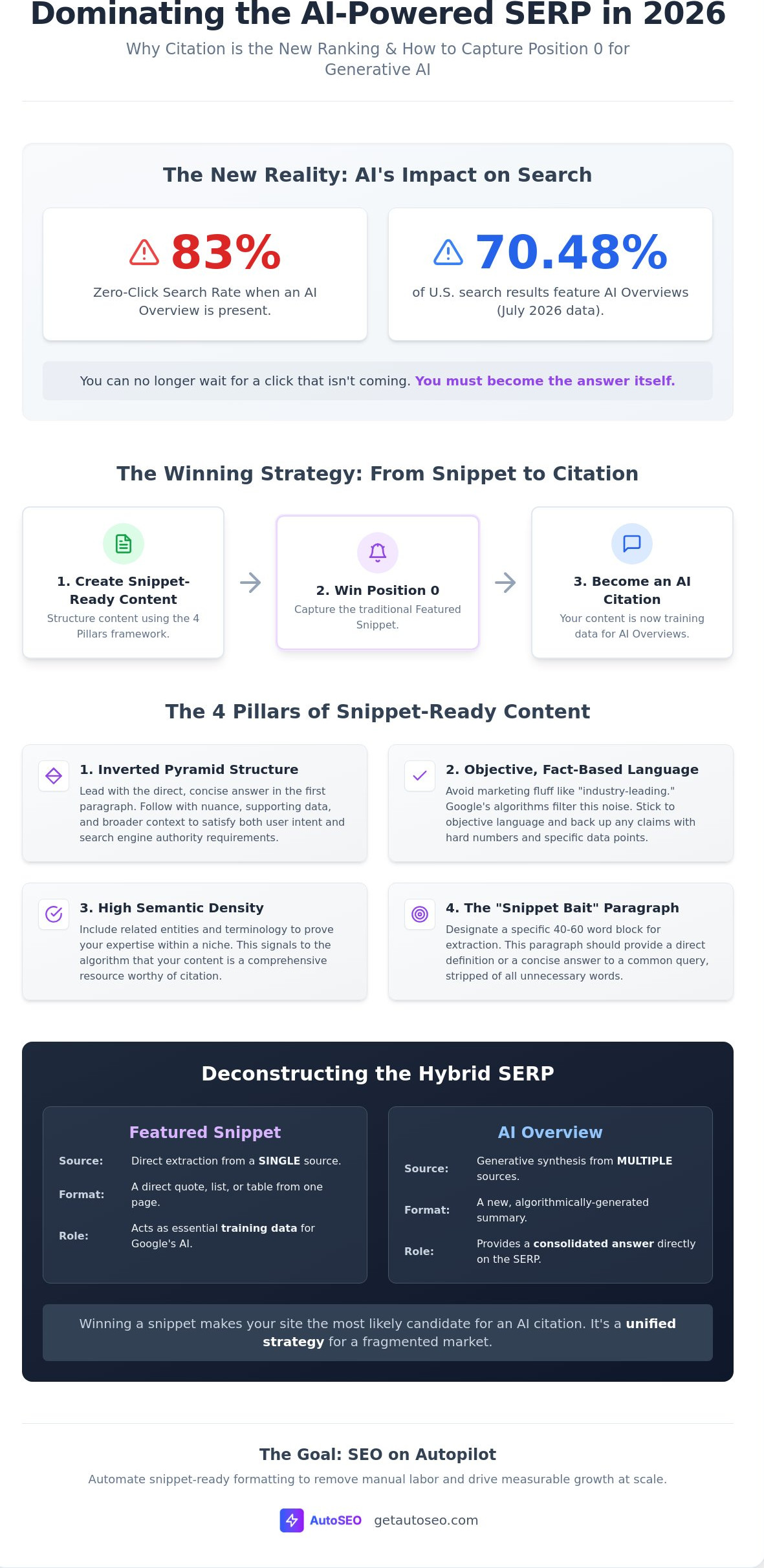
A featured snippet is a concise answer pulled directly from a webpage to satisfy a user query instantly. In 2026, the search engine results page (SERP) has evolved into a high-stakes hybrid environment. Traditional blue links now fight for oxygen alongside AI Overviews and featured snippets. If your content doesn't land in Position 0, it doesn't exist for the majority of users. Data from July 2026 shows that AI Overviews now appear in 70.48% of personalized U.S. search results. This shift has triggered a massive spike in zero-click searches. When an AI Overview is present, the zero-click rate hits approximately 83%. You can't afford to wait for a click that isn't coming. You must become the answer itself.
Capturing the snippet box is the only way to beat the fold in this automated landscape. There is a powerful psychological impact at play here. Users trust the highlighted answer more than standard links because Google has essentially "verified" it as the definitive truth. By implementing ai for featured snippet optimization, you position your brand as the primary authority. This isn't just about traffic anymore; it's about being the cited source that the algorithm trusts to speak on your behalf.
The Evolution of the Answer Box
Google's algorithms have moved far beyond simple keyword matching. The system now relies on deep entity understanding to identify the relationships between concepts. To win the box in 2026, your content must satisfy strict E-E-A-T requirements. Google won't promote a source to Position 0 unless it demonstrates clear expertise and authoritativeness. Modern searchers have zero patience for fluff. They prioritize speed and accuracy over deep reading. If your page can't answer a complex question in 50 words or less, the algorithm will find a competitor that can. Speed is the new currency of search.
Snippet vs. AI Overview: Knowing the Difference
You must understand how these two features interact to dominate the hybrid SERP. A featured snippet is a direct extraction from a single source. In contrast, an AI Overview is a generative synthesis that merges information from multiple websites. While they serve different visual roles, they share the same DNA. The structured, fact-heavy content required for ai for featured snippet optimization provides the perfect training data for Google's generative engine. Winning a snippet makes your site the most likely candidate for an AI citation. This synergy allows you to scale your visibility across both traditional and generative search modes simultaneously. It's a unified strategy for a fragmented market.
The 4 Pillars of Snippet-Ready Content Structure
Winning Position 0 is a matter of engineering, not luck. You cannot capture snippets with rambling introductions or vague conclusions. To dominate the 2026 SERP, your content must follow a rigid structural logic that search engines can parse instantly. Implementing ai for featured snippet optimization allows you to apply these structures across your entire site without manual oversight. When every page is built to be "scannable" by an algorithm, your citation rate climbs naturally.
The inverted pyramid is your most effective tool. Lead with the direct answer to the user's query in the first paragraph. Follow that answer with the nuance, supporting data, and broader context. This satisfies the user's intent immediately while providing the depth Google requires for authority. Google's current algorithms ignore marketing fluff. Terms like "industry-leading" or "unparalleled" are noise that the system filters out. Stick to objective language and hard facts. If you claim a benefit, back it with a specific number. Objective content presents as neutral, authoritative data, making it the preferred choice for extraction.
Topical authority also requires high semantic density. You must include related entities that prove your expertise within a specific niche. If you are discussing organic growth, you should naturally include terms like "crawling budget," "indexation," and "internal linking." This signals to the algorithm that your content is a comprehensive resource. Finally, every article must include a "Snippet Bait" paragraph. This is a 45-word block designed specifically for extraction. It provides a direct definition or a concise answer to a "how-to" query, stripped of all unnecessary words.
Formatting for Different Snippet Types
Different queries trigger different snippet formats. For paragraph snippets, craft a definition sentence that starts with "[Subject] is..." or "[Subject] refers to..." List snippets are ideal for step-by-step queries. Use clear H3 headings or bullet points to outline the process. Table snippets are essential for transactional or comparison data. Organize your information in a clean table format to ensure maximum machine readability. If you're tired of manually formatting every post, you can automate your content production to ensure every article is pre-formatted for snippet capture.
Technical Signals and Schema Markup
Schema markup provides the roadmap Google needs to find your answers. Use Speakable and FAQ schema to highlight your most important sections. Keep your HTML clean and avoid messy div containers that can confuse crawlers. The Snippet Bait technique for AI extraction is the practice of placing a concise, fact-heavy answer block directly under a relevant heading to trigger an immediate citation. By combining ai for featured snippet optimization with clean technical signals, you create a high-performance site that scales its own visibility.
AI Overviews vs. Featured Snippets: Navigating the Hybrid SERP
Stop treating featured snippets and AI Overviews as separate problems. They are two sides of the same algorithmic coin. Data from 2026 confirms that 80% of AI Overview citations come from pages already ranking in the top 10 traditional search results. This means your success in generative search is directly tied to your performance in standard organic rankings. By focusing on ai for featured snippet optimization, you aren't just winning a box; you're securing the training data Google uses to build its generative answers.
Many marketers mistakenly believe snippets will disappear as AI Overviews become more prevalent. The 2026 data shows this isn't happening. Snippets remain a core component of the hybrid SERP because they provide the specific, single-source verification that users demand for transactional and navigational queries. These snippets act as the primary sources for Google’s Gemini model. While AI Overviews synthesize multiple viewpoints, the featured snippet provides the authoritative foundation. The value of the source link in an AI Overview is different than a traditional blue link. It represents a high-intent citation that builds brand authority even if the user doesn't click through immediately.
The Snippet-to-AIO Pipeline
Winning a snippet is the fastest way to get your brand mentioned in AI search. It functions as a shortcut. When Google’s generative engine looks for a definitive answer, it prioritizes the content it has already promoted to Position 0. You can track this visibility by monitoring both your snippet share and your citation rate in modern SEO tools. Use strategic internal linking to funnel authority to your snippet-target pages. This boosts their credibility and ensures the algorithm sees them as the most reliable source for a specific entity.
Optimizing for "Answer Engines"
The market is moving beyond simple keywords toward conversational intent. Users no longer type "best running shoes"; they ask "what are the best running shoes for marathon training on asphalt?" You must structure your content to answer these complex, multi-layered prompts. This approach works for Google, ChatGPT, and Perplexity simultaneously. Understanding AI for SEO is critical for this shift. It helps you pivot from traditional link-building to answer engine optimization. By providing clear, structured responses, you ensure your brand is the one the AI chooses to highlight.
The Step-by-Step Framework for Capturing Featured Snippets
Execution is the difference between a standard ranking and a high-value citation. To dominate the hybrid SERP, you need a repeatable framework that targets high-intent queries. Focus your efforts on "What," "How," and "Cost" queries—such as those served by a Truck Accident Calculator—as these specific triggers are the low-hanging fruit of the 2026 search landscape. By applying ai for featured snippet optimization, you can identify these opportunities across thousands of pages and deploy structured answers that the algorithm can't ignore.
Analyzing the current winner is your next priority. Google only replaces a snippet if the new candidate offers a clear upgrade in accuracy, freshness, or formatting. Look for gaps in the existing answer. Is the data outdated? Is the explanation buried in a wall of text? Drafting the "Answer Box" passage requires extreme precision. You must strip away all introductory filler and deliver a fact-dense response that fits the 40 to 60 word sweet spot. This isn't just about writing; it's about engineering a block of data that satisfies both the user and the crawler instantly.
Visuals play a critical role in 2026 snippet selection. Google frequently pairs text snippets with relevant images or diagrams. Ensure your primary visuals include descriptive alt-text that mirrors your target query. This increases the likelihood of your brand owning the entire visual block at the top of the page. Finally, you must monitor and iterate. If you don't capture the box within 30 days, re-evaluate your semantic density and formatting. Search is a living system. If your answer isn't the best, it won't stay in Position 0.
Finding Your Best Opportunities
Direct your energy toward keywords where you already rank in positions 1 to 5. These pages have already cleared the authority hurdle; they just need a structural adjustment to win the snippet. Use "People Also Ask" (PAA) boxes as your content roadmap. Each PAA question is a direct signal of what the algorithm wants to extract. For those managing small business SEO, focusing on niche-specific queries is the most efficient way to build topical authority without a massive budget.
The "Better Answer" Strategy
Freshness is a primary ranking signal in 2026. If a competitor's snippet relies on data from 2024, an update with 2026 statistics will often trigger an immediate replacement. Use tables to simplify complex comparisons that your competitors explain in long-form text. Tables are highly digestible for machines and often win the snippet box for transactional queries. If you're ready to stop manual editing and start winning at scale, start your $1 trial to put your snippet capture on autopilot.
Scaling Snippet Capture with AutoSEO: SEO on Autopilot
Manual snippet hunting is a losing game. You can't scale a business by manually tweaking sentences for Position 0 across hundreds of pages. The 2026 search landscape moves too fast for human intervention alone. AutoSEO provides the infrastructure to deploy ai for featured snippet optimization across your entire site on autopilot. This shift allows you to capture high-volume keywords while your competitors are still stuck in the research phase. By automating the formatting process, you eliminate the time vs. reward bottleneck that stops most businesses from reaching the top. You need a system that identifies opportunities and executes them without oversight.
The relief of offloading these difficult tasks allows you to focus on your actual business growth. When you automate your content, you ensure that every paragraph is pre-formatted for snippet capture. This isn't just about saving time; it's about high-performance reliability. Our technology acts as a high-level consultant, providing the tools for success while you focus on scaling your operations. You can finally conquer the complexities of search through the power of automation and stop worrying about declining click-through rates.
Quality and Scale: The AutoSEO Promise
Quality and scale are no longer conflicting goals. Our platform generates 30 high-quality articles every month, each specifically designed for snippet capture and AI citation. We handle the initial deep research to identify exactly where your competitors have left gaps in their content. Once the content is ready, we use automated publishing to WordPress to keep your site fresh and relevant. This done for you SEO model is the ultimate shortcut to dominance. It removes human error from the formatting process and ensures your content always meets Google’s technical extraction standards. You aren't just writing for users anymore; you are writing for the AI models that decide which users see your brand.
Future-Proofing Your Rankings
Authority is the second half of the snippet equation. You won't win the box without the trust of the algorithm. AutoSEO includes built-in backlink building to boost your site’s authority and ensure you meet snippet eligibility requirements instantly. This technical foundation prepares your brand for the next iteration of Google’s Search Generative Experience. As search engines evolve, your content must remain the definitive source of truth for your niche. Transitioning to this hybrid model is the only way to maintain authority as search engines become more generative. You can finally offload the complexities of search to a superior tool that delivers measurable outcomes. Don't waste another hour on manual optimization. Start your $1 trial and automate your snippet capture today.
Dominating the 2026 Hybrid SERP
The search landscape has shifted permanently. You can no longer rely on traditional blue links to drive growth when 83% of AI-driven searches end without a click. Capturing Position 0 is the only strategy that ensures your brand remains visible as a cited authority. By mastering ai for featured snippet optimization, you secure the training data Google needs to build its generative answers. You've learned that structural precision and objective facts are the keys to extraction. Now, you need a way to apply these rules across your entire site without drowning in manual labor.
AutoSEO removes the guesswork and the manual editing. Our platform delivers one expert article daily, each perfectly pre-formatted for snippet capture. We build 100 DA worth of backlinks on autopilot to ensure your site has the authority to rank in both Google and AI search engines. It's time to stop chasing the algorithm and start leading it. Automate your path to Position 0 with AutoSEO and start your $1 trial now. You finally have the tools to achieve quality at scale and reclaim your organic dominance.
Frequently Asked Questions
Is it still possible to get featured snippets in 2026?
Yes, featured snippets remain a core component of the hybrid SERP. While AI Overviews provide generative summaries, traditional snippets offer the direct, single-source verification that users demand for quick facts and navigational queries. They function alongside AI results to provide a balanced search experience, making Position 0 as valuable as ever for brand authority.
What is the ideal word count for a featured snippet answer?
The optimal length for a paragraph snippet is between 40 and 60 words. Google's algorithm prioritizes concise, fact-dense blocks that can be extracted without losing their original meaning. If your answer is too long, the system will likely truncate the text or bypass your page in favor of a more succinct competitor who follows this formatting rule.
Do I need to use schema markup to win a featured snippet?
Schema markup is not a strict requirement, but it serves as a powerful technical signal for the algorithm. Implementing FAQ and Speakable schema helps crawlers identify specific sections of your page as snippet-ready. Clean HTML structure and logical heading hierarchies often carry more weight than markup alone when executing ai for featured snippet optimization effectively.
How does winning a featured snippet impact my AI Overview visibility?
Winning a snippet creates a direct pipeline to being cited in AI Overviews. Since the majority of AI citations are pulled from the top 10 organic results, the structured data used for featured snippets acts as the primary training data for Google's generative engine. Securing Position 0 effectively pre-qualifies your content for mention in AI-generated summaries.
Can AI-generated content win featured snippets on Google?
Google rewards high-quality, expert content regardless of whether a human or a machine produced it. The algorithm focuses on accuracy, structure, and E-E-A-T signals. AI-generated content that is built for quality at scale and pre-formatted for extraction wins snippets daily. The key is ensuring the output is objective, factually correct, and properly structured for machine readability.
Why did I lose my featured snippet to a competitor?
Snippet loss typically occurs because a competitor provided a fresher or better-formatted answer. If their content includes 2026 data while yours relies on 2025 statistics, the algorithm will prioritize the more recent source. Other factors include a decline in your page authority or a competitor using a more machine-readable format, such as a table or a clear list.
How long does it take to see results from snippet optimization?
Results often appear within a few days for high-authority sites with frequent crawl rates. For sites with lower authority, it may take several weeks for the algorithm to process structural changes and re-evaluate your content for Position 0. Consistent ai for featured snippet optimization ensures that your pages are ready for extraction the moment a crawler reaches your site.
What are the most common types of featured snippets?
The three dominant formats are paragraphs, lists, and tables. Paragraphs are the standard for definition-based queries, while lists are the preferred choice for step-by-step instructions or rankings. Tables are exceptionally effective for comparison data or pricing queries because they provide the highest level of machine readability, allowing the algorithm to parse complex information instantly.


