

Did you know a single Google penalty can wipe out up to 95% of your organic traffic in less than 72 hours? For a small business, this isn't just a dip in stats; it's a total loss of revenue. You're likely feeling the pressure of the June 2026 Spam Update and the new back button hijacking policy. It's difficult to stay ahead when the rules change every month. You need a reliable system for avoiding google penalties 2026 without spending dozens of hours on manual audits.
We understand the fear of waking up to a hollowed-out Search Console. You want to use automation to grow, but the fear of thin content flags keeps you hesitant. This article delivers a clear safety framework to protect your rankings and align your site with Google’s latest quality standards. You’ll learn how to maintain high-performance reliability while leveraging AI-safe SEO strategies that prioritize information gain and E-E-A-T. We provide the tools to ensure your content meets the mark every time.
We're stripping away the confusion to give you a direct, no-nonsense checklist. From meeting the 600ms Time to First Byte threshold to mastering mobile-only indexing, this is your roadmap to sustainable organic growth. It's time to stop worrying about algorithm shifts and start scaling with confidence on autopilot using a strategy that actually works.
Key Takeaways
- Distinguish between manual actions and algorithmic demotions to identify exactly why your traffic fluctuates.
- Master the Three Pillars of safety to eliminate risks from scaled content abuse and E-E-A-T deficiencies.
- Use our proactive checklist for avoiding google penalties 2026 by fixing thin content and removing factual hallucinations.
- Understand how SpamBrain evaluates link relevance to ensure your backlink profile remains an asset rather than a liability.
- Scale your content production with a research-driven automation strategy that maintains expert-level quality on autopilot.
What Are Google Penalties in 2026? Manual vs. Algorithmic
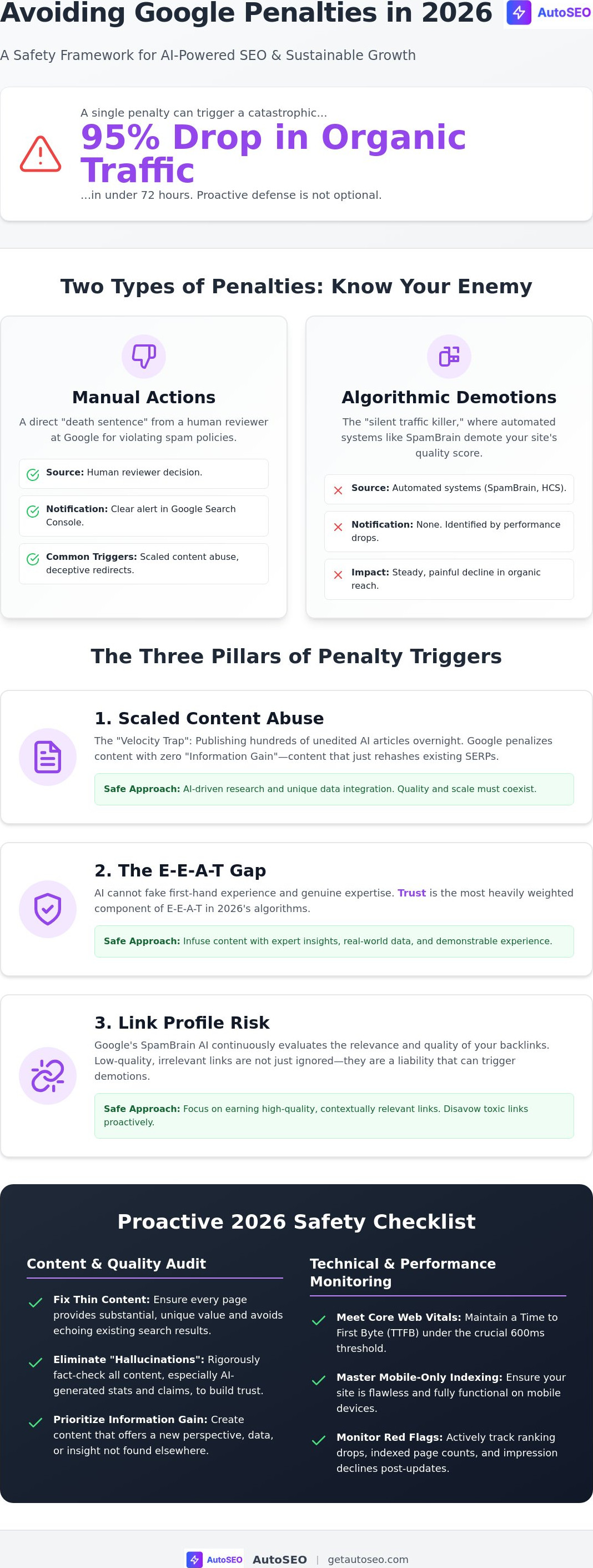
A Google penalty is either a direct human intervention or an automated software adjustment that suppresses your site's visibility. In the past, SEOs waited for massive quarterly updates to see if their strategies survived. That era is over. 2026 is the year of "Ongoing Evaluation," where Google’s systems assess your site in real-time. Understanding the difference between a manual action and an algorithmic demotion is the first step toward avoiding google penalties 2026. You might face a total site-wide de-indexing or just a demotion of specific pages. Panic is a useless response. Clarity is the solution.
Google issues approximately 750,000 manual penalties per month to combat web spam. When this happens, your traffic doesn't just dip; it vanishes. Statistics show that penalized websites typically lose between 50% and 95% of their organic traffic within 24 to 72 hours. This isn't a subtle shift in the market. It's an immediate threat to your business continuity that requires an aggressive, data-driven response.
Manual Actions: The "Death Sentence" for Domains
A manual action occurs when a human reviewer at Google determines your site violates their spam policies. You'll find these notifications instantly in the "Manual Actions" report within Google Search Console. In 2026, the primary triggers are scaled content abuse and deceptive redirects that hijack the user experience. The new spam policy targeting "back button hijacking," enforced since June 15, 2026, has already triggered a wave of these actions. These aren't suggestions; they're removals from the index. Fixing this requires a rigorous reconsideration request process. You must document every change, prove you've removed the offending content, and wait for a human to verify your compliance. It's a labor-intensive process that leaves no room for error.
Algorithmic Demotions: The Silent Traffic Killer
Most traffic drops aren't manual. They're algorithmic. Systems like SpamBrain and the Helpful Content System are now fully integrated into Google's core ranking engine. This evolution follows the path set by the Google Penguin algorithm update, which shifted the focus from manual list-clearing to automated quality detection. You won't get an email for an algorithmic demotion. You'll simply see a steady, painful decline in organic reach as your "quality score" drops. The June 2026 Spam Update, rolled out between June 24 and June 26, 2026, highlights how quickly these automated systems can re-evaluate global rankings across all languages. An Algorithmic Demotion is a continuous quality score adjustment that recalculates your rankings based on real-time signals of spam or low utility.
To stay safe, you must monitor your metrics for these three red flags:
- A sudden drop in rankings for your top-performing keywords without a manual action notice.
- A decrease in the "indexed pages" count in Search Console.
- A steady decline in impressions that correlates with recent core update dates.
The Three Pillars of Penalty Triggers in 2026
Google’s 2026 defense systems rely on three specific pillars to identify and demote low-quality sites. These aren't just minor checks; they're the foundational logic behind every modern core update. If you understand these pillars, you understand the roadmap for avoiding google penalties 2026. Ignoring them means leaving your traffic to chance. The history of Google algorithm updates shows a clear progression toward penalizing automation that lacks substance. Today, Google uses sophisticated AI to detect the "effort gap" in your content strategy.
Scaled Content Abuse and Publishing Velocity
The "Velocity Trap" is a primary red flag in 2026. Many small businesses make the mistake of publishing 1,000 pages of raw, unedited AI content overnight. This sudden spike triggers an immediate investigation by SpamBrain. Google doesn't penalize automation itself, but it does penalize content that provides zero "Information Gain." To stay safe, you need AI content creation that integrates deep research and unique data. Every page must offer something that doesn't already exist in the top 10 results. Quality and scale must coexist. If you're just echoing existing articles, you're building a house of cards that will collapse during the next core update.
The E-E-A-T Gap: What AI Cannot Fake
In 2026, "Trust" is the most critical component of E-E-A-T. The March 2026 Core Update significantly strengthened how Google evaluates first-hand experience. You can't just state facts; you must demonstrate that you've lived them. This is why our automated SEO platform focuses on research-driven articles that cite proprietary data and expert insights. The definition of what is seo has evolved. It's no longer just about keywords. It's about establishing a verified author identity and proving your expertise through comprehensive subject coverage. If your content lacks a human-in-the-loop quality signal, Google’s algorithms will eventually flag it as low-value.
Manipulative Link Building and SpamBrain
The third pillar is link integrity. In 2026, Google’s SpamBrain doesn't just penalize bad links; it often ignores them entirely, rendering your investment worthless. However, aggressive spikes in irrelevant, low-quality backlinks still trigger manual reviews. You need high-DA links that are contextually relevant to your niche. Relevance is the only currency that matters. A single link from a trusted industry publication is worth more than 5,000 generic directory links. Building a natural link profile is essential for avoiding google penalties 2026. We've built our system to handle this complexity for you, ensuring your growth remains sustainable and safe from algorithmic scrutiny.
Proactive Content Audit: A 2026 Safety Checklist
Prevention beats recovery. If you wait for a Manual Action notification, you've already lost. Use this systematic audit to secure your site against the automated scrutiny of Google’s latest core systems. This proactive approach is the core of avoiding google penalties 2026. You must audit your site with the same intensity as a Google quality rater. Every page that doesn't serve a clear purpose or provide unique value is a potential trigger for a site-wide demotion. Clarity and utility are your primary defenses.
Follow these five steps to ensure your content remains compliant with current standards:
- Identify Thin Content: Flag any pages that merely summarize existing search results without adding new data.
- Verify Factual Claims: Conduct a manual hallucination check on all AI-generated statements to maintain trust.
- Audit Meta Tags: Remove repetitive keyword strings in your meta descriptions and titles.
- Analyze Internal Links: Fix broken paths and ensure every link provides a relevant, logical connection for the user.
- Validate User Intent: Confirm that informational pages aren't cluttered with aggressive transactional calls-to-action.
Fixing the "Thin Content" Problem
Thin Content is content that adds no incremental value to the web. Google’s 2026 updates prioritize "Information Gain." If your page simply echoes the top three search results without adding new data or unique insights, it’s a liability. You need to provide more depth than the competition to remain visible. Merge redundant or overlapping pages to create comprehensive power pages. This consolidation builds a stronger seo automation foundation that Google rewards with higher authority scores. Quality always trumps sheer page count.
Technical Safety: UX and Core Web Vitals
Technical errors are now interpreted as trust signals. As of July 1, 2026, websites without a functional mobile version are excluded from the index entirely. This isn't a penalty; it's a total removal. Additionally, the March 2026 Core Update introduced stricter thresholds for Core Web Vitals that you must meet. Your Time to First Byte (TTFB) must be under 600ms, and your Largest Contentful Paint (LCP) should stay below 2.0s. High-performance small business seo relies on a clean technical foundation. Intrusive interstitials or poor mobile navigation will trigger quality demotions. Maintaining these technical standards is crucial for avoiding google penalties 2026 and ensuring your automation strategy remains effective.
Link Building Safety: Avoiding the 'SpamBrain' Radar
Link building in 2026 is no longer a game of volume. Google’s SpamBrain AI has evolved to a point where it doesn't just penalize low-quality links; it simply nullifies them. If your backlink profile consists of generic directory submissions or comment spam, you aren't just risking a penalty. You're wasting your budget on assets that Google ignores entirely. For small businesses, avoiding google penalties 2026 requires a shift from chasing quantity to securing high-relevance authority. Relevance is the only currency that prevents your site from being flagged as a "spam neighborhood."
The definition of what is link building has shifted toward authority-driven automation. Private Blog Networks (PBNs) are now a primary target for manual actions. Google’s algorithms can now detect the footprint of linked sites sharing hosting patterns, registration dates, or content themes with surgical precision. If you rely on these outdated tactics, a site-wide de-indexing is inevitable. You need a strategy that prioritizes natural acquisition and verified domain trust.
Quality over Quantity: The 100 DA Rule
Ten high-quality links from established industry publications will always outperform 1,000 links from low-authority blogs. This is the foundation of high-performance SEO. At AutoSEO, our platform builds 100 Domain Authority worth of backlinks safely by targeting sites with genuine traffic and topical alignment. This isn't about hitting a number. It's about building a trust signal that Google cannot ignore. Anchor text diversity is equally critical. Over-optimizing your anchor text with exact-match keywords is a 2026 red flag. We ensure your profile looks natural by mixing branded, naked URL, and topical anchors to keep you under the SpamBrain radar.
The Risk of Manual Outreach in 2026
Traditional manual outreach has become a liability. Generic email blasts for guest posts are now classified by Google as "Outreach Spam." If your domain is associated with high-volume, low-response email campaigns, your search visibility will suffer. Using a done for you seo service eliminates this risk by managing relationships with vetted publishers. We analyze referring domains for "neighborhood" quality before any link is placed. If a site links to gambling, pharma, or known spam hubs, it's excluded from our network. This level of scrutiny is essential for avoiding google penalties 2026. You deserve a backlink profile that acts as a shield, not a target.
Stop risking your domain with manual mistakes. Automate your link building safely with AutoSEO today.
Future-Proofing with Quality-First SEO Automation
Automation is not a risk; it is a necessity for growth. Google does not penalize the use of AI. It penalizes the "effort gap" left by businesses that use raw, unresearched generators. To remain competitive, you must close this gap with high-performance reliability. AutoSEO is engineered specifically for avoiding google penalties 2026 by automating the research process before the writing even begins. We don't just generate text. We analyze the current search landscape to ensure every article provides the unique "Information Gain" that Google’s March 2026 Core Update now demands.
Our "Research First" approach identifies exactly what the top-ranking competitors are missing. By filling these information gaps, your site becomes a primary source of authority rather than a secondary echo of existing content. This strategy protects you from the "thin content" flags that trigger algorithmic demotions. We also maintain a natural publishing rhythm that mimics organic human growth. This avoids the velocity traps that often lead to manual reviews, allowing you to scale your traffic without raising red flags. It is SEO on Autopilot that actually works.
Scaling Without Triggers
Google rewards expertise and first-hand experience. Every article our platform produces is designed as an expert-level "Explainer" or "How-to" guide. These formats naturally satisfy E-E-A-T requirements by focusing on utility and depth. Our automated WordPress publishing system follows every technical best practice, from schema markup to optimized meta tags. Leveraging ai for seo is the only way to manage a growing content library while maintaining 2026 quality standards. We ensure your automation strategy remains compliant so you can focus on running your business.
Next Steps: Your 2026 SEO Strategy
Transitioning from "Panic Mode" to "Autopilot Mode" is the smartest move you can make for your domain's health. Stop worrying about the next core update or the latest SpamBrain detection pattern. When you prioritize quality and scale simultaneously, you build a site that is resilient to algorithm shifts. You get the relief that comes from offloading complex, labor-intensive tasks to a superior, innovative tool. It's time to secure your rankings with a proactive, AI-safe framework. Start your $1 trial with AutoSEO today and experience sustainable organic growth without the fear of penalties.
Secure Your Search Dominance for 2026
Success in the current search environment requires moving beyond reactive fixes. You now have a complete framework for avoiding google penalties 2026 by prioritizing information gain and technical precision. By auditing your content for thin pages and securing relevant, high-authority links, you stay ahead of SpamBrain's automated filters. Google rewards consistency and depth; you can't afford to leave these to chance or manual labor.
AutoSEO provides the high-performance reliability you need to scale with confidence. Our platform publishes expert articles daily and includes 100 DA worth of backlinks to ensure your site meets every quality threshold. You get the relief of offloading complex audits to a system designed for measurable outcomes. This is Autopilot SEO that actually works, built for the modern SaaS landscape.
Don't wait for your traffic to drop before you take action. You can finally conquer the complexities of search engine optimization through the power of intelligent automation. Automate your SEO without the risk; start your $1 AutoSEO trial now. Your path to sustainable organic growth starts today.
Frequently Asked Questions
Will Google penalize my site for using AI-generated content in 2026?
Google does not penalize AI-generated content simply for being automated. It penalizes content that fails to provide unique value or "Information Gain." In 2026, the focus is on utility. If your AI content is just a rewrite of existing top-10 results, it will be demoted. Using research-driven automation is the key to avoiding google penalties 2026 while scaling your output effectively.
How can I tell if my website has been hit by a Google penalty?
You can identify a penalty by checking the "Manual Actions" report in Google Search Console. If that report is clear but your traffic has dropped by 50% to 95% within 72 hours, you've likely suffered an algorithmic demotion. Monitor your rankings daily. Sudden, massive declines usually indicate a violation of the June 2026 Spam Update or core quality standards.
What is "Scaled Content Abuse" and how do I avoid it?
Scaled content abuse is the practice of generating large volumes of pages to manipulate search rankings without providing original value. It’s a primary target for avoiding google penalties 2026. To avoid this, ensure every page includes expert-level research and proprietary data. Automation should bridge the "effort gap" by analyzing competitors and adding new insights rather than just repeating them.
Can I recover from a Google penalty if my site is de-indexed?
Recovery is possible but requires a complete audit. If de-indexed by a manual action, you must identify and remove all non-compliant content before submitting a Reconsideration Request. For algorithmic demotions, you must improve the overall quality of the site. Recovery usually takes weeks or months as Google’s systems re-evaluate your updated content signals and trust scores.
How many backlinks are safe to build per month in 2026?
Safety isn't about a specific count; it's about relevance and velocity. Building 1,000 low-quality links in a week is a red flag. However, building 100 DA worth of high-quality, contextually relevant links is a natural growth signal. Google’s SpamBrain now ignores irrelevant links, so focus your energy on securing a few authoritative placements that actually move the needle for your business.
Is it possible to automate SEO without triggering spam filters?
Yes, you can automate SEO safely by prioritizing quality over raw speed. The "Research First" approach mimics human editorial standards by analyzing the SERP before publishing. This ensures your automated articles provide genuine value. High-performance automation integrates with WordPress and follows all SEO best practices, making it indistinguishable from high-quality manual work to Google’s detection systems.
What is the role of E-E-A-T in preventing Google penalties?
E-E-A-T is your primary defense against quality-based demotions. Trust is the most important component in 2026. By demonstrating first-hand experience and expertise, you prove to Google that your site is a reliable resource. Content that lacks these signals is often flagged as "thin," especially during core updates that target low-utility sites. Quality and scale must coexist to satisfy these signals.
Does Google Search Console notify you of every penalty?
No. Google Search Console only sends notifications for manual actions. Algorithmic demotions happen automatically and silently. You won't receive an email if the Helpful Content System decides your site is low-value. You must rely on traffic monitoring and ranking audits to detect these shifts. Real-time data analysis is the only way to catch and fix demotions before they cause permanent damage.


