

If your automated SEO engine produces 30 articles a month but you are still buried in manual spreadsheets, is it actually saving you time? Most marketing leaders struggle with this contradiction. You know that 83% of your peers prioritize ROI above all else, yet you are likely drowning in complex data from tools that don't speak the language of profit. Learning how to track automated seo results shouldn't be a full-time job. You need a system that confirms your AI content is ranking and your link-building is driving real revenue.
We understand the fear that automation might be a black box. This guide promises to clear the fog. You will learn how to build a 5-minute weekly review process that proves your SEO on autopilot is working. We will show you how to leverage the latest GA4 AI Assistant tracking to see your visibility in chatbot searches. From navigating the June 2026 spam update to mastering new disclosure regulations, this is your blueprint for high-performance growth that actually works. We are moving past vanity metrics and focusing on the quality and scale that defines modern search success.
Key Takeaways
- Stop wasting time on vanity keyword counts and start measuring the conversion rates that prove your business is growing.
- Discover how to track automated seo results using a streamlined 2026 framework that prioritizes non-branded traffic and revenue impact.
- Use our 5-minute monthly checklist to verify a 5-10% growth in organic reach while auditing traffic intent.
- Monitor domain authority and content velocity as leading indicators to ensure your SEO engine stays ahead of competitors.
- Replace manual spreadsheets with automated reporting that delivers clear proof of ROI without the productivity drain.
Beyond Vanity Metrics: Why Most Owners Track the Wrong SEO Data
Most business owners celebrate when a keyword hits page one. They shouldn't. If that keyword doesn't open a wallet, it's a vanity metric. Automated SEO tracking is the process of monitoring the ROI of AI-driven content and link-building systems. It shifts the focus from simply "appearing" in search results to "earning" from them. You need to know if your automation is a profit center or just a digital paperweight.
Large corporations can afford to burn cash on vague brand awareness. Your small business cannot. Every dollar spent on automation must return more in gross profit. This is why knowing how to track automated seo results is a survival skill in 2026. You have less room for error, meaning your data must be exact and actionable. If your tracking doesn't point directly to a sale, it's a distraction.
Avoid the "App Trap" of fragmented tools. Logging into ten different dashboards to see your performance is a productivity killer. This data noise often hides the truth about your growth. High-performance SEO requires a single source of truth that connects your content output to your bottom line. To better manage the leads generated by your automation, you can learn more about Cadence CRM and how it streamlines your sales data. You don't need more data; you need the right data delivered instantly.
The Problem with 'Rankings Only' Thinking
Ranking #1 for "how to fix a faucet" is useless if you sell high-end plumbing fixtures. That is a low-intent keyword. You need "money keywords" that signal a ready-to-buy mindset. Success in Search Engine Optimization depends on matching your automated content to specific search intent. If your tracking doesn't distinguish between a curious reader and a qualified lead, you're measuring the wrong thing. Focus on the terms that drive appointments, calls, and checkouts.
Leading vs. Lagging Indicators in Organic Search
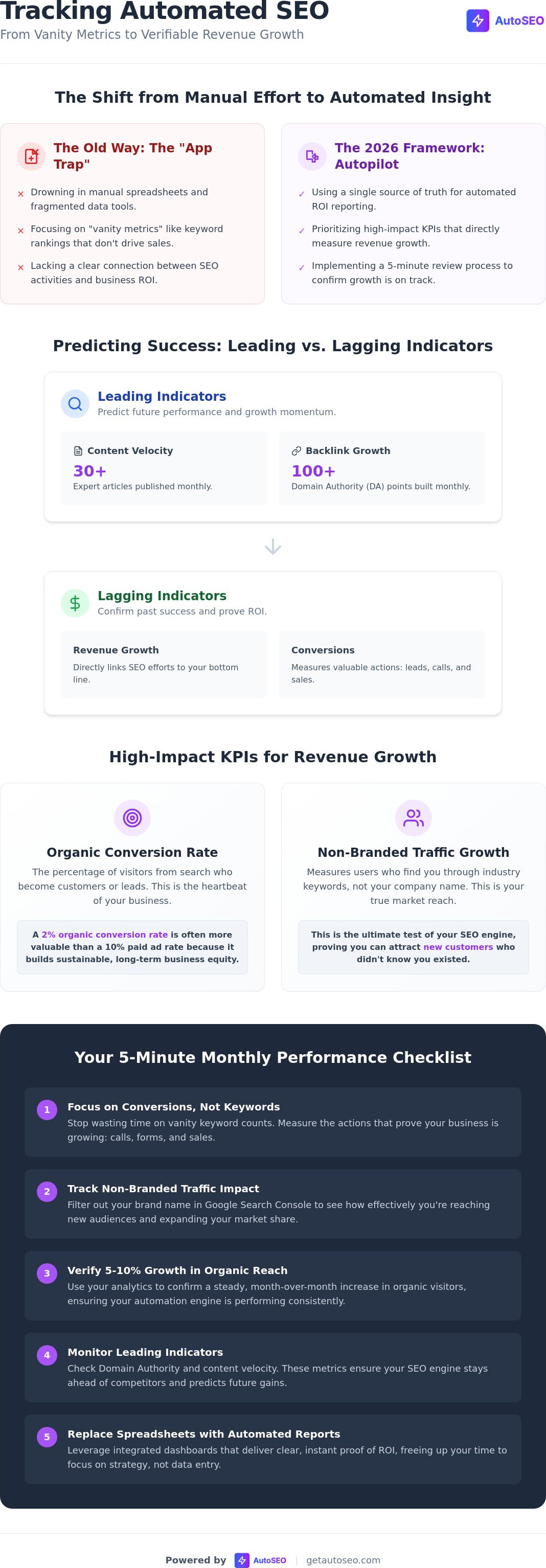
Revenue and conversions are lagging indicators. They tell you what happened last month. While they are the ultimate proof of success, they don't help you plan for next week. To scale, you must monitor leading indicators like content velocity and backlink growth. These metrics predict where your traffic will be in ninety days. When you understand how to track automated seo results, you see the connection between today's output and tomorrow's bank balance.
Our platform maintains your momentum by delivering 30 expert articles and 100 DA worth of backlinks every month. This high-velocity output ensures your leading indicators stay strong. You aren't just waiting for results; you are manufacturing them. Tracking this specific output allows you to see the engine working before the revenue hits the ledger.
Small businesses must balance immediate conversion data with growth-predicting metrics to ensure consistent, scalable revenue.
The 3 High-Impact SEO KPIs for Revenue Growth
You cannot manage what you do not measure. In 2026, high-performance SEO isn't about total clicks; it is about the quality of those clicks. To master how to track automated seo results, you must focus on three specific levers that dictate your bottom line. These metrics separate profitable automation from expensive experiments. They provide the clarity needed to scale your business without second-guessing your strategy.
Organic Conversion Rate: Turning Visitors into Leads
Organic conversion rate is the heartbeat of your business. It measures the percentage of visitors who take a specific action, such as filling out a contact form or purchasing a product. In Google Analytics 4 (GA4), you should set up "Thank You" page triggers to capture these events accurately. This allows you to see exactly which automated articles are generating revenue. While paid ads might boast a 10% conversion rate, those leads often vanish the moment you stop paying. A 2% organic conversion rate is often more valuable because it represents sustainable, recurring interest that builds equity over time. You should also monitor essential SEO elements like page load speed and mobile responsiveness, as these directly impact your ability to convert traffic into customers.
Organic Traffic Growth (Non-Branded)
Non-branded traffic is the ultimate test of your automation engine. This metric tracks users who find you through industry terms rather than your company name. To see your true performance, go to Google Search Console and filter out your brand keywords. This reveals how well you are reaching new customers who didn't know you existed. Focus on your top-performing content pillars. If your automated posts on "commercial roofing costs" are driving 80% of your new leads, you know exactly where to double down. Tracking the ratio of new versus returning users helps you understand if your content is attracting a fresh audience or simply recycling the old one. If you want to see these metrics move in real-time, you can start your $1 trial to begin scaling your output immediately.
Finally, monitor your Customer Acquisition Cost (CAC). Organic search should consistently be your lowest-cost lead source. In 2026, a healthy benchmark for small businesses is a 5-10% month-over-month increase in non-branded traffic. If your CAC from organic search is 50% lower than your paid search CAC, your automation is working. This data gives you the confidence to offload manual tasks and trust the system to deliver results. By focusing on these three KPIs, you ensure that your SEO on autopilot remains a high-performance asset rather than a mystery.
Technical Health and Visibility: The 'Leading' Indicators of Success
Leading indicators are the early signals that your strategy is working before the revenue hits your bank account. If you only look at sales, you're looking at the past. To stay ahead, you must monitor the metrics that predict future growth. Understanding how to track automated seo results requires a deep dive into your site's technical foundation and its standing in the eyes of search algorithms. You don't just wait for growth; you engineer it through consistent, high-velocity output.
Domain Authority and Backlink Profile
Think of Domain Authority (DA) as the credit score for your website. It represents your site's overall power and reliability. In 2026, quality backlinks remain the primary ranking factor because they serve as third-party verification of your expertise. You should track the growth of your referring domains every month. A steady increase in high-DA links signals to Google that your automated content is worth promoting. To understand the specific mechanics of this process, read our guide on What Is Link Building? The Autopilot Guide to Winning in 2026. Our system automates this by delivering 100 DA worth of backlinks monthly, ensuring your "credit score" never plateaus.
Visibility in the Age of AI Search
Search has evolved beyond a simple list of blue links. You must now track your brand's presence in AI Overviews and chatbot citations like ChatGPT or Gemini. These platforms prioritize high-authority, daily-updated content because it signals relevance and reliability in a fast-moving information market. If your brand isn't appearing in these AI-generated summaries, you're losing a massive share of the modern search market. How to track automated seo results in this context involves monitoring "share of voice" within AI responses.
Content velocity is your secret weapon here. In 2026, publishing daily is the new standard for maintaining visibility. By producing 30 expert articles per month, you provide the fresh data that AI search engines crave. Optimization now focuses on natural language patterns rather than rigid keyword stuffing. Use these leading indicators to stay agile:
- Content Velocity: Ensure your platform is publishing at least one high-quality article every 24 hours.
- AI Citations: Use specialized tracking tools to see if your site is a primary source for AI-generated answers.
- CTR for Meta Tags: Monitor your click-through rate in Search Console to ensure your automated titles are compelling to humans, not just bots.
When you maintain high content velocity and a robust backlink profile, you create a defensive moat around your rankings. This technical health ensures that when search algorithms update, your site remains a trusted authority. This is high-performance SEO on autopilot that actually works.
The 2026 Small Business SEO Performance Checklist
Consistency is the engine of growth. You can't rely on sporadic check-ins if you want to dominate search in 2026. This checklist provides a rigorous schedule for how to track automated seo results without getting lost in the weeds. By breaking your monitoring into weekly, monthly, and quarterly tasks, you maintain a high-performance rhythm that mirrors the speed of our automation platform. It's about verifying that your SEO on autopilot is delivering the quality and scale your business demands.
- Weekly: Verify your content velocity. Ensure your site is publishing at least 7 to 8 expert articles. Our platform automates 30 articles per month, but a quick weekly check ensures the WordPress sync is active.
- Weekly: Monitor new backlink acquisitions. Confirm you are on track to hit the 100 DA monthly growth target.
- Monthly: Review non-branded organic traffic. You should aim for a 5-10% month-over-month increase. This proves you are reaching new prospects.
- Monthly: Audit your organic conversion rate. High traffic is useless if it doesn't result in leads or sales.
- Quarterly: Calculate your total ROI. Compare your SEO spend against the revenue generated from organic traffic to prove the system's value.
If you want to stop manual data entry and start scaling your results immediately, start your $1 trial and let our platform handle the heavy lifting for you.
Setting Your 2026 SEO Benchmarks
Good results vary by business model. A local service business, like a law firm or HVAC company, might see lower total traffic but should expect a conversion rate of 5% or higher. Conversely, an e-commerce site requires massive traffic volume but may operate successfully at a 1-2% conversion rate. Use your historical data to identify seasonal trends. Don't panic during a standard industry dip; instead, use those periods to double down on content velocity to prepare for the next peak. High-performance specialists use these benchmarks to predict year-end growth patterns with precision.
The 'Red Flag' Checklist
Watch for these three warning signs that your strategy needs adjustment. First, if your rankings drop on high-intent "money" keywords while total traffic rises, you are winning on fluff but losing on profit. Second, high traffic with declining conversion rates suggests an intent mismatch. Your automated content might be too broad. Third, stagnant Domain Authority despite consistent content efforts indicates your backlink profile isn't growing fast enough. If you spot these issues, it's time to refine your automation to ensure you're using a system that actually works.
SEO on Autopilot: Tracking Growth Without the Manual Work
The transition to automation allows you to offload the most labor-intensive parts of search engine optimization. Instead of wondering if your strategy is working, you rely on a platform that executes the work and provides the data simultaneously. This "Done For You" approach ensures that your organic growth remains consistent, regardless of how busy your schedule becomes. You gain the relief of knowing your digital presence is expanding while you focus on high-level operations. This is the only way to compete with enterprise-level competitors who have massive, dedicated marketing teams.
Automating the Hardest KPIs
AutoSEO eliminates the struggle of maintaining content velocity and domain authority. Our platform manages your output by publishing 30 expert articles every month directly to your WordPress site. This consistent pulse keeps your site relevant to both human readers and AI search engines. Simultaneously, we scale your authority by building 100 DA worth of high-quality backlinks every month. You can learn more about how this works by reading about our AI Content Creation: Your 24/7 SEO Writing Team on Autopilot. By automating these difficult KPIs, you ensure that your leading indicators always point toward growth.
Winning in 2026 with SEO Automation
In 2026, the gap between successful small businesses and their struggling peers is defined by efficiency. Automation acts as the ultimate equalizer. It allows you to maintain the quality and scale of a much larger organization at a fraction of the cost. You no longer need to worry about how to track automated seo results through manual entry because the results are visible in your bottom line. The software handles the rankings, the backlinks, and the content. You simply review the revenue. This is SEO on autopilot that actually works.
Ready to put your growth on autopilot and see real revenue impact? Start your $1 AutoSEO trial today and stop wasting time on manual SEO tasks.
Take Control of Your SEO Revenue
Search in 2026 moves too fast for manual spreadsheets. You've learned that vanity metrics like keyword counts are distractions. Real growth lives in your organic conversion rate and non-branded traffic. By focusing on leading indicators like domain authority and content velocity, you can predict your revenue months in advance. Mastering how to track automated seo results is the final step in reclaiming your time and ensuring your marketing budget works as hard as you do.
You don't need to be a data scientist to win. You need a system that delivers quality and scale without the overhead. Our platform publishes 30 expert articles every month and builds 100 DA worth of backlinks to ensure you rank on Google and AI search engines instantly. It's time to stop the manual data entry and start seeing the proof in your bank account. Scale your SEO on Autopilot with AutoSEO today. You have the tools to dominate your market; now it's time to use them.
Frequently Asked Questions
What are the most important SEO KPIs for a small business?
Focus on organic conversion rate, non-branded traffic, and content velocity. These metrics directly correlate with revenue growth and market share. While keyword rankings provide a general sense of visibility, they don't guarantee profit. High-performance businesses prioritize the data that proves their automation is attracting ready-to-buy customers rather than casual browsers.
How long does it take to see results in automated SEO KPIs?
Leading indicators like content velocity and indexation rates improve instantly as soon as you start your high-velocity output. However, lagging indicators such as organic traffic and revenue typically require 90 days of consistent activity to show significant trends. Understanding how to track automated seo results involves monitoring these early signals to predict future financial gains.
Is organic traffic more important than keyword rankings?
Organic traffic is far more valuable because it represents actual users visiting your website. A #1 ranking for a low-intent keyword is a vanity metric that doesn't pay the bills. You should prioritize non-branded organic traffic growth. This metric proves that your content is successfully reaching new prospects who weren't already searching for your specific brand name.
How do I calculate the ROI of my automated SEO efforts?
Calculate your ROI by subtracting the total cost of your SEO platform from the revenue generated by organic conversions. Divide that number by the cost of the platform and multiply by 100. This provides a clear percentage of your return. This calculation is the most direct way to prove that your SEO on autopilot is a profitable asset for your business.
What is a good conversion rate for organic traffic in 2026?
A healthy conversion rate for most service-based small businesses ranges between 2% and 5%. E-commerce brands often see success with rates between 1% and 2% due to higher traffic volumes. If your rate falls below these benchmarks, your content might be attracting the wrong audience. You must ensure your automated articles target high-intent "money" keywords to maximize your return.
Can I automate my SEO KPI tracking and reporting?
Yes, you can and should automate your reporting to save time. Most modern platforms integrate directly with Google Analytics 4 and Search Console to provide real-time dashboards. This is a critical part of how to track automated seo results without manual data entry. Automation ensures you stay focused on high-level strategy while the software handles the tedious documentation of your growth.
What is the difference between branded and non-branded traffic?
Branded traffic comes from users who search for your specific company name. These are usually existing customers or referrals. Non-branded traffic comes from users searching for industry terms or solutions. This second category is the true measure of SEO success. It shows your ability to capture new market share and introduce your business to people who didn't know you existed.
How many backlinks do I need to improve my Domain Authority?
Quality and consistency matter more than raw numbers. Building 100 DA worth of high-quality backlinks every month creates a steady upward trend in your site's authority. A single link from a high-authority site is often more valuable than dozens of low-quality links. Our platform automates this process to ensure your "digital credit score" grows at a predictable and sustainable pace.


