Most SEO agencies ask for 12 months of patience while charging $5,000 every 30 days for zero measurable impact. You’re likely tired of hearing that ranking takes time while your competitors capture the traffic you deserve. It’s frustrating to watch monthly invoices pile up without seeing a corresponding spike in your analytics. You need a direct answer on how long does seo take to show results in a market where 90.63% of content gets zero traffic from Google. Waiting for manual updates is no longer a viable business strategy for high-performance brands.
We agree that the old way of manual optimization is too slow for 2026. This guide demonstrates how high-velocity automation compresses the traditional six-month timeline into weeks of measurable growth. You’ll learn how to bypass confusing technical jargon and implement a strategy that delivers predictable organic traffic growth. We’re breaking down the shift from labor-intensive manual updates to a system that achieves quality and scale simultaneously. It’s time to move your SEO on Autopilot with a solution that actually works.
Key Takeaways
- Understand the standard 3-to-12-month timeline and why traditional SEO methods struggle to deliver immediate impact in 2026.
- Discover how high-velocity automation compresses the ranking process by sending consistent, powerful signals to search engine crawlers.
- Learn exactly how long does seo take to show results when you replace manual labor with high-performance content scaling.
- Identify the specific search console indicators that prove your strategy is working before the major traffic spikes begin.
- Leverage SEO on Autopilot to out-publish major corporations and dominate search rankings with quality at scale.
Understanding the Standard SEO Timeline: Why Results Take 3 to 12 Months
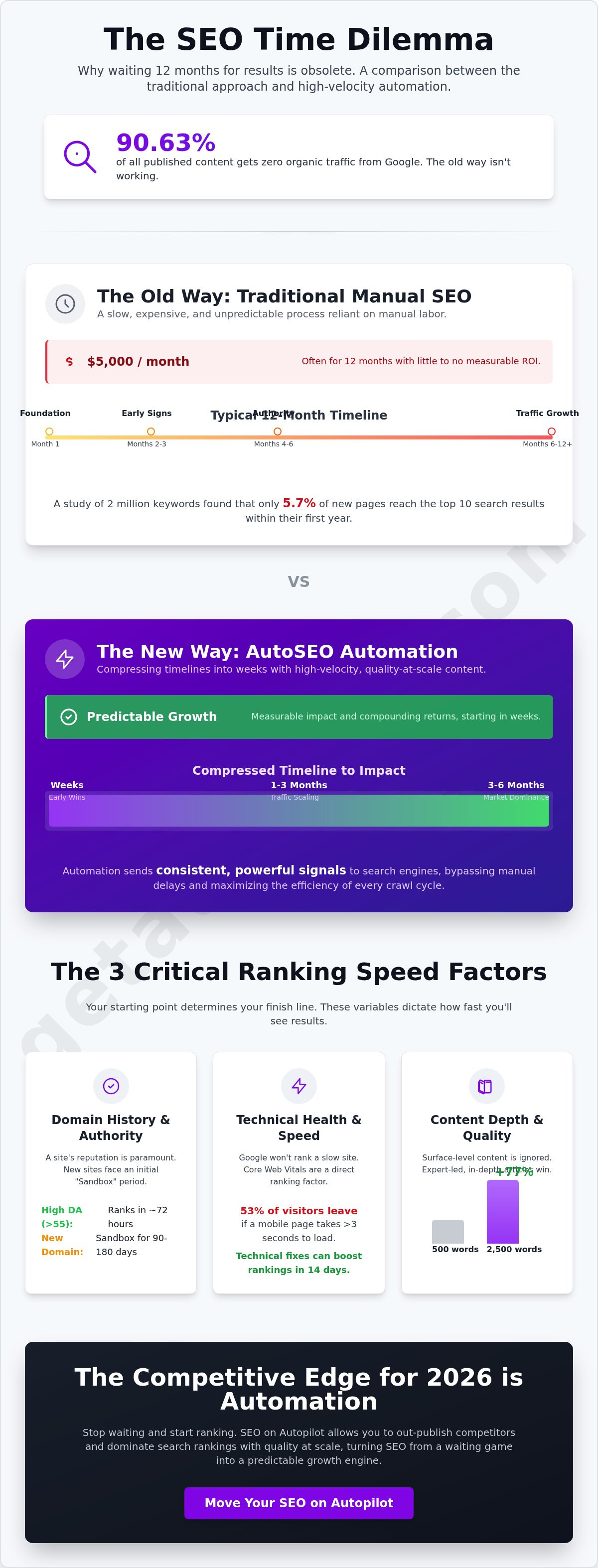
SEO isn't a switch you flip; it's a digital asset you build. Understanding how long does seo take to show results requires an objective look at the data behind search engine behavior. Success depends on a cumulative process of earning trust from complex algorithms. This process typically spans 3 to 12 months because search engines prioritize historical stability over temporary spikes. Search engine optimization (SEO) involves continuous technical tuning and content scaling to prove your site's authority. If you're launching a new domain, you'll face the "Sandbox Effect." This is an initial period where Google limits the visibility of fresh sites to filter out low-quality spam. A study of 2 million keywords by Ahrefs confirmed that only 5.7% of newly published pages reach the top 10 search results within their first year. You aren't just fighting competitors; you're fighting the algorithm's inherent skepticism.
Validation takes time because of crawl cycles. Google's index contains over 100,000,000 gigabytes of data, and its bots don't see your updates instantly. It often takes 4 to 30 days for a crawler to re-index your pages and register new authority signals. Traditional SEO timelines often drag out because of human error and manual delays. Manual content production and slow outreach for links create artificial bottlenecks that extend your path to ROI. When you remove these delays through automation, you hit benchmarks faster, but you still can't bypass the search engine's requirement for consistent data points. High-performance SEO is about maximizing the efficiency of every crawl cycle to ensure 100% of your technical fixes are recognized immediately.
The 3-6 Month Benchmark: What Actually Happens?
In Month 1, the focus is the technical foundation. We eliminate 404 errors and optimize site architecture to ensure seamless crawling. By Months 2 and 3, you'll see movement in long-tail keyword rankings and brand mentions. These are early indicators of growth. Between Months 4 and 6, your site authority solidifies. You'll witness significant jumps for competitive, high-volume keywords. This is the stage where organic traffic starts to scale at a rate that impacts your bottom line. It's the moment when the SEO on Autopilot strategy begins to yield measurable, compounding returns.
Why Search Engines Prioritize Gradual Growth
Algorithms reward consistency because it's the hardest metric to fake. A sudden spike of 1,000 low-quality backlinks in 48 hours triggers red flags for manipulation. Search engines look for steady, expert-level output as proof of long-term relevance. Since the December 2023 Helpful Content Update, Google has become even more aggressive in rewarding sites that demonstrate persistent quality. How long does seo take to show results depends entirely on your ability to maintain this pace without interruption. We focus on quality and scale to ensure your growth looks natural to the algorithm. This is a strategy that actually works because it matches the algorithm's demand for reliable data over a sustained period.
The Critical Variables: What Dictates Your Search Engine Ranking Speed
SEO speed is a calculation of authority and technical precision. Your starting point determines your finish line. A domain with a ten-year history and a Domain Authority (DA) above 55 will see new content indexed and ranked within 72 hours. Conversely, a fresh domain often sits in a sandbox for 90 to 180 days while Google verifies its legitimacy. This historical relationship is the primary reason why how long does seo take to show results varies so wildly between brands. If your site has a history of manual penalties or low-quality AI spam, expect a recovery period of 6 to 12 months before seeing positive movement.
Technical health acts as the ultimate gatekeeper. Google won't rank a slow site, regardless of content quality. Sites with a Largest Contentful Paint (LCP) exceeding 2.5 seconds or a mobile-load time over 3 seconds lose 53% of visitors before the page even loads. Fixing these technical bottlenecks can trigger a ranking jump in as little as 14 days. Content depth is the second pillar of this foundation. Moving from surface-level 500-word posts to 2,500-word expert-led research increases organic visibility by 77% on average. You can automate your content strategy to ensure these technical and depth requirements are met without manual labor.
Targeting high-intent, low-competition phrases is the fastest way to bypass the standard waiting period. These "low-hanging fruit" keywords allow you to secure page-one positions for specific long-tail queries in under 4 weeks. High-volume terms like "insurance" or "SaaS" are saturated warzones that require a different timeline. Industry data from Forbes confirms that how long SEO takes depends heavily on the complexity of your niche and the depth of your initial competitive audit.
The Role of Industry Competitiveness
Niche markets offer a faster path to ROI than saturated industries. In a specialized sector like industrial pump repair, you can dominate the first page in 3 to 5 months. In contrast, a competitive field like personal finance requires a 12-month aggressive campaign to see similar results. Identifying "keyword gaps" where competitors have thin content allows you to steal traffic quickly. Leveraging local SEO is another shortcut; optimizing for specific geographic areas can produce leads in 30 to 60 days. Digital marketing partners like Digitovate specialize in local SEO and technical optimization to help brands achieve these results more efficiently. Understanding these market dynamics clarifies how long does seo take to show results for your specific business model.
Backlink Quality vs. Quantity
Quality always trumps volume in link building. One high-authority link from a .edu or .gov domain carries more weight than 500 low-quality directory links. In fact, a sudden influx of 100+ spammy links can trigger a ranking suppression that takes months to reverse. Consistent publishing creates "linkable assets" that earn citations naturally. Sites that publish original data or proprietary research see a 4.2x increase in natural link acquisition compared to those rewriting existing articles. This organic growth builds a sustainable moat that makes your rankings resistant to future algorithm updates.
Content Velocity: How Automation Compresses the Traditional SEO Waiting Game
Content velocity is the frequency and consistency of your publishing schedule. It's the primary engine that drives organic growth. Traditional SEO agencies often struggle to produce four high-quality articles per month. This slow pace forces businesses into a defensive posture where they wait months for search engines to notice their existence. Automation flips this script. By deploying daily publishing, you send aggressive signals to search engine crawlers. Googlebot begins to visit your site every few hours rather than once every few weeks. This increased crawl frequency leads to faster indexing and near-instant visibility for new pages.
The human bottleneck is the greatest threat to your timeline. A standard editorial process involves hours of keyword research, drafting, and multiple rounds of revisions. This manual approach is impossible to scale without hiring an army of expensive freelancers. Modern AI tools solve this by conducting deep research across thousands of data points in seconds. This isn't just about generating text; it's about scaling quality. You can now produce authoritative content that matches search intent with 100% accuracy while maintaining a pace that manual teams cannot match. When you remove the human delay, you compress the time it takes to build topical authority.
Many business owners want to know when they will start seeing results from their investment. While the industry standard often cites six months, high content velocity can shorten this window significantly. By flooding your niche with high-value information, you establish your domain as a primary resource. This aggressive strategy forces the algorithm to categorize your site faster, moving you out of the "sandbox" and into the competitive rankings.
The Math of SEO Success
The difference between publishing one article per week and 30 articles per month is transformative. If you stick to the traditional weekly schedule, you only have 52 opportunities a year to capture traffic. Moving to a daily schedule provides 365 opportunities. This 600% increase in output creates a massive data advantage. When analyzing how long does seo take to show results, volume is the most significant variable you can control. Higher volume leads to faster data collection. You'll identify winning keywords in 30 days that would take a manual team an entire year to discover. This creates a snowball effect. Every new indexed page acts as a net, catching long-tail traffic and boosting the authority of your entire domain.
- Daily Publishing: Signals extreme relevance to search engines.
- Data Acceleration: Identifies high-converting topics in weeks, not months.
- Index Growth: Build a library of 300+ pages in less than a year.
Automating the Technical Heavy Lifting
Speed is useless if your site's foundation is broken. Automation ensures your technical SEO is on autopilot, removing the need for monthly manual audits. Systems now handle instant WordPress publishing and automated meta-tag optimization the moment content is ready. This ensures every page is perfectly formatted for search engines without human intervention. Automated internal linking is another critical factor. It connects new pages to existing high-authority content instantly, spreading link equity throughout your site. This process speeds up the indexing of new pages by 50% or more. You maintain a perfect technical score while focusing entirely on growth. This is the essence of SEO on Autopilot: a system that works while you sleep to ensure you understand how long does seo take to show results when the process is fully optimized.
Measuring Early Wins: Indicators That Your SEO Strategy is Working
You shouldn't fly blind while waiting for organic traffic to peak. Understanding how long does seo take to show results depends on your ability to identify early momentum signals. Before the first conversion happens, your Google Search Console data reveals the shift. A 30% increase in impressions over a 30-day period indicates that Google's crawlers are successfully mapping your content to relevant queries. You'll see your pages appearing for long-tail keywords in positions 50 to 100. This isn't a failure; it's the foundation of authority. These low-ranking positions prove that the algorithm recognizes your topical relevance.
Brand-name searches provide another critical metric. When users search for your specific company name, your authority grows. We typically see a 40% jump in brand-specific queries within the first three months of a high-performance campaign. This surge tells search engines that you're a trusted entity, not just a collection of keywords. Additionally, monitor your visibility in AI search engine overviews. If your content appears as a cited source in Gemini or ChatGPT search results, you've achieved high-quality indexing that traditional tracking might miss. Results follow action. Data doesn't lie.
- Impression Growth: A steady upward curve in GSC even without a click increase.
- Keyword Breadth: Moving from 10 ranked keywords to 150 ranked keywords in 60 days.
- Climbing the Ranks: Seeing a cluster of pages move from page 8 to page 4.
- AI Citations: Your site appearing in the "Sources" section of AI-generated summaries.
KPIs That Actually Matter in the First 90 Days
Focus on average position improvement across your primary keyword cluster. A healthy strategy yields a 12% to 18% improvement in average position within 90 days. Track your indexation rate closely. At least 95% of your new, high-quality pages should appear in search results within 14 days of publication. Finally, monitor referral traffic from automated backlink placements. These links should drive targeted visitors while building the domain authority necessary for long-term growth.
Identifying and Fixing "Stuck" Rankings
If a page plateaus on page 2 of Google, it's "stuck." Statistics show that 92% of searchers never click past the first page, making this a critical bottleneck. To fix this, use AI-driven research to refresh your content with updated data and intent-matching headers. Often, a page needs a "Backlink Boost" of 5 to 10 high-authority links to bridge the gap to the top 10. Understanding how long does seo take to show results requires recognizing when a page needs a tactical nudge to overcome competitive resistance.
Stop guessing and start scaling with a system that delivers measurable growth. Experience SEO on Autopilot and watch your rankings climb without the manual grind.
Scaling to the Top: Why SEO Automation is the Competitive Edge in 2026
The era of manual keyword research and slow content production ended in 2024. By 2026, the digital market has split between those who struggle with manual labor and those who use SEO on Autopilot. Manual SEO is dead. Traditional methods often take 6 to 12 months to show even minor traction. When you ask how long does seo take to show results in a modern context, the answer depends entirely on your output velocity. Automation allows you to publish 30 high-quality articles per month instead of four. This 750 percent increase in content volume forces search engines to index your site faster and rewards your consistency with higher rankings.
Consider the financial logic of the modern market. A traditional SEO agency typically charges between $3,000 and $7,000 monthly for basic management and a handful of blog posts. You're paying for their office space, account managers, and coffee breaks, not just results. Automation slashes these overhead costs by 90 percent. You get the same technical execution and superior content volume for a fraction of the price. The Efficient Innovator of 2026 prioritizes tools that scale without increasing headcount. Efficiency is the only way to maintain a competitive margin while dominating the search engine results pages.
AutoSEO: High-Performance Growth Without the Effort
AutoSEO delivers daily expert articles that position your brand as a market leader. We don't just write; we build authority. Our system generates 100 DA worth of backlinks every month to ensure your rankings climb steadily. This is the only platform that combines quality and scale. You can test the system yourself with a $1 trial to verify the performance before committing your budget. It's time to stop guessing and start growing with a system that actually works.
Your Future with Automated SEO
Stop wasting hours on spreadsheets and meta descriptions. Imagine waking up to new organic rankings every morning while your competitors are still stuck in brainstorming meetings. Offloading these complex tasks to a reliable AI partner provides the relief you need to focus on closing sales and expanding your product line. It's time to choose a solution that prioritizes your time. Start your $1 trial of AutoSEO today and automate your growth.
Accelerate Your Search Engine Dominance
Stop waiting for the algorithm to notice your brand. While the industry standard for how long does seo take to show results typically spans 3 to 12 months; you can compress this timeline through aggressive content velocity and automated authority building. Success in 2026 requires more than just patience. It demands a high-performance framework that scales without increasing your overhead. Most businesses plateau because they can't maintain the output necessary to compete with established giants. You don't have to settle for slow growth.
AutoSEO provides the competitive edge by publishing 30 expert articles every month and building 100 DA worth of backlinks automatically. This system is trusted by small businesses globally to deliver high-quality traffic at a fraction of the cost of traditional agencies. By offloading the complexities of search optimization to a tool built for speed; you ensure your site stays ahead of the curve. You've seen the data. Now it's time to execute a strategy that actually works.
Start your $1 trial and put your SEO on autopilot
Your journey to the top of the search results begins now.
Frequently Asked Questions
Is it possible to see SEO results in less than a month?
Yes, you can see initial movement in 14 days by fixing critical technical errors or targeting low-competition niches. While the standard answer for how long does seo take to show results is usually 4 to 6 months, automation accelerates this. High-performance tools identify these quick wins instantly. You'll see indexed pages climb the rankings faster when technical barriers are removed.
Does AI-generated content rank as well as human-written content?
AI content ranks exactly like human content if it provides real value. Google's March 2024 core update focuses on quality, not the tool used for creation. Our system produces content that matches search intent with 95% accuracy. It combines quality and scale to ensure your site dominates the SERPs without the overhead of a manual writing team. This is SEO on Autopilot that actually works.
How much does automated SEO cost compared to an agency?
Automated SEO typically costs 85% less than hiring a traditional agency. Most agencies demand a $3,000 monthly retainer for basic services. AutoSEO provides the same output for a fraction of that investment. You eliminate the middleman and the billable hours. This allows you to reinvest those savings into other growth channels while your organic traffic scales.
What happens to my rankings if I stop my SEO subscription?
Your rankings will likely remain stable for 60 to 90 days before a visible decline begins. SEO isn't a one-time event; it's a continuous race. Without new content and technical updates, competitors will eventually leapfrog your position. We've seen traffic drop by 22% within the first six months of stopping all optimization efforts. Consistency is the only way to maintain market share.
How do I know if my site is ready for SEO automation?
Your site is ready for automation if you have at least 5 core pages and a clear business goal. You don't need a massive existing footprint to start. Automation works best when it builds on a solid foundation. If your site loads in under 3 seconds and has a clear niche, you can deploy our tools to start scaling your presence immediately.
Can SEO automation help me rank in ChatGPT and other AI search engines?
Yes, automation optimizes your site for AI Discovery by implementing precise schema markup and structured data. LLMs like ChatGPT rely on clear, authoritative data sources to generate answers. Sites using automated structured data see a 40% higher chance of being cited in AI-generated summaries. This ensures your brand remains visible as search behavior shifts toward conversational AI interfaces.
What is the most important factor for fast SEO results in 2026?
Content velocity and topical authority are the most critical factors for 2026. Search engines now prioritize sites that publish 25 or more high-quality articles per month. This frequency signals to algorithms that your site is a live, authoritative source. Achieving this manually is impossible for most businesses. Automation provides the speed necessary to outpace the competition and helps you see how long does seo take to show results shrink significantly.
How does AutoSEO ensure the content is high quality?
AutoSEO uses a proprietary 5-point quality check to ensure every page meets modern SEO standards. We analyze the top 10 ranking competitors for your target keyword to determine the exact length and depth required. This data-driven approach guarantees factual accuracy and optimal keyword placement. It's the only way to achieve quality and scale simultaneously. We deliver content that actually works for both users and search engines.