

Most marketing retainers in this industry don't sign new properties; they generate tenant repair calls. If you're investing in seo for property management companies, you already know the frustration of ranking for irrelevant search terms while national franchises bury you on page two and capture the best local property owners.
Adding doors requires attracting serious real estate investors, not fielding complaints about maintenance tickets. Winning those lucrative contracts demands relentless topical authority across every sub-market you manage. Unfortunately, internal bandwidth is limited, and manual content creation moves too slowly to outpace competitors in organic search.
This guide shows you how to dominate search results, outrank regional competitors, and sign property owner contracts on autopilot. You'll discover how to secure top rankings in the Google Local Map Pack, get cited by generative AI engines, and scale your local reach without operational overhead. Here is the exact blueprint to turn organic visibility into your most predictable door-acquisition channel.
Key Takeaways
- Executing high-yield seo for property management companies requires filtering out tenant traffic and targeting investors searching for rental yields, fee structures, and eviction laws.
- Secure top rankings in the Google Local Map Pack by combining hyper-local Google Business Profile optimization with continuous, high-authority backlink building.
- Build compounding topical authority across every managed sub-market by consistently publishing search-optimized content tailored to property owners.
- Replace slow, expensive agency retainers with automated execution systems that scale organic traffic and sign contracts on autopilot.
Why Traditional SEO Fails Property Management Companies
Most digital agencies treat property management like any other local service. They run a basic audit, target search terms with high monthly traffic, and celebrate vanity impressions. This broken framework wrecks your operations. Effective Search Engine Optimization (SEO) requires surgical alignment between search intent and business value. When agencies target general real estate traffic, they optimize for volume instead of revenue.
Generic campaigns routinely target phrases like "cheap apartments for rent" or "pet-friendly two-bedroom rentals." That traffic looks impressive inside a monthly report, but it generates zero doors. Instead, your front desk drowns in tenant maintenance calls, application questions, and vendor inquiries. Your operational overhead spikes while your sales pipeline starves. High-performing seo for property management companies requires an intentional filter that deflects tenant volume and isolates commercial investor intent.
The Critical Difference Between Owner Intent and Tenant Queries
Search engines index intent, not just words. Property investors search with commercial friction. They search terms like "average property management fees in [city]" or "local eviction process for landlords." These queries signal a customer ready to outsource asset management.
- Tenant queries drain capital: Ranking for terms like "apartments under $1,500" forces your team to filter thousands of unqualified prospects, burning operational hours for zero new contracts.
- Investor queries drive contracts: Targeting commercial keywords attracts landlords experiencing operational fatigue, vacancy anxiety, or regulatory headaches.
- Intent-based site architecture: Structuring pages around fee transparency, tenant screening protocols, and local rent regulations filters out renters while converting landlords.
Why Traditional Agency Retainers Drain Property Management Budgets
Traditional marketing retainers move too slowly to compete. Legacy agencies charge thousands every month to produce two generic blog posts and a templated performance spreadsheet. Their lengthy onboarding cycles drag on for months before any content actually goes live.
Manual production cannot build the local topical authority required in competitive markets. Real estate markets move fast, and Google demands deep, continuous topic coverage across every neighborhood you serve. Drip-feeding two articles a month leaves your site vulnerable to agile competitors and regional brands. Manual execution creates high costs and slow delivery, leaving your business stranded on page two.
How to Build an Owner-Generating SEO Strategy: Step-by-Step
Executing predictable acquisition requires an intentional framework. Ranking on the first page happens when you build a structured content engine that satisfies both algorithmic requirements and property investor intent. The residential sector represents 84.6% of property management industry revenue, making localized investor acquisition your most profitable growth channel. Follow this execution framework to transform seo for property management companies into a predictable contract pipeline.
Step 1: Keyword Research Focused on Landlords and Real Estate Investors
Target search terms that signal operational headaches or property acquisitions. Landlords search for answers when dealing with non-paying tenants, city compliance updates, or portfolio expansion.
- Transactional queries: Target buyer-intent terms such as "best rental property managers in [city]" and "commercial property management companies near me."
- Informational compliance terms: Answer technical regulatory queries, including state rental inspection checklists, security deposit return windows, and local eviction timelines.
- Asset-specific variations: Build separate keyword clusters for single-family portfolios, multi-family complexes, and commercial strip centers.
Step 2: Architecture for Multi-City and Neighborhood Landing Pages
Don't stop at a single city-level landing page. True geographic dominance requires building individual URLs for every operational suburb, municipality, and distinct neighborhood in your market. Each landing page must feature distinct sub-market rental rates, local school district boundaries, and municipal licensing requirements. Link these sub-market pages directly to your primary metropolitan service hub using contextual anchor text to distribute page authority evenly.
Step 3: Scaling Content That Converts Landlords into Signed Contracts
Search engines reward topical depth that proves hands-on operational authority. Publish detailed breakdowns covering lease agreement clauses, preventive maintenance markups, and thorough tenant vetting standards. Referencing guidelines established by the National Association of Residential Property Managers signals deep professional credibility to both search crawlers and sophisticated landlords.
Every article must solve a tangible operational problem. If an owner searches for guidance on lease enforcement, deliver a thorough breakdown, then present your full-service management as the turnkey alternative. To scale high-intent publishing across dozens of localized markets without expanding internal overhead, you can run SEO on autopilot to continuously publish research-backed content directly to your site.
Local SEO and High-Authority Link Building for Regional Dominance
Dominating your local market requires more than just publishing pages. Search algorithms demand proof that your brand actually operates as an established local authority. When prospective clients seek out seo for property management companies, the top three Google Map Pack positions capture the vast majority of calls. Securing these spots requires balancing on-page relevance, regional signals, and continuous link acquisition.
Dominating the Google Map Pack in Your Service Areas
Your Google Business Profile serves as your direct conversion asset. Local algorithm signals weight Google Business Profile elements at 32% to 36% of ranking impact, making it your highest-priority local asset.
- Category precision: Set your primary category strictly to "Property Management Company" rather than generic real estate terms.
- Landlord reviews: Collect reviews specifically mentioning owner services. Testimonials highlighting low vacancy days and smooth rent disbursement carry far more commercial weight than tenant reviews.
- Citation uniformity: Match your Name, Address, and Phone data across core registries. Discrepancies between your site and public directories dilute algorithmic confidence.
Building Powerful Backlinks That Signal Industry Authority
You cannot defend first-page rankings with localized citations alone. Traditional links still account for 13% to 15% of local ranking factors. Understanding what is link building clarifies why inbound equity matters: links from recognized regional publications and real estate portals pass essential trust signals to your domain.
Ditch spammy web directory submissions. Modern search filters detect low-quality link schemes instantly, penalizing domains that buy cheap volume. Instead, accumulate continuous inbound references from regional business journals, housing market studies, and local commercial developments to build enduring authority.
Optimizing for AI Search Engines: ChatGPT, Perplexity, and Gemini
Search discovery extends beyond classic search result links. AI-driven answer engines synthesize data from across the web to recommend property management partners directly to owners. When an AI Overview triggers in Google search results, the click-through rate for the top organic link drops by up to 35%. To remain visible, you must become the primary source cited by these models.
Structure your content with direct definitions, concise data tables, and structured schema markup. Generative AI engines cite sources that deliver direct factual answers regarding local eviction statutes, average leasing fees, and vacancy metrics. If your website provides the cleanest data feed on local market conditions, generative engines will quote your brand as the definitive authority in your territory.
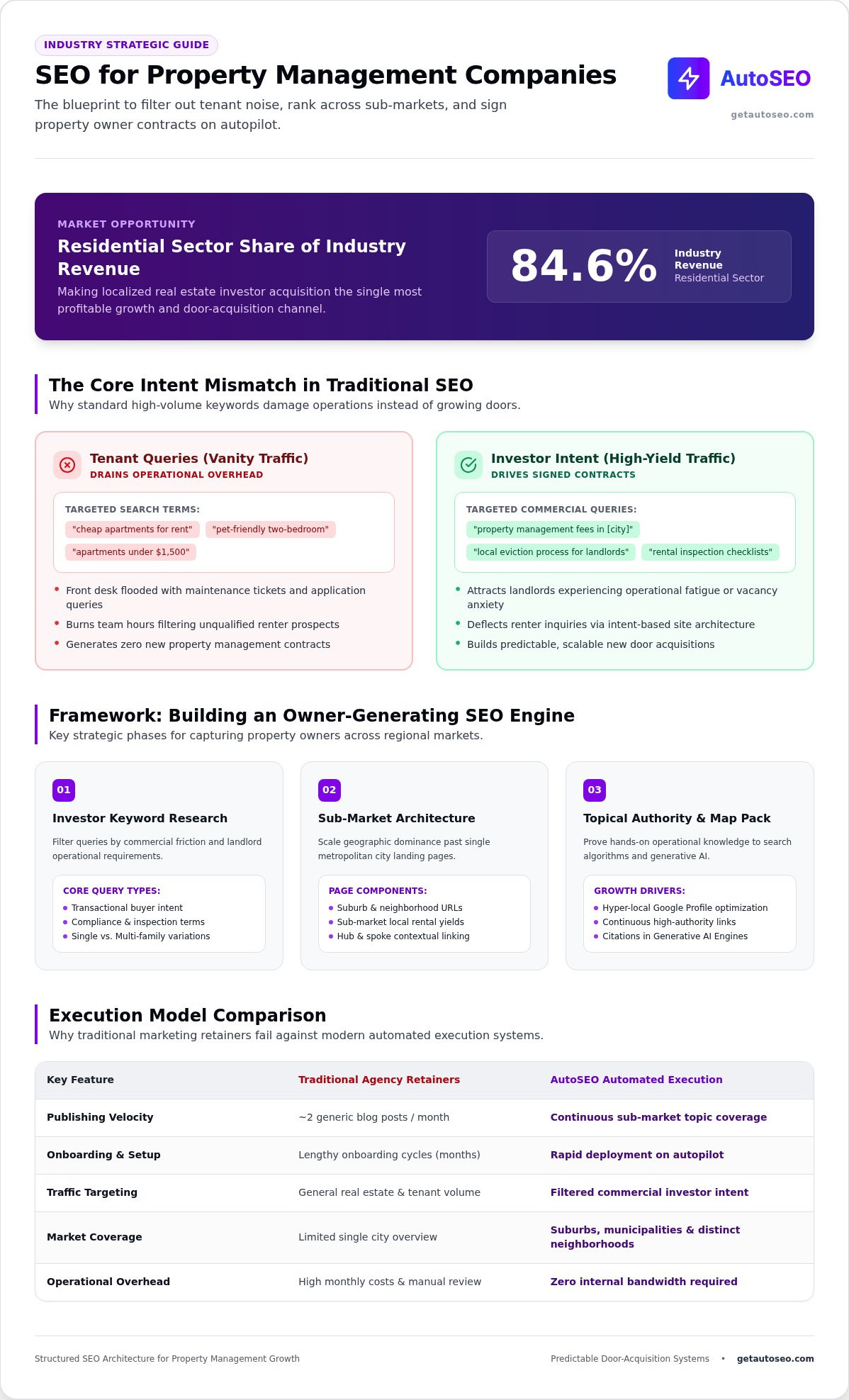
Agency Retainers vs. In-House SEO vs. SEO Automation
Property management executives face a distinct operational fork in the road. You can hire a traditional marketing agency, recruit internal staff, or deploy intelligent software. Choosing the right path determines whether your customer acquisition costs drop or spiraling marketing budgets eat away your margins. Winning at seo for property management companies requires consistent output that neither agencies nor internal staff can deliver efficiently.
The Cost and Velocity Breakdown
Agencies operate on human hours, meaning high costs and sluggish output. Multi-market agency retainers for property managers regularly run between $3,000 and $6,000 per month, yet they rarely produce more than four blog posts in thirty days. Onboarding eats up the first quarter before you see any live updates.
Hiring internally shifts the bottleneck without solving it. The average salary for an in-house SEO manager in the United States spans from $86,000 to $123,474 per year, excluding benefits and required enterprise software subscriptions. You end up managing another employee instead of signing doors.
Adopting SEO automation removes operational drag entirely. Automated platforms eliminate account manager meetings, administrative delays, and manual writing queues by publishing technical, search-optimized articles directly to your website every day.
Quality and Scale: Eliminating the Growth Bottleneck
Skeptics often claim automated content lacks professional depth. That assumption is outdated. Modern automated engines analyze your exact service areas, target specific investor intent, and produce authoritative localized guides that outperform human freelancers. Achieving both quality and scale is no longer a contradiction.
Search engines reward topical authority. A property management site publishing 30 strategic articles per month builds domain coverage fifteen times faster than an agency delivering two pieces. Combine that publication cadence with continuous high-authority backlink acquisition, and you create an insurmountable ranking moat around your regional service footprint.
Stop paying high agency retainers for slow delivery. You can launch your automated SEO platform subscription today and turn organic search into an effortless acquisition engine that actually works.
Scaling Property Management Contracts on Autopilot with AutoSEO
Capturing high-value property portfolios shouldn't require running a secondary marketing department. AutoSEO delivers a fully hands-off growth engine engineered specifically for operators targeting steady organic expansion. Instead of chasing unreliable freelancers or deciphering complex spreadsheets, you gain an autonomous system that manages competitive analysis, keyword mapping, content deployment, and link equity. This is modern seo for property management companies designed to perform without human bottlenecks.
The platform conducts continuous AI-driven research across your specific service areas and regional competitors. Every month, AutoSEO delivers 30 optimized articles directly published to your WordPress site. At the same time, the platform builds 100 Domain Authority worth of natural backlinks continuously. This steady stream of domain equity and local topical relevance establishes an unshakeable market position that drives serious property owners directly to your inbox.
Complete Hands-Off Organic Search Execution
Manual marketing management drains time you should spend evaluating properties and signing client agreements. Advanced AI content creation works around the clock to expand your regional footprint, targeting commercial landlord queries across every zip code you serve.
Setup requires zero technical friction. Connect your WordPress site seamlessly, and the platform takes over immediately. From strategic keyword insertion and automated internal linking to schema injection and instant indexing requests, every technical operational task runs entirely in the background.
Compounding Doors and Revenue Without the Overhead
Achieving growth shouldn't inflate your payroll. Deploying done for you SEO transforms your website into an automated lead generation asset that produces qualified commercial inquiries day after day. You bypass the risk of hiring six-figure in-house personnel and avoid slow-moving agency retainers entirely.
The math behind organic expansion is straightforward. Every single managed door yields years of recurring management fees, leasing commissions, and renewal revenue. Consistently adding units through automated organic visibility lowers your blended customer acquisition cost while building an appreciating operational moat around your brand. AutoSEO combines quality and scale into an autonomous system that actually works, giving you predictable growth on autopilot.
Dominate Local Search and Add Doors on Autopilot
Relying on slow agency retainers to sign new property owners is an uphill battle that drains cash reserves. Capturing high-margin market share requires targeting commercial landlord queries, dominating local map rankings, and establishing deep topical authority across every municipality you manage. Predictable regional growth comes down to executing high-performing seo for property management companies at relentless speed and scale.
AutoSEO removes the operational friction of traditional search marketing completely. With seamless, hands-off installation, the automated platform runs advanced AI market research, publishes 30 optimized articles directly to your WordPress site each month, and builds 100 Domain Authority worth of quality backlinks continuously. You don't need a bloated internal payroll or overpriced agency retainers to command page one. Take control of your customer acquisition pipeline. Automate your property management SEO with AutoSEO today and turn organic visibility into signed management contracts on autopilot.
Frequently Asked Questions
How long does SEO take to generate property owner leads?
Most property management companies begin generating qualified owner leads within three to six months of active optimization. Initial ranking improvements often appear within weeks, but building the topical authority required to outrank established regional competitors takes consistent publishing and backlink growth. Compounding search equity accelerates over time, turning your organic presence into a predictable pipeline of property management contracts rather than relying on volatile paid ads.
How do I stop my website from ranking for tenant search queries instead of property owners?
You stop attracting tenant inquiries by systematically removing residential rental listings from your core index and targeting investor-focused intent. Align your metadata, page copy, and headings around commercial pain points like vacancy reduction, eviction handling, and fee schedules. Effective seo for property management companies requires structuring dedicated landing pages specifically for landlords while routing prospective tenant applications through an isolated third-party portal.
What are the most profitable SEO keywords for property management companies?
The most profitable keywords combine hyper-local intent with commercial landlord operations. Focus on high-intent terms like "full-service property manager in [city]," "rental property management fees," and "multi-family leasing services." Informational queries regarding local landlord-tenant laws, security deposit regulations, and eviction procedures also capture real estate investors actively seeking professional operational help before signing a contract.
Can automated SEO outperform a traditional boutique marketing agency?
Yes, automated platforms outperform traditional agencies by publishing content and building authority at a velocity manual teams cannot match. While agencies deliver only two to four articles per month, automated solutions publish thirty deeply researched articles directly to your site while acquiring high-tier backlinks continuously. You eliminate human delays, high overhead, and administrative meetings while achieving the quality and scale necessary to dominate local search.
Why is link building critical for local property management websites?
Link building proves your business credibility and domain trust to search algorithms, separating your site from regional rivals. Local proximity signals and business profiles only take you so far. High-authority backlinks from regional publications, real estate platforms, and commercial directories pass essential equity to your domain. Without continuous link acquisition, national franchises and entrenched local competitors will outrank your landing pages.
Does my property management company need a blog to rank on Google?
Yes, maintaining an active, search-optimized blog is mandatory to build the topical authority required for top rankings. Static service pages can only target a small cluster of commercial terms. A consistent publishing engine allows you to answer hundreds of specific owner questions, capture long-tail search volume, and internally link back to your primary market pages. Executing strategic seo for property management companies requires consistent editorial volume to signal ongoing relevance.
How do AI search engines like ChatGPT affect property management SEO in 2026?
AI search engines bypass traditional blue links to deliver synthesized answers, citing only the most authoritative web sources. When landlords prompt AI platforms for the best local property managers or regional market trends, these engines pull facts from clearly structured, data-rich sites. Optimizing with concise answers, schema markup, and robust topical coverage ensures your company gets recommended directly within conversational search results.


