

A growing backlink count doesn’t automatically mean your site is getting stronger. Links from irrelevant sites, paid placements, or automated schemes can add risk without earning trust. Learning how to build backlinks safely starts with a sharper goal: earn relevant editorial citations that make sense to readers, not links designed to manufacture authority.
It’s reasonable to be cautious. The line between legitimate outreach and a link scheme isn’t always obvious, and reviewing every potential site can take time. This guide will help you spot worthwhile opportunities, avoid manipulative tactics, and build a repeatable process focused on quality and relevance.
You’ll learn how to assess a site and the page where your link may appear, choose practical ways to earn citations, and monitor your backlink profile without overreacting to every unfamiliar link. Use this framework whether you’re building links yourself or evaluating an automated approach.
Key Takeaways
- Judge a backlink by its relevance and usefulness to readers, not by volume or promises of rankings.
- Learn how to build backlinks safely by prioritizing transparent outreach and useful resources over tactics designed to manipulate rankings.
- Use a consistent checklist to assess a site’s audience, editorial standards, and proposed link placement before agreeing.
- Build a repeatable workflow that starts with a page worth citing, then moves through prospect research, outreach, and review.
- Review backlink patterns over time, and respond proportionately rather than treating every unfamiliar link as a threat.
How to Build Backlinks Safely: What Makes a Link Worth Earning?
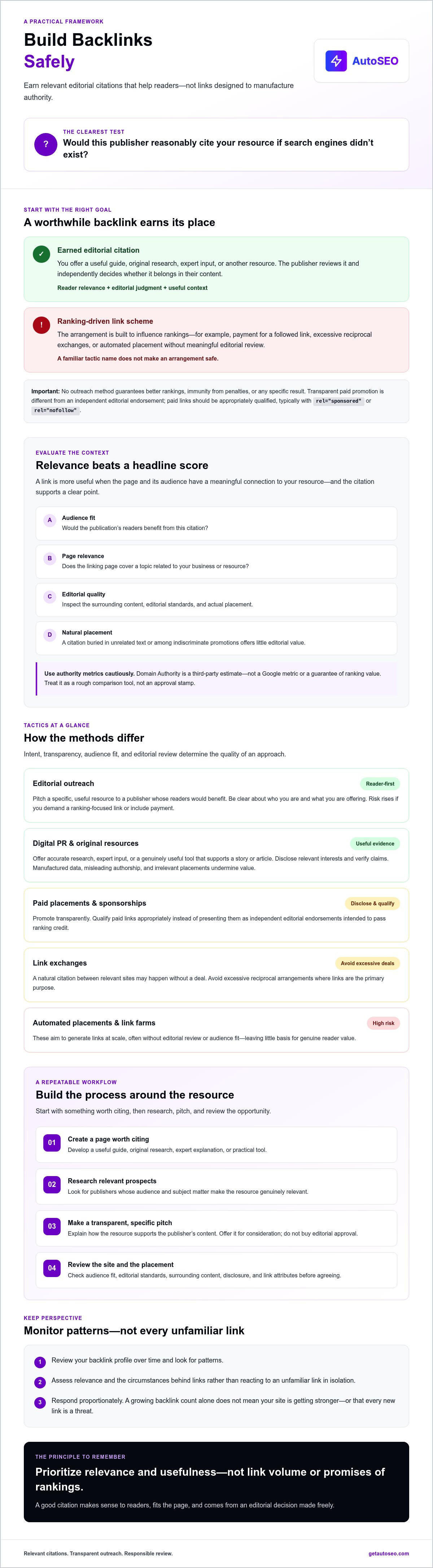
A safe backlink is a relevant citation that helps readers and is earned without trying to manipulate search rankings. A publisher links because your resource supports its reporting or helps its audience, not because you arranged a ranking-focused exchange. For a neutral overview of what backlinks are, consider how a link can guide readers and search engines from one useful page to another.
No outreach method guarantees better rankings, immunity from penalties, or any specific result. Instead of asking, “Can this link boost authority?” ask, “Would this publisher reasonably cite this resource if search engines didn’t exist?” That test keeps the focus on editorial value.
What separates an earned backlink from a link scheme?
An earned link follows an independent editorial decision. You offer a useful guide, original research, or another resource. A publisher reviews it and chooses whether it belongs in their content. You can pitch the resource, but you don’t control the publisher’s judgment.
A link scheme starts with a ranking-driven arrangement. Payment for a followed link, excessive reciprocal exchanges, or automated link placement can cross that line when the purpose is to influence rankings. Paid advertising is different when it’s transparent and appropriately qualified, rather than presented as an independent endorsement intended to pass ranking credit. Assess the arrangement, disclosure, and link attributes before agreeing.
For a broader foundation on the strategy, see What Is Link Building? The Autopilot Guide to Winning in 2026. The distinction is straightforward: outreach can earn consideration, but it shouldn’t buy editorial approval.
Why relevance matters more than a headline authority score
Start with context. Does the linking page cover a topic related to your business or resource? Would its audience benefit from the citation? A small industry publication linking to a useful, specific resource may be a better fit than a site with a higher authority score but no meaningful connection.
Metrics such as Domain Authority are third-party estimates, not Google metrics or guarantees of ranking value. Use them as rough comparison tools, not approval stamps. Inspect the actual page: its editorial standards, surrounding content, audience, and whether the link supports a clear point. A link buried in unrelated text or placed among indiscriminate promotions offers little editorial value, regardless of its score.
Relevant editorial links are more useful than raw link volume because they give the right readers a reason to follow the citation. That’s the practical starting point for how to build backlinks safely: evaluate the reason for the link, not just the number attached to it.
Which Backlink Tactics Are Safe and Which Should You Avoid?
No tactic is safe just because it has a familiar name. Editorial outreach can earn a citation, while the same outreach becomes risky if it promises a followed link in exchange for payment or reciprocal placement. A backlink tactic’s intent and implementation matter more than its label.
Use this comparison to assess the method, what should be disclosed, and where risk can arise:
- Editorial outreach: Pitch a specific resource to a publisher whose readers would benefit. Be clear about who you are and what you’re offering. Risk rises if the pitch includes payment or demands a ranking-focused link.
- Digital PR and original resources: Offer accurate research, expert input, or a genuinely useful tool that supports a story or article. Disclose relevant interests and verify claims. Risk comes from manufactured data, misleading authorship, or irrelevant placements.
- Paid placements and sponsorships: Promote a product, event, or resource transparently. Paid links should use an appropriate attribute, typically
rel="sponsored"orrel="nofollow", rather than being presented as independent editorial endorsements. - Link exchanges: A natural citation between relevant sites may happen without a deal. Avoid excessive reciprocal arrangements where links are the primary purpose.
- Automated placements and link farms: These aim to generate links at scale, often without editorial review or audience fit. They carry high risk and offer little basis for genuine reader value.
Which link-building methods create genuine editorial value?
Make the resource the reason for contact. A small business could pitch original customer research to an industry publication, offer an expert explanation for a journalist’s article, or share a practical tool that solves a problem for the publication’s readers. Keep the pitch specific, make sure the resource supports the article, and be clear about authorship and evidence. Relevant placement and accurate claims matter more than the number of links earned.
Which backlink shortcuts can put a site at risk?
Link farms, automated link placement, paid links intended to manipulate rankings, and reciprocal schemes built around link swapping are warning signs. Google’s official spam policies describe link spam practices, including buying or selling links that pass ranking credit and excessive exchanges. Review the current guidance before approving a campaign. Paid promotion isn’t automatically an editorial endorsement, so check that the publisher discloses the relationship and qualifies the link appropriately.
If you’re evaluating ways to reduce repetitive SEO work, explore an automated SEO platform with the same standard: ask how links are sourced. Automation can streamline a process, but it doesn’t make placements safe by itself. That distinction is central to how to build backlinks safely.
How to Evaluate a Backlink Opportunity Before You Say Yes
Assess the actual publisher and page, not just the domain score or the promise of a link. A quick review can reveal whether the citation fits your audience, meets basic editorial standards, and adds useful context. Use the same checks for every prospect to make decisions consistent and easier to explain.
How do you check whether a publisher and page are relevant?
Start with the site’s subject matter, intended readers, and recent articles. If you run a bookkeeping service, a small-business finance page may be relevant; a general page about unrelated consumer products probably isn’t. Then review the proposed linking page. Would your resource clarify a point or help readers take a useful next step? Look for clear site ownership, identifiable authors, and evidence that editors select and review content.
Use third-party scores, such as Domain Authority, only as rough comparison signals. They are not Google metrics and don’t guarantee that a link will help rankings. For added context on unnatural links and Google’s Webmaster Guidelines, consult Moz’s explanation, then verify the opportunity against the page itself.
Which warning signs call for a closer review?
Look for a page filled with unrelated outbound links, thin or generic content, obvious link-selling language, and the same commercial anchor text repeated across placements. A sudden, unexplained rise in links to your site is a reason to investigate the source and pattern, not proof of a penalty. Don’t reject a prospect based only on one automated toxicity label or third-party score. Check what is actually published and how the links fit.
Use this sample decision table before you approve a placement:
Outcome
Use it when
Next step
Accept
The topic fits, the page is useful, and editorial ownership is clear.
Confirm the final placement and destination.
Investigate
The site looks relevant, but authorship, audience, link terms, or page quality remain unclear.
Ask questions and review more published pages before agreeing.
Decline
The offer depends on hidden payment, irrelevant placement, or manipulative anchor patterns.
Walk away. Don’t trade editorial fit for volume.
This review makes how to build backlinks safely a repeatable decision process: inspect the context, identify unresolved risks, and approve only placements that make sense for readers.
How to Build Backlinks Safely: A Step-by-Step Process
A reliable link-building process starts with something worth citing, not a target number of links. Use this workflow to keep outreach relevant, transparent, and measurable. It builds on the prospect checks above: contact only publishers whose readers have a clear reason to value your resource.
- Set a goal. Decide what the resource should help achieve, such as answering a customer question, supporting a product comparison, or attracting referral visits. Keep the goal focused on audience value, not a guaranteed ranking result.
- Create a cite-worthy resource. Find a customer or industry question that lacks a clear, useful answer. Build a practical guide, a well-supported original study, or a tool that helps readers complete a task.
- Identify relevant prospects. Find publishers who cover the topic and serve the audience your resource is designed for. Record the specific page or editorial need that makes each prospect a fit.
- Pitch with context. Explain why the resource may help that publisher’s readers. Make a suggestion, not a demand for a followed link or a particular anchor text.
- Review and learn. Check the final placement for accuracy and context. Track the prospect’s relevance, outreach details, response, published link, and any resulting referral activity.
How do you create a resource publishers have a reason to cite?
Choose a question you can answer better than a generic article can. For example, a local service business might publish a clear maintenance checklist that helps customers prepare for a seasonal appointment. Use original evidence only when you have it. Name sources, explain how you gathered information, and avoid presenting estimates as verified findings. Keep the resource current when facts change, and make its practical value obvious from the page title and opening.
How should safe, relevant outreach work?
Personalize the pitch around one publisher, one audience, and one relevant page. Say what the resource offers and why it could strengthen that page. Be accurate about your role and any relationship with the publisher. Respect a refusal, and skip mass-produced messages that pretend to be personal. A useful overview of the wider strategy is Small Business SEO: The Autopilot Guide to Getting Customers in 2026.
Automation can reduce repetitive SEO research and publishing work, but it doesn’t replace quality controls for link opportunities. If you want to streamline recurring SEO tasks, explore AutoSEO’s automated SEO platform and assess its backlink process against the relevance and transparency criteria in this guide.
How to Monitor Backlinks and Scale Link Building Responsibly
Backlink monitoring works best as a routine review, not a reaction to every unfamiliar domain. Periodically check new links, the pages that contain them, anchor text patterns, and referral activity. Look for meaningful changes, such as repeated commercial anchors across unrelated sites, and investigate the source before deciding whether action is needed.
What should you do if you find suspicious backlinks?
Start with evidence. Open the linking page and assess its content, outbound links, and relevance. Compare when the links appeared with your outreach and other link-building activity. Then check Search Console for a manual action notice. A low-quality or unfamiliar link by itself doesn’t prove that your site has been penalized, and it doesn’t automatically require disavowal.
Document what you find, including URLs, dates, and any known outreach or third-party activity. Google’s disavow links guidance treats the tool as an advanced option, not a routine cleanup step. Review the current instructions before using it, especially if you suspect links were created to manipulate rankings. If Search Console reports a manual action, follow the specific guidance provided there and address the cause before requesting a review.
How can automation support safe link building?
Automation can organize prospect research, outreach records, and link reporting. It shouldn’t bypass human checks on relevance, editorial context, or transparency. Before using a provider, ask how it sources opportunities, evaluates the publisher and placement, and reports links. Review the answers, not just the volume promised. The principles in SEO Automation: The End of Manual SEO as You Know It are most useful when automation reduces repetitive work while people retain quality control.
For a consistent process, record each prospect’s relevance, the reason for outreach, the response, the final placement, and any referral activity. This makes it easier to spot patterns and assess whether your approach is earning useful citations. It also keeps how to build backlinks safely grounded in reviewable decisions rather than assumptions.
If you want to streamline recurring SEO research and publishing, explore AutoSEO as an automated SEO option. Review how its backlink sourcing and reporting work, and apply the same quality checks before relying on any placement.
Build a Link Process You Can Stand Behind
Safe link building is a disciplined process, not a shortcut to guaranteed rankings. Focus on citations that fit the topic, serve readers, and come from transparent editorial decisions. Before accepting an opportunity, review the publisher, the specific page, and the context around the link. Then track placements and investigate unusual patterns calmly instead of treating every unfamiliar backlink as a threat.
That’s the practical answer to how to build backlinks safely: create resources worth referencing, earn relevant placements, and keep reviewing the process as it grows. Automation can reduce repetitive SEO work, but it can’t replace checks on link sourcing, relevance, and reporting.
AutoSEO’s subscription combines SEO content, backlink services, and automated WordPress publishing. Its AI research uses business, customer, and competitor context to inform content planning. Before choosing any automated approach, confirm how it sources, qualifies, and reports backlinks. Explore AutoSEO’s automated SEO approach and assess whether it fits your quality standards.
Build deliberately, measure what matters, and keep your process accountable. Relevant links earned for real value are the foundation for growth you can pursue with confidence.
Frequently Asked Questions
Is building backlinks safe for SEO?
Yes, how to build backlinks safely comes down to earning relevant citations without trying to manipulate rankings. A publisher should choose to reference your resource because it helps their audience, not because you paid for ranking credit or agreed to an artificial exchange. No approach guarantees better rankings or penalty immunity. Focus on useful content, transparent outreach, relevant placements, and regular reviews of the links you earn.
Can buying backlinks hurt your website?
Buying links intended to manipulate search rankings can put your site at risk under Google’s spam policies. A paid advertisement or sponsorship isn’t automatically an editorial endorsement, so make the relationship clear and ensure the publisher uses an appropriate link attribute, such as rel="sponsored" or rel="nofollow". Before paying for a placement, clarify what you’re purchasing, how the link will be presented, and whether it serves readers beyond ranking goals.
How do I know if a backlink is high quality?
Check whether the linking page and its audience are relevant to your business or resource. Then assess whether the page has useful content, credible authorship, and clear editorial standards. The link should fit naturally into the surrounding discussion and help readers understand or explore a topic. Third-party scores can offer rough comparisons, but they aren’t Google metrics or guarantees. Review the actual page before accepting a link opportunity.
What backlinks should I avoid?
Avoid links from link farms, automated placements, and pages that publish unrelated links without meaningful editorial review. Be cautious of paid links presented as independent endorsements, excessive reciprocal exchanges, and repeated commercial anchor text arranged to influence rankings. Also question offers promising large link volumes without explaining the sources. A suspicious pattern deserves investigation, but assess the pages and circumstances before deciding what action to take.
Do nofollow links help SEO?
Nofollow links can still bring relevant visitors to your site, even when they don’t function as a conventional endorsement. Google treats rel="nofollow" as a hint when crawling and indexing, rather than a strict directive in every case. Don’t dismiss a link solely because it’s nofollow. Consider whether the placement reaches the right audience, supports useful discovery, and comes from a trustworthy editorial context.
Should I disavow low-quality backlinks?
Usually, don’t disavow links simply because a tool labels them low quality or you don’t recognize the referring site. Google describes the disavow tool as an advanced option, generally relevant when a site has a considerable number of spammy or artificial links and a manual action, or a credible risk of one. Check Search Console, investigate link sources, document your findings, and follow Google’s current guidance before submitting a file.
How long does it take to build backlinks safely?
There’s no fixed timeline. It depends on how quickly you create a resource publishers value, find relevant prospects, and earn editorial consideration. A publisher may respond promptly, take time to review a pitch, or decline it. Links also don’t guarantee a specific ranking change or schedule. Set a sustainable outreach cadence, record responses and placements, and review referral activity over time. Measure the process by quality and relevance, not speed alone.


