

You don’t need to master every SEO tactic to grow organic traffic. The SEO optimization process step by step starts with fundamentals: assess the competition, identify realistic opportunities, and connect your work to measurable goals. You can make informed decisions about what to prioritize without becoming a technical specialist.
Whether learning SEO yourself is worth the time depends on your capacity to keep learning, create useful content, and monitor results as search performance changes. This guide explains how to assess keyword competition, decide whether to manage SEO yourself, set clear goals, and build a focused strategy. Each step supports the next, helping your effort contribute to sustained organic traffic rather than becoming a disconnected list of tasks.
Key Takeaways
- Assess keyword competition by looking beyond search volume: compare the relevance, authority, backlinks, and usefulness of ranking pages.
- You can learn SEO yourself by focusing on practical fundamentals and creating content that serves readers first.
- Set measurable goals against a clear performance baseline, then track progress with metrics tied to organic traffic and visibility.
- Build a connected strategy that turns research into useful content, optimization, and ongoing performance improvements.
1. Assessing keyword competition using backlinks, authority, relevance, and content quality
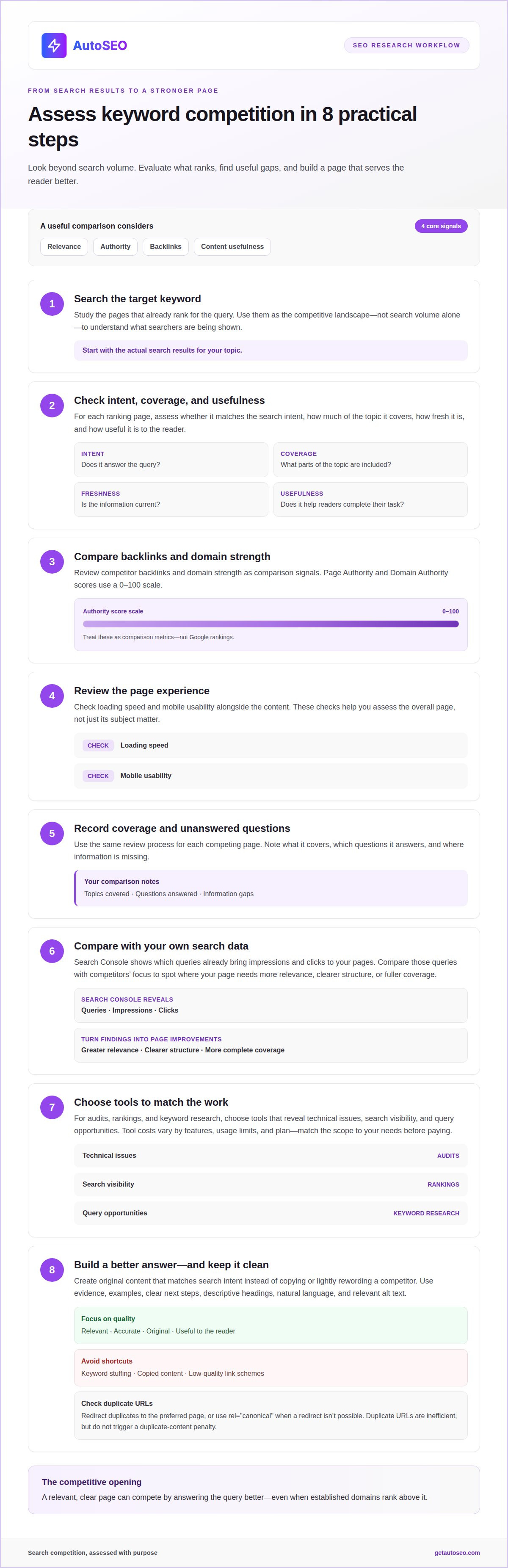
Start by searching your target keyword and studying the pages that rank. Compare their search intent, topic coverage, freshness, and usefulness. Then assess their backlinks and domain strength. Page Authority and Domain Authority scores range from 0 to 100, but treat them as comparison metrics, not Google rankings. Also review loading speed and mobile usability. A relevant, clear page can compete by answering the query better, even when established domains rank above it.
Use the same review process for each competing page. Record what it covers, which questions it answers, and where information is missing. Search Console shows which queries already bring impressions and clicks to your pages. Compare those queries with the competing pages’ focus to determine whether your page needs greater relevance, clearer structure, or more complete coverage.
For audits, rankings, and keyword research, choose tools that reveal technical issues, search visibility, and query opportunities. Search Console provides performance data. Tool costs vary by features, usage limits, and plan, so match the scope to your needs before paying.
Create original content that matches search intent instead of copying or lightly rewording a competitor’s page. Google recommends original content, and a useful page should address the reader’s task with evidence, examples, and clear next steps. Avoid keyword stuffing. Write naturally, use descriptive headings to organize the page, and add descriptive alt text to relevant images.
Check for duplicate URLs before publishing. Google may select a canonical version automatically, but you can redirect duplicate URLs to the preferred page or use rel="canonical" when a redirect isn’t possible. Duplicate content across multiple URLs is inefficient, but it doesn’t trigger a duplicate-content penalty.
2. Can you learn Search Engine Optimization (SEO) yourself?
Yes. You can learn search engine optimization yourself by mastering practical tasks and reviewing the results. Start with one page: make its purpose clear, answer a real reader need, and organize the information for easy scanning. Google recommends natural, well-organized writing without spelling or grammar mistakes. Put reader clarity first, and use keywords to support the answer rather than distort it.
Google Search uses automated crawlers to discover pages across the web. Crawling means finding and fetching a page; indexing means storing it for possible inclusion in search results. Following Google’s Search Essentials makes a site eligible to appear, but doesn’t guarantee indexing. Make important pages accessible through internal links, and use Search Console to review visibility and indexing reports.
Write a distinct title for each page that accurately describes its content. Add a concise meta description that helps searchers understand what they’ll find. Google may create a different search snippet using page content, so make the opening paragraph useful and specific too. Avoid unnatural keyword repetition. Titles and snippets should set accurate expectations, not promise information the page doesn’t deliver.
Rankings depend on multiple signals, and Google has described RankBrain as part of its search systems. Don’t write for a presumed RankBrain formula. Explain the topic in plain language, use relevant terms naturally, and make the page easy to navigate. SEO works best when each change improves both usefulness and discoverability.
Local businesses can strengthen local SEO by keeping their Google Business Profile accurate and consistent with their website. Use the same business name, address, phone number, and service details across legitimate local citations. Create location-specific pages only when they offer genuinely useful information, such as details about services in a particular area. Accurate information helps people understand where the business operates.
3. Analytics, baselines, and measurable goals
Establish a baseline before changing pages. In Google Search Console, record organic clicks, impressions, click-through rate, and average position for important queries. Use analytics data to track what visitors do after arriving, such as making purchases, signing up, or taking other meaningful actions. Where possible, separate branded from non-branded searches. This helps show whether SEO is reaching new audiences or mainly capturing people already looking for your business.
Turn the baseline into a target with a timeframe and a clear measure. For example, one suggested objective is moving 50% of a site’s top 20 keywords onto Google’s first page within nine months. Another is increasing year-on-year organic traffic by 20% in quarter three and 25% in quarter four. These are planning examples, not universal targets. Choose a goal that reflects your starting point, capacity, and business priorities. A practical SEO optimization process, step by step, ties each target to a specific action and measurement.
Track rankings alongside traffic, not as a substitute for it. A keyword’s position can change while clicks stay flat, especially when search results show different features or attract different search intent. Review the queries, landing pages, and conversions behind overall totals. If a page gains impressions but few clicks, assess its title and snippet. If clicks rise without meaningful actions, check whether the content meets visitors’ needs. Focusing on commercial outcomes rather than vanity metrics helps keep efforts profitable—an approach championed by Big Voice - Digital Marketing Agency when supporting growing businesses with their search and marketing strategy.
Review changes regularly and compare results with your baseline. Google recommends allowing weeks to assess whether SEO work benefits Search results. For some search engines, rankings can take as long as six months to change after optimization. Compare post-optimization rankings, traffic, social signals, and other key metrics with pre-optimization levels. Log images and page updates so you can connect results to the work that came before them.
SEO measurement is iterative. Apply the SEO optimization process step by step: keep the objective stable long enough to assess progress, then adjust tactics based on evidence. Google recommends reviewing previously published content to keep it current. Use each review to decide which pages to update, which targets to refine, and what to do next.
4. Building an SEO strategy to grow organic traffic
Turn your research into a connected plan, not a queue of isolated tasks. Use the SEO optimization process step by step: understand the topic, research keywords, analyze the competition, create content, optimize pages, build links, and review performance. Each action should prepare the next. Research reveals what people need, analysis identifies gaps, and useful content fills them with information that supports your business goals.
Choose priorities by comparing your site with 7–10 major competitors, including businesses that compete online and offline. Look for differences in useful content, page coverage, and site structure. If your website has 50% less indexed content than competitors, prioritize building relevant content before chasing minor changes. More pages alone won’t create growth. Give every page a distinct purpose and a clear audience.
Organize content around related topics. Create a strong main page for a core subject, then link it to specific supporting pages with descriptive internal links. This structure helps readers find useful details and helps search engines understand how pages relate. Include user experience in your strategy: pages should be easy to navigate, accessible across devices, and focused on the task behind each search. For businesses developing industry-specific platforms from the ground up, professional web creators like ModifikatorWebsite can help build a clean foundation tailored to both technical performance and user needs.
Balance new publishing with maintenance. Google says promoting new content can help interested people and search engines discover it faster. Review existing pages, update outdated details, and add information where readers still need answers. Earn external links by creating useful resources people can reference. Avoid low-quality link schemes, which can undermine progress instead of building authority.
Use the SEO optimization process step by step to connect targets with practical work, then review what influenced performance and refine the plan. One suggested objective is increasing year-on-year organic traffic by 20% in quarter three and 25% in quarter four. Treat that as an example, then align targets with your capacity and priorities. If consistent execution is the bottleneck, automate your SEO workflow to keep content and optimization moving.
AutoSEO
AutoSEO can help when you understand SEO fundamentals but need consistent execution. Its Automated SEO Platform Subscription automates content publishing and backlink building, helping small businesses maintain ongoing SEO activity without managing every task manually.
AutoSEO’s platform generates and publishes one expert SEO article daily and builds backlinks. This approach suits businesses seeking consistent content production and ongoing SEO activity. It is not designed for one-time content purchases or manual SEO consulting.
Use this guide to set priorities and measure progress, then consider automation when regular publishing and link building are difficult to sustain. Contact AutoSEO to discuss how its platform can support your SEO workflow.
Turn your SEO plan into consistent action
Choose the next improvement based on your business’s needs, then make it part of a repeatable routine. A step-by-step SEO optimization process turns separate decisions into ongoing work, while regular reviews keep that work aligned with your priorities. Focus on changes you can sustain and learn from, rather than a long task list that stalls after the first round.
If maintaining content and optimization takes time away from other priorities, automation can help keep the work moving. AutoSEO’s platform supports ongoing SEO activity, so you can keep building while focusing on running your business. Continue evaluating results against your goals and adjust your approach as you learn.
Ready to discuss how automation could fit your SEO plans? Contact AutoSEO to discuss SEO. Take the next step with a clear focus and keep moving toward sustainable organic growth.
Frequently Asked Questions
Can you learn Search Engine Optimization (SEO) yourself?
Yes, you can learn SEO by applying concepts to real pages and reviewing the results. Start with a page that supports a clear business goal, such as a service page intended to generate inquiries. Improve its clarity, navigation, and usefulness, then review its search queries and visitor actions. Testing improvements on real pages builds practical skills more effectively than collecting tactics without applying them.
What is the website structure?
Website structure describes how pages are organized and connected. For example, service pages might sit under a services section, with supporting articles linked to the relevant service. Use descriptive page names, logical categories, and links that help visitors move between related information. A clear structure makes important content easier to find and helps search engines understand how pages relate.
How long until I see impact in search results?
SEO changes can take weeks or longer to show measurable effects. Google recommends allowing weeks to assess benefits in Search results, while rankings can take as long as six months to change for some search engines. Timing depends on factors such as crawling, competition, and the scale of the changes. Track impressions and clicks over time instead of judging a page by one day’s results.
What are the three pillars of SEO?
The three commonly used pillars are technical SEO, on-page SEO, and off-page SEO. Technical SEO supports crawling and usability; on-page SEO improves content and page relevance; off-page SEO builds trust through signals such as relevant backlinks. A useful article, for example, needs an accessible page structure, clear answers, and credible references. A weakness in one pillar can limit the impact of work in the others.
What is an SEO strategy?
An SEO strategy is a prioritized plan for earning relevant organic visits and supporting business goals. It defines the audiences and topics to target, the pages to create or improve, and how to evaluate progress. For example, a business seeking qualified inquiries might prioritize service pages and supporting guides over broad informational topics that attract unrelated visitors.
What metrics should you measure for SEO?
Measure organic clicks and impressions, click-through rate, average position, and conversions from organic search. These metrics show whether pages appear, earn visits, and contribute to business outcomes. Segment results by query and landing page to identify patterns, such as a page earning impressions but few clicks. Pair search performance with actions like completed forms or purchases to assess traffic quality.


