

A backlink doesn’t become editorial just because it points to your site. An earned editorial backlink is placed naturally in relevant content on a real site with traffic. Knowing how to get editorial backlinks starts with creating something worth citing, then showing the right publishers how it adds value.
That takes more than a generic link request. You need a useful asset, a clear reason it belongs in a publisher’s content, and a pitch that respects the publication’s audience and editorial standards.
This guide explains what qualifies as an editorial link and how to create linkable assets, use the Skyscraper Technique, and conduct focused outreach. You’ll also learn how to assess whether a link fits naturally, supports the surrounding content, and gives readers a reason to follow it.
Key Takeaways
- Create a useful resource that answers a specific information gap, such as original research, a practical guide, or a tool readers can use.
- Use the Skyscraper Technique to make an existing resource more complete and current, then identify publishers whose content would benefit from it.
- Personalize outreach around a clear improvement for the publisher’s audience instead of making the backlink the focus.
- Prioritize links that fit naturally in relevant content and come from sites with real editorial standards and an engaged audience.
1. Creating linkable assets such as research, guides, infographics, reports, and tools
A linkable asset gives journalists, researchers, and industry writers something specific to cite. Build it around a question your audience already asks, then offer evidence or practical value a routine blog post may lack. For example, a cybersecurity company could publish a guide to how small retailers prepare for phishing attempts. A clearly defined audience and practical focus make the resource easier to place in relevant coverage.
Original data can make a report more citable. Gather information from customer surveys, public datasets, or carefully documented internal analysis. Explain how you collected and interpreted the data, and present the findings in a clear chart. A marketing team could compare its campaign results across channels, then publish the methodology alongside the findings. Clear explanations help journalists understand what the data represents and cite it accurately.
Choose a format that makes the information easy to use. A guide can explain a complex process, while an infographic can clarify a sequence or comparison. A calculator or checklist can help readers apply findings to their own situation. For example, a shipping company might create a delivery-cost calculator that explains each input. Make the tool useful on its own, rather than merely a route to a sales pitch.
Before publishing, check that the asset answers a distinct question and supports every claim. Add a descriptive title, clear source notes, and a concise summary that journalists can quote accurately. Divide long reports into sections and make key findings easy to scan. Then identify publications that cover the topic and explain how the asset could help their readers. A linked placement depends on relevance and usefulness, not length. Guest posts can earn coverage too, but original research or a practical tool gives editors a distinct reason to cite your work.
2. What are editorial links?
An editorial backlink is a link a publisher chooses to place naturally in relevant content. It points to a useful source, such as an original report, to support a point for readers. A guest post link appears in an article contributed by an outside author. The difference is who chooses the placement: the publisher independently cites a resource, or the author includes a link in contributed content.
An editorial citation can reflect topical relevance and editorial judgment. For example, a gardening publication linking to a university study about soil quality gives readers a related reference. The link may also bring referral visitors interested in the research. Search engines can use links among many signals, but one backlink alone neither establishes authority nor guarantees a ranking change.
Make editorial links one part of a broader SEO strategy, not its only goal. Pair relevant citations with useful pages, sound technical foundations, and content that meets search intent. For example, a local accounting firm could earn a citation from a business publication while improving its tax guidance pages. Competitors’ link profiles can reveal topics publishers cover, but copying placements without matching their relevance wastes effort.
Paid placements differ because compensation influences the link. Sponsored content should be clearly identified, rather than presented as an independent editorial reference. Since 2019, Google has treated nofollow, sponsored, and ugc link attributes as hints. The attribute helps describe a link’s relationship; it doesn’t make irrelevant content valuable.
Avoid generic outreach, irrelevant target lists, and pitches focused only on getting links. A recipe resource gives a finance editor little reason to cite it. Instead, connect your research to the article’s subject and explain how it benefits readers. Links can result from contributions or other placements, but an earned editorial link reflects a publisher’s decision to reference a resource because it fits the story. Prioritize context, relevance, and reader value over raw link counts.
3. The Skyscraper Technique and outreach
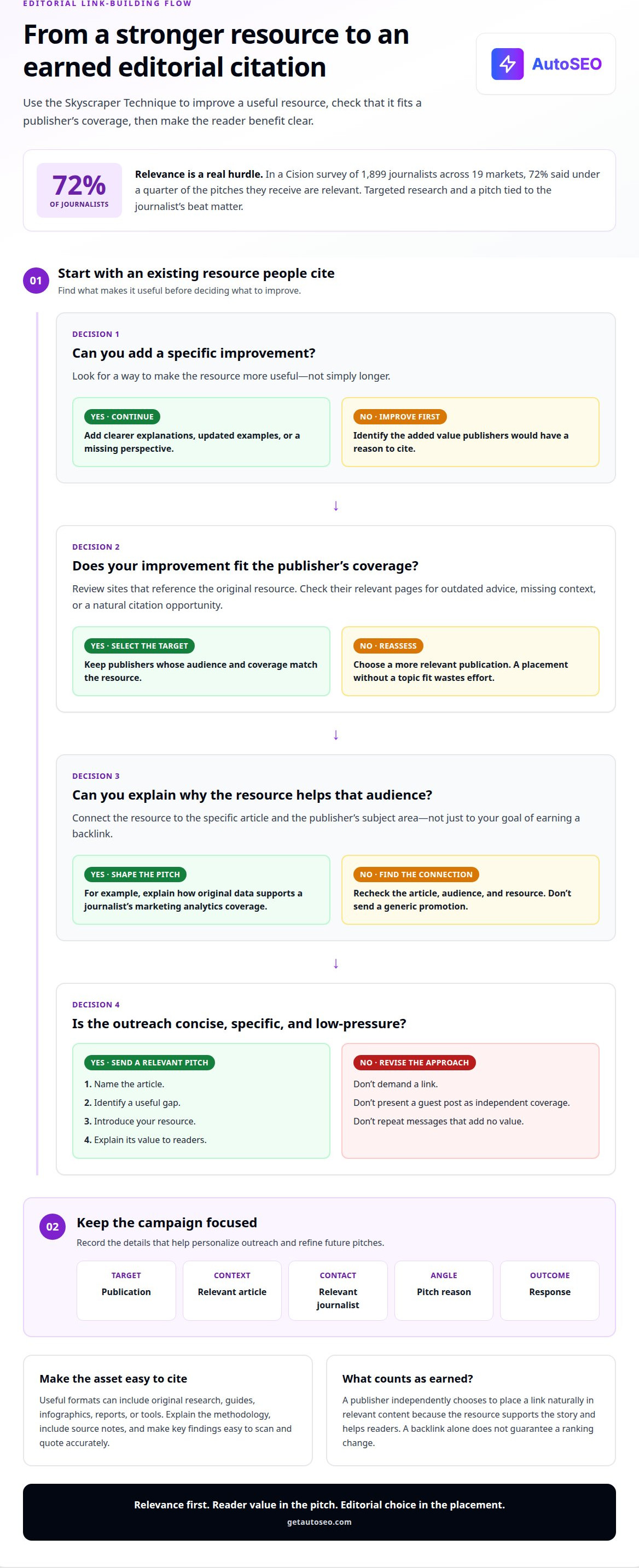
The Skyscraper Technique begins with a resource that already attracts links. Identify what makes it useful, then publish a stronger version with clearer explanations, updated examples, or a missing perspective. For example, if a popular link-building guide lacks advice on measuring referral traffic, add practical steps and explain the relevant metrics. A longer page alone won’t improve rankings. The added value must give publishers a reason to cite your version.
Next, identify sites that reference the original resource and check whether your improvement fits their coverage. Review each page for outdated advice, missing context, or a relevant citation opportunity. Cision surveyed 1,899 journalists across 19 markets, and 72% said under a quarter of pitches they receive are relevant. Targeted research matters. A pitch to a journalist covering marketing analytics should explain how your data supports that beat, not send a generic promotion. This focused process offers a practical way to learn how to get editorial backlinks.
Plan digital PR around a specific asset, audience, and news angle. A report on changing customer habits might offer journalists a timely source, while an industry guide may suit specialist publications. Keep a simple campaign record with the target publication, relevant article, contact, pitch angle, and response. This keeps outreach focused and helps your team build relationships instead of repeatedly sending the same message.
Use a concise email structure: name the article, identify a useful gap, introduce your resource, and explain its value to readers. For instance, mention that a publisher’s guide explains setup but lacks a comparison, then offer your original analysis as a possible citation. Keep the request low-pressure. Don’t demand a link or present a guest post as independent coverage. If there’s no response, avoid repeated messages that add no value. Track replies and placements, then refine your approach based on the angles editors find relevant. Learning how to get editorial backlinks takes relevance, focused outreach, and a resource worth citing.
4. What qualifies as an earned editorial backlink
An earned editorial backlink passes three practical tests: it fits naturally, supports the surrounding point, and helps readers. To assess whether you’re learning how to get editorial backlinks through genuine editorial choice, ask whether the publisher would keep the citation if your outreach stopped. For example, a health publication might cite a university study while explaining a treatment topic. The reference belongs because it supports the article, not because someone added it to influence rankings.
Review the publication’s standards and audience, then inspect the page containing the link. A relevant article from a genuine publication may be more valuable than a high-authority domain with unrelated content. The surrounding sentence should explain why the cited organization matters. A bare URL gives less context than a link identified as the source of a specific finding. Look for a low spam footprint and signs of genuine editorial review.
Tools can surface opportunities and monitor mentions, but human review is essential to judge relevance. Backlink analysis tools can show which domains link to competitors and which pages attract citations. Google Search Console’s links report can help you review links pointing to your site. Mention-monitoring tools can flag brand references so you can assess whether a citation fits naturally.
A practical approach to how to get editorial backlinks starts with distinguishing independent citations from paid or controlled placements. A sponsored article may reach readers, but its commercial relationship differs from an editor independently choosing a reference. Review link patterns across the domain too: repeated keyword-heavy anchors or unrelated pages can weaken confidence in a placement. Don’t judge success by authority scores or link counts alone. Prioritize topical fit, clear editorial context, and a useful path for readers. If a link would look out of place without SEO goals, it probably isn’t genuinely earned.
AutoSEO
AutoSEO helps businesses maintain SEO content publishing and backlink building through its Automated SEO Platform Subscription. The service delivers one expert SEO article daily and builds backlinks, supporting the ongoing work of making useful resources visible. It can suit businesses that need a consistent way to support broader SEO work, though editorial citations still depend on publishers finding a resource relevant and worth referencing.
Editorial links still depend on relevance and independent editorial judgment. Automation can support ongoing visibility efforts, but it can’t make a publisher cite a resource. Keep creating useful content and assess each backlink for fit, context, and value to readers.
For a more consistent SEO workflow, contact AutoSEO.
Build a Link-Worthy Presence Over Time
Think beyond the next placement. An editorial link can introduce your work to new readers, but lasting visibility depends on useful resources and attention from relevant publications over time. Choose a topic your audience needs, create a resource with lasting value, and make it easy for writers to understand why it matters.
A practical answer to how to get editorial backlinks is to make citation-worthy content part of a consistent SEO workflow, rather than relying on a one-off campaign. AutoSEO’s Automated SEO Platform Subscription delivers one expert SEO article daily and builds backlinks to support ongoing SEO work. Focus on quality, relevance, and steady progress. You control those parts of the process, while editorial decisions remain with publishers.
Contact AutoSEO to discuss link building and take the next step toward a more consistent SEO workflow.
Frequently Asked Questions
What are editorial links?
Editorial links are citations a publisher chooses because they support the article’s subject. For example, a city newspaper might link to a university’s public transit study while reporting on commuting changes. That choice distinguishes an editorial citation from a link added solely to promote a contributor or fulfill a placement agreement. Evaluate the article’s context and intended readers, not just the linking domain.
How do you earn editorial backlinks?
Make a resource easy to cite, then connect it with publications covering the topic. For example, a nonprofit studying food access could share a regional data brief with a journalist reporting on grocery availability. Lead with the finding relevant to the article, explain how the brief supports it, and make the source material clear. A focused pitch gives editors a concrete reason to consider the citation.
Why should you consider editorial link building?
Editorial links can introduce your work to readers interested in its subject and give them a direct path to useful information. A citation in a specialist article may also reach an audience that wouldn’t find your organization through a branded search. Treat that visibility as an added benefit of useful content, not as a guaranteed ranking improvement or a substitute for meeting search intent.
How has link building evolved in 2026?
In 2026, a durable strategy focuses on the usefulness and context of citations, not just the number of links acquired. Search discovery also includes AI assistants alongside conventional results, so clear, attributable information can support visibility across different discovery experiences. A business publishing a technical guide, for example, should make its evidence and authorship understandable to both readers and publishers who may reference it.
How long does it take to see results?
Earning links and seeing search effects are separate stages. A linkable-asset campaign may take 2–6 months to earn links, while the Skyscraper Technique with outreach is estimated to take 3–4 months to produce results. Editorial links may take 3–6 months to affect SEO results. Relevance, publisher response, competition, and how quickly search engines process changes all influence the timeline.
What’s the best method?
The best method depends on your strongest evidence and the publication’s coverage. Use original data when you can substantiate a timely finding; improve an existing resource when it has a clear gap. For a specialist publication, a precise expert contribution may fit better than a broad report. Match the asset and pitch to the editor’s audience, and prioritize relevance over outreach volume.


