

The bigger SEO platform isn’t automatically the better fit. In a cognitiveSEO vs. Ahrefs comparison, the right choice depends on the capabilities your workflow relies on most, from keyword research and SEO features to support and API access.
Both tools may look compelling on a feature list, but the details determine how useful they are day to day. If you’re evaluating them for a team, a growing site, or a specific SEO process, you need a practical comparison, not just a list of features.
This guide compares support and learning resources, keyword coverage, core SEO features, and API access. It also offers a decision framework to help you match each tool to your priorities and choose confidently.
Key Takeaways
- Compare support and learning resources by how well they help you solve issues and build an effective workflow.
- Assess keyword coverage against the countries and markets you need to research, not just the size of a database.
- Match SEO features and API access to the tasks you need to run, automate, or connect with other systems.
- Use backlink analysis needs and link-index coverage to decide which platform better fits your SEO priorities.
Customer support and learning resources
Support affects how quickly you can turn a site audit or backlink report into action. For cognitiveSEO and Ahrefs, compare the actual support channels available to your account, then test how quickly each resolves a practical issue, such as locating a technical SEO error or interpreting rank tracking data.
Current US plan names and prices for cognitiveSEO and Ahrefs can’t be stated responsibly without verified pricing details. Before deciding, compare the billing period shown, included usage, and account access. Trial availability, refunds, and usage limits depend on each vendor’s current terms, so don’t assume either tool offers a trial or refund, or that usage is unlimited.
Learning resources matter when a team needs to move beyond basic reports. Look for step-by-step guidance on monitoring backlinks, using an explorer, and turning site-audit findings into prioritized work. A tutorial that moves from a crawl issue to a specific technical SEO fix is more actionable than a general feature overview.
Multi-language support covers two separate things: the interface language and the languages available for customer assistance or learning materials. They may differ. If your team works across markets, assess whether the interface, help content, and support conversations are available in the languages your staff uses. Don’t infer support-language coverage from an SEO tool’s international data.
| Option | Support options | Learning resources | Language and account checks |
|---|---|---|---|
| cognitiveSEO | Confirm available channels and response process | Assess guidance for audits and backlink workflows | Check interface, help, and account terms |
| Ahrefs | Confirm available channels and response process | Assess guidance for explorer and rank tracking tasks | Check interface, help, and account terms |
Choose the platform whose support and training help your team complete its actual SEO tasks in the languages it uses.
Keyword databases and international coverage
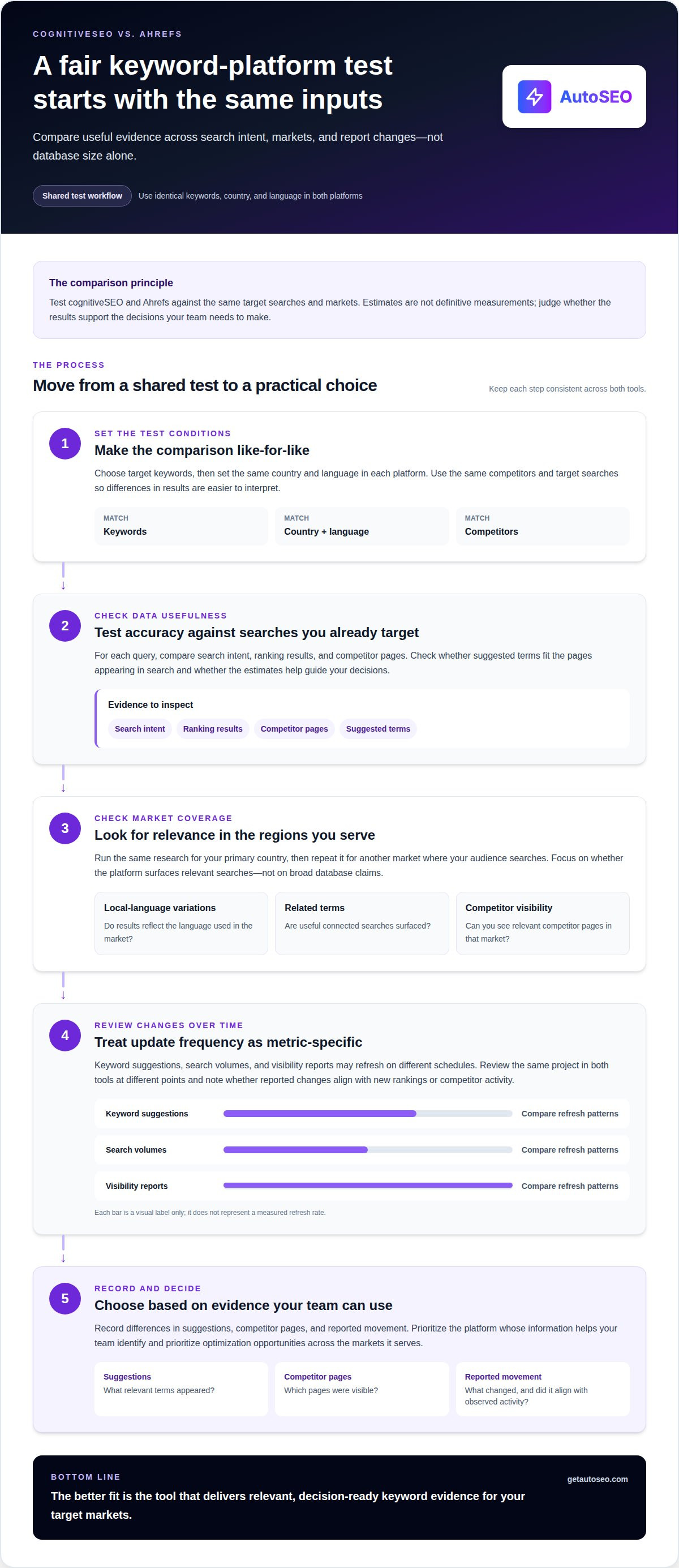
Keyword research depends on more than database size. Compare both platforms using the same markets, competitors, and target searches.
To assess data accuracy, compare each tool’s estimates with your own search performance data. A cognitiveSEO vs Ahrefs comparison is most useful when it tests identical keywords in the same country, rather than treating either platform’s estimates as exact measurements.
Data Accuracy
Test both platforms with keywords your site already targets. For each query, compare search intent, ranking results, and competitor pages. Group results by country and search purpose, then check whether the suggested terms match the pages appearing in search. This gives you a practical basis for judging which estimates support your decisions, without assuming either tool provides definitive measurements.
Database Coverage
Database coverage matters when it reflects the markets you serve. Run the same keyword research in each tool for your primary country, then repeat it for another market where your audience searches. Compare local-language variations, related terms, and competitor visibility. In a cognitiveSEO vs Ahrefs assessment, focus on whether each platform surfaces relevant searches in your regions, rather than relying on broad database claims.
Update Frequency
Update frequency can affect how current a keyword or ranking report appears. Treat it as metric-specific: keyword suggestions, search volumes, and visibility reports may refresh on different schedules. Review the same project in both tools at different points, and note whether reported changes align with new rankings or competitor activity. Prioritize the platform whose information supports the decisions you need to make.
Use a shared test workflow: select target keywords, set the same country and language, then compare the results in both platforms. Record differences in suggestions, competitor pages, and reported movement. This keeps your evaluation focused on useful evidence, not database size alone. Choose the tool that helps your team prioritize optimization opportunities across the markets it serves.
SEO features and API access
Feature comparisons matter when they reflect real tasks. Evaluate how each platform supports research, monitoring, audits, recommendations, and API workflows.
Backlink Analysis and Link Indexes
Backlink analysis helps you assess referring pages, anchor text, and link patterns. Compare cognitiveSEO and Ahrefs using the same domain and reporting scope. Check whether each result identifies the source page, target URL, and context behind a link. For link auditing, see how easily each tool lets you filter and export evidence. The more actionable report is the better fit for your review process.
For unnatural link detection and penalty recovery, don’t treat either tool as an automatic verdict. Review reported links, confirm their context, and use search-engine guidance when deciding what action to take. A report can organize evidence, but it cannot establish on its own that a link caused a ranking issue.
Keyword Research and Rank Tracking
Keyword research identifies search opportunities, while rank tracking monitors selected terms over time. Compare the tools using identical keywords, locations, and devices where available. Then check whether each report connects a ranking change to the relevant page and search query. This distinction helps teams decide whether to refine content, improve internal linking, or investigate a technical issue.
For keyword research and rank tracking, choose the platform whose reporting fits your target markets and monitoring routine. Use one shared test set and compare the clarity of the results, not just the volume of recommendations.
API access serves a different purpose: bringing SEO data into dashboards, internal reports, or custom workflows. Before choosing, compare each platform’s current API documentation for available data fields, authentication, usage limits, and access requirements. For example, a team building a dashboard needs to know whether it can retrieve the ranking or backlink fields it needs. Treat API access as a workflow requirement, not a bonus feature.
Finally, compare how each tool turns audit findings into recommendations. Run the same sample URL through both and check whether technical issues are clearly described, prioritized, and tied to an affected page. This shows which SEO tool gives your team a practical next step, rather than a long list of findings without context.
How do cognitiveSEO and Ahrefs compare on backlink analysis and link indexes?
Backlink analysis helps you assess which sites link to a domain and where those links lead. cognitiveSEO and Ahrefs both provide backlink data, but the useful comparison is how their reports support your specific decisions. A larger reported index alone doesn’t prove a stronger audit. Coverage, freshness, filtering, and the ability to investigate individual links all matter.
Use the same domain in both tools and compare the same report scope. Start with referring domains, then review individual backlinks, target pages, and anchor text. Check whether each interface makes it easy to separate links by page or identify changes over time. If you’re investigating a new link to a key landing page, for example, prioritize the tool that clearly shows its source and destination.
Link indexes are snapshots, not complete records of every link on the web. A link may be missing because it hasn’t been discovered, has changed, or falls outside the selected report scope. Compare overlapping results before treating a difference as a quality verdict. For a competitor review, note which referring domains appear in both tools, then inspect unique results separately.
For link building, judge the evidence by relevance and context. A list of referring domains is more useful when you can identify the linking page, the page receiving the link, and whether the relationship makes sense. During an audit, export a consistent set of results from each platform, group them by target page, and investigate unusual patterns. Don’t treat a tool’s classification as proof that a link is harmful or beneficial.
Choose cognitiveSEO or Ahrefs based on the workflow you need: broad competitor discovery, focused link auditing, or recurring backlink monitoring. Compare the same domain, filters, and export needs before choosing. Then turn findings into a repeatable process with automated SEO workflows that support consistent publishing and organic growth.
A Promodo study found that third-party traffic tools can have an error rate of around 50% compared with Google Search Console. That finding concerns traffic estimates, not backlink coverage, so it should not be used to rank backlink indexes. Treat traffic figures as context when assessing a linking domain, and keep that signal distinct from evidence about the link itself.
AutoSEO
AutoSEO is a natural next step if comparing SEO tools has clarified your priorities but you still need consistent execution. Its automated SEO platform subscription publishes one expert SEO article daily and builds backlinks, helping small businesses maintain ongoing SEO activity. It suits teams that want to support organic growth without managing every publishing task manually. It isn’t a replacement for cognitiveSEO or Ahrefs when you need their specific research and reporting capabilities. Instead, AutoSEO focuses on putting recurring SEO work into motion.
Use your tool comparison to decide which insights should shape your content and link-building priorities. Then consider whether automation fits your workflow and growth goals. Contact AutoSEO to discuss whether its platform suits your SEO needs.
Turn your SEO priorities into consistent action
A cognitiveSEO vs. Ahrefs decision is most useful when it leads to a clear operating plan. Choose the platform that supports your research needs, then define how its insights will shape content, technical improvements, and link-building priorities. The next challenge is keeping that work moving while your business handles its daily demands.
AutoSEO can support that execution through its automated SEO platform subscription. It’s designed for small businesses that want ongoing SEO activity without managing every publishing task manually. The right next step depends on whether automation fits your goals and existing workflow.
Set a clear priority for your next stage of growth, then decide how you’ll keep SEO work progressing. Contact AutoSEO to discuss your SEO needs and explore whether its platform fits your plans. A focused decision now can help you build a more consistent path toward organic growth.
Frequently Asked Questions
Which tool is better for link auditing, unnatural link detection, and penalty recovery?
Neither tool should be treated as an automatic verdict for unnatural links or penalty recovery. Compare the same domain and report scope, then assess how clearly each supports filtering, exporting, and investigating link context before choosing a tool for link auditing.
Do cognitiveSEO and Ahrefs offer free trials, refunds, or usage limits?
Trial availability, refunds, and usage limits depend on each vendor’s current terms. Review those terms before deciding; don’t assume either tool offers a trial or refund, or provides unlimited usage.


