

A higher Domain Rating won’t guarantee higher Google rankings. If you’re learning how to build domain rating from scratch, focus on earning relevant backlinks that strengthen your site over time, not collecting links to chase a score.
When your site has few or no backlinks, SEO metrics can be confusing, and link-building advice can sound expensive, vague, or risky. That concern is justified: Domain Rating (DR) is Ahrefs’ measure of backlink profile strength, not a ranking factor Google uses. Treat it as a reference point, not a promise of traffic or rankings.
This guide lays out a practical backlink-building process: prepare your site, create pages people have a reason to cite, find relevant link opportunities, and track whether your work supports search performance. You’ll also learn how to compare tactics and assess link prospects, using referring domains, organic traffic, and rankings alongside DR. The goal is a clear process you can repeat as your site grows.
Key Takeaways
- Learn how to build domain rating from scratch by earning relevant backlinks, not accumulating low-quality links.
- Prepare your site for promotion by checking indexability, clarifying its purpose, and building useful pages.
- Compare digital PR, expert contributions, resource outreach, partnerships, and linkable assets to find tactics that fit your goals.
- Use a repeatable process to find prospects, pitch useful resources, and track referring domains, organic clicks, and page performance.
- Build a sustainable SEO workflow with helpful content and consistent backlink activity, while keeping editorial judgment in the loop.
What Is Domain Rating, and What Does a Score Actually Tell You?
Domain Rating (DR) is Ahrefs’ proprietary, logarithmic measure of a website’s backlink profile. It provides a comparative snapshot of the links Ahrefs has discovered pointing to a domain. Because the scale is logarithmic, moving up through higher scores generally takes more authority than moving through lower ones. DR can help you monitor changes in a backlink profile, but it doesn’t measure your site’s overall quality or business performance.
Google does not use Ahrefs Domain Rating as a direct ranking factor. A higher score doesn’t guarantee stronger rankings or more organic traffic. Use DR as one reference point, then check whether your site is earning relevant referring domains, attracting qualified organic traffic, and improving rankings for the pages that matter.
How Domain Rating differs from Domain Authority
Ahrefs calculates Domain Rating, while Moz calculates Domain Authority (DA). Each platform uses its own backlink data and methodology, so the scores aren’t interchangeable. The broader idea of Domain authority is used across the SEO industry, but individual metrics are their creators’ estimates of authority.
Neither score is a Google metric or a guarantee of rankings. To assess progress, compare your site with itself over time using the same tool, rather than treating one platform’s score as equivalent to another’s.
What a new website’s starting score means
A new domain with few or no discovered backlinks may show a low DR or no score at all. That’s normal. It doesn’t automatically mean the site is poorly built, and it says little about whether its pages answer visitors’ needs.
Record a starting snapshot with the date, DR, known referring domains, organic clicks, and rankings for important pages. Review the same signals consistently. This gives you a useful comparison point, not a verdict on business performance.
Keep domain-level and page-level signals separate. DR describes a domain’s backlink profile; it doesn’t tell you how authoritative every page is. A particular page can attract relevant links and perform well even when the wider domain has a modest DR. The link’s relevance to that page and your subject matters too. A rising score without relevant links or stronger page performance may not reflect meaningful SEO progress.
That distinction is the foundation for how to build domain rating from scratch: focus on earning relevant links and improving the pages they support, then use DR as context rather than the goal.
Preparing a New Site for Its First Quality Backlinks
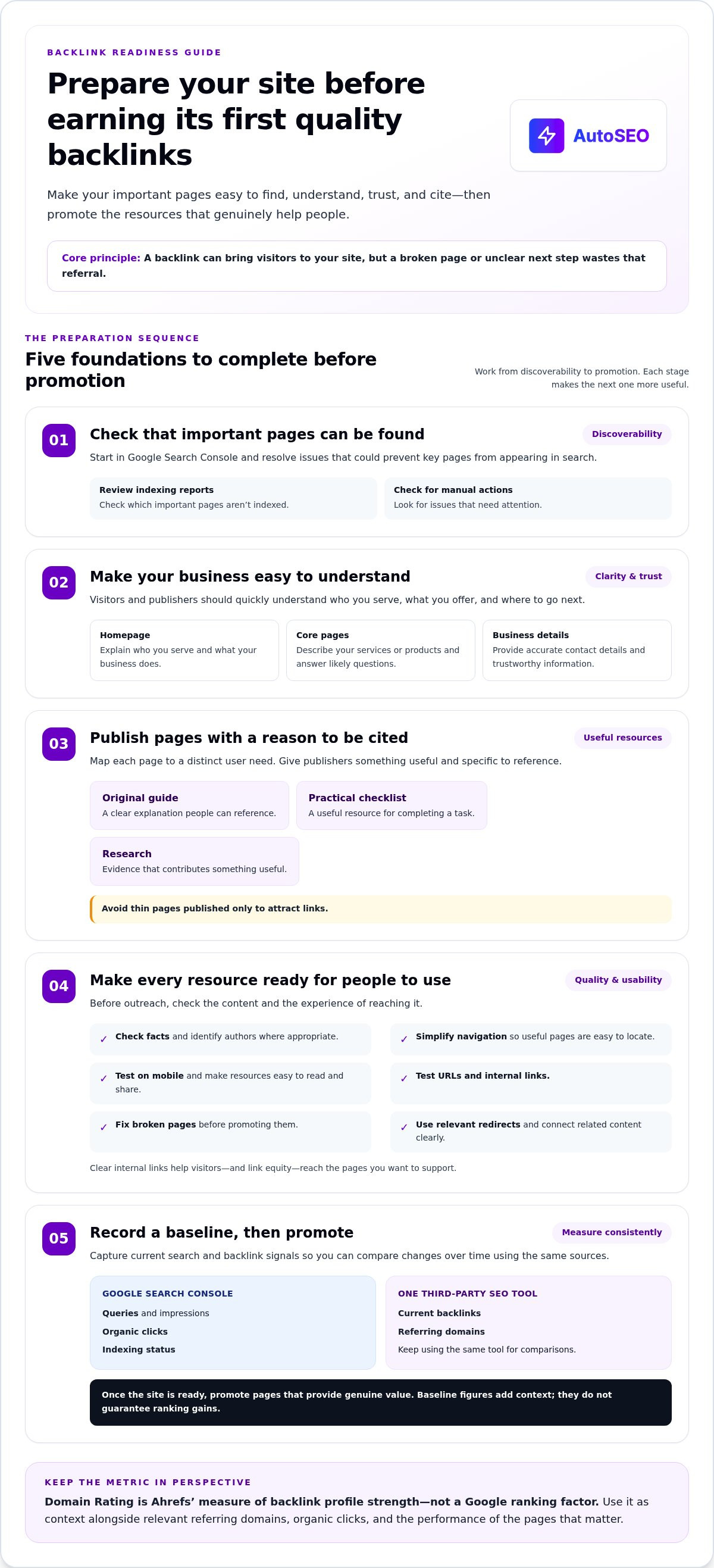
Before asking anyone to link to your site, make sure it’s ready to be found, understood, and trusted. Confirm that important pages can be indexed, explain what your business does, publish useful resources, and then promote them. A backlink can bring visitors to your site, but a broken page or unclear next step wastes that referral.
Start with Google Search Console. Review indexing reports for pages that aren’t indexed, check for manual actions, and record a baseline for queries, impressions, and organic clicks. Google’s SEO Starter Guide offers practical guidance on making content accessible and useful to people. Fix technical and content gaps before scaling promotion.
Make your homepage explain who you serve and what you offer. Add clear core service or product pages, accurate contact details, and trustworthy business information. Visitors and publishers should be able to understand your site without guessing what you do or where to go next.
Which foundational pages should a new domain publish?
Map each page to a distinct user need. Your homepage introduces the business; service or product pages explain the offer and answer likely questions. Add resources with a specific reason to cite them, such as an original guide, a practical checklist, or research that contributes useful evidence. Avoid thin pages published only to attract links.
Before promotion, check facts, identify authors where appropriate, simplify navigation, and test pages on mobile. Make sure each resource is easy to read, locate, and share.
How to establish a reliable SEO baseline
Record Search Console queries, impressions, clicks, and indexing status. Note current backlinks and referring domains in one third-party SEO tool, and keep using that tool for consistent comparisons. These figures provide context for later changes; they don’t guarantee ranking gains.
Test important URLs and internal links. Fix broken pages, ensure redirects lead to relevant destinations, and link related content clearly. This makes it easier for visitors and link equity to reach the pages you want to support.
Use this preparation sequence as your starting checklist for how to build domain rating from scratch. Once the site is ready, promote the pages that provide genuine value. If you want a more consistent way to manage SEO content and backlink activity, explore automated SEO execution.
Which Link-Building Tactics Help Build Domain Rating from Scratch?
The best tactic gives a relevant publisher a real reason to cite your site. Focus on useful contributions and genuine relationships, not link volume. Compare these approaches by relevance, effort, editorial control, and why a publisher might link.
| Tactic | Relevance | Effort | Editorial control | Why a publisher might link |
|---|---|---|---|---|
| Digital PR | High when the story fits the outlet | High | Low | Original data, timely expertise, or a newsworthy finding strengthens a story. |
| Expert contributions | High within your subject area | Medium to high | Low to medium | A useful, informed quote or article adds expertise for readers. |
| Resource outreach | High when the resource matches the page | Medium | Low | Your guide or tool fills a genuine gap in an existing resource list. |
| Partnerships | High when audiences and work align | Medium | Low to medium | A real collaboration gives the publisher a useful project or story to share. |
| Linkable assets | Depends on the audience and topic | High to create, lower to maintain | Low | Original research, practical tools, or clear guides serve as useful references. |
How to earn links with useful content and digital PR
Build something worth citing before you pitch. It could be original data, expert commentary, a practical calculator, or a detailed resource that answers a specific audience question. Identify journalists, publishers, and organizations already covering that topic. Then explain briefly how your resource helps their readers. Ahrefs’ comprehensive SEO guide can help ground your broader SEO approach, but your pitch should focus on the distinct value of your own contribution. Editors make the final call, so outreach can earn consideration but can’t guarantee publication or a backlink.
How to assess a backlink opportunity
Check whether the linking site covers a related subject, the link appears in meaningful editorial context, and its audience would benefit from the destination page. Confirm the page is accessible and visitors can follow the link. Avoid paid placements intended to manipulate rankings, private blog networks, and automated spam. These tactics can be ignored or devalued and may put your site at risk. Be wary of anyone promising a specific score increase.
A relevant editorial link is more meaningful than an irrelevant link acquired for volume. Genuine partnerships can support natural mentions, but avoid scaled link exchanges designed mainly to influence rankings. That’s the practical answer to how to build domain rating from scratch: provide value, earn the chance to be cited, and let publishers decide whether your resource deserves a link.
How to Build Domain Rating Step by Step, and Measure Progress
A repeatable process is more useful than reacting to every score change. Use this workflow to keep link-building focused and measure whether it supports real search performance:
- Set a baseline: Record your current Domain Rating, referring domains, and backlinks in one third-party SEO tool. In Google Search Console, note organic clicks, impressions, and the performance of the pages you want to grow.
- Choose a resource: Select a useful page that deserves attention, such as an original guide, tool, or research resource. Make sure it serves a clear audience need.
- Find relevant prospects: Identify publishers, organizations, and websites that cover your topic and whose readers could benefit from the resource.
- Pitch with a reason: Personalize your outreach. Explain what the resource adds to the publisher’s content instead of asking for a link without context.
- Review and refine: Log links earned or lost, check the linked pages, and decide what resource or prospect group to pursue next.
Use a monthly review to keep the work moving. Check which links appeared or disappeared, whether target pages are earning clicks, and what readers’ needs suggest about your next resource. Keep the same reporting tools and compare trends across multiple review periods.
What is a realistic timeline for Domain Rating growth?
There’s no fixed timeline or reliable score target. Progress depends on your starting point, competition, how quickly publishers respond, and when third-party crawlers discover new links. Those tools update on their own schedules, so a backlink may appear before a score changes. Build authority through consistent, useful work over time, and don’t treat daily metric shifts as a verdict.
Which metrics should you track beyond Domain Rating?
Look beyond total backlink counts. Track relevant referring domains, the pages linking to you, and the pages on your site receiving those links. In Search Console, review impressions and clicks for target pages, along with the queries they appear for and their performance over time.
Interpret changes carefully. A new link and a ranking improvement may happen around the same time, but that alone doesn’t prove the link caused the change. Consider other factors, including content updates and search demand, and look for sustained trends rather than one-off movements. That’s how to build domain rating from scratch with a process grounded in evidence, not score chasing.
Make consistent content and backlink execution easier to maintain with automated SEO content and backlink activity.
How to Scale a Sustainable Domain Rating Strategy with SEO on Autopilot
A sustainable authority strategy has two connected parts: publish content that answers real audience needs, then earn relevant links that help people discover it. Consistency matters, but volume alone won’t build trust. Each article should support a clear content plan, and every backlink opportunity should make sense for the subject and audience.
What responsible SEO automation can and cannot do
Automation can support research, content planning, consistent production, publishing, and repetitive workflows. It helps maintain momentum when SEO tasks compete with daily business priorities. Explore practical SEO automation strategies as part of a system designed to support quality and scale.
Automation doesn’t make every backlink relevant, replace editorial judgment, or guarantee authority gains. Review content for accuracy and usefulness, and assess link opportunities for topical fit. Search engines and third-party metrics respond to the wider quality of your site and its link profile, not simply the number of tasks completed.
How AutoSEO can support consistent execution
AutoSEO’s AI-powered platform researches your business, customers, and competitors to inform a content plan and identify relevant keywords. The subscription includes 30 SEO-optimized articles per month and automated publishing to WordPress, alongside a backlink component described as “100 Domain Authority worth of backlinks” per month. That phrase does not mean 100 Domain Rating points or promise a specific score increase.
Use a workflow that keeps the purpose clear: research informs the plan, content addresses relevant search needs, publishing keeps the site active, and backlink activity helps put useful pages in front of potential publishers. Apply editorial judgment as you review each asset and link opportunity. For more background, read about what link building involves and responsible AI content creation.
If you want a more consistent way to coordinate these SEO tasks, explore SEO on Autopilot. Build the process around useful content and relevant links, then measure progress through meaningful outcomes rather than chasing a guaranteed score.
Build Authority with a Consistent SEO Process
Learning how to build domain rating from scratch starts with understanding what the score can’t promise. Domain Rating is a third-party backlink metric, not a Google ranking guarantee. Earn relevant links by creating useful resources, and judge progress through referring domains, organic clicks, and the performance of the pages those links support.
Keep the work consistent. AutoSEO uses business and competitor research to inform a content plan, supports SEO-focused content creation, and includes automated WordPress publishing in its subscription workflow. Automation can help you maintain momentum, but editorial judgment still matters, and no process can guarantee a specific Domain Rating or ranking.
Ready to make SEO execution more consistent? Put your SEO on Autopilot and keep building with a focus on quality, relevance, and measurable progress. Start by choosing a useful page, identifying the right audience, and earning attention through work that deserves to be shared.
Frequently Asked Questions
What is Domain Rating?
Domain Rating is Ahrefs’ proprietary score for assessing the strength of a website’s backlink profile. It isn’t a Google metric, a direct ranking factor, or a measure of every part of SEO. Use it to compare backlink profiles within Ahrefs, then check whether you’re earning relevant referring domains and improving organic search performance. Also review which pages attract links and whether those pages are useful to your audience.
How is Domain Rating different from Domain Authority?
Domain Rating is Ahrefs’ metric, while Domain Authority is Moz’s. Each provider uses its own data and calculation, so scores can differ for the same website and aren’t interchangeable. Neither score comes from Google. Compare websites using the same tool, and treat the result as a directional indicator, not proof of rankings or business performance. For a fuller picture, consider relevant links and actual search results alongside the score.
How long does it take to build Domain Rating from scratch?
There’s no fixed timeline for building Domain Rating from scratch. Progress depends on how useful your content is, whether it fits publishers’ audiences, the quality of your outreach, competition, and when third-party tools discover backlinks. Earn relevant links consistently and track referring domains and search performance over time. Review trends across multiple reporting periods rather than expecting a score to change immediately, and be cautious of anyone promising a specific increase by a set date.
Can I increase Domain Rating quickly?
A third-party score can change when a tool discovers or reassesses backlinks, but chasing a quick increase can push you toward irrelevant or manipulative tactics. Create resources people have a genuine reason to cite, then pursue links from relevant pages. Track link quality, organic search data, and target-page performance instead of focusing on a short-term score spike. A fast metric change alone doesn’t show that your site has earned useful authority or improved in search.
How many backlinks do I need to build Domain Rating?
There’s no universal backlink target for building Domain Rating. A smaller number of relevant, editorially earned links may be more useful than many unrelated links, and backlink profiles vary by topic and competitor. Start by reviewing your relevant referring domains and the pages that could earn citations. Build a steady plan around your audience, then monitor link quality and organic performance alongside a third-party authority metric.
Do nofollow links count toward Domain Rating?
How a nofollow link affects a score depends on the metric provider’s data and methodology, and different tools may report links differently. Link attributes also indicate different relationships to search engines, so don’t assume one attribute guarantees a particular score outcome. Focus on relevant mentions and useful referral opportunities rather than building a strategy around link attributes. Review how your chosen SEO tool reports the links it discovers.
Does Domain Rating affect Google rankings?
Domain Rating doesn’t directly affect Google rankings because it’s an Ahrefs metric, not a Google ranking factor. A strong backlink profile may form part of your broader SEO context, but a high DR doesn’t guarantee rankings or traffic. Use Google Search Console to monitor impressions, clicks, and target-page performance. Treat Domain Rating as a third-party comparison metric, not a substitute for actual search results or evidence that your business is growing.


