

More rankings don’t automatically mean more moving estimates. SEO for moving companies works best when local visibility, useful service pages, and a clear path to request an estimate work together as one lead system. If customers struggle to find you on Google Maps or your website attracts people outside your service area, more traffic alone won’t solve the problem.
You already know local search matters. The challenge is deciding which tasks are most likely to bring qualified prospects closer to requesting a quote, while finding time to create relevant content and stand out from nearby competitors. A focused plan makes that work more manageable and repeatable.
This guide shows you how to strengthen your Google Business Profile, build location-relevant service pages, use reviews and content to support local visibility, and track whether SEO attracts estimate requests. You’ll also see how research and automation can support a consistent publishing workflow without pulling your attention away from moving operations. The goal is practical: a system you can improve over time, with quality and relevance at the center.
Key Takeaways
- Build SEO for moving companies around local search intent, connecting useful visibility to actions like calls and estimate requests.
- Create focused service pages and location pages that reflect the work you do and the areas you genuinely serve.
- Compare owner-led, agency, and automated SEO workflows by the time, control, and consistency each requires.
- Use a weekly routine to research opportunities, improve pages, publish helpful content, and track meaningful activity.
- Use automation to support a consistent content workflow, while your business knowledge keeps every page relevant and useful.
SEO for moving companies starts with local search intent
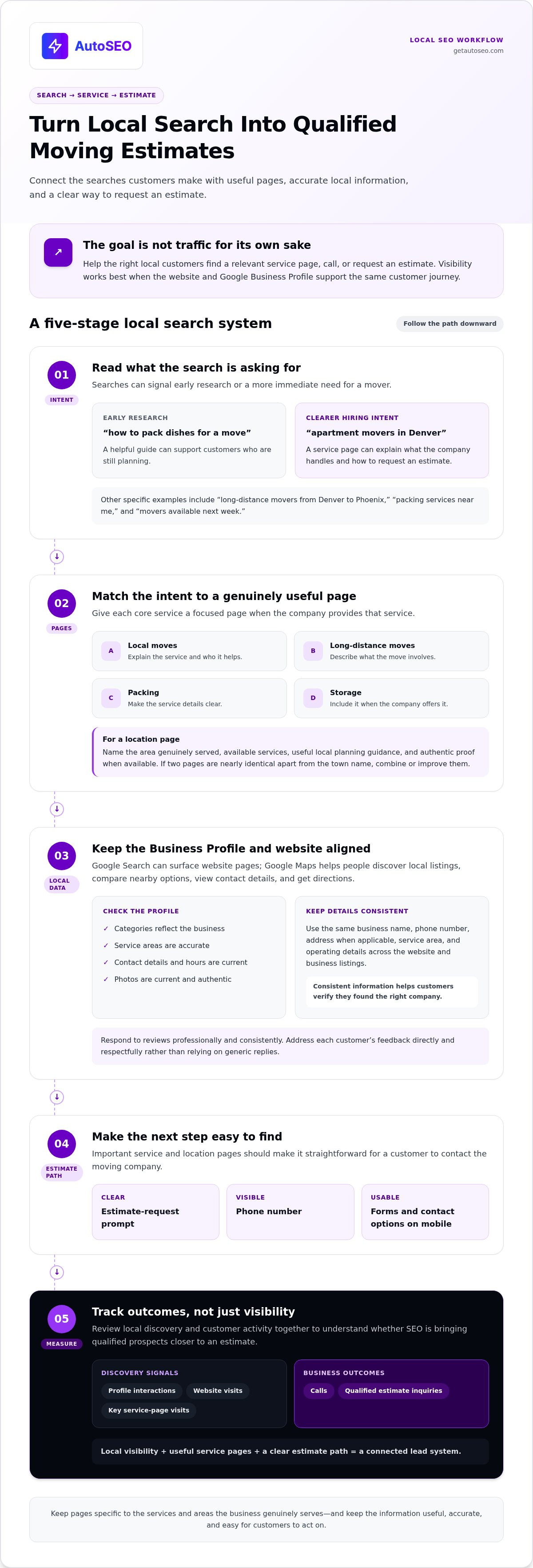
SEO for moving companies means improving a website’s unpaid visibility when people search for moving services in places the business serves. The goal isn’t traffic for its own sake. It’s helping the right local customers find a relevant service page, call, or request an estimate.
Local search engine optimization connects a business with searches shaped by geography and nearby needs. The Local Search Engine Optimization overview explains the broader concept. For movers, the practical work starts with matching website pages and business information to the services and areas customers actually search for.
SEO is one part of a wider marketing system. Paid ads buy placement, referral programs encourage past customers or partners to send business, and Google Business Profile management keeps a company’s local listing accurate and useful. These channels can complement each other, but they aren’t interchangeable. Organic SEO builds relevant website visibility over time, while a Business Profile supports discovery in Google Search and Maps.
Which searches signal a customer is ready to hire movers?
Broad searches often show early research: “how to pack dishes for a move” or “long-distance moving checklist.” These topics can help customers before they’re ready to choose a mover. Searches with a location, service, or timing detail tend to show clearer hiring intent, such as “apartment movers in Denver,” “long-distance movers from Denver to Phoenix,” or “packing services near me.”
Use those differences to plan content. A customer comparing packing tips may need a helpful guide. Someone searching for apartment movers in a specific city needs a service page that explains what the company handles and how to request an estimate. Timing also changes the need: “movers available next week” signals something different from “moving company for a summer relocation.” Build pages around genuine services and service areas, rather than creating a page for every possible keyword variation.
How do local results and Google Maps fit into moving SEO?
Google Search can show website pages for service and location queries. Google Maps surfaces local business listings, helping people compare nearby options, view contact details, and get directions. A strong website presence and an accurate listing support different parts of the discovery journey.
Keep the Google Business Profile aligned with real operations. Review the service areas, contact details, business categories, and operating information for accuracy. Then make sure relevant website pages provide consistent service and location details. Clear information helps potential customers determine whether the company fits their move before they call or request an estimate.
Build local visibility with pages movers actually need
A useful website makes it easy for customers to match their move to the right service. Give each core offering a focused page instead of squeezing everything into one general “moving services” page. For example, separate pages can explain local moves, long-distance moves, packing, and storage when those are services the company provides. Each page should describe what the service involves, who it helps, and how to take the next step.
Keep business details consistent wherever they appear online. Use the same business name, phone number, address when applicable, service area, and operating details across the website and business listings. Inconsistent information can make it harder for customers to verify they’ve found the right company.
What should a moving company service-area page include?
A service-area page should offer more than a city name swapped into a template. State the area genuinely served, explain which moving services are available there, and include useful local guidance, such as planning considerations for the types of moves common to that area. Add authentic proof when available, like customer feedback or photos from completed work. Industry context can also inform useful content; the American Trucking Associations' Moving & Storage Conference is one relevant reference for the moving and storage sector.
Create a location page only when you can make it meaningfully specific. If two pages provide the same information with only the town name changed, combine or improve them. A smaller set of genuinely useful pages is clearer for customers and easier to keep accurate.
How should movers improve their Google Business Profile?
Treat the profile as a working customer touchpoint. Check that categories reflect the business, service areas are accurate, contact information is current, and listed hours match actual operating information. Add current, authentic photos, then respond to reviews professionally and consistently. Avoid generic replies; address each customer’s feedback directly and respectfully.
Make the next step obvious on every important service and location page. Use a clear estimate-request prompt, show the phone number prominently, and make sure forms and contact options work smoothly on mobile. Then measure profile interactions alongside website visits, visits to key service pages, calls, and qualified estimate inquiries. This helps distinguish visibility from outcomes that matter to the business.
For teams that want a more consistent publishing workflow, an automated SEO content workflow can help maintain useful pages and content while owners focus on daily moving operations.
Compare SEO approaches and judge content quality before scaling
SEO for moving companies needs a workflow that fits your team’s time, desired control, and publishing pace. Owner-led work keeps decisions close to the business, agency support shifts execution to an outside service, and an automated platform can systematize recurring research and publishing tasks. None removes the need for accurate business knowledge and editorial judgment.
In-house, agency, or automated SEO: what changes?
Compare the operating model, not just the volume of content. Each approach still depends on the mover to provide accurate service details, local knowledge, and clear priorities.
| Approach | Workflow it supports | Business input still needed |
|---|---|---|
| Owner-led | The owner or staff handles topic research, writing, page updates, and measurement. | Dedicated time, process ownership, service expertise, and regular follow-through. |
| Agency support | An external provider handles agreed SEO tasks through its service workflow. | Clear goals, access to accurate company information, feedback, and review of deliverables. |
| Automated platform | Software can support repeatable research, content production, publishing, and link-building workflows. | Business context, priorities, fact-checking, and review for local fit and quality. |
For example, AutoSEO’s subscription uses AI research about a business, its audience, and competitors to inform a content plan. It includes 30 SEO-focused articles per month, 100 Domain Authority worth of backlinks, and automated publishing to WordPress after initial setup. Automation can help maintain a steady workflow, but output volume alone doesn’t make content accurate, useful, or distinctive.
How can movers keep scaled content useful and trustworthy?
Before publishing, check each piece against the customer’s real question and the company’s actual operations. A practical review should cover:
- Search intent: Does the article answer a specific question about planning or completing a move?
- Accuracy: Are services, service areas, business details, and any safety guidance correct?
- Local value: Does it provide relevant detail instead of repeating a generic template?
- Originality and usefulness: Does it add a clear explanation, example, or practical next step?
For content about interstate moves, use authoritative references rather than guessing at consumer guidance. The Federal Motor Carrier Safety Administration’s Protect Your Move resource can help inform readers about moving-related protections and planning. Link each article to a relevant service page, then make the next step obvious, such as viewing service details or requesting an estimate. Scale only when your review process can protect quality.
Turn moving-company SEO into a measurable weekly workflow
Make SEO for moving companies a repeatable operating routine, not a string of disconnected updates. Each week, move through five steps: research what customers are searching for, prioritize a page or topic, publish or improve useful content, measure activity, then choose the next update based on what the data shows.
- Research: Review Search Console queries and customer questions for relevant service and location needs.
- Prioritize: Choose one important service page, location page, or content gap to address.
- Publish or improve: Make the page more useful, accurate, and aligned with the search intent.
- Measure: Check impressions, clicks, landing pages, calls, and estimate requests.
- Improve: Keep what works, revise weak points, and document the next action.
What should moving companies measure beyond rankings?
Rankings can help diagnose visibility, but they don’t show whether the right customers are finding the right services. In Google Search Console, review impressions and clicks by query and page. Website analytics can show which organic landing pages attract visits and what visitors do next.
Connect those signals to actual inquiries. Use a consistent process to record whether calls and estimate requests came from organic search, and note the page or service involved when that information is available. Compare inquiry quality and service fit, not just total traffic. A smaller number of relevant requests may be more useful than a larger volume of visits from people outside the company’s service area.
How can movers prioritize SEO during busy and slow seasons?
Plan evergreen guidance, such as move-planning checklists, alongside timely content that answers seasonal customer questions. Before a period when demand typically rises for the business, review the relevant service pages, contact details, and estimate-request path. Prioritize updates based on actual services, capacity, and past inquiry patterns rather than publishing seasonal content just to fill a calendar.
Review performance regularly, but interpret changes in context. Moving demand can fluctuate by season, and a short-term dip doesn’t automatically mean a page has failed. Compare similar periods when data allows, look for sustained shifts in impressions, clicks, and qualified inquiries, and avoid assuming SEO will produce a ranking change on a fixed schedule. Use the data to identify a specific opportunity, then make and track one clear improvement.
Build a consistent research-to-publishing workflow with AutoSEO’s automated SEO platform, while keeping your attention on the quality and relevance of each page.
Scale moving-company SEO with AutoSEO on autopilot
Once your SEO priorities are clear, automation can help keep recurring work moving. AutoSEO is an automated SEO platform subscription for businesses that want research, content production, publishing, and backlink building in one ongoing workflow. It supports execution; your knowledge of services, customers, and service areas keeps the work grounded in the business.
How does automated SEO fit a moving company’s workflow?
AutoSEO uses AI to research your business, audience, and competitors, then uses that input to inform a content plan. The subscription includes 30 SEO-focused articles per month and 100 Domain Authority worth of backlinks. After initial setup, articles can be published automatically to WordPress. The goal is a repeatable publishing workflow, not a promise of specific rankings, traffic, or estimate requests.
Automation handles repeatable production tasks, but it can’t replace accurate company information. Keep service descriptions, locations served, and customer priorities current so planned content reflects the moving work you actually do. Review articles for factual accuracy and local relevance before they go live, especially where a detail could affect a customer’s plans.
For a closer look at the supporting workflows, explore this SEO automation guide, small business SEO guide, AI content creation guide, and link-building guide. Together, these topics explain how research, content, publishing, and backlinks fit into a consistent SEO process.
What should a moving company prepare before starting?
Give the workflow a reliable foundation. Gather accurate service descriptions, the locations you serve, common customer questions, and current business details. Identify which pages or topics matter most, then review planned content for operational accuracy and alignment with actual services. This input helps keep quality and local relevance intact as production scales.
If you want a structured way to maintain recurring SEO activity while focusing on moving operations, AutoSEO may fit your workflow. Explore the $1 trial to evaluate the subscription for your business.
Build a local SEO system you can sustain
Effective SEO for moving companies connects local search intent to useful service pages and a clear path to request an estimate. Focus on areas you genuinely serve, keep business details accurate, and review whether organic visitors become relevant calls and inquiries. A weekly cycle of research, publishing, measurement, and improvement turns SEO into a manageable operating process.
Consistency takes time, especially when moving operations demand your attention. AutoSEO uses AI research about your business, audience, and competitors to inform a content plan. Its subscription includes 30 SEO-focused articles per month, with automated publishing to WordPress after initial setup. Review content for accuracy and local relevance, then use performance data to guide what you improve next. Automation supports execution, while your business knowledge keeps the work grounded.
Ready to make recurring SEO work easier to manage? Put your moving company’s SEO on autopilot with AutoSEO and build a consistent workflow around your growth priorities. Start with a clear plan, protect content quality, and keep improving. Your next local lead starts with being easier to find.
Frequently Asked Questions
How does SEO help a moving company get more customers?
SEO helps a moving company appear when people search online for relevant moving services in areas the company serves. A focused approach to SEO for moving companies connects those searches to useful service and location pages, making it easier for potential customers to learn what the business does and request an estimate. Track calls and qualified inquiries alongside website visits to see whether organic visibility is reaching the right audience.
How do I do SEO for a moving company?
Start by identifying the services and locations the business genuinely serves. Create useful pages for core services and meaningful service areas, keep business information consistent, and maintain an accurate Google Business Profile. Publish content that answers real moving questions, then use Search Console and website analytics to review impressions, clicks, landing pages, calls, and estimate requests. Improve pages based on customer fit and performance, not rankings alone.
How long does SEO take to work for a moving company?
There’s no reliable fixed timeline for SEO results. Progress depends on factors such as your website’s current condition, local competition, content quality, and how consistently you improve relevant pages. Treat SEO as ongoing work rather than a quick campaign. Track impressions, clicks, and qualified inquiries over time, and compare similar seasonal periods where possible. A temporary change in visibility doesn’t guarantee a lasting trend or predict when leads will arrive.
What should a moving company include on its local SEO pages?
Each local page should clearly describe the moving services offered in that area and the actual locations served. Add genuinely useful local information, move-planning guidance, and authentic customer proof when available. Keep business details accurate, make the estimate-request path clear, and ensure contact options work well on mobile. Avoid pages that only swap in a different city name. Every page should offer distinct value to the people it’s meant to help.
Does a moving company need a Google Business Profile for SEO?
A Google Business Profile is a core asset for local visibility, especially for discovery through Google Maps and local results. It complements your website, which can rank with service and location pages in Google Search. Keep profile categories, contact details, service areas, and operating information accurate. Add current photos and respond professionally to reviews. Measure profile interactions alongside website visits and inquiries to understand how each channel supports customer discovery.
Can AI content help a moving company rank in Google?
AI can help research topics and produce content, but using AI doesn’t guarantee rankings. The content still needs to answer real customer questions, reflect the company’s actual services and locations, and provide accurate, helpful information. Review every article for originality, local relevance, factual accuracy, and alignment with search intent before publishing. Use AI to support a consistent workflow, then apply moving-business knowledge to keep quality high as production scales.
Should a moving company use SEO automation or manage SEO manually?
Choose the workflow that fits your available time and how much control you want over recurring tasks. Manual SEO gives your team direct ownership but requires regular research, writing, publishing, and measurement. Automation can support those repeatable steps. AutoSEO’s subscription includes AI research, 30 SEO-focused articles per month, 100 Domain Authority worth of backlinks, and automated WordPress publishing after initial setup. Your team should still verify service details and local accuracy.


