

What if SEO could keep moving while you focus on running your business? If you’re asking what is zero touch seo, the short answer is an approach that automates recurring tasks such as research, content production, publishing, and link building, with minimal hands-on work. It doesn’t mean strategy and quality control disappear.
That distinction matters. Automation can save time and make SEO work more consistent, but AI-generated content still needs to be accurate, relevant, and useful to your customers. To assess an “autopilot” service, look at the work it actually handles, the information it uses, and how you can catch errors.
This guide explains the typical zero-touch SEO workflow, what automation can handle, and where human judgment remains essential. You’ll also see how AutoSEO combines AI research, content planning, 30 SEO-focused articles per month, automated WordPress publishing after setup, and backlink building in one subscription. By the end, you’ll have a practical way to assess whether this model fits your business and its quality standards.
Key Takeaways
- Understand what is zero touch seo by separating automated execution from the strategy and oversight that still need human judgment.
- Trace the workflow from business and customer research to topic selection, content production, publishing, and ongoing iteration.
- Compare zero-touch SEO with DIY work, agencies, and standalone AI tools to see how control and recurring responsibilities differ.
- Use a quality checklist to assess factual accuracy, search intent, publishing controls, and reporting instead of judging performance by content volume alone.
What Is Zero-Touch SEO? A Clear Definition of SEO on Autopilot
What is zero touch seo? It’s an operating model that automates recurring SEO tasks after initial setup, reducing how much work a business owner must manage by hand. A platform may connect research, content planning, publishing, and backlink activity in an ongoing workflow. “Zero-touch” describes the level of automation, not a promise that people never need to guide or review the work.
This distinction matters for small businesses. SEO takes consistent effort, but owners may not have time to coordinate every task. Automation can keep routine work moving without requiring someone to manage each step. It differs from a standalone AI writing tool, which focuses on generating text, and from a traditional agency relationship, which involves people delivering SEO work. An automated platform can bring several recurring tasks together in one workflow.
Zero-touch SEO is also different from zero-click search. A zero-click result answers a query on the results page, so the user may not visit a website. Zero-touch SEO refers to automating SEO work, not the way search results display information.
Which SEO tasks can a zero-touch workflow automate?
Depending on the platform, automation may cover keyword and audience research, topic planning, content creation, on-page optimization, publishing, and backlink activity. Some systems recommend actions; others carry out selected tasks. The scope varies, so “automated SEO” doesn’t mean every platform does the same work. When comparing services, map each one to the tasks you currently handle, then note which steps still need your input.
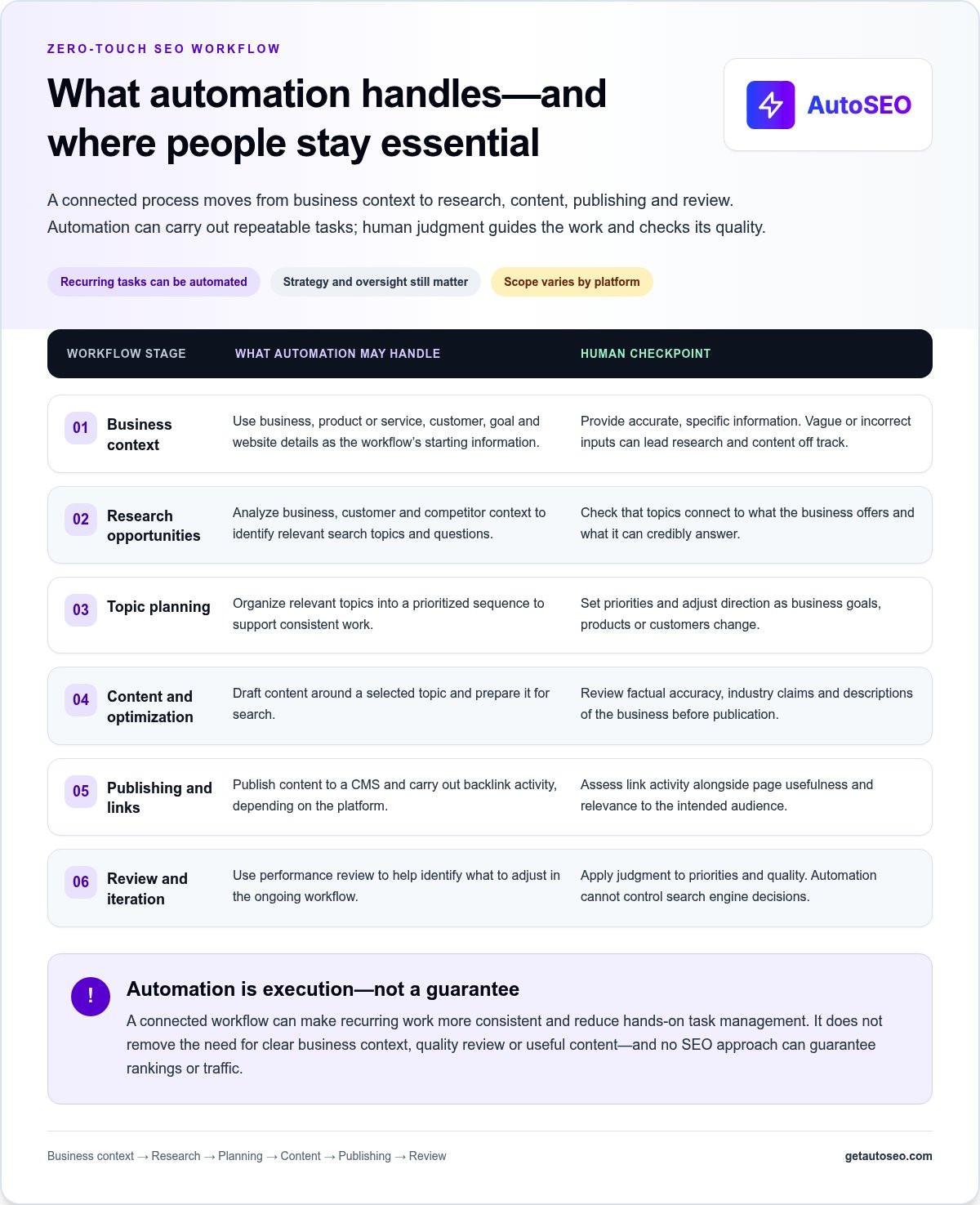
Setup and business context → Research and topic selection → Content and optimization → Publishing and backlink activity → Review and iteration
Good topic selection starts with accurate information about the business, its customers, and its competitors. That context helps ensure content addresses relevant questions the business can credibly answer.
Does zero-touch SEO mean SEO runs itself?
No. Automation can execute repeatable tasks, but people remain responsible for business context, priorities, and quality. Review factual claims, confirm that content describes the business accurately, and adjust direction when products, customers, or goals change.
Setup is important. If a platform receives vague or incorrect business information, its research and content may miss the mark. Clear goals and a precise business description give the workflow a stronger starting point. After setup, human involvement may be lighter, but that is not the same as having no oversight.
No SEO approach can guarantee rankings or traffic. Automation can make execution more consistent and reduce the burden of managing recurring tasks, but it can’t control search engine decisions or replace judgment about what customers find useful.
How Zero-Touch SEO Works: From Business Research to Published Content
A zero-touch workflow connects recurring SEO tasks in a sequence. Research guides the content plan, the plan informs production, and performance review helps shape what comes next. Understanding what is zero touch seo in practice means looking at these handoffs, not just whether a platform uses AI.
- Set up the business context. Provide accurate details about the business, its products or services, customers, goals, and website. Clear inputs give research and content planning a useful foundation.
- Research opportunities. The workflow can analyze business, customer, and competitor context to identify relevant search topics and questions. The goal is relevance, not a list of keywords with no connection to what the business offers.
- Build a content plan. Topics are organized into a sequence based on relevance and priority. A plan supports consistent work, but it doesn’t promise that any page will rank.
- Create and optimize content. Content is drafted around a selected topic and prepared for search. Check business facts and industry claims carefully before publication.
- Publish, build links, and review. Automated publishing can move content into a CMS, reducing repetitive manual steps. Backlink activity supports the wider SEO effort, while performance review helps identify what to adjust next.
How research and content planning shape the workflow
Research is most useful when it reflects both customer needs and what the business can credibly answer. A company’s services, audience questions, and competitor coverage can help distinguish useful topics from generic ones. A content plan turns those opportunities into a prioritized sequence. Before content goes live, verify industry claims and business details such as names, features, and service descriptions. For a deeper explanation of SEO automation, explore how recurring tasks fit into a connected process.
How content publishing and link building fit together
Publishing automation can reduce repeated copying, formatting, and scheduling in a content management system. It doesn’t make a page valuable by itself. Backlinks are one part of SEO, not a substitute for relevant pages that answer customer questions. Evaluate link activity alongside the usefulness of the content and the fit between each page and its intended audience. If you want to see this workflow applied through a recurring subscription, explore AutoSEO’s automated SEO platform.
Zero-Touch SEO vs. DIY SEO, Agencies, and Standalone AI Tools
Choosing an SEO model means deciding who does the work, who sets the direction, and how much control you want over each step. If you’re weighing what is zero touch seo against other options, compare the operating models, not just the tools or content they produce.
DIY SEO
Control: High. You choose the topics and actions.
Recurring workload: High. You coordinate research, writing, publishing, and follow-up.
Expertise: You build or bring it.
Responsibility: You manage the process and results.
SEO agency
Control: Shared, shaped by the strategy and working arrangement.
Recurring workload: Lower for the owner, though collaboration and approvals may remain.
Expertise: Human specialists may guide and deliver strategic work.
Responsibility: Work is divided between the agency and business according to their agreement.
Standalone AI tools
Control: Often high over individual outputs.
Recurring workload: You connect separate tools and move work from research to publication.
Expertise: You need enough knowledge to direct and assess the output.
Responsibility: Planning, publishing, and quality control stay with you.
Zero-touch SEO subscription
Control: Less hands-on control over routine execution, depending on the platform.
Recurring workload: Reduced when research, content, publishing, or backlink tasks are combined.
Expertise: The platform automates tasks, but you still provide business context and judgment.
Responsibility: Automation handles execution; you remain accountable for accuracy and fit.
When is a zero-touch SEO service a practical fit?
It may suit a business that wants consistent SEO activity but lacks the in-house capacity to manage every recurring task. Consider whether your goals are clear, your website can support ongoing content, and you have time to review important work. Businesses with highly specialized subject matter or strict approval needs may benefit from closer control. Automation isn’t the right operating model for every business or stage of growth.
What trade-offs should buyers understand?
Convenience usually means less involvement in individual topic and publishing decisions. Understand how the workflow handles review, corrections, and changes to business priorities before relying on it. Automated content still needs to be accurate, relevant, and consistent with your brand. Assess backlink activity on its quality and relevance, not quantity alone. A useful system should support strong pages, not distract from them.
How to Evaluate Zero-Touch SEO Quality Before You Rely on Automation
Before relying on an automated workflow, understand how it makes decisions and how you’ll catch errors. Asking what is zero touch seo should lead to more than a list of automated tasks. Consider research quality, factual accuracy, publishing controls, and whether reporting connects SEO activity to business outcomes.
How can you protect content quality at scale?
Use this checklist to assess the workflow:
- Research relevance: Do selected topics reflect your business, audience questions, and real expertise, or are they generic keyword matches?
- Search intent: Does each page clearly and usefully answer the reason behind the query?
- Factual accuracy: Are business details, product or service descriptions, and industry claims correct and current?
- Publishing controls: Can you review content, correct errors, and manage when pages go live?
- Reporting clarity: Can you see which pages are indexed, how they perform, and what the workflow is doing?
Set a human review process for sensitive, regulated, or fast-changing claims. Verify those details against reliable sources before publication, and update content when facts change. For every article, look for original guidance that reflects the business’s experience. Publishing more pages won’t compensate for thin answers or inaccurate information. For more on building repeatable content workflows, read about AI content creation.
Which SEO metrics should you monitor?
Measure progress in stages. First, check whether pages are indexed and earning organic impressions. These are leading indicators: they show that pages are appearing in search, not that they’re producing business value. Next, review organic clicks and the landing pages attracting them. Then assess meaningful actions, such as relevant inquiries or purchases, against a baseline from before the workflow began.
Don’t judge performance by article count alone. A smaller set of pages that matches search intent and attracts relevant visitors can be more useful than a larger batch with little audience fit. Compare results over time and account for other changes, including site updates, seasonality, and shifts in demand. A ranking change after an automated action doesn’t prove that action caused it.
Ready to put these quality checks into a recurring workflow? Explore AutoSEO’s automated SEO platform.
How AutoSEO Applies Zero-Touch SEO to Recurring Business Growth
AutoSEO puts zero-touch SEO into practice as a recurring workflow for small businesses. Its subscription combines AI-powered research into a business, its customers, and its competitors with content planning, article creation, backlink building, and automated WordPress publishing. After initial setup, the workflow is designed to run on autopilot, reducing the need to coordinate each recurring task by hand.
What does AutoSEO automate for a small business?
Research provides context for a content plan, helping guide topic choices toward the business and its audience rather than producing content in isolation. The subscription includes 30 SEO-focused articles per month and automated publishing to WordPress after setup. It also includes backlink building, bringing recurring content and link activity into the same subscription.
That’s a practical example of what is zero touch seo as an operating model: automation connects repeatable work, but it doesn’t remove accountability. Business owners should keep their business information accurate and ensure published content reflects their expertise and customers’ needs. Backlink activity and a steady publishing schedule support SEO work, but neither guarantees rankings, traffic, or conversions. Outcomes depend on multiple factors, including the website, content relevance, competition, and how search engines respond.
What is a sensible next step for exploring SEO on autopilot?
Start by listing the SEO tasks you currently handle or coordinate. Include topic research, content planning, drafting, publishing, link activity, and performance review. Compare that workload with the automated workflow. Identify which tasks you want to offload and where you’ll keep human review, especially for factual accuracy and business-specific claims.
Set realistic expectations. A recurring publishing process can make execution more consistent, but SEO still needs evaluation. Monitor whether pages are indexed, whether they reach the right audience, and whether they contribute to meaningful business actions. Use those observations to guide future priorities instead of treating automation as a set-and-forget promise.
If that workflow matches the work you want to streamline, explore AutoSEO’s automated SEO platform.
Put Your SEO Workflow on Autopilot
Zero-touch SEO reduces the time you spend coordinating recurring work, but it doesn’t eliminate the need for sound business context or quality checks. If you’re asking what is zero touch seo, think of it as automated execution with human oversight where accuracy, relevance, and judgment matter.
The right approach connects research, planning, content, publishing, and link activity instead of relying on an AI writing tool alone. Measure quality by whether pages serve search intent and support meaningful business goals, not by article volume alone. Keep expectations realistic: automation can support consistent SEO work, but it can’t guarantee rankings or traffic.
AutoSEO brings AI research, content planning, and backlink building together in one subscription, with 30 SEO-focused articles per month and automated WordPress publishing after initial setup. It gives small businesses a way to reduce repetitive work while keeping quality in view.
Explore SEO on Autopilot with AutoSEO to see how a recurring, automated SEO workflow can help streamline your content and backlink activity.
Frequently Asked Questions
What is zero-touch SEO?
Zero-touch SEO automates recurring search optimization tasks after initial setup. Depending on the service, it may include research, content planning, article creation, publishing, backlink activity, or reporting. The term describes reduced manual execution, not SEO without strategy or oversight. Businesses still need accurate information, realistic goals, and a process for checking content quality and performance. Automation can streamline routine work, but it can’t guarantee rankings or traffic.
How does zero-touch SEO work?
A typical workflow starts with research into a business, its customers, and competitors. That context informs keyword and topic choices, which feed into a content plan. Automation may then help create and publish articles, coordinate recurring SEO tasks, and report on performance. Workflows differ by platform. Accurate setup information and periodic review remain essential, since a system may not recognize every change in the business or its priorities.
Is zero-touch SEO effective for small businesses?
It can help small businesses maintain recurring SEO activity when they don’t have the time or staff to coordinate every task. Results depend on factors such as research quality, content relevance, website health, competition, and consistency. Treat zero-touch SEO as an operating model, not a shortcut to guaranteed rankings. Track indexed pages, impressions, clicks, and meaningful business actions over time to judge whether the work supports your goals.
Can AI-generated SEO content rank on Google?
AI-assisted content can appear in search results when it’s useful, accurate, original, and relevant to the query. Using AI doesn’t guarantee visibility, and publishing a large volume of generic pages may not help readers. Check facts, add genuine business expertise, and make sure each page answers its intended question. Follow current search guidance and measure performance over time rather than assuming automation or publication volume will produce rankings.
Does zero-touch SEO mean you never need human oversight?
No. Automation can handle repeatable tasks, but people remain responsible for business context, sensitive claims, brand accuracy, and strategic priorities. Review content involving regulated, technical, or fast-changing information with particular care. Periodic checks of published pages can also catch errors and reveal changing customer needs. Zero-touch SEO should mean less manual execution, not an absence of accountability or quality control.
What is the difference between zero-touch SEO and an SEO agency?
Zero-touch SEO generally uses software or a subscription to automate recurring tasks after setup. An SEO agency typically provides a service relationship that may involve human strategy, communication, and execution, depending on its scope. Neither model guarantees results. Compare the work each approach covers, how it manages quality, what reporting it provides, and how much involvement your business wants. The better fit depends on your goals and available capacity.
What should I check before choosing an automated SEO service?
Check how the service researches your business, selects topics, handles factual accuracy, publishes content, and reports progress. Clarify which tasks it automates and which decisions remain yours. Look for clear expectations rather than ranking guarantees, and assess whether the workflow fits your website and goals. Plan how to review sensitive claims and measure meaningful outcomes. AutoSEO combines AI research, content planning, 30 SEO-focused articles per month, backlink building, and automated WordPress publishing.


