

Publishing more pages won’t automatically make your business an authority. A focused set of useful, connected pages can do more than a backlog of articles that repeat the same points. If you’re figuring out how to build topical authority for small business, the challenge is choosing what deserves a page and grounding each piece in what you know.
Limited time and budget make that decision harder. You need a content plan built around real customer questions, not a long list of topics you can’t maintain. AI can speed up research and drafting, but it can’t supply your firsthand experience. Your expertise is what makes content specific, trustworthy, and genuinely useful.
This guide shows you how to turn your knowledge into a manageable topic system that supports organic visibility without wasting effort. You’ll learn how to choose a focused subject, group related questions into the right pages, connect them with internal links, and keep content accurate and helpful. You’ll also see how to use AI in a repeatable workflow while keeping your business expertise at the center.
Key Takeaways
- Learn how to build topical authority for small business by starting with customer needs and expertise you can credibly demonstrate.
- Use customer conversations, Search Console, and search suggestions to uncover questions worth answering.
- Choose distinct, useful pages over a larger cluster of repetitive content, and connect related pages with internal links.
- Follow a repeatable workflow to prioritize, create, publish, measure, and refresh content at a sustainable pace.
- Use automation to reduce repetitive work while keeping human expertise, factual accuracy, and useful differentiation in every page.
What topical authority means for a small business, and what it does not
Topical authority is the depth and clarity of your website’s coverage of subjects that matter to your customers. It comes from useful pages that answer related questions and show what your business knows, not from adding every possible keyword to your site. Search visibility depends on usefulness, relevance, and many other signals, so no content plan can guarantee rankings.
A page may rank for a specific search without showing broader expertise. Publishing frequently can also make a site larger without making it more helpful. Authority develops through connected work over time: choose relevant questions, answer them well, and maintain pages as your knowledge or services change. The practical starting point for how to build topical authority for small business is focus, not volume.
How topical authority differs from domain authority
Topical relevance comes from the quality and depth of your coverage. Domain Authority and similar scores are third-party estimates, not Google ranking factors. They can provide a way to compare sites within a tool, but they don’t certify expertise or predict a specific search outcome.
Consider a bicycle repair shop serving a defined local area. It can build relevant coverage by explaining the repairs it handles, common bike problems, what customers can expect during a repair, and how to care for a bike afterward. Those connected pages demonstrate focused subject coverage more directly than a single broad page or a third-party score.
Why focused coverage helps small businesses compete
A small business doesn’t need to cover an entire industry. A narrower topic makes it easier to show real experience and keep content manageable. Start with what customers ask and what your team can answer accurately. For the repair shop, one article might explain how to recognize a brake issue; another could describe what information to share when booking a repair. Each page serves a distinct need and reinforces the shop’s relevant knowledge.
Organize related pages so readers can move naturally between them. This creates a useful knowledge base, where connected concepts clarify how topics relate. Internal links help readers find relevant details and give search engines structural context, though they don’t guarantee visibility.
Topical authority is demonstrated expertise across connected customer questions, not a high page count. A focused cluster of accurate, distinct pages can be a stronger foundation than a larger collection of repetitive articles. Build coverage around what your business genuinely knows, then expand it as new customer needs emerge.
How to build a topical map from real customer questions
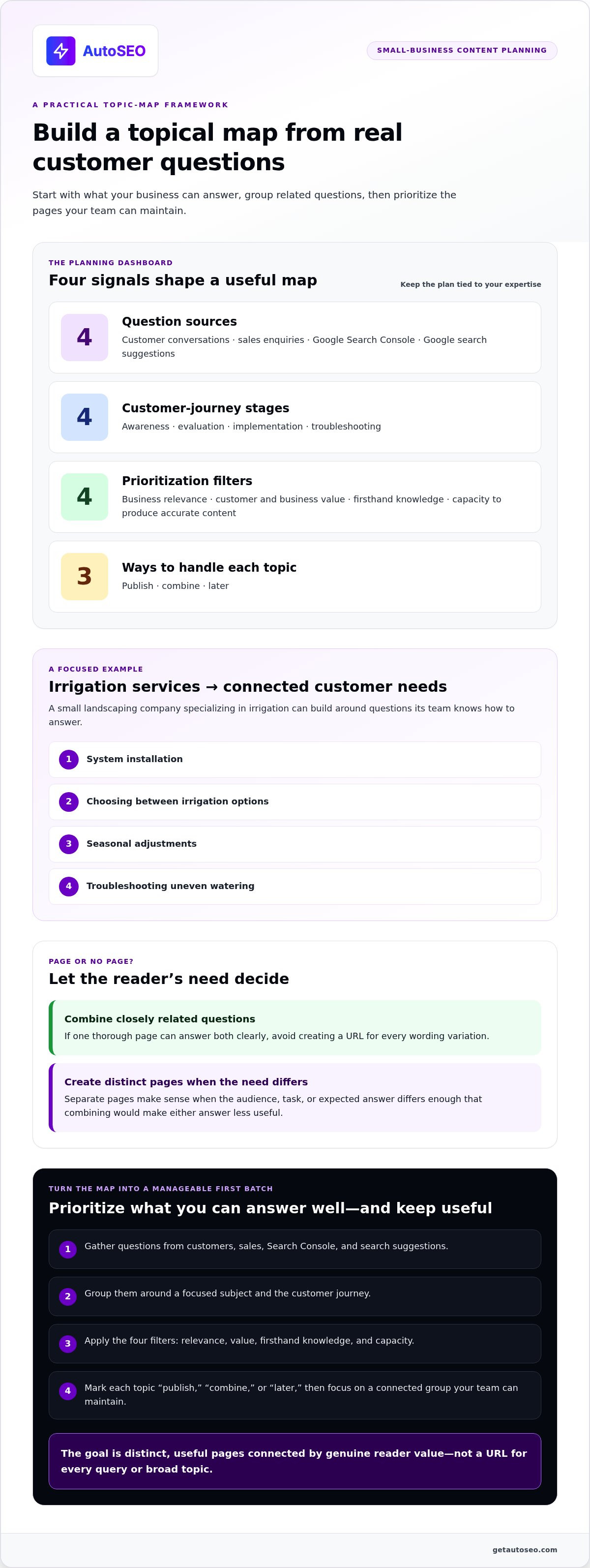
A useful topical map starts with what your business can answer, not with a giant keyword export. List your core services, the customers you serve, the questions they ask before buying, and the problems you can solve from direct experience. Then gather language from customer conversations, sales enquiries, Google Search Console, and Google’s search suggestions. These sources help you plan around actual needs instead of guessing what people want to know.
For example, a small landscaping company that specializes in irrigation could collect questions about system installation, choosing between irrigation options, seasonal adjustments, and troubleshooting uneven watering. Keep the map tied to the company’s expertise and customers’ needs rather than expanding into every broad gardening topic.
Choose a focused pillar topic and supporting subtopics
Pick one commercially relevant subject the business can explain well. Map questions across the customer journey: awareness questions define the problem, evaluation questions compare approaches, implementation questions explain what to expect, and troubleshooting questions help resolve common issues.
For an irrigation topic, a pillar page could cover planning a system, supported by focused pages on water coverage, installation preparation, seasonal settings, and common problems. Link pages when the next step is genuinely useful to the reader. The goal is a clear route through the subject, not links added for their own sake.
Decide when a search question needs its own page
Don’t create a URL for every wording variation. Compare what searchers appear to want and whether results for similar queries substantially overlap. If one thorough page can answer two closely related questions clearly, combine them. Create separate pages when the audience, task, or expected answer differs enough that combining them would make either answer less useful.
Prioritize the resulting clusters with four practical filters: relevance to your business, value to customers and the business, strength of your firsthand knowledge, and capacity to produce accurate content. A highly relevant question you can answer well is usually a better starting point than a broad topic that would take time without serving a clear customer need.
To decide how to build topical authority for small business, turn the map into a manageable first batch. Mark each topic as “publish,” “combine,” or “later,” then focus on the strongest connected group your team can maintain. A platform such as AutoSEO’s automated SEO platform can support recurring research and content planning, while your expertise shapes what the pages need to say.
What makes a topic cluster trustworthy, not just bigger
A trustworthy topic cluster earns its depth. It answers related questions with distinct, accurate information and gives readers a clear path between answers. A high page count alone proves nothing. If several pages repeat the same advice with minor wording changes, they add workload without giving customers a stronger reason to trust your expertise.
Before publishing or expanding a cluster, assess it with a simple editorial table. Give each page a row and check four areas:
- Useful depth: Does it answer the question clearly, beyond a surface-level summary?
- Firsthand evidence: Does it include a real process, example, observation, or lesson from your work?
- Intent match: Does the page deliver the kind of answer the searcher needs?
- Maintenance: Who will verify details and update the page when information changes?
Use the results to improve, combine, or hold pages before adding more. This approach supports quality and scale without making publishing volume the goal.
How to add experience competitors cannot copy
Include details that come from doing the work: explain how your team approaches a common problem, share anonymized patterns from customer questions, or describe a practical lesson learned during a project. For example, a plumbing business could explain the checks it makes when diagnosing low water pressure, while clearly separating its own process from general guidance.
Make authorship clear and keep claims precise. Label opinion as opinion, support external facts with reliable sources, and avoid invented case studies or expertise claims you can’t substantiate. AI can help organize or draft material, but generic filler won’t replace evidence from your business. Review every page for accuracy and a clear reason it deserves to exist.
How internal links make expertise easier to navigate
Link each supporting page to its relevant pillar and to closely related answers that help readers take the next step. Use descriptive anchor text, such as “how to identify a leaking pipe,” so readers know what a link leads to. Don’t force a link between pages just because they share a broad keyword.
Audit the cluster for orphan pages with no useful incoming links, dead ends that leave readers without a logical next step, and repeated links that add no value. A well-linked structure helps readers navigate the subject and makes the relationships between pages clear.
This is the practical test behind how to build topical authority for small business: every page should contribute distinct expertise, evidence, or guidance, and fit naturally into the cluster. If it doesn’t, improve it before scaling the content operation.
A practical topical authority workflow for a lean small-business team
Build a repeatable loop, not a publishing treadmill. Move each topic through research, prioritization, briefing, creation, publication, internal linking, measurement, and refresh. Set a cadence your team can sustain while checking facts and adding useful business insight. One accurate, relevant article is more valuable than rushing out pages that need major corrections.
- Research: Collect customer questions and search queries.
- Prioritize: Choose topics that matter to customers and fit your expertise and capacity.
- Brief and create: Define the reader, intent, answer, and evidence before drafting.
- Publish and connect: Review the page, then link it to relevant content.
- Measure and refresh: Review performance and update or consolidate pages when needed.
Build a brief that protects quality as production scales
A concise brief keeps each page focused. Specify who it serves, what the searcher wants to do, what distinct answer the page will provide, which evidence supports it, and which internal links will help readers continue. AI can assist with research and drafting, but treat its output as a starting point. Someone familiar with the business should verify claims, examples, and business-specific details before publication. Automation can reduce repetitive work; it can’t replace that review.
Measure, update, and consolidate the content cluster
Use Google Search Console to review the queries bringing impressions and clicks to each page. Track those separately from conversions, indexing status, and engagement. Each signal answers a different question: Are pages appearing? Are people clicking? Are they taking a valuable next step? Is the page available in search? Do visitors find it useful?
Look for unanswered queries, pages losing visibility, and overlap between URLs. Refresh content when facts, services, customer needs, or search results change. If two pages target the same intent and neither offers distinct value, combine the strongest material into one clearer resource and redirect the retired URL appropriately.
Interpret changes with care. Seasonality and search algorithm updates can affect performance, but a short-term rise or drop doesn’t prove what caused it. Compare trends over a useful period, consider what else changed, and make one informed adjustment at a time.
An automated SEO content workflow can support recurring research, planning, and WordPress publishing.
Scale topical authority with automation without sacrificing quality
Automation can take repetitive SEO work off a small team’s plate. Use it to support research, organize content plans, assist with drafting, publish to WordPress, and manage recurring workflow tasks. That leaves more time for the work that requires your judgment: choosing the right topics, adding business-specific experience, checking facts, and deciding whether a page genuinely helps customers.
That distinction is central to how to build topical authority for small business. Automate execution, not expertise. AI-generated drafts still need a knowledgeable human to review claims, examples, tone, and relevance before publication. Without that checkpoint, speed can scale generic content just as easily as useful content. This guide to SEO automation explores how automation can fit into a deliberate workflow.
Which topical authority tasks are suited to automation?
Repeatable tasks are strong candidates: identifying keyword ideas, organizing a content plan, preparing draft outlines, publishing approved articles, and coordinating routine workflow steps. Keep human judgment in control of sensitive claims, editorial choices, firsthand insights, and final quality checks. Automation can help you maintain a strategy; it can’t confirm that a statement matches your actual business experience or guarantee rankings.
How AutoSEO supports consistent SEO execution
AutoSEO is a subscription platform that researches a business and its competitors, uses AI research to inform a content plan, publishes SEO-focused articles to WordPress after initial setup, and includes backlink building. The subscription includes 30 SEO-optimized articles per month. These recurring tasks can help a small business execute a content strategy consistently, while business expertise and editorial review keep the work grounded. For broader context, see this guide to small business SEO and this explanation of link building.
Measure meaningful outcomes over time. Review impressions, clicks, relevant conversions, indexing, and engagement as distinct signals. Consistent publishing and backlink work can support a broader authority-building effort, but results depend on many factors. Treat performance data as feedback for improving the strategy, not proof that any single automated task caused a change.
Turn focused expertise into a repeatable growth system
Topical authority grows when you answer real customer questions with useful, accurate pages that connect into a coherent body of expertise. Start with a focused topic map, prioritize what your team can credibly cover, and keep improving the cluster based on reader needs and performance. That’s how to build topical authority for small business without relying on publishing volume alone.
Automation can help you execute consistently, but your business knowledge and quality checks still matter. AutoSEO uses business and competitor research to inform its content plan. Its subscription includes 30 SEO-optimized articles per month, automated publishing to WordPress, and recurring backlink building. These activities support a broader strategy, but they don’t guarantee rankings or replace useful, differentiated content.
Ready to reduce repetitive SEO work and keep your content system moving? Automate consistent SEO execution with AutoSEO. Build your authority one useful step at a time, and let a repeatable workflow make that progress easier to sustain.
Frequently Asked Questions
How long does it take to build topical authority?
Building topical authority takes consistent work over time, not a single publishing sprint. There’s no reliable timeline because progress depends on your subject, competition, existing site, content quality, and how well pages meet customer needs. Start with a focused cluster, connect useful pages, and review performance regularly. Use search visibility and customer actions as feedback, then update content as your expertise, services, or customer questions change.
How many articles does a small business need to build topical authority?
There’s no set article count that establishes topical authority. The right number depends on how many distinct customer needs you can answer usefully within a focused subject. Begin with a pillar page and a manageable set of supporting topics. Combine overlapping questions when one page can answer them well, and add separate pages only when the audience, task, or intended answer meaningfully differs.
Does topical authority guarantee higher Google rankings?
No. Topical authority doesn’t guarantee rankings. Search visibility depends on usefulness, relevance, competition, and other signals, so even a thoughtful content cluster can’t promise a particular position. Focus on what you can control: accurate, helpful pages that answer real questions, clear internal links, and regular updates. Measure impressions, clicks, and meaningful conversions over time rather than treating one ranking change as proof of success.
Can a small business build topical authority with AI content?
Yes, AI can support research, topic planning, and drafting, but it can’t replace firsthand expertise or fact-checking. Use it to reduce repetitive work, then have someone familiar with the business verify claims, examples, and advice before publication. Add specific knowledge from your processes and customer needs. If AI-assisted pages are generic, repetitive, or inaccurate, producing more of them won’t create a trustworthy topic cluster.
What is the difference between topical authority and domain authority?
Topical authority describes how clearly and thoroughly a website covers a relevant subject with useful, connected information. Domain Authority and similar metrics are third-party estimates created by SEO providers, not Google ranking factors. A score may help compare sites within a tool, but it doesn’t prove expertise or guarantee search performance. For a small business, relevant pages grounded in real knowledge matter more than chasing a metric.
How should small businesses measure topical authority?
Measure the signals that show whether your content is reaching and helping the right people. In Google Search Console, review impressions, clicks, and the queries bringing visitors to relevant pages. Track indexing separately, then assess conversions and engagement to understand whether visitors take useful next steps. Look across the whole cluster, not just one page. Consider seasonality and algorithm changes, and avoid assuming short-term movement proves a specific cause.


