

What if the problem isn’t getting more search traffic, but attracting the wrong visitors? Broad technology terms can bring curious readers without hiring intent, while buyers searching for a specific development partner never find your expertise. That’s the challenge seo for software development companies must solve.
Software teams know technical depth matters. Turning that expertise into clear, useful content takes time, and SEO can easily lose priority to client delivery. A scattered blog won’t fix that.
This guide shows how to build a focused SEO process that connects buyer searches to useful content, authority, and qualified demand. You’ll learn to target service- and solution-specific searches, create content for each stage of the buying journey, build authority consistently, and measure progress through visibility, relevant engagement, and inquiries.
The goal is a repeatable approach, not a pile of disconnected keywords. Research-led planning and consistent execution can help your team reach better-fit buyers without letting SEO compete endlessly with delivery work.
Key Takeaways
- Build your SEO strategy around a focused set of software services and use cases before expanding to broader topics.
- Use seo for software development companies to connect buyer intent with relevant pages, useful content, and qualified demand.
- Compare in-house, agency-led, and automated workflows by separating strategy decisions from routine production and publishing.
- Track indexing and impressions as early signals, then assess clicks and engagement on relevant service pages.
- Create a repeatable workflow for research, planning, publishing, authority building, and performance review, with technical content checked for accuracy.
Why SEO for Software Development Companies Must Start With Buyer Intent
Ranking for a broad term like “software development” can attract students, job seekers, and people looking for general explanations. That traffic may increase page views, but it won’t necessarily create demand for your services. SEO for software development companies works when it connects a buyer’s specific need with relevant expertise and a clear next step.
Search engine optimization (SEO) helps make useful pages more visible in search. For a software company, the goal isn’t visibility alone. It’s to reach people searching for a solution you provide, then give them enough relevant information to take the next step. A founder investigating custom software has different needs from a technical leader planning legacy-system modernization or a product team exploring dedicated development teams.
Which buyers and searches should a software company target?
Start with the people involved in a buying decision and the questions they ask. Founders may search for ways to validate or build a product. Product leaders may need to extend delivery capacity. Technical decision-makers may be comparing architecture, integrations, or modernization approaches. Group topics by service, industry, technology, and business outcome, then match each group to the language buyers use to describe the problem.
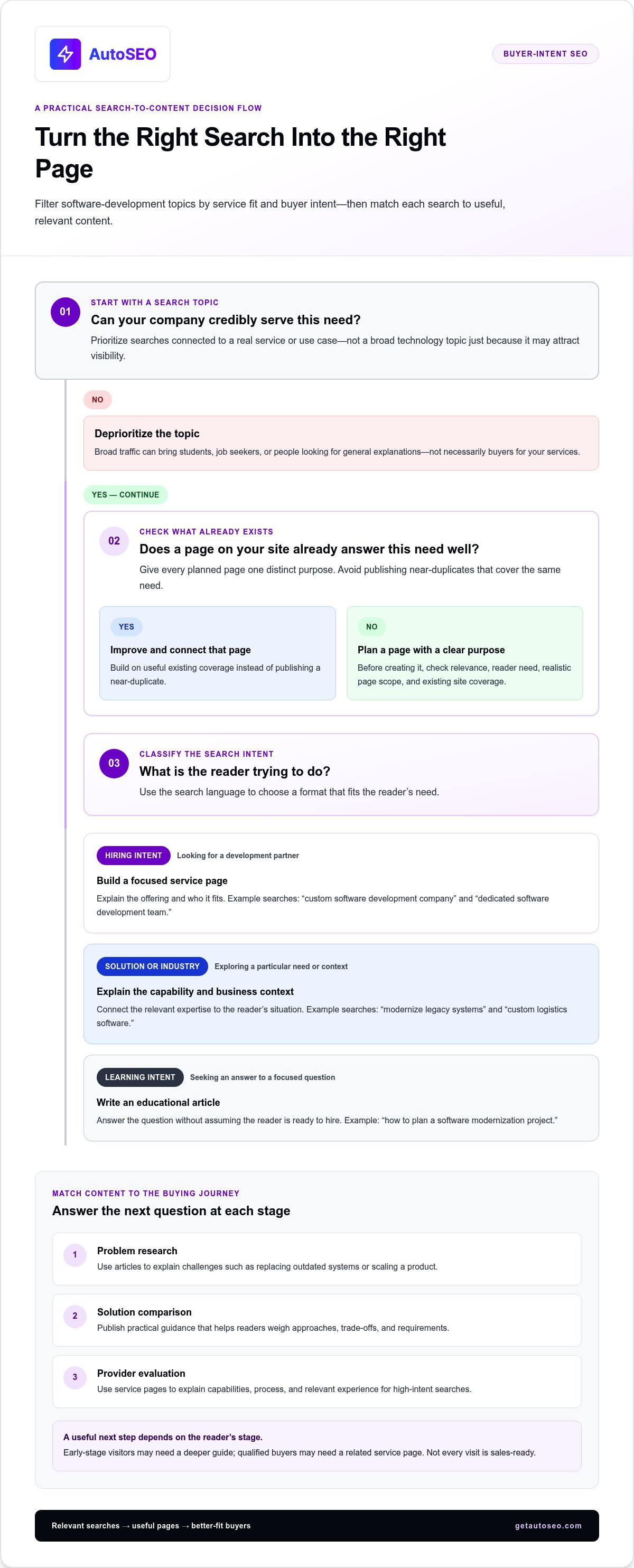
- Hiring-intent searches: “custom software development company” or “dedicated software development team.” These often call for focused service pages that explain the offering and its fit.
- Solution and industry searches: “modernize legacy systems” or “custom logistics software.” These need content that explains the relevant capability and business context.
- Learning searches: “how to plan a software modernization project.” These suit articles that answer a focused question without assuming the reader is ready to hire.
This distinction keeps keyword research tied to service fit. Prioritize searches your company can credibly serve instead of chasing broad technology topics simply because they may attract visibility. Before adding a topic, ask: Does it connect to a real service, and can the page give the reader a useful next step?
How does SEO support a longer software buying journey?
Software projects involve evaluation, not just a quick click. A buyer may first investigate a problem, compare possible approaches, then assess providers. Build content for each stage so the next page answers the next question.
- Problem research: Use articles to explain challenges such as replacing outdated systems or scaling a product.
- Solution comparison: Publish practical guidance that helps readers weigh approaches, trade-offs, and requirements.
- Provider evaluation: Use service pages to explain your capabilities, process, and relevant experience for high-intent searches.
Give each topic a relevant next step, such as exploring a related service or reading a deeper guide. Don’t treat every visit as sales-ready. Useful answers build confidence early; focused service pages help qualified buyers evaluate fit when they’re ready.
How to Build a Software Development SEO Strategy Step by Step
A reliable strategy turns research into a focused publishing plan, then uses performance data to refine it. For seo for software development companies, the priority is not covering every technology topic. Start with the services you want to grow and the searches that indicate a real fit.
How should software companies find and prioritize SEO topics?
Gather language from sales conversations, support requests, and product discovery. Customers often describe the problem before they know which technical solution they need. Group those questions by service line, buyer problem, industry, and decision stage. Then assess each topic against four checks: relevance to your services, a clear reader need, a realistic page scope, and existing coverage on your site. Michigan Technological University’s guidance on authoritative content reinforces the role useful, relevant pages play in search visibility.
Keep the first plan manageable. A focused set of service and use-case topics is easier to produce, review, and connect than a sprawling list of loosely related keywords. Before creating a page, search your site for existing content that addresses the same need. If a page already answers it well, improve and connect that page rather than publishing a near-duplicate. This gives each page a distinct purpose and reduces overlap.
How do you turn topic research into a useful content plan?
Give each planned page one primary search intent and one reader need. Match the format to that intent: service pages explain what you deliver, comparison pages help evaluate approaches, case studies show how work addressed a business need, and educational articles answer narrower questions. A health software team, for example, might plan a service page around healthcare software development and an article that answers a specific question about integrating clinical systems.
Use this workflow to move from ideas to execution:
- Define service focus: Choose the offerings and use cases most relevant to business goals.
- Research demand: Collect customer questions and search terms connected to those priorities.
- Map intent: Assign each topic to the right page type and buying stage.
- Publish and connect: Create useful pages, then link educational articles to relevant service pages with descriptive anchor text.
- Review outcomes: Check visibility, engagement, and meaningful actions, then refine the plan.
Give each page a sensible next step, such as reading a related guide or exploring a relevant service. A visitor researching a technical question may need more context before evaluating providers. Track actions that fit the page’s role instead of expecting every visit to generate an inquiry.
Once priorities and review standards are clear, research-led automation can help keep production and publishing consistent while your team focuses on delivery. Explore SEO automation for consistent execution, or see how an automated SEO platform can support a repeatable workflow. Review technical claims before publication to protect accuracy as you scale.
How to Compare SEO Approaches Without Sacrificing Technical Quality
The right execution model depends on who owns strategy, who understands the product, and how much time the team can dedicate to recurring work. For seo for software development companies, separate those responsibilities before comparing options. A team might keep topic priorities and technical review in-house while assigning research, production, and publishing to another model.
When does an in-house, agency, or automated SEO model fit?
In-house execution suits teams with dedicated SEO capacity and direct access to subject-matter experts. It offers close control, but routine work still needs time and coordination. Agency-led execution adds external strategy and service support, with collaboration needed to transfer technical context. Automation can systematize research, content production, publishing, and link acquisition for teams that need a repeatable workflow alongside client delivery.
Compare the models across four dimensions: control, consistency, expertise, and operational effort. Separate strategy ownership from routine execution when you map the work. For example, assign service priorities and final technical approval to internal experts, then decide who will handle ongoing research, drafting, publishing, and performance reviews. This makes trade-offs visible instead of treating every task as one all-or-nothing decision.
How can teams maintain quality while scaling SEO content?
Set a review process before increasing output. Check each piece for technical accuracy, original insight, alignment with search intent, and brand fit. Ask a subject-matter expert to validate claims, examples, and implementation details, especially when a page discusses architecture, integrations, security, or delivery methods. Automation can make execution more consistent, but it can’t replace informed review of specialized claims.
HubSpot’s Product SEO strategies for SaaS offers another lens for connecting product knowledge with search visibility. Apply the same discipline to software services: publish content that reflects real capabilities and addresses a defined buyer need, rather than producing pages just to target more keywords.
Publishing more articles doesn’t prove SEO quality; relevant visibility, useful engagement, and qualified inquiries do. Review whether pages are indexed, how they perform in search, and whether visitors engage with relevant service content. Use those signals to improve the plan. AutoSEO’s platform subscription supports recurring research and publishing, while your team retains ownership of technical validation and strategic priorities.
How to Measure SEO Progress for a Software Development Company
Measure progress in stages. Search visibility shows whether your pages are being discovered. Engagement indicates whether the right visitors find them useful. Qualified inquiries and pipeline show whether organic search is contributing to business outcomes. This distinction keeps seo for software development companies focused on more than rankings or rising traffic.
Which SEO metrics matter beyond rankings and traffic?
Use Google Search Console to review impressions, clicks, search queries, and the landing pages earning visibility. Treat indexed pages and impressions as leading indicators, not proof of commercial impact. Then use analytics to assess engaged visits and meaningful actions, such as a relevant inquiry or another defined conversion on a software-service page.
Connect organic acquisition data with lead quality where your tracking allows. A rise in inquiries matters more if sales feedback confirms they match your services and target market. If reliable attribution links those leads to pipeline, include that view too. Keep the limits clear: rankings and traffic fluctuate, and neither guarantees leads or revenue.
- Visibility: Are relevant service pages indexed and appearing for useful queries?
- Engagement: Do visitors interact with the right landing pages and take relevant next steps?
- Business outcomes: Are organic inquiries relevant, and can they be connected to pipeline?
How often should a software company review its SEO plan?
Set a recurring review cadence. A monthly check can surface indexing problems, changes in impressions and clicks, and pages that need attention. A deeper quarterly review can assess whether content still matches your services, buyer questions, and technical details. Refresh a page when its claims, implementation guidance, or search intent materially changes. Don’t update content just to make it appear new.
Review performance by page and topic, not only across the entire site. If a service page gains impressions but few qualified visits, revisit its search intent and messaging. If an educational article earns engagement, strengthen its route to a related service page. For execution ideas, explore AI content creation for scalable publishing and the link-building guide.
Compare your current workflow with a consistent publishing process. Explore an automated SEO workflow to see how recurring research and publishing can support execution, while your team reviews technical accuracy and measures qualified demand.
Put Software Development SEO on Autopilot With a Repeatable Workflow
Consistent SEO depends on a process your team can maintain alongside client delivery. For software development companies, that process should connect business research to focused topics, useful articles, authority building, and regular measurement. Automation can handle recurring execution. Your team still sets priorities and reviews technical claims.
What does an automated SEO workflow handle day to day?
AutoSEO starts with AI research into your business, customers, and competitors. That research informs a content plan and keyword targeting, giving article production a foundation tied to your audience rather than a generic list of topics. The subscription provides 30 SEO-optimized articles per month, with articles published automatically to WordPress after initial setup.
The subscription also includes 100 Domain Authority worth of backlinks. Treat these activities as parts of a recurring SEO workflow, not as a promise of specific rankings or leads. Search performance depends on relevance, technical quality, competition, and how well each page serves its intended reader.
The workflow is straightforward: research the business, plan topics, publish useful articles, build authority, and measure results. Your team can focus its review on whether the content reflects actual services, technical realities, and buyer needs. That division makes consistent execution more practical without removing human oversight.
What should a software company do before switching workflows?
Set the direction before automating. Identify the services you want to grow, the buyers you need to reach, the content already on your site, and the organic outcomes you’ll measure. Assign an owner to review technical accuracy and approve important business claims. This gives production a clear target and makes quality checks part of the process, not an afterthought.
Then compare your current workflow with a repeatable publishing system. Are research and topic selection happening consistently? Can your team maintain production during busy delivery periods? Do you have a clear review step before content goes live? These questions help identify where automation can reduce operational effort while your experts retain control of strategy and accuracy.
For a related perspective, read about done-for-you SEO on autopilot. If your priorities are clear and you’re ready to automate recurring execution, Start building SEO on Autopilot.
Build a More Consistent SEO Growth Engine
SEO for software development companies works best when it targets buyer intent, connects useful content to relevant services, and measures qualified engagement rather than traffic alone. Start with the services and buyers that matter most. Then build a repeatable workflow for research, publishing, authority building, and review.
AutoSEO uses AI research into your business, customers, and competitors to inform a content plan. Its subscription includes 30 SEO-optimized articles per month, automated WordPress publishing after initial setup, and 100 Domain Authority worth of backlinks. Automation supports consistent execution, while your team stays responsible for reviewing technical claims and keeping content aligned with real capabilities.
Ready to make SEO easier to sustain alongside client delivery? Start building SEO on Autopilot with a focused publishing workflow. Keep your priorities clear, review for accuracy, and use performance data to improve each cycle. Consistent, useful work gives your team a stronger foundation for reaching the right buyers.
Frequently Asked Questions
How do software development companies get clients through SEO?
Software development companies can attract clients by matching pages to what buyers search for at each stage. Use service pages for high-intent searches, such as custom software development, and use-case articles to answer earlier questions about modernization or product development. Connect these pages with clear internal links and measure qualified inquiries, not traffic alone. Results from seo for software development companies depend on competition, site quality, content relevance, and consistent execution, so no ranking or lead volume is guaranteed.
What SEO keywords should a software development company target?
Prioritize keywords that describe your actual services, buyer problems, industries served, and project types. Separate hiring-intent phrases, such as “custom software development company,” from research queries, such as “how to modernize legacy software,” then map each group to an appropriate page. Don’t target broad terms just because they have search volume. Customer conversations, sales questions, and support requests can reveal the specific language buyers use when they’re evaluating a solution.
How long does SEO take to work for a software development company?
There’s no universal SEO timeline for a software development company. Progress depends on competition, site condition, content quality, authority, and how consistently useful pages are published. Early indicators, such as indexing and impressions, may appear before meaningful inquiries. Track changes over time rather than expecting an instant result, and assess relevant page engagement and organic lead quality alongside rankings. Search visibility can improve without producing immediate leads or revenue.
Is AI-generated SEO content effective for software companies?
AI can support research, drafting, and publishing at scale, but its effectiveness depends on accuracy and relevance to real buyer questions. For technical subjects, have a subject-matter expert check claims, examples, and implementation details, then add practical insight that reflects your company’s expertise. A steady publishing process can help maintain consistency, but article volume alone doesn’t guarantee rankings, authority, or leads. Measure performance and refine content based on what readers need.
Can a software development company do SEO in-house?
Yes, a software development company can do SEO in-house if it has capacity to manage research, technical upkeep, useful content, internal links, and performance reviews. That work can compete with product development and client delivery, so teams may keep strategy and approvals in-house while assigning recurring execution elsewhere. Compare in-house, agency-led, and automated approaches by capacity, control, expertise, and consistency. The right model depends on your team’s resources and operating priorities.
What should a software development company measure in SEO?
Track impressions, clicks, search queries, indexed service pages, and engagement on organic landing pages. These metrics show whether relevant content is being discovered and used. Where attribution is reliable, connect organic inquiries to lead relevance and pipeline. Rankings can help diagnose search visibility, but they shouldn’t stand alone as a success measure. Review performance over time and interpret changes alongside site updates, competition, and content improvements.
How can a software development company scale SEO content without losing quality?
Build a focused topic plan around your services and buyer questions, then establish editorial standards for accuracy, search intent, and brand fit. Assign technical review to someone with relevant expertise. Automation can make research, drafting, and publishing more consistent, while human review protects accuracy and differentiation. Check performance as content scales, and refresh important pages when your services, search intent, or technical details change. More output matters only if the content remains useful.


