

Your UK ranking isn’t one fixed position. The practical answer to how to get my website ranked in the UK is to target the local phrases your customers use, create useful pages for those searches, and make your site easy to use on mobile. A local keyword connects a service or product with a place, such as “plumber in Leeds.” Search results can vary depending on where someone is searching.
It’s easy to assume that one keyword or a high search volume will drive results on its own. But relevance matters: the right phrase should match what you offer and where you serve customers. Strong mobile performance helps visitors use your site, while search volume can help you prioritise which topics to target.
This guide explains how local keywords and searcher location affect UK rankings, how to choose phrases using search volume, and why mobile performance matters. You’ll get a practical framework for building visibility around the places and services that matter to your business.
Key Takeaways
- Build location-specific pages around the services or products people seek in each UK area you target.
- Assess local rankings from the searcher’s location, since results can vary across places.
- Prioritise relevant keyword ideas by balancing search intent and search volume, rather than chasing volume alone.
- Make mobile usability and page speed part of your optimisation plan to support a smoother search and browsing experience.
Local keyword rankings and searcher location
UK rankings vary by searcher location, especially when a query signals local intent. To understand how to get my website ranked in the UK, track the location and type of search behind each result.
Local and International Targeting
Match each page to a real audience and location. A UK plumber might target “plumber in Leeds,” while an international business could build separate pages for the countries it serves. Use location terms naturally in page titles, headings and useful service details. Avoid targeting places you don’t serve: mismatched pages can attract visitors who are less likely to enquire.
For local UK search, optimise your Google Business Profile with an accurate business name, primary category, address or service area, opening hours and service details. Keep this information consistent with your website, then add relevant photos and respond to customer reviews. This helps searchers understand where you operate and what you offer.
Country and Local Ranking Checks
Check national visibility separately from local ranking. Google Search Console averages performance across users, so one reported position can hide differences between searchers 3 miles away and those 300 miles away. Use rank tracking software that lets you set a UK country target and specific towns or postcodes. Compare the same keywords and locations over time.
A new website on a brand-new domain may take 3 to 6 months to generate meaningful organic traffic. Local pack visibility in less competitive areas may appear within 6 to 10 weeks when on-page SEO and a Google Business Profile are set up properly. SEO costs depend on scope and are given after a quote request.
Paid, Local and Organic Results
Record paid ads, Google’s local pack and standard organic listings separately. Ads are marked as sponsored, the local pack presents nearby businesses, and organic results rank web pages. Track each type independently: appearing in the local pack doesn’t mean a service page has the same organic ranking. Local businesses should monitor the top three local results alongside their target pages.
Buying backlinks or using black-hat SEO can create manipulative links instead of relevant authority, undermining ranking performance. Prioritise useful content and legitimate links from relevant UK sources, such as local directories or industry publications. Avoid schemes promising rapid gains through mass-produced links.
Mobile responsiveness and page speed
Mobile usability affects how visitors experience a page and whether they stay to read, enquire or buy. In 2026, more than 65% of UK web traffic comes from mobile devices. Make mobile layouts, loading speed and clear page structure part of your visibility plan.
Start with a phone-sized screen. Open key pages and test whether menus, buttons, forms and contact details work without zooming. Check that text is readable and that important content appears without excessive scrolling. Aim for pages to load in under 2.5 seconds, and compress large images or remove unnecessary scripts when pages feel slow.
Use Google Search Console to review your website and page visibility. Set up a property for your site, verify ownership, submit your sitemap and check which pages are indexed. The Performance report shows queries, clicks and impressions. Compare pages that get search impressions with those that attract clicks, then improve titles and snippets if they don’t match search intent.
On-page SEO audits and setup
An on-page audit checks whether important pages are accessible, relevant and easy to understand. Review mobile rendering, loading speed, page titles, headings, internal links and image descriptions. For example, a specialist service like iRepairMan London makes its targeted area, repair services and next steps clear on dedicated neighbourhood pages. Compare your coverage with competitors, but build pages around your own services and customers.
Give each page one clear topic, a descriptive title, a useful main heading and content that answers the visitor’s need. Local SEO also depends on consistent business details across relevant pages. Fix broken links and duplicate or thin content before expanding the site. More pages won’t improve visibility if they add no distinct value.
UK rules for cookies and accessibility depend on how a site works and whom it serves. Treat SEO, cookie handling and accessible design as separate responsibilities, and review your site’s needs before adding tracking or interactive features.
Earn relevant mentions through useful resources, industry expertise and genuine local relationships to build quality backlinks from UK websites. UK directories, journals and industry specialists can be potential sources. Prioritise relevance and editorial value over volume.
Keyword suggestions and search volume
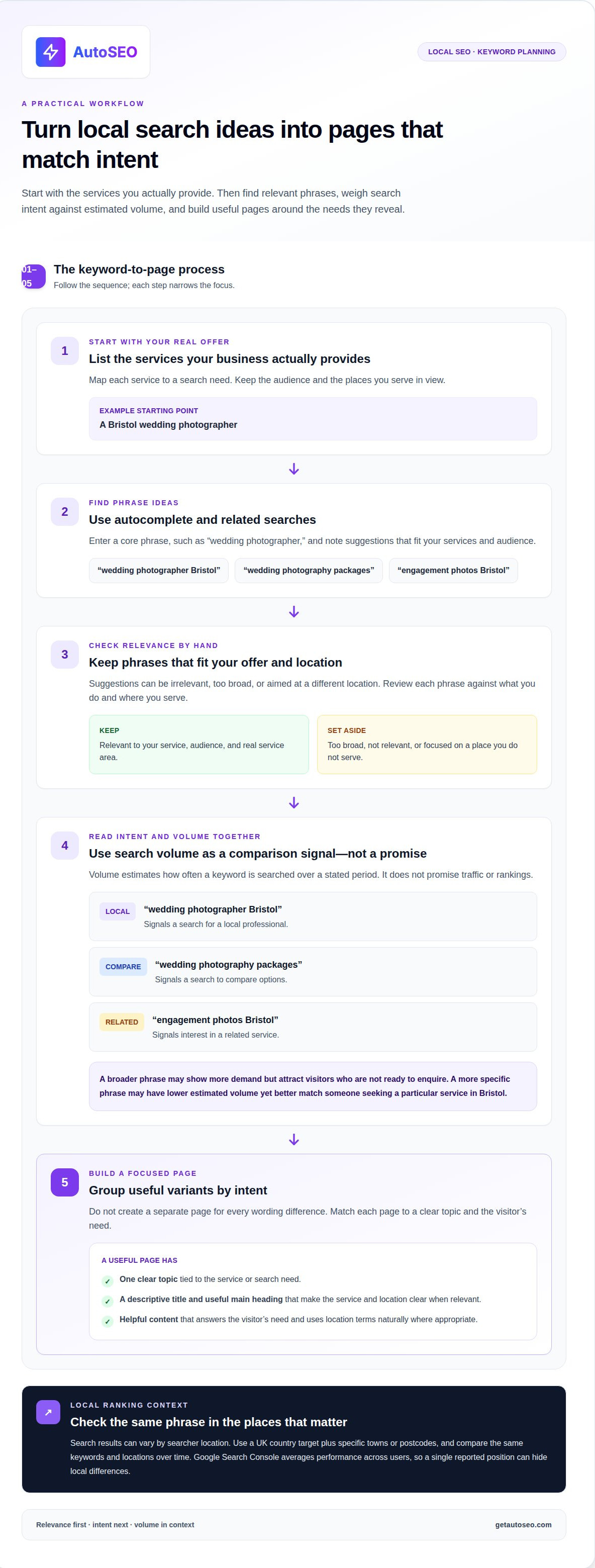
Start with the services your business actually provides, then map each service to a search need. For a Bristol wedding photographer, suggestions might include “wedding photographer Bristol,” “wedding photography packages” and “engagement photos Bristol.” These keywords signal different needs: finding a local professional, comparing options or researching a related service. Search engines can match your page more effectively when its topic and wording fit the searcher’s need.
Use Google autocomplete and related searches to find phrases people may use. Enter a core phrase, such as “wedding photographer,” then record suggestions that match your services and audience. Check each phrase manually: a suggestion can be irrelevant, too broad or aimed at a different location. Group useful variants by intent instead of creating a separate page for every wording difference.
Search volume estimates how often people search for a keyword over a stated period. Treat it as a comparison signal, not a promise of traffic or rankings. A broad phrase may show more demand but attract visitors who aren’t ready to enquire. A more specific phrase may have lower estimated volume but better match a customer looking for a particular service in Bristol.
Prioritise keywords using three checks: relevance to your offer, search intent and realistic competition. Google Keyword Planner can help compare estimated demand, while Google Search Console shows queries already bringing impressions to your domain. If a query gets impressions but few clicks, the page title or description may need to reflect the search more clearly.
Assign each keyword group to the page that best answers it. Use a service page for booking-focused searches and an informative article for questions that need explanation. Review your site structure before publishing: if two pages target the same intent, they may compete for visibility. Refine the existing page, improve its coverage and add genuinely distinct content only when the search need differs.
Location and personalisation effects on search results
Google ranks websites for UK queries by matching page content to search intent and considering the searcher’s context. Results can vary with location, search settings, browser and device, so one ranking position won’t represent every UK user. A search for “accountant” from Birmingham may show different results from the same query in Glasgow.
Location matters most when a query suggests a nearby need. For example, someone searching “emergency plumber” is likely looking for relevant services close by. Build useful pages for the areas you genuinely serve, and make each location and service clear. A single national position won’t show how visible your business is in every town.
Separate national checks from local checks. Track the same queries across representative UK locations, then compare changes over time. Google Search Console averages ranking data across users, which can mask local differences. A result seen by someone 3 miles away may differ from one seen 300 miles away. Use a location-specific rank check alongside Search Console, and keep device and query settings consistent.
Your own searches can give a misleading view because Google may tailor results using your location and search settings, while your browser and device can also affect the search experience. Record the location and device used for each check. Review results in a logged-out or private browser window for a cleaner comparison, but treat that view as one snapshot, not a universal position.
For international targeting, make the intended country clear through your page content and site structure. A .com website can use a UK-based server, which may improve visibility in UK searches. A US-based IP address can signal a US location to geotargeting systems. Hosting alone doesn’t establish relevance: UK-focused pages, local service details and relevant links also help search engines understand your audience.
Use each location check to identify a specific gap: a page missing from local results, a query with weak visibility, or a mismatch between the page and search intent. Then improve the page for the audience it should serve.
AutoSEO
AutoSEO helps turn a UK SEO plan into a consistent publishing and link-building process. Its Automated SEO Platform Subscription generates and publishes 30 SEO-optimised articles monthly and builds backlinks worth 100 Domain Authority. That can support businesses that need to keep developing relevant content and growing organic visibility without managing each task manually.
Use AutoSEO when you’re ready to scale ongoing SEO activity alongside the practical work covered here: targeting relevant searches, improving pages and tracking results. AutoSEO publishes one expert-written SEO article daily, with built-in backlinks, to help maintain momentum. The content and links should still serve your audience and business goals.
To support your UK search visibility with daily SEO content and built-in backlinks, contact AutoSEO.
Turn UK visibility into consistent progress
Strong rankings come from focused work and steady refinement, not a one-off change. Make your next move measurable: choose a priority audience, connect your pages to its needs, then use performance data to decide what to improve. This gives your SEO a clear direction as your business and customer demand evolve.
If you’re deciding how to get my website ranked in the UK over the long term, build a repeatable process instead of relying on occasional updates. Choose the next step that fits your goals and helps you maintain momentum.
Contact AutoSEO about UK rankings to discuss your next step. Keep refining your approach, stay focused on your audience, and turn each improvement into stronger search visibility.
Frequently Asked Questions
What is a local keyword?
A local keyword includes a place or signals that the searcher wants a nearby service. “Emergency electrician in Cardiff” names a location directly, while “near me” relies on the searcher’s current location. Businesses serving several areas can create distinct, useful pages for each location, with accurate service details instead of swapping place names into otherwise identical copy.
How to do keyword research for a UK audience?
Start with the words UK customers use to describe your service, including regional terms and spelling differences. Compare those phrases with autocomplete suggestions and queries already appearing in Google Search Console. Group terms by intent, such as researching a service or getting ready to book. Then choose a suitable page for each group, prioritising relevance over high estimated search volume.
How to optimize website pages for UK search results?
Make each page clearly relevant to its intended UK audience. Use the service and location naturally in the title, main heading and page copy, then provide details that help someone decide what to do next. For example, a page for a Cardiff electrician can describe the specific work offered there. Keep contact and business information consistent across the page and relevant listings.
Does a .co.uk domain help UK SEO rankings?
A .co.uk domain can indicate a UK focus, but it doesn’t guarantee higher rankings. Choose a domain that suits your long-term audience and use it consistently. If you already operate a .com site, avoid creating a duplicate just to add a UK extension. Clear UK-focused content and a coherent site structure still matter to search engines and visitors.
How important are UK hosting and website speed for SEO?
Hosting in the UK can support faster delivery for nearby visitors, but server location alone doesn’t determine search position. Measure page performance from the places and devices your audience uses, then address slow images, unnecessary scripts or unreliable hosting. A fast-loading page makes it easier for visitors to find service details and complete actions, improving the overall experience.


