

Fintech SEO is about more than keywords: it connects a technically sound website with useful, trustworthy financial content. SEO for financial technology (fintech) startups combines technical optimization, search-focused content, and authority building to help the right users find and understand your platform. A strong strategy treats site performance and credibility as core requirements, not optional extras.
Search visibility can support growth, but fintech platforms face a distinct challenge: visitors need clear information before they trust a financial product. This guide covers practical SEO priorities, from site structure and mobile usability to keyword targeting, expert-reviewed content, and digital PR. It also explains how to measure progress and build a consistent publishing process without letting SEO consume your team’s time. Use this framework to attract qualified organic traffic while keeping your technical foundations in focus.
Key Takeaways
- Build authority with digital PR and relevant backlinks that strengthen your fintech brand’s credibility.
- Choose keyword targets by matching search intent with your product and the competition you can realistically address.
- Make pages easier to scan with clear headings, useful FAQs, thoughtful internal links, and focused metadata.
- Prioritize a fast, mobile-friendly technical foundation so visitors and search engines can use your platform smoothly.
1. Link building and digital PR
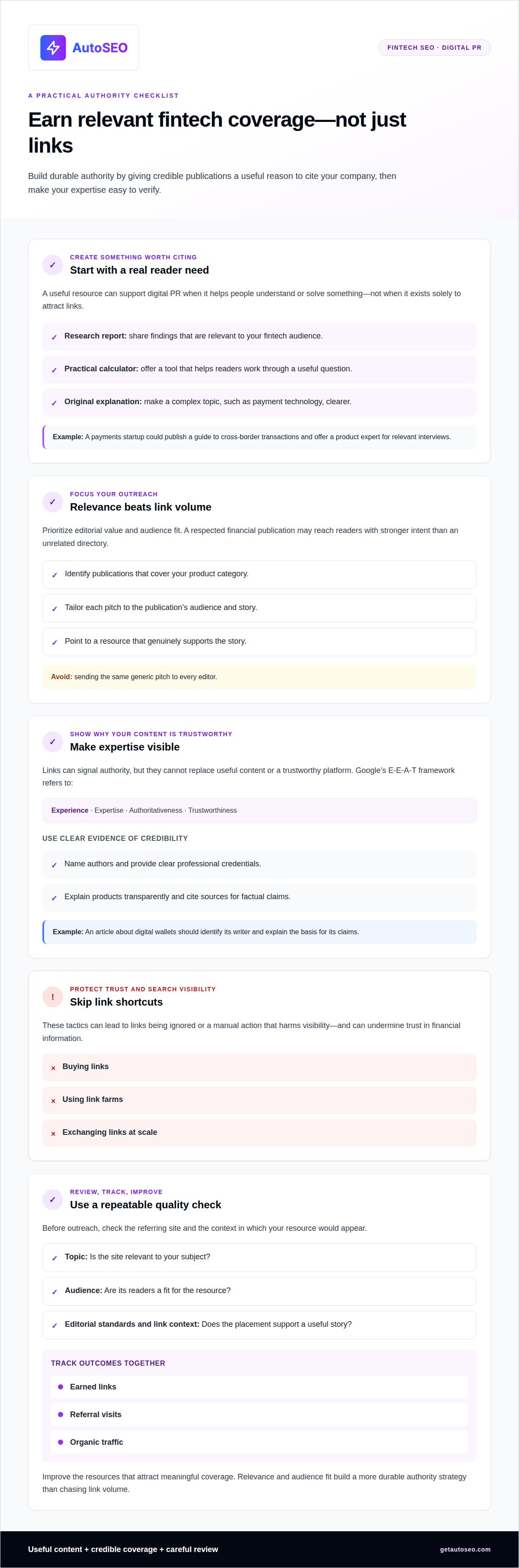
Give journalists and industry writers a useful reason to cite your fintech company. A clear research report, practical calculator, or original explanation of payment technology can support digital PR. For example, a payments startup could publish a guide to cross-border transactions and offer a product expert for relevant interviews. The resource should address a real reader need, not exist solely to attract links.
Prioritize relevance and editorial value over link volume. A mention from a respected financial publication may reach readers with stronger intent than a link from an unrelated directory. Build a focused outreach list by identifying publications that cover your product category, tailoring each pitch to its audience, and pointing to a resource that supports the story. Avoid sending the same generic pitch to every editor.
Links can signal authority, but they cannot replace useful content or a trustworthy platform. Google’s E-E-A-T framework refers to experience, expertise, authoritativeness, and trustworthiness. Demonstrate these qualities with named authors, clear professional credentials, transparent product explanations, and sources for factual claims. For example, an article about digital wallets should identify its writer and explain the basis for its claims.
What are the risks of SEO tactics that can trigger Google penalties for fintech sites? Buying links, using link farms, or exchanging links at scale can result in links being ignored or a manual action that harms visibility. These shortcuts can also undermine trust in a sector where users carefully assess financial information.
Use a repeatable review process before outreach: assess each referring site’s topic, audience, editorial standards, and link context. Track earned links alongside referral visits and organic traffic, then improve the resources that attract meaningful coverage. For seo for financial technology (fintech) startups, a focus on relevance and audience fit builds a more durable authority strategy than chasing links.
2. Fintech SEO competition and keyword strategy
Fintech keyword research should start with customer problems, not a list of popular phrases. A payments platform, for example, might target searches about invoice delays, cross-border transfers, and transaction fees. Each phrase points to a different need. Group related searches by intent, then create pages that answer those needs directly. This builds search visibility without pushing every visitor toward a signup page.
Map keywords to the customer journey. Someone learning how digital wallets work needs clear educational content. Someone comparing business payment platforms needs product details, fees, and supported use cases. A search such as “business payment platform for contractors” signals more specific intent than “payments.” High-intent, bottom-of-funnel keywords can attract qualified prospects, but only if the landing page matches the query.
Long-tail research helps uncover specific customer needs. Start with product features, customer questions, and the language prospects use in sales conversations. Expand topics with modifiers such as audience, use case, or location. For example, “business banking for independent contractors” could inspire a focused page, while “business banking” may be too broad for a new company competing with established platforms.
Assess competition by reviewing the pages already ranking for each target. Note their format, depth, and search intent, then identify a useful angle they have not covered. One available example gives “best investment app for beginners” a search volume of 150 and a keyword difficulty ranking of 5. Treat those figures as a starting point, not a ranking promise. Search results change, and the best target also depends on product fit and the strength of your page.
Prioritize a manageable set of keywords, assign each to one primary page, and connect related pages with descriptive internal links. Track organic traffic and conversions by topic to see which intent produces valuable visits. An automated SEO workflow can help keep keyword-led publishing consistent as your content strategy grows.
3. What to look for when choosing a fintech SEO agency?
Choose an SEO strategy that turns product knowledge into clear, usable pages. For a budgeting platform, a strong topic cluster might link a budgeting guide, product feature pages, and answers about account setup. Similarly, multi-asset brokerage sites like tradingpro.com demonstrate how organizing offerings across distinct account tiers helps tailor content to different experience levels. Descriptive internal links help users move between pages without losing context. Each page should address a distinct need rather than repeat the same claims.
Review on-page optimization for readability and structure. Clear headings should describe the content beneath them, while concise paragraphs make complex financial topics easier to scan. Keep title tags under 60 characters and meta descriptions under 160 characters. Add FAQs that answer real customer questions, and use FAQ schema to help search engines interpret eligible page content.
For US-facing financial products, align claims on organic landing pages with the supporting evidence and disclosures used in advertising. Explain rates, fees, eligibility, and risks clearly, and have qualified subject-matter and compliance reviewers assess financial claims. This is a practical content control, not a substitute for legal review of advertising requirements.
International experience matters when fintech companies target customers across markets. Ask how the SEO strategy handles localized landing pages, regional terminology, and hreflang implementation. For example, a payments platform serving several countries needs content that reflects each market’s search intent, not a direct translation of one generic page. Local SEO can also support region-specific services, even for primarily digital businesses.
How much does SEO cost for a fintech startup in the United States? Pricing depends on the scope, market coverage, technical complexity, and content volume, and is provided after a quote request. Compare the proposed deliverables and reporting approach, not just the monthly figure.
Before selecting an agency, assess how it measures results. A useful report connects target keywords and organic visibility to qualified leads, and shows which work supports each change. For example, a fintech team should be able to trace a product topic cluster from its landing page to related FAQs and regional pages.
4. Secure technical SEO for fintech platforms
For financial services, technical SEO needs to support both discoverability and safe account experiences. Separate public pages, such as product explanations, from private customer areas. Keep useful public content crawlable, but prevent account-specific pages from appearing in search results. This protects user privacy while giving search engines clear paths to pages that serve your audience.
Measure page experience with specific targets: Largest Contentful Paint under 2.5 seconds, Interaction to Next Paint under 200 milliseconds, and Cumulative Layout Shift below 0.1. Google PageSpeed Insights can help identify slow pages and layout movement. A delayed application page can frustrate visitors before conversion, while broken navigation can make important product information harder to discover.
Mobile performance deserves priority. More than 60% of global web traffic comes from mobile devices, so test menus, forms, and pricing explanations on phone screens. Responsive layouts should keep key actions visible without hiding fees or eligibility details. A mobile user comparing payment platforms needs readable text and a working application flow, not cramped desktop content.
Protect account access with two-factor authentication, and keep security controls separate from SEO settings. Review content-system permissions and remove outdated accounts. A compromised publishing login can expose users to harmful changes and disrupt rankings. After each major platform release, check redirects, broken links, indexation rules, and canonical tags.
Structured data can clarify what a fintech business offers. Structured data can help search engines interpret relevant pages when it accurately reflects their content. Use it only when the page content supports the markup. Pair schema with clean page structure, descriptive titles, and accurate product details so search engines and visitors receive consistent information.
Track organic landing pages, mobile usability, and conversion paths together. This shows whether technical changes improve access to useful information, not just rankings. Build consistent fintech SEO growth with a publishing process that supports ongoing optimization.
AutoSEO
AutoSEO gives fintech startups a practical way to keep SEO publishing and link building moving. Its Automated SEO Platform Subscription publishes 30 SEO-optimized articles per month and builds backlinks worth 100 Domain Authority. That consistent activity can support a broader strategy for organic visibility, while your team keeps financial claims and technical changes aligned with its review processes.
Turn to AutoSEO when your team has a clear fintech audience and content priorities but needs a more repeatable way to execute SEO. The platform helps scale publishing without replacing the expertise needed to assess financial information.
Contact AutoSEO to discuss how automated SEO can support your fintech growth goals.
Make your next SEO move count
Fintech growth depends on more than visibility. Turn search activity into a dependable process that supports product goals, audience needs, and internal review standards. Set a clear priority, such as reaching a new customer segment or building visibility around a core product category. Then align publishing and measurement with that priority.
A focused approach to seo for financial technology (fintech) startups connects growth work to business outcomes instead of isolated rankings. Choose the areas that deserve consistent attention, and give your team a publishing process it can sustain as the platform evolves.
AutoSEO can help automate ongoing SEO execution so your team can focus on product and financial expertise. Explore AutoSEO’s platform and decide whether it fits your growth workflow. Your next organic growth opportunity starts with a clear plan and steady action.
Frequently Asked Questions
What is fintech SEO?
Fintech SEO helps people find financial technology products and useful financial information through unpaid search results. For a budgeting app, that could mean answering questions about expense tracking, account setup, or whether the product suits a particular user. SEO for financial technology (fintech) startups connects those searches to relevant pages and helps visitors understand what to do next.
Can SaaS SEO techniques be applied to the fintech industry?
Yes. SaaS techniques such as product-led landing pages, educational content, and clear conversion paths can work for fintech platforms. Adapt them to the financial product and its audience. For example, a niche SaaS provider offering mortgage document collection software can explain a specific workflow and then guide visitors to a product page. Keep product explanations accurate and make important details easy to find.
How does content marketing play a role in fintech search engine optimization?
Content marketing gives fintech companies useful pages that address customer questions before a purchase decision. A budgeting platform might publish a guide to separating business and personal expenses, then link readers to relevant product information. Review financial content for accuracy, keep it current, and make it clear which information is educational and which describes the product.
How long does it take to see SEO results in the financial services sector?
Fintech websites may begin seeing measurable SEO improvements within 3 to 6 months, though the timing depends on competition, technical condition, content quality, and site history. Early movement may appear in impressions or rankings before qualified leads grow. Track progress by landing page and search intent, so you can distinguish useful visibility from traffic that does not support business goals.
What Does SEO Bring to Your Business?
SEO can bring relevant visitors to pages that explain your product, answer questions, and support informed decisions. For a fintech company, that might mean a business owner finding a payment tool while researching invoice workflows. Search visibility can also show which customer problems attract interest, helping the business improve its content and product messaging based on search behavior.
What KPIs should I track in a financial SEO campaign?
Track organic traffic, keyword performance, conversion rates, engagement, and backlink growth. Break results down by landing page and audience intent. For example, compare visits to an educational guide with visits to a product page, then assess whether each attracts meaningful engagement or leads. This helps identify which content to improve and which topics deserve further coverage.


