

What if the expertise that earns client referrals could also help the right prospects find you through search? Referrals are valuable, but they can make lead flow hard to predict. That’s why seo for business consultants should do more than chase rankings. It should help prospective clients discover your specific expertise and decide whether it fits their needs before they book an introductory call.
A focused search strategy connects what you know with what potential clients are actively looking for. It turns your services, methods, and insights into useful pages that answer real questions and build trust. You can attract relevant organic traffic without relying on generic content or letting SEO take over your schedule.
This guide shows you how to build a practical SEO program for your consulting business. You’ll learn how to identify search intent, translate your expertise into clear service pages and articles, strengthen credibility, and measure progress. You’ll also compare execution options, including how business-specific research and automation can help you publish consistently while keeping client work front and center.
Key Takeaways
- Start with the problems your ideal clients search for, then shape your content around their intent and your expertise.
- Use seo for business consultants to connect focused service pages with helpful articles that support discovery and trust.
- Compare DIY, agency support, and automation by the time, control, consistency, and involvement each requires.
- Build momentum by choosing a focused specialty, answering buyer questions, publishing core pages, and reviewing performance regularly.
- Business-specific research and automated publishing can support a repeatable SEO process alongside client work.
Why SEO for business consultants starts with client intent
Consultants often grow through referrals, but referrals depend on someone already knowing whom to recommend. Search adds another route: it helps prospective clients discover your expertise while they’re looking for ways to solve a business problem. It doesn’t replace relationship-based selling. It gives the right people a useful first impression before a referral or introductory call.
Consultant SEO makes relevant expertise discoverable in search and connects it with prospective clients whose needs fit your services. The goal isn’t simply to attract more visitors. It’s to guide a well-matched prospect from a search query to a useful page, from that page to greater confidence, and from confidence to an informed inquiry.
Search engine optimization includes the work involved in improving how pages appear in search results. The Search Engine Optimization (SEO) overview provides foundational context, but a consultant’s strategy also needs to address what potential clients are trying to resolve. Intent and fit shape what to publish and what next step to offer on each page.
What prospective consulting clients search for
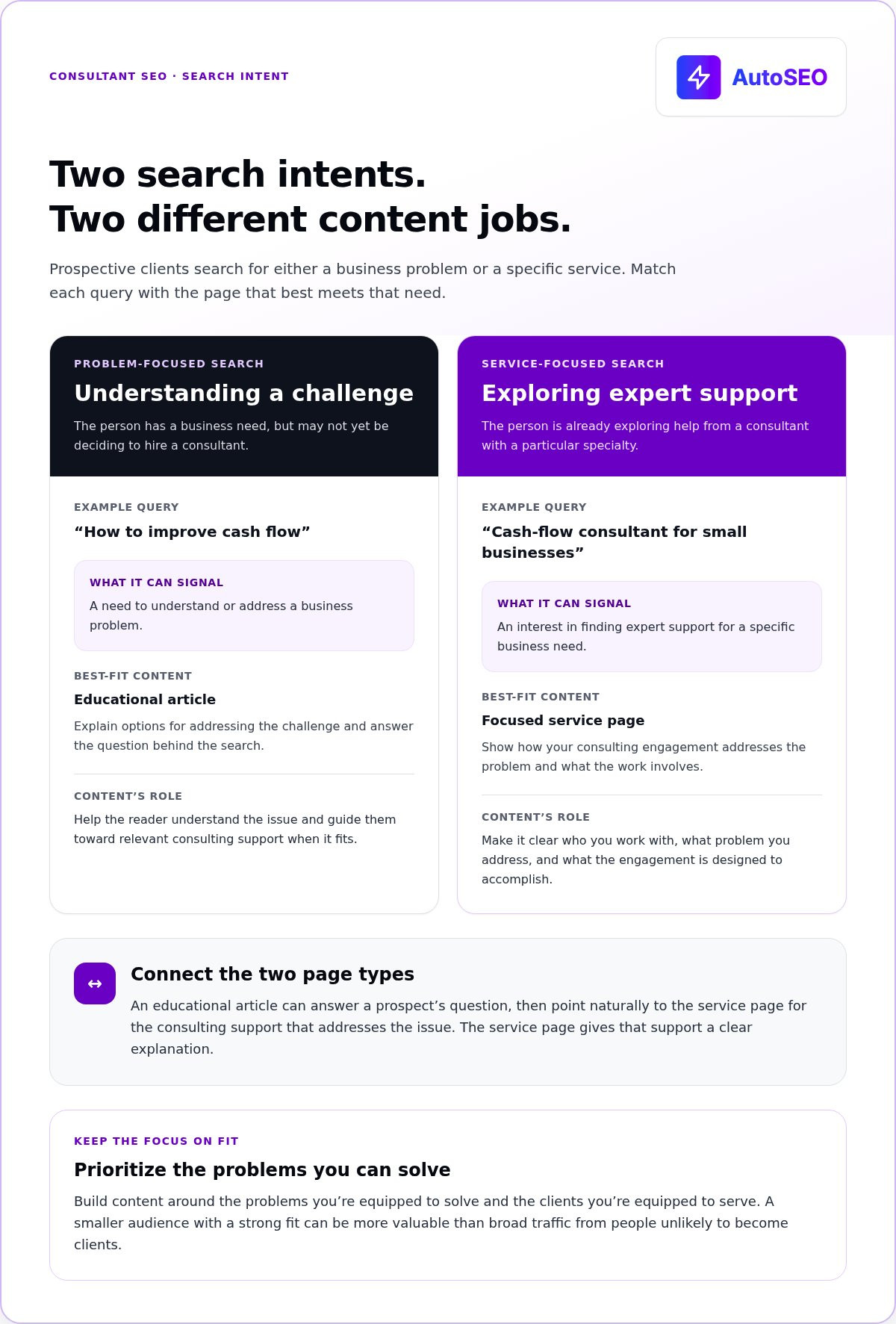
Searches often reveal either a problem or a service. A business owner might search “how to improve cash flow” or “why are operating costs rising?” These problem-focused queries signal a need, but not necessarily a decision to hire a consultant. A service-focused search, such as “cash-flow consultant for small businesses,” suggests the person is already exploring expert support.
Build content for both types of intent. An educational article can explain options for addressing a challenge; a focused service page can show how your consulting engagement addresses it. Prioritize the problems you’re equipped to solve and the clients you’re equipped to serve. A smaller audience with a strong fit can be more valuable than broad traffic from people unlikely to become clients.
How expertise builds trust before the first call
A service page should make three things clear: who you work with, what business problem you address, and what the engagement is designed to accomplish. For example, an operations consultant could describe the types of growing businesses they support, explain common process bottlenecks, and outline the outcomes clients can work toward. Be specific, but don’t promise a guaranteed result.
Demonstrate your expertise with practical examples, relevant credentials, and plain-language explanations of your approach. Explain how you assess a challenge, what information you use, and what a client can expect from the working relationship. These details help prospects judge fit before a conversation and give your claims substance.
Keep the site’s foundations clear too. AutoSEO’s small business SEO guide offers broader context on making a business discoverable. For consultants, the next step is to connect those fundamentals to a defined specialty, specific client questions, and pages that support relevant inquiries.
How SEO for business consultants turns expertise into visibility
Expertise becomes discoverable when it’s organized around what prospective clients search for and published in formats that meet their needs. A repeatable process keeps the work focused: understand buyers, build relevant pages, then use performance data to decide what to improve or publish next.
- Understand buyers. Define the industries, roles, business situations, and problems you’re best equipped to address. Note the questions prospects ask before deciding to seek outside expertise.
- Research topics. Turn those questions into search topics. Consider whether the person wants to understand a challenge, compare possible approaches, or find a consultant with a specific specialty.
- Create useful pages. Build a clear service page for each priority offering. Support it with educational articles that answer related questions in depth.
- Publish consistently. Set a realistic cadence and keep each page accurate, useful, and connected to your expertise. Consistent publishing supports discoverability, but it can’t guarantee search rankings.
- Measure and refine. Review search visibility, relevant queries, and qualified inquiries. Use what you learn to improve existing pages and choose future topics.
Service pages are the foundation. They explain who you help, the business problem you address, and what an engagement involves. Educational articles support those pages by answering questions prospects may have before they’re ready to contact a consultant. For example, an article about reducing project delays can explain common process issues and link readers to a relevant operations consulting page.
Build a search-focused content map
Group topic ideas by specialty, audience, problem, and decision stage. A growth consultant might create a service page for a particular type of business, then plan articles around questions that arise as that business considers expansion. Build the priority service page first so supporting content has somewhere relevant to lead. Internal links should guide readers naturally from advice to the consulting service that addresses the issue.
Write for the question behind the query, not for a keyword count. Repeating a phrase mechanically won’t explain how you think or help a prospect choose a next step. A focused content map helps seo for business consultants connect expertise to search intent without producing disconnected pages.
Measure the signals that support business decisions
Google Search Console can show which queries generate impressions and clicks, and whether those queries match the work you want to attract. Analytics can help you understand what visitors do after arriving, including whether they view service information or submit an inquiry. Track lead quality as well as page views: a smaller number of relevant conversations may be more useful than a surge in loosely related traffic.
Review the data regularly, then update pages where intent and content don’t align. Repeatable execution can make that review easier to act on; the SEO automation guide explores how automation can support ongoing research and publishing. If you want to reduce the manual workload, explore automated SEO execution as one way to maintain a consistent process.
DIY SEO, agency support, or automation: compare the options
There’s no single best way to execute SEO. The right model depends on how much time you can commit, how much control you want, and which recurring tasks you’re prepared to manage. For seo for business consultants, the key is choosing a process you can sustain without letting marketing displace client work.
Use this comparison to weigh the trade-offs. Workflows vary, but these operating differences can help you choose an approach:
| Approach | Time required | Control | Consistency | Operating involvement |
|---|---|---|---|---|
| DIY | High: you handle research, writing, publishing, and measurement. | Direct control over priorities, messaging, and timing. | Depends on your available time and ability to maintain a routine. | High: you manage each step. |
| Agency support | Less hands-on production time, but collaboration and review still take time. | Shared: you provide direction while an external team executes agreed work. | Can follow an established workflow, depending on the engagement. | Ongoing coordination, decisions, and feedback. |
| Automation | Can reduce repetitive execution work after setup. | You set business priorities and review what the system produces. | Designed to support a repeatable publishing process. | Initial setup plus strategic oversight and quality review. |
Explore automated SEO if you want a more repeatable workflow that preserves time for client delivery.
When hands-on SEO makes sense
DIY can work well when you have time to learn the process and want direct control over each decision. Plan for recurring research, drafting, publishing, and measurement, not just occasional writing. Your understanding of the audience and editorial judgment still matter. Useful content reflects real client questions and your experience rather than simply inserting target phrases.
Whatever model you choose, keep strategic decisions close to your expertise. You know which clients you want, how your approach differs, and what outcomes an engagement can reasonably support. Review content for accuracy, voice, and fit as well. Automation can help move work forward, but it shouldn’t make positioning decisions for you.
What to evaluate in an agency or automated workflow
Look at how business and customer research informs topic selection. A plan grounded in your specialty and prospects’ needs is more useful than a generic list of popular subjects. Also consider publishing consistency, how the workflow fits your existing site and review process, and whether performance information helps you make decisions.
For a related view of a managed execution model, the done-for-you SEO guide explores how recurring work can be handled as an ongoing process. Compare each approach against your capacity and priorities, then choose the level of involvement you can sustain.
Create a practical SEO plan for your consulting business
A sustainable plan starts narrow. Choose one consulting specialty and one audience you want to reach, then build core pages and content around their needs. Trying to rank for every consulting topic at once can scatter your effort and make your expertise harder to understand.
Use this four-step launch sequence:
- Define a service. Describe one specific consulting offer, the audience it serves, and the business problem it addresses.
- Identify buyer questions. List what prospects ask about the problem, possible solutions, and how to decide whether expert support is a fit.
- Publish core pages. Create or improve a focused service page, then add useful educational content that answers related questions.
- Review results. Check search visibility, content quality, and the relevance of inquiries. Use what you learn to refine pages and choose what to publish next.
Consultant SEO launch checklist: define one service, understand its audience, publish a clear service page, answer real buyer questions, and review search signals and inquiries. This gives seo for business consultants a practical starting point without requiring a large content library before you know which topics fit.
Choose topics that connect expertise to demand
Build your first topic list from recurring prospect questions, urgent business problems, and the criteria clients use to evaluate support. A finance consultant might hear questions about forecasting, cash-flow visibility, or preparing for seasonal changes. Prioritize questions that connect directly to a real service and a defined audience, rather than broad subjects that attract readers outside your target market.
Client conversations can supply strong content ideas, but protect confidentiality. Turn a recurring question into general guidance without sharing identifying details, sensitive figures, or private business circumstances. If you use an illustrative scenario, label it clearly as an example. Don’t present it as a verified client case study unless you have permission and supporting facts.
Keep publishing and improvement manageable
Choose a review cadence you can maintain. Set a recurring time to check whether pages accurately describe your services, answer current prospect questions, and attract relevant search queries and inquiries. Update content when your offer, supporting evidence, or audience’s concerns change. A useful review improves accuracy and relevance; it doesn’t require rewriting every page each time.
Scaled content workflows can help maintain execution, but each piece still needs to reflect your expertise and audience. AutoSEO’s AI content creation guide explains how AI-assisted production fits into ongoing content work. If you want to streamline research and publishing as you put this plan into action, explore automated SEO execution.
Put consultant SEO on autopilot with a repeatable system
Consistent SEO takes more than good ideas. It takes a process that turns business knowledge into relevant topics and moves content from planning to publication. For consultants, automation can handle recurring execution while you protect time for client work and retain control over your positioning, claims, and editorial standards.
AutoSEO’s workflow starts with AI research into your business, customers, and competitors. That research informs a content plan based on your business context rather than generic topic generation. The subscription includes daily article creation, 30 SEO-optimized articles per month, and automated publishing to WordPress. It also includes 100 Domain Authority worth of backlinks. These features don’t guarantee higher rankings or a particular result.
What the automated workflow handles
The process connects research, planning, article creation, and publishing in one recurring workflow. Business-specific research helps inform the topics, while daily article generation supports a steady publishing rhythm. WordPress publishing is included, reducing the manual steps between content creation and getting an article onto your site. Backlink building is also included in the subscription, without a promise of a specific ranking or traffic effect.
How to decide whether automation fits your practice
Automation can fit if research and publishing keep slipping behind client delivery and you want a repeatable execution process. It doesn’t replace your judgment. Review each article for strategic fit, factual accuracy, and brand voice, and make sure it reflects the clients and services you want to attract. Keep refining the direction as your practice and prospects’ questions change.
Think of automation as a system for consistent execution, not a substitute for expertise. You define the specialty and business priorities; the workflow supports ongoing content production and publishing. That balance lets seo for business consultants scale activity while preserving the perspective that makes the content credible and relevant.
If you’re ready to reduce the recurring work involved in research and publishing, Start building SEO on autopilot.
Make your next SEO step one you can sustain
Your next move doesn’t need to be a full-scale campaign. Pick one consulting specialty, decide which prospects you want to reach, and build a publishing process that can keep moving alongside client work. That’s the practical test for seo for business consultants: does your approach turn expertise into useful content consistently, without pulling your attention away from the work only you can do?
Automation can take recurring execution off your plate while you retain strategic and editorial control. AutoSEO uses business, customer, and competitor research to inform its content plan. The subscription includes 30 SEO-optimized articles per month and automated WordPress publishing, giving you a defined workflow for ongoing visibility without promising a particular ranking or lead outcome.
If a repeatable publishing system fits your practice, take the next step and Put your consultant SEO on autopilot. Keep your expertise at the center, let a consistent process support it, and build a stronger path for the right prospects to find you.
Frequently Asked Questions
How does SEO help business consultants get clients?
SEO helps prospective clients find a consultant while researching a business challenge or comparing possible support. A useful page can answer an early question, explain your approach, and make it easier for a suitable prospect to take the next step. For example, an article about diagnosing declining margins can reach a business owner before they search for a specialist. Treat search as another discovery channel, not a replacement for referrals or relationship-building.
What keywords should a business consultant target?
Target phrases that reflect your specialty, audience, and the problem you solve. A consultant focused on operations might research terms related to process improvement, workflow bottlenecks, or operations consulting for a particular type of company. Include both problem-focused searches and service-focused phrases. Review the actual queries appearing in Search Console, then prioritize those that match your expertise and the clients you want, rather than choosing terms based on volume alone.
How long does SEO take to work for a consulting business?
SEO usually requires sustained effort; meaningful changes in organic traffic and inquiries commonly take 6 to 12 months, while stronger compounding returns may take 12 to 18 months. These are general timeframes, not promises. Results depend on factors such as your site’s starting point, competition, and the quality and relevance of your pages. Track progress through search visibility and qualified inquiries, and use early data to improve the strategy.
Can AI-generated content rank for consultant keywords?
AI-assisted content can compete in search when it delivers accurate, useful information and reflects real expertise. The tool alone doesn’t make an article valuable. Add your perspective, verify claims, and remove generic advice that could apply to any consultant. For example, use AI to organize a draft about a client question, then add your own decision framework and practical caveats. Review every piece before publishing to protect accuracy and credibility.
Should business consultants hire an SEO agency or do SEO themselves?
Choose based on your available time, desired control, and ability to manage recurring work. DIY gives you direct oversight but requires learning and performing research, writing, publishing, and measurement. Agency support can shift execution to a team, while automation can reduce repetitive tasks. In every model, keep responsibility for business positioning and final review. Set clear goals before expanding your effort so you can assess whether the workflow is helping.
How often should a consultant publish SEO content?
Publish at a pace you can sustain while maintaining accuracy and usefulness. A strong starting point might be one well-developed article every few weeks, alongside a complete service page. Increase frequency only if you can review content properly and keep it connected to your expertise. A calendar tied to real prospect questions is more useful than publishing on a rigid schedule simply to hit a volume target.
Do business consultants need backlinks to rank in Google?
Backlinks can help search engines discover and assess pages, but no specific link count guarantees rankings. Focus first on earning relevant mentions through credible partnerships, expert contributions, and useful resources others may choose to reference. Avoid manipulative link schemes or unrelated placements; they can undermine trust and create search risks. Strong service pages, helpful content, and clear expertise matter too. Treat link building as one part of a broader strategy, not a shortcut.


