

What good is a search result if a prospective student still can’t find the program details, admissions steps, or location information they need? SEO for educational institutions works when each student question leads to accurate, relevant information, not just another page competing for a click.
That takes coordination. Small marketing teams may manage dozens of programs, locations, and stakeholders while details change and pages need regular review. Traffic alone also doesn’t show whether SEO is helping students move from discovery to an inquiry or application. A useful plan connects helpful content with clear measures of progress.
This 2026 guide lays out a practical, prioritized approach. You’ll learn how to map search intent to program and admissions pages, improve local discovery, keep institutional information accurate, and measure performance beyond rankings and visits. It also explains how to build a repeatable workflow that includes subject-matter review, so teams can scale routine SEO work without handing over control of the facts. The goal is a clearer path from prospective-student questions to the next step, supported by information your institution can stand behind.
Key Takeaways
- Build seo for educational institutions around prospective students’ real questions, from program choices to admissions and campus details.
- Use Search Console queries, admissions questions, and program language to group search intent and assign topics to the right pages.
- Prioritize accurate, regularly reviewed program information alongside the technical foundations that make pages easy to find and use.
- Create a repeatable monthly workflow for research, planning, expert approval, publishing, and updates.
- Measure relevant organic visits and inquiry actions, then choose an in-house, agency-supported, or software-assisted workflow that fits your team.
Why SEO for Educational Institutions Starts With Prospective Student Needs
A prospective student searching for a nursing program, entry requirements, or a campus location isn’t looking for a higher ranking. They need reliable information to make a decision. SEO for educational institutions makes useful pages more visible in relevant searches and helps people find clear answers when they arrive. It applies the principles of Search Engine Optimization (SEO) to the real questions students and other audiences bring to search.
Enrollment-focused SEO makes accurate program and admissions information easier to find, so prospective students can move from a search to an informed next step. That’s different from generic website promotion, which may prioritize traffic without checking whether visitors found what they needed.
Which audiences should an institution's SEO serve?
Start with the audiences the institution actually serves. Use enrollment goals and first-party evidence, such as admissions inquiries and search queries, to set priorities. Different groups may need different answers:
- Prospective students may want program options, entry requirements, tuition details, and application steps.
- Parents and supporters may look for practical information about campus life, costs, and student support.
- Adult learners may need details about flexible study formats, prerequisites, or balancing study with work.
- Community audiences may seek continuing education, public events, or local resources, where those are part of the institution’s remit.
Not every institution needs to target every audience. Focus first on the groups and questions that align with its programs and available evidence.
What does educational SEO contribute to enrollment?
Relevant organic visibility can bring people to program and admissions pages while they’re researching options. A well-matched landing page then gives them a useful next step, such as reviewing requirements or submitting an inquiry. A search visit is only one point in the decision journey. By itself, it doesn’t show that someone inquired, applied, or enrolled.
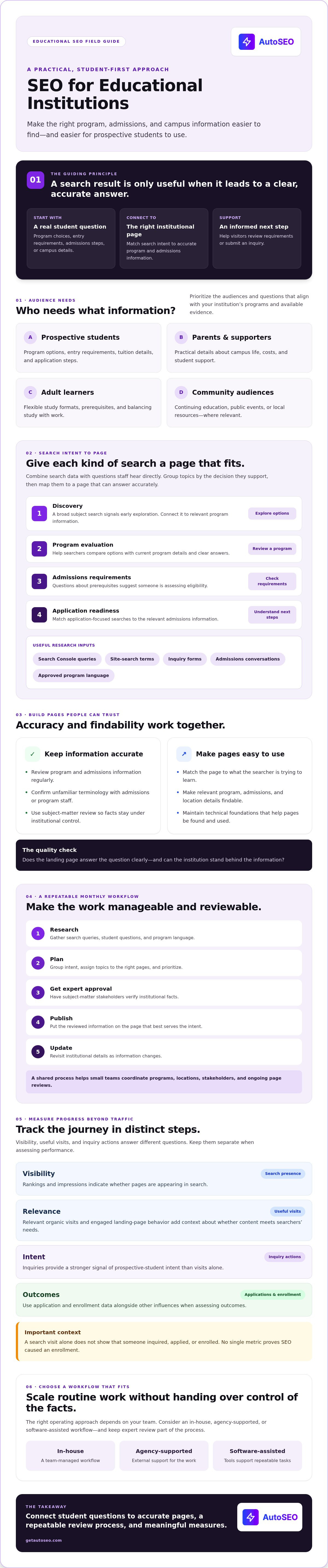
Measure those steps separately. Rankings and impressions indicate visibility. Relevant organic visits and engaged landing-page behavior add context about whether the content meets searchers’ needs. Inquiry actions provide a stronger signal of intent, while application and enrollment data help assess outcomes alongside other influences. No single metric proves SEO caused an enrollment.
A practical starting point is to connect each priority audience to a decision and a page that answers it. This keeps the strategy focused on discoverability and usefulness, not rankings for their own sake.
Map Educational SEO Keywords to Programs, Admissions, and Student Questions
Useful keyword research starts with the words prospective students use, not a list of phrases generated without institutional context. For seo for educational institutions, combine search data with questions staff hear directly, then connect each search intent to a page that can answer it accurately.
How do you find the searches prospective students actually use?
Review Google Search Console queries and site-search terms to see how people already look for institutional information. Add recurring themes from inquiry forms and admissions conversations, along with approved program names and terminology. If a phrase is unfamiliar, ask admissions or program staff what it means before using it in public-facing copy.
Group searches by the decision they support: initial discovery, program evaluation, admissions requirements, or readiness to apply. For example, a broad subject search may signal early exploration, while a query about prerequisites suggests the person is comparing eligibility. The page should answer that intent directly.
How should keywords map to institutional pages?
Use this sequence to turn research into a manageable page plan:
- Gather questions: Pull queries from Search Console, site search, inquiries, and staff input.
- Group intent: Sort each topic by discovery, program evaluation, admissions, or application readiness.
- Map pages: Match program searches to current program pages and admissions questions to the relevant admissions page.
- Prioritize: Start with topics tied to institutional enrollment goals and pages that can provide authoritative answers.
- Review: Check the mapping with admissions and subject-matter staff, then revisit it as queries and program details change.
Rule to remember: assign each priority search intent one authoritative destination page. A program page should reflect the approved program name, current requirements, and relevant outcomes. An admissions page should cover applicable deadlines, eligibility, application steps, and contact details. Supporting guides can answer narrower questions and link to the main page instead of competing with it.
Don’t create separate pages for minor keyword variations if they serve the same need. And don’t publish a claim about a program, format, or outcome that the institution hasn’t confirmed. Clear ownership reduces duplication and gives reviewers one place to maintain authoritative information.
Once the page map is approved, keep it as a shared working document with the target intent, destination URL, content owner, and review status. Teams looking to scale repeatable research and publishing can also consider an automated SEO workflow, while institutional experts retain final review of facts and claims.
Strengthen Educational SEO With Accurate Content and a Search-Friendly Website
Strong SEO depends on two things working together: pages that answer real questions and a website that search engines and people can use. For seo for educational institutions, accuracy isn’t a final proofreading step. It belongs in the content process, especially when program information must pass through multiple departments before publication.
What should a strong program page include?
Give each program page a clear purpose and an accountable owner. Confirm the approved program name, current curriculum details, delivery format, and admissions requirements with the relevant department. Use a descriptive page title and headings, accessible links, and concise answers to common questions. Assign responsibility for verifying facts and set a defined review schedule, so changes don’t leave outdated details online.
Every published academic claim needs a verifiable institutional source. That includes statements about requirements, outcomes, course content, or delivery options. Automation can help teams draft and scale repeatable work, but it can’t replace expert review or independently verify institutional facts. Identify the department or subject-matter expert responsible for approval before content goes live.
Which technical and local signals deserve attention?
Use this implementation table to separate page-content checks from site-wide foundations. Owners can work through both tracks, then record issues and review status in a shared content process.
| Program-page essentials | Technical and local foundations |
|---|---|
| Approved program name, curriculum, delivery format, and entry requirements | Mobile usability, HTTPS, and clear navigation |
| Descriptive page title, headings, accessible links, and direct answers | Indexability, page speed, and checks for broken links |
| Named department owner and scheduled fact review | Consistent institution name, address, contact details, and campus information where applicable |
| Claims checked against current institutional sources | Structured data used only when the page is eligible and the information is accurate |
Publishing more often won’t build trust if facts are stale or unsupported. Prioritize accurate updates over volume, and check current eligibility requirements before implementing structured data. Keep responsibilities clear: content teams manage the page, subject experts verify academic claims, and technical owners address website issues. This workflow helps institutions scale content production without scaling uncertainty.
Build a Manageable SEO Workflow and Measure What Improves
A lean team needs a process it can repeat, not a long list of SEO tasks competing with admissions deadlines. Set a monthly cycle to review queries, choose priority pages, plan updates, get expert approval, publish, and schedule the next review. Track an owner and status for each task so content doesn’t stall between departments.
How can an institution measure SEO progress?
Use Google Search Console to review queries, impressions, clicks, and the landing pages appearing in search. Then use Google Analytics 4 to assess relevant engagement and configured inquiry or application events. Compare trends over time, and check that measurement settings are working before interpreting a change as a result.
Segment by program or audience where tracking and privacy practices permit. A rise in impressions may indicate greater visibility, but it doesn’t confirm that the visitors are prospective students. Review relevant organic visits, landing-page engagement, and inquiry actions together. Treat applications and enrollment as downstream outcomes influenced by more than search alone.
How can teams scale content without losing quality?
Make approval explicit. Assign who supplies source facts, who checks subject-matter accuracy, who approves publication, and who owns future updates. Start automation with lower-risk informational topics, then expand only when the review process is reliable. Keep sensitive admissions claims under close expert review.
Workflow choices involve trade-offs. In-house execution offers direct control but depends on available staff capacity. Agency support may add production capacity, while still requiring clear institutional review and coordination. Software-assisted workflows can help scale repeatable research and content tasks, but the institution remains responsible for accuracy and approval. Compare these models in this SEO automation guide, and see the AI content creation guide for a closer look at review workflows.
For seo for educational institutions, the right model is one your team can sustain while protecting the quality of institutional information. If software-assisted execution fits your workflow, an automated SEO platform subscription is one option to assess. Keep expert review in place, and measure whether the process is improving visibility, engagement, and inquiry activity.
Choose an Educational SEO Approach That Fits Your Team
The right SEO model depends on your team’s capacity, need for control, and ability to review institutional information. In seo for educational institutions, no workflow removes the need for accurate sources and accountable approval. Compare the work each model can support with the review effort your institution can sustain.
| Approach | Potential fit | Key trade-off |
|---|---|---|
| In-house execution | Teams with staff who can manage research, content, publishing, and updates | Offers direct control, but capacity may limit consistency and output. |
| Agency support | Teams seeking external production capacity | Requires clear briefs, stakeholder coordination, and internal fact-checking. |
| Software-assisted workflow | Teams with repeatable content needs and reliable source material | Can support scale, but staff must review claims and own publishing decisions. |
AutoSEO is a subscription platform, not an agency, consulting engagement, or standalone tool. Its stated workflow combines AI research into a business, audience, and competitors with 30 SEO articles monthly, 100 Domain Authority worth of backlinks, and automated WordPress publishing. Confirm current capabilities and subscription inclusions before deciding. These features support workflow execution; they don’t promise rankings, inquiries, or enrollment outcomes.
When is SEO automation a practical fit?
Automation may suit a team with recurring content needs, current institutional source material, and named reviewers who can check accuracy before publication. Keep subject experts responsible for academic facts, policy-sensitive details, and final approval. For context on backlinks as one part of SEO, review this SEO and link-building guide.
What should teams confirm before choosing a solution?
Check whether the workflow fits your publishing process and access controls. Clarify editorial review, reporting, update ownership, and who approves content before it goes live. Be especially careful with claims about admissions, programs, and student outcomes. Backlink volume and article output aren’t ranking guarantees; review performance against your own tracking and goals.
Choose a model your staff can operate consistently without weakening quality or accountability. Explore AutoSEO and evaluate whether automation fits your SEO workflow.
Turn Your SEO Plan Into a Repeatable Process
Effective seo for educational institutions starts with prospective students’ questions. Map those searches to authoritative program and admissions pages, keep academic information accurate, and measure whether relevant visitors engage or take an inquiry step. A consistent review and approval process helps small teams maintain quality as needs change.
Automation can support repeatable research and content production, but institutional experts must still verify facts and approve publication. AutoSEO’s subscription includes AI research informed by business, customer, and competitor information, 30 SEO articles monthly, and 100 Domain Authority worth of backlinks. These capabilities support execution, not guaranteed rankings or enrollment outcomes. Confirm current inclusions and make sure the workflow fits your institution’s publishing and review process.
Start with a manageable set of priority pages, keep ownership clear, and build from what your performance data shows. With accurate information and a workflow your team can sustain, you can make it easier for prospective students to find a useful next step.
Frequently Asked Questions
What is SEO for educational institutions?
SEO for educational institutions improves an institution’s visibility in relevant organic search results, helping prospective students, families, and other audiences find accurate information. Useful pages cover programs, admissions, campuses, and services. A strong approach combines relevant content with sound technical foundations, clear navigation, and ongoing measurement. SEO supports discovery and helps people find a next step, but it can’t guarantee applications or enrollment.
How can a school improve its SEO?
Start by identifying priority audiences and the questions they ask. Map those searches to accurate program and admissions pages, then improve page titles, headings, internal links, mobile usability, and indexability. Ask subject experts to verify factual claims before publishing. Track search visibility alongside meaningful inquiry actions, review performance regularly, and update pages when institutional information changes. Focus first on pages that support current institutional goals.
Why is local SEO important for colleges and schools?
Local SEO can help people find relevant campus and institution information when searching within a geographic area. Keep eligible institution details consistent, including names, addresses, and contact information, and make campus information easy to locate. Create a location page only when it serves a distinct audience need and contains accurate, useful details. Avoid duplicate campus pages that offer no unique information or could confuse prospective students.
How long does SEO take to work for an educational institution?
There’s no dependable universal timeline for SEO progress. Results depend on the site’s technical condition, competition, content quality, approval processes, and how consistently pages are maintained. Track early indicators such as indexation, impressions, and relevant organic visits, then assess inquiry activity over a longer period. Avoid vendors or tools that promise rankings by a specific date. Use regular reviews to identify movement and adjust priorities.
Can educational institutions use AI-generated SEO content?
Yes, AI can help research topics and draft content, but it can’t replace institutional expertise or approval. Have qualified staff verify program details, admissions policies, dates, and other consequential claims before publication. Name the reviewer and assign responsibility for future updates. Use automation to reduce repetitive work, while checking every page for accuracy, originality, accessibility, and alignment with the institution’s editorial standards.
What SEO metrics should schools and universities track?
Track search impressions, clicks, query relevance, organic visits to priority pages, and configured inquiry or application actions. Google Search Console shows search performance, while analytics tools can help assess on-site behavior when tracking is configured correctly. Segment results by program or audience where practical and appropriate. Interpret these measures together: more traffic alone doesn’t show that visitors are relevant or that SEO contributed to enrollment outcomes.
Should an educational institution hire an SEO agency or use automation?
Choose based on internal expertise, staff capacity, review requirements, and recurring workload. In-house teams retain direct control but need time and skills. Agencies provide an external service relationship that requires clear briefs and institutional review. Automation can scale repeatable tasks, provided staff verify content and approve publication. An automated SEO platform subscription may fit teams with reliable source material and a workflow for checking facts and measuring results.
Explore AutoSEO’s automated SEO platform subscription and assess whether its research, content, backlink, and WordPress publishing workflow fits your institution’s review process.


