

Just under half of people looking for a new doctor use Google. SEO for healthcare and medical practices helps local patients find a practice through location-based search, Google Maps, and useful website content. Consistent practice details, an optimized Google Business Profile, and a fast, mobile-friendly site make that information easier to find and use.
Visibility matters because patients need clear information to compare care options, and practices need to reach people searching nearby. Strong SEO supports that connection, but healthcare content must also be accurate, patient-focused, and easy to navigate.
This article covers how local SEO, healthcare-specific content, and technical improvements support discovery. You’ll learn which steps help a practice appear in local results, how to keep its online information useful and consistent, and what to track to assess SEO performance.
Key Takeaways
- Keep practice details consistent across your website, Google Business Profile, and local directories to strengthen local discovery.
- Manage patient reviews professionally and protect privacy when responding to feedback.
- Audit clinical content for accuracy and track performance to see which pages help patients find your practice.
- Improve mobile usability, page speed, and site security so patients and search engines can access your content smoothly.
1. Local SEO, Google Business Profile, and directory citations
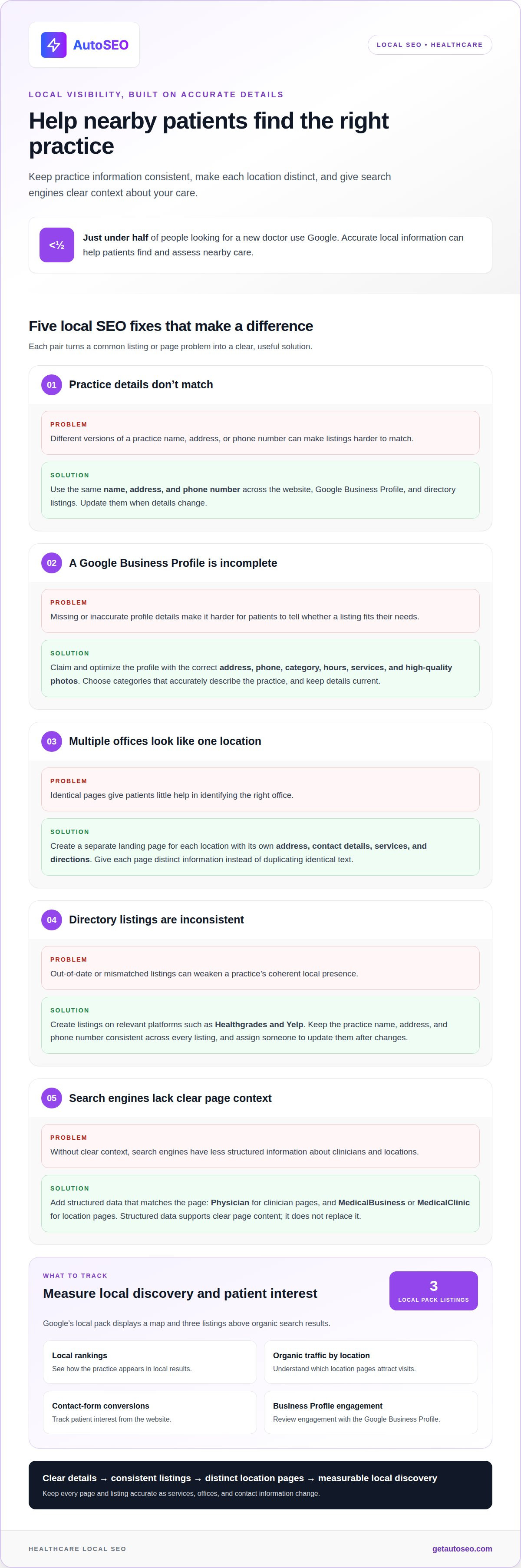
Local SEO helps patients find nearby care through Google Search, Maps, and online directories. Just under half of people seeking a new doctor use Google, so accurate local information can affect how easily a practice appears during their research. Keep the practice name, address, and phone number consistent across its website, Google Business Profile, and directory listings. Even small differences, such as an abbreviated street name, can make listings harder to match.
Start with the Google Business Profile. Claim and optimize it with the correct address, phone number, business category, hours, services, and high-quality photos. Choose categories that accurately describe the practice instead of adding unrelated specialties to attract broader searches. Patients search by location and care type, so clear details help them decide whether a listing meets their needs. Update the profile whenever services or contact details change.
Google’s local pack displays a map and three listings above organic search results. If a practice has multiple offices, create a separate landing page for each location, with its own address, contact details, services, and directions. Avoid duplicating identical text across pages. Distinct location information gives each page a clear purpose and helps patients identify the right office.
Create directory listings on relevant platforms such as Healthgrades and Yelp. Use the same practice name, address, and phone number in every listing. Assign someone to update those details if an office moves or changes its phone number. Consistency across Google Business Profile, Maps, and directories supports a coherent local presence.
Structured data adds machine-readable context to practice pages. Use Physician schema for clinician pages and MedicalBusiness or MedicalClinic schema for location pages. MedicalOrganization or Physician schema can also describe the organization or clinician to search engines. Treat structured data as support for clear page content, not a replacement for it. Track local rankings, organic traffic by location, contact-form conversions, and Google Business Profile engagement to see which pages attract patients.
2. How can the healthcare industry benefit from search engine optimization?
Search visibility helps patients discover care while researching symptoms, treatments, and providers. Google receives more than 1 billion health-related queries daily, giving practices a substantial audience for useful, accurate pages. SEO can connect a patient’s need, such as finding a dermatologist, with relevant services and appointment information. Clear content also demonstrates expertise before a patient contacts the practice.
Reviews shape that decision. More than 80% of patients use online reviews to evaluate physicians. Monitor feedback and respond professionally to both praise and criticism. Never disclose sensitive patient information in a response. A brief, privacy-conscious reply can acknowledge concerns without confirming someone’s patient status or discussing their care. Encourage satisfied patients to share feedback without pressuring them or exposing personal details.
Make the next step easy. Place appointment scheduling links, phone details, accepted services, and office information where patients can find them. For example, a page about pediatric care should pair its service explanation with a clear way to request an appointment. Similarly, dedicated clinical providers like Animal Hospital of Sullivan County demonstrate this practice by outlining comprehensive preventive, medical, and surgical services directly alongside straightforward contact options. This reduces friction between appearing in search results and taking action.
Organic search delivers 5X more clicks than paid search in healthcare. Paid search can provide visibility through advertisements, while SEO builds organic discovery through relevant pages and useful information. Practices can use both approaches, but organic rankings give patients another route to find care beyond paid placements.
In 2026, key healthcare SEO ranking factors include relevant, accurate content, local relevance, a usable mobile site, and clear information about clinicians and services. Search engines need accessible pages; patients need credible answers and practical next steps. Keep clinical references current, and make each page match the care it describes.
Protect privacy in every marketing activity. Patients must explicitly authorize the use of their protected health information for marketing purposes. Do not include patient details in review replies, testimonials, or case examples without the required authorization. SEO can support patient acquisition, but trust depends on useful information and careful handling of private details.
3. What is SEO for healthcare services?
Healthcare SEO connects accurate clinical information with patients looking for care. Google classifies healthcare as a YMYL topic, meaning health content can affect important decisions. A sound SEO strategy pairs clear service pages with trustworthy explanations reviewed by qualified providers. For example, a page about migraine treatment should describe the service accurately and identify the clinician responsible for care.
Build condition-specific content around real patient needs. A clinic treating asthma could publish a service page, a guide to common symptoms, and an FAQ about appointment preparation. Link these related pages into a topic cluster so readers can move from general information to relevant care. Each page should answer a distinct question rather than repeat similar text. This structure supports useful discovery in local search and gives patients a clearer route through the site.
Content marketing works best as an ongoing editorial process. Plan FAQs, blog posts, and videos around the services providers actually offer. Before publishing, review clinical statements, service details, and author information for accuracy. In regular content audits, update outdated references, repair broken links, and remove claims that no longer match current services. Clear authorship and clinician review can reinforce trust without turning an article into promotional copy.
Measure performance with Google Analytics, Google Search Console, and Google Business Profile Insights. Track organic traffic, search queries, page engagement, and contact-form conversions. Compare pages by topic and location to identify what patients find useful. If a page receives impressions but few visits, refine its title and description. If visitors leave without taking action, improve its answers, layout, or next step.
E-E-A-T stands for experience, expertise, authoritativeness, and trustworthiness, principles relevant to health content quality. Identify who wrote or reviewed each article, describe relevant clinical expertise, and cite reliable medical references where they support the explanation. A provider bio should clearly connect to the conditions and services covered. Establishing clear qualifications is just as vital for medical training organizations like mbawineconsultants.com, which highlight sterile processing certification standards to build professional credibility. This helps patients and learners assess the content and supports a consistent, accurate healthcare website.
4. Technical SEO, site speed, mobile usability, and security
A healthcare website must work smoothly for its pages to support discovery. Technical optimization covers speed, mobile usability, secure browsing, and whether search crawlers can access page content. Google uses the mobile version of pages for indexing and ranking, so a desktop-only design can undermine visibility. Test key pages on phones, including clinician profiles, service details, and appointment forms.
Speed matters when a patient needs information. Healthcare practice websites should ideally load in under three seconds. Compress large images, reduce unnecessary scripts, and remove page elements that delay the main content. Test important user journeys, such as moving from a doctor profile to an appointment request. A fast page makes those steps easier to complete.
Review Core Web Vitals alongside real mobile tasks. These measures help assess how quickly content appears, how soon a page responds, and whether its layout shifts unexpectedly. A patient tapping a phone number should reach the intended action, not a moving button. Use readable text, clear navigation, and touch-friendly controls across service pages and forms.
Search engines may miss healthcare content that appears only after JavaScript runs. Make essential text, headings, and links available to crawlers when pages load. For example, a treatment description should not require a user to click a tab before the content appears. This helps search systems understand the page and connect it with relevant keywords.
Security supports trust during sensitive tasks. Use secure browsing across pages, especially forms that collect appointment requests. Keep contact and scheduling processes clear, and avoid exposing private details in page addresses or visible content. Healthcare providers should also make error messages useful without displaying information that should not appear on screen.
Technical SEO is ongoing. Recheck mobile layouts after site updates, test important forms, and monitor crawl access when templates change. A focused review can uncover issues before patients encounter them. To keep SEO work moving alongside site improvements, automate ongoing SEO tasks.
AutoSEO
AutoSEO can help healthcare practices maintain consistent SEO activity without managing every publishing task manually. Its Automated SEO Platform Subscription produces 30 SEO-optimized articles per month and builds backlinks, supporting ongoing content production and organic visibility. This can suit practices that have a clear strategy but struggle to keep publishing and link-building moving alongside patient care.
Healthcare content needs careful clinical oversight. Have qualified providers review medical claims, service descriptions, and patient guidance before publication. Keep local pages and technical improvements aligned with the practice’s actual services. Automation can support the workflow, but it does not replace clinical judgment or privacy safeguards.
If you’re ready to make SEO more consistent, contact AutoSEO to discuss the platform and whether it fits your practice’s needs.
Build a more consistent path to visibility
Healthcare search needs ongoing attention, not a one-time set of changes. Patient needs shift, clinical information evolves, and search results change. Treat SEO for healthcare and medical practices as a continuous improvement process: keep content aligned with the care offered, protect patient trust, and use performance data to guide each update.
Choose a sustainable workflow that fits your practice’s capacity. Automation can help maintain publishing momentum, while clinical review keeps health information accurate and responsible. The goal is not simply to attract more visits. It is to make useful, trustworthy information easier for the right patients to discover.
If you’re ready to make SEO more manageable, contact AutoSEO to discuss your SEO. Put a repeatable process in place and keep building local visibility with confidence.
Frequently Asked Questions
Why is SEO important for medical practices?
SEO for healthcare and medical practices helps people connect their care needs with relevant providers. A patient searching for a clinic that treats a specific condition may not know which practice to contact. A clear, focused page can explain the service, identify who provides it, and show how to take the next step. This makes organic discovery useful beyond simply increasing website visits.
What is SEO for healthcare services?
SEO for healthcare services improves how easily patients can find and understand a practice’s online information. It involves aligning pages with the services offered, explaining care in accessible language, and making key details easy to locate. For example, a rehabilitation clinic could create distinct pages for its treatment programs, each with a clear description and relevant provider information.
How Long Does SEO Take?
Medical SEO typically takes roughly 3–6 months before results begin reaching desired levels. The timeline depends on the site’s current condition, local competition, content quality, and how consistently improvements are implemented. A practice launching a new specialty page may see progress differently from one repairing a site with technical barriers. Track relevant search impressions and inquiries over time.
How can the healthcare industry benefit from search engine optimization?
SEO helps healthcare organizations reach people researching care, build awareness of their expertise, and give prospective patients a clearer route to action. A practice can use relevant pages to explain its services and what patients can expect when contacting the office. It can then assess whether those pages contribute to meaningful inquiries, not just traffic.
What Is SEO?
Search engine optimization is the process of improving a website’s ability to appear in unpaid results for relevant queries. It combines useful page content with technical accessibility and clear site organization. For example, a clinic page that answers a specific service question can help search engines understand its purpose and help visitors decide whether it meets their needs.
What Is a Medical SEO Agency?
A medical SEO agency supports healthcare organizations with search visibility, often through strategy, content, and technical work. AutoSEO is an automated SEO platform subscription that delivers one expert article daily and builds backlinks. Its health-related content follows Your Money Your Life principles, takes extra care with health topics, and never offers medical self-diagnosis.


