

Legal tech SEO doesn’t fail because buyers aren’t searching. It fails when software expertise gets packaged as generic law firm marketing advice. SEO for legal tech companies needs to connect product capabilities with the questions legal teams ask before they book a demo, start a trial, or recommend a solution internally.
If your content is technically accurate but hard to find or understand, rankings alone won’t solve the problem. You need topics that match buyer intent, clear explanations that build trust, and a way to connect organic search activity to pipeline outcomes.
This playbook shows you how to build that system. You’ll learn to prioritise legal tech topics by search intent and buying stage, translate complex product language into useful content, and measure performance beyond traffic. You’ll also compare in-house, agency, and automated execution models using practical criteria for choosing an approach that can scale while protecting quality and legal accuracy.
Key Takeaways
- Separate legal software evaluation searches from law firm client-acquisition queries to target the buyers your product serves.
- Build seo for legal tech companies on sound technical foundations, then organise content around education, comparisons, integrations, and solutions.
- Compare in-house, agency, and automated execution by expertise, oversight, publishing capacity, consistency, and reporting.
- Set a baseline for organic visibility, qualified sessions, demo actions, and assisted conversions, then prioritise work by buyer relevance and business value.
- See how AutoSEO’s AI research informs its content plan, with a subscription that includes 30 SEO-optimised articles monthly and 100 Domain Authority worth of backlinks.
Why SEO for legal tech companies needs a different growth strategy
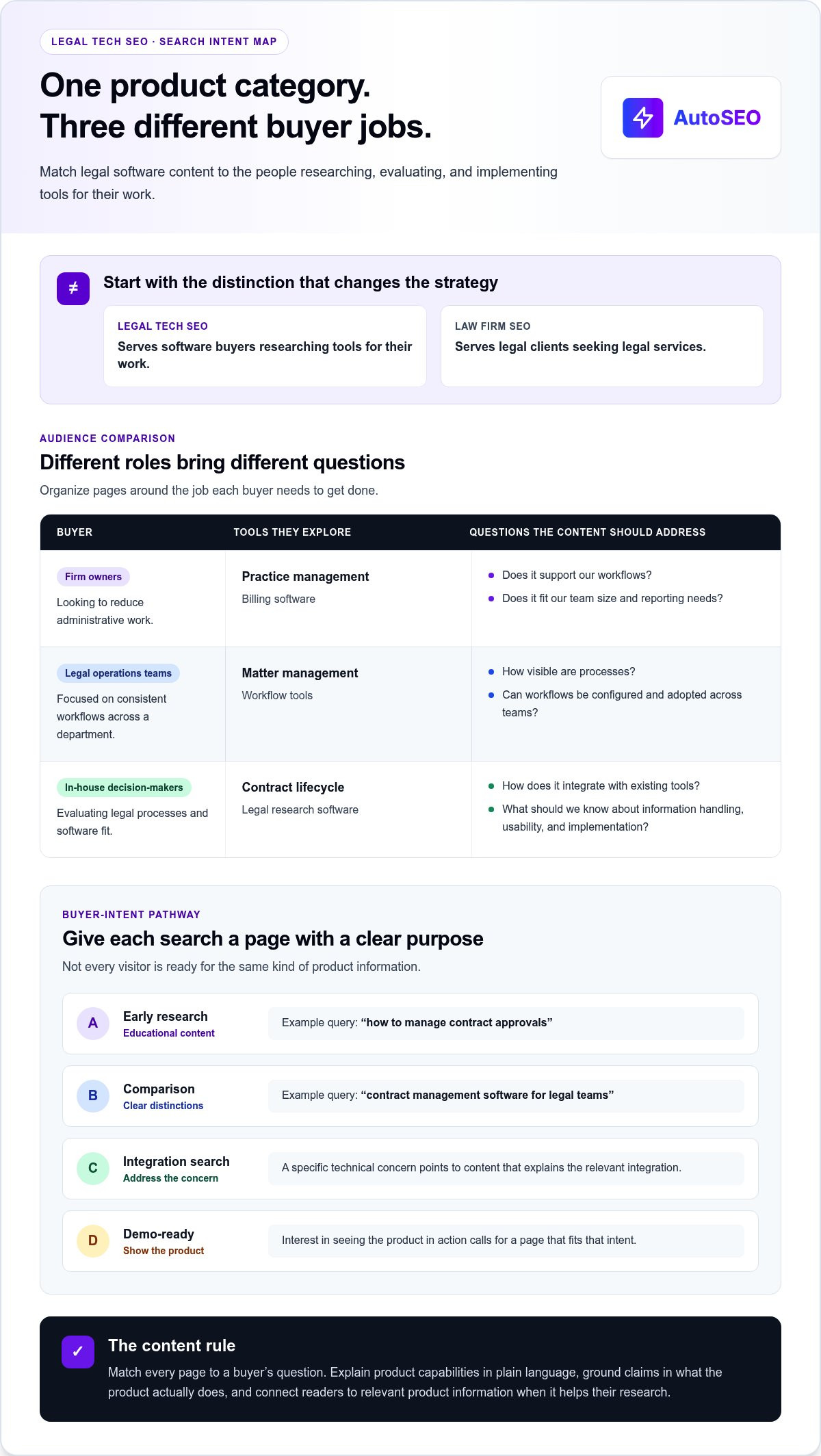
Legal tech SEO helps legal software reach the people researching, evaluating, and implementing tools for their work. The category includes products such as practice management platforms, contract tools, and legal research software. A useful overview of legal technology can help clarify how varied these applications are. That variety matters for search: a firm seeking new clients has a different problem from a legal operations team assessing software.
Legal tech SEO serves software buyers, while law firm SEO serves legal clients. This distinction changes which keywords, pages, proof points, and calls to action deserve priority. SEO for legal tech companies should answer buyers’ operational questions, not simply borrow local service-page tactics designed to generate enquiries for a law practice.
Map legal tech audiences to their search intent
Start by matching each audience to the job they need to get done. A firm owner may want to reduce administrative work; a legal operations team may need consistent workflows across a department; an in-house decision-maker may be evaluating contract processes, research, or matter management. Each role brings different needs and buying questions.
- Firm owners: Explore practice management or billing software. They may ask whether it supports their workflows, team size, and reporting needs.
- Legal operations teams: Research matter management or workflow tools. They may focus on process visibility, configuration, and adoption across teams.
- In-house decision-makers: Compare contract lifecycle or legal research software. They may assess integrations, information handling, usability, and implementation requirements.
Match each page to the buyer’s stage. Early research searches such as “how to manage contract approvals” call for educational content. Comparison queries such as “contract management software for legal teams” need clear distinctions between approaches and capabilities. Integration searches point to a specific technical concern, while demo-ready queries suggest interest in seeing a product in action. Build content for each intent instead of sending every visitor to the same product page.
Turn product expertise into credible search content
Translate features into outcomes buyers can understand. Instead of repeating a label like “automated matter intake,” explain what information the workflow captures, who uses it, and which problem it is designed to address. Keep the explanation grounded in the product’s actual capabilities, and avoid promises the page cannot substantiate.
Credibility comes from evidence and clear ownership. Support product claims with relevant screenshots, documented workflows, implementation details, or customer examples when available. Assign review to people who understand both the product and the legal audience, and revisit pages when capabilities change. This keeps technical shorthand from obscuring the answer and reduces the risk of overstating what the software does.
Legal software can be a high-consideration purchase. Buyers need enough detail to assess fit and enough clarity to share the case internally. Direct explanations, precise comparisons, and transparent limitations make content more useful at every stage. They also help search engines understand the page’s subject, audience, and purpose.
Build the legal tech SEO system: technical foundations, content, and authority
Strong seo for legal tech companies depends on three connected systems: search engines must access the right pages, buyers must find useful answers, and the site must give them credible reasons to trust what it says. Technical access, useful content, and credible evidence work together. A weakness in one can limit the value of the others.
Make the website easy to crawl and understand
Start with a focused technical review. Confirm that important product, integration, and educational pages can be crawled and indexed. Check that canonical signals point to the preferred version of each page, and identify duplicate or thin pages that may compete for attention. Then trace the internal links: a guide about contract workflows should lead naturally to relevant product information, rather than leaving readers at a dead end.
Use simple navigation and descriptive page titles so people and search engines can identify each page’s purpose. Test mobile usability and page speed, and check that structured data matches visible page content. These checks don’t replace useful information, but they help ensure the right content can be discovered and understood.
Create content that answers real software-buyer questions
Build topic clusters around workflows, pain points, integrations, and product comparisons. For example, a cluster on contract review could connect an educational guide about review workflows to an integration page and a solution page. Give each page a distinct purpose. Avoid publishing near-identical pages that target the same question without adding meaningful detail.
Use product and legal subject-matter reviewers to verify terminology, examples, and capability claims. Link an article to a relevant product page when it gives readers a logical next step, not as a forced pitch. A clear answer earns attention first. A relevant product connection can then help a qualified reader continue their research.
Build authority and visibility beyond classic blue links
Earn relevant editorial mentions by contributing practical expertise to publications, professional discussions, and industry resources your audience already uses. Prioritise references that make sense for legal software buyers over generic link volume. Backlinks should support discoverability and credibility, not substitute for useful content. For a deeper look at the principles, explore this link-building fundamentals guide.
Track organic visibility for priority topics alongside referrals and meaningful page engagement. Also review how your brand and product appear in AI search experiences where buyers research solutions. Keep claims accurate and pages current so search systems and prospective customers have a clear source to interpret. To streamline ongoing research and publishing, explore automated SEO workflows as one way to support a consistent process.
Compare in-house SEO, agencies, and automation for legal tech
The right execution model depends on your main constraint. You may need deeper SEO expertise, more publishing capacity, or tighter control over product claims. Compare who owns each decision and which tasks can be systemised. For a broader look at operating models, see this SEO automation guide.
When an in-house SEO team makes sense
An in-house team can work closely with product, sales, and legal subject-matter experts. That access helps it reflect product changes and buyer feedback in the search strategy. The trade-off is capacity: research, technical SEO, writing, publishing, and reporting all need ongoing ownership. If priority pages keep slipping or publishing becomes irregular, limited team time may be the bottleneck.
What agencies and automated platforms change
An agency can add strategic expertise and collaborative delivery, while your team contributes product knowledge, approvals, and business priorities. Automation can reduce repetitive research, publishing, and link-building work through a repeatable subscription workflow. Neither model removes the need for oversight. Set editorial standards, assign subject-matter review, and assess performance. Automation can increase output, but output alone doesn’t establish accuracy or value to buyers.
| Model | What your company owns | What a partner or platform handles |
|---|---|---|
| In-house | Strategy, expertise, production, approvals, and reporting | Usually no external execution; specialist support may be added separately |
| Agency | Business goals, product input, access, and final internal alignment | Agreed strategy and SEO delivery through a collaborative service relationship |
| Automation | Priorities, product accuracy, editorial standards, and performance review | Repeatable research, content production, publishing, and backlink activity, depending on the subscription |
Choose an execution model with a practical scorecard
Score each option against the constraints that matter to your team. Use a simple low, medium, or high rating, then discuss the trade-offs instead of treating one score as a verdict.
- Budget fit: Can you sustain the model as a recurring part of marketing?
- Internal time: How much work stays with your team, including review and coordination?
- Control: Can product experts shape topics and approve claims?
- Scalability: Can you maintain a consistent workflow as content needs grow?
- Quality assurance: Are legal terminology, product facts, and brand voice checked before publication?
In-house execution offers direct control but requires enough capacity across the workflow. Agency delivery adds collaboration and external expertise. Automation can systemise recurring work while your team retains responsibility for accuracy and strategic fit. Match the model to the actual bottleneck, not the largest output claim. Explore an automated SEO workflow as one option for making execution more consistent.
How to launch and measure a legal tech SEO programme
A clear baseline turns SEO from a publishing task into a growth programme. Record current organic visibility, qualified sessions, demo actions, and assisted conversions before changing pages or expanding content. For seo for legal tech companies, the aim is to connect search visibility with actions from relevant buyers, not to treat rankings as the finish line.
Sequence the first stages of execution
Set a manageable scope before scaling. Begin with audience research, a technical baseline, and a focused set of priority topics. Then follow an execution sequence that connects buyer needs to measurable outcomes:
- Check the starting point: Review which pages are indexed, what queries bring organic impressions and clicks, and where visitors take meaningful action.
- Improve core solution pages: Make sure priority pages explain the product, intended users, key workflows, and relevant next steps clearly.
- Expand with supporting content: Publish educational resources that answer related buyer questions and link naturally to the solution pages they support.
- Review and refine: Set a recurring cycle to check technical health, search performance, conversion actions, and editorial quality. Use what you learn to update existing pages and choose the next priorities.
Prioritise work by buyer relevance, business value, and your team’s realistic capacity. A page aimed at a core buyer need may deserve attention before a broad topic that attracts visitors unlikely to evaluate the product.
Measure progress without mistaking activity for impact
Use Google Search Console to examine queries, impressions, clicks, and search visibility. Use Google Analytics 4 to review organic sessions, engagement, and configured conversion actions such as demo requests. Read these signals together. More impressions show increased exposure, but qualified visits and meaningful actions help show whether the right audience is responding.
Define “qualified” based on your sales process. For example, segment organic sessions to priority product pages, then compare demo actions and subsequent pipeline activity where your analytics and CRM setup allow. Legal software purchases can involve extended evaluation, so a first visit may inform research without producing an immediate conversion. Review assisted conversions and customer journeys alongside last-click reporting. Connect visibility metrics to qualified actions, not rankings alone.
Maintain trust as publishing scales
Set review ownership before increasing output. Product experts should verify capabilities and integration details; legal subject-matter reviewers should check terminology and context. Keep a record of who approves claims, and revisit pages when product features, integrations, or buyer language changes. This protects accuracy as your content workflow grows. For more context on scalable editorial processes, explore this AI content creation guide.
Once your priorities and quality checks are clear, explore an automated SEO workflow to support consistent research and publishing while your team focuses on product expertise and performance review.
How AutoSEO supports legal tech SEO on autopilot
Legal tech teams need consistent search execution without handing product expertise over to an automated process. AutoSEO is an automated SEO platform subscription that supports recurring research, content publishing, and backlink activity. It handles repeatable work while your team sets priorities, checks accuracy, and decides how search supports business goals.
What the automated workflow handles
AutoSEO’s AI researches your business, customers, and competitors to inform its content plan and target keywords. This research gives your team a structured starting point for choosing topics. Review the planned themes against your legal software audiences, product roadmap, and buyer questions before making them publishing priorities.
The subscription includes 30 SEO-optimised articles per month and 100 Domain Authority worth of backlinks. WordPress publishing is automated after initial setup. The backlink quantity describes the subscription’s included activity, not a Google ranking metric or a promise of ranking impact. Evaluate links for relevance and quality as part of your broader SEO review.
Automation can create a steadier production rhythm, but publishing more pages isn’t the goal by itself. Articles still need a clear purpose, accurate product information, and a useful connection to the questions legal software buyers are trying to answer.
Fit the workflow to a legal tech content operation
Build review into the process. Assign product experts to validate features and integrations, and ask people close to legal customers to check terminology and whether the language reflects real buyer concerns. Make ownership clear before publication, especially for pages that describe product capabilities or explain legal workflows.
Then connect content choices to business priorities. A company selling matter management software may focus on workflow questions and product use cases, while a contract platform may prioritise content about approval processes and integrations. Select topics for the audiences and buying stages the business wants to reach, not simply because a keyword looks attractive.
Review organic engagement and qualified actions regularly. Check whether priority pages attract relevant visitors, whether readers continue to product information, and whether organic sessions contribute to demo activity or other meaningful conversions. Use those signals to refine the next content plan. This keeps quality and scale aligned instead of treating output volume as proof of performance.
Take the next step with an automated SEO workflow
The trade-off is straightforward: automate repeatable research and publishing while retaining human review and strategic ownership. Automation can reduce the operational load, but it doesn’t replace product knowledge, legal subject-matter review, or ongoing performance checks. This balance supports consistency without treating every topic or claim as ready to publish by default.
Explore an automated SEO workflow to see how recurring execution can fit into your search process. Keep your team focused on decisions that require context: which buyers matter, what the product can substantiate, and which organic actions signal genuine demand.
Make organic growth part of the product motion
Treat search as an operating capability, not a campaign that ends when a page goes live. Set a clear owner for buyer priorities, establish a review rhythm, and use questions from sales conversations to sharpen the topics you publish. That feedback loop keeps seo for legal tech companies connected to real product demand as your market and roadmap change.
Choose an execution model that gives your team room to focus on the work only it can do: understanding customers, validating product claims, and deciding where the business should compete. Then make recurring execution consistent enough to learn from. The aim isn’t to publish for its own sake. It’s to build a repeatable system that turns useful expertise into discoverability and gives qualified buyers a clearer path to evaluate your solution.
Keep the standard simple: every page should serve a real buyer need, and every review should help you make the next decision with better evidence. That discipline lets your search programme adapt without losing focus as the company grows.
Explore AutoSEO and put recurring SEO execution on autopilot. Start building a search workflow your team can sustain, improve, and scale with confidence.
Frequently Asked Questions
How long does SEO take to produce meaningful leads for a legal tech company?
There’s no dependable fixed timeline for meaningful leads. Site history, competition, technical health, and publishing consistency all affect progress, and visibility can shift before qualified enquiries do. For seo for legal tech companies, compare performance by page group or topic rather than relying on a single sitewide trend. Note when key pages change, then assess whether search exposure is followed by relevant buyer activity over time.
Can a legal tech startup compete with established software brands in organic search?
Yes. A startup can focus on specific users and workflows where its product knowledge gives it a credible edge. For example, instead of targeting a broad software term, explain how a particular legal team handles a distinct workflow and what to consider when evaluating tools for it. Support claims with real product evidence. This focused approach helps a smaller company build relevance without trying to publish on every topic larger brands cover.
Is SEO worthwhile for a legal tech company before product-market fit?
Yes, if you treat it as a way to learn rather than a reason to publish at scale. Search queries and conversations with early prospects can reveal how people describe a problem, what alternatives they consider, and which questions remain unanswered. Publish a small number of useful pages around those insights. If the target customer or value proposition changes, update the pages before expanding the programme.
Can AI-generated content rank for legal tech searches?
AI-assisted content can appear in search, but using AI doesn’t make a page useful or accurate by itself. Treat generated drafts as material to verify, not as approved product explanations. Check technical claims against current product information, confirm legal terminology with a knowledgeable reviewer, and remove unsupported statements. A page should answer the query clearly and offer a reason to trust its details, regardless of how its first draft was created.
Should a legal tech company use programmatic SEO?
Use programmatic SEO only when each page can provide distinct value supported by reliable information. A directory of integrations, for example, may help buyers if every entry explains a genuine, relevant connection and its purpose. A template that swaps product or industry names while repeating the same copy adds little. Review sample pages before expanding, then monitor whether pages are indexed and whether visitors engage with the information.
How can a legal tech company measure SEO when sales cycles are long?
Connect organic discovery to the buyer journey using several signals, not a single attribution model. In addition to search visits and demo actions, review whether organic pages appear in the history of opportunities that later progress. CRM data and analytics can help, though privacy settings and untracked research create gaps. Add a “How did you hear about us?” field to capture buyer recollection, then compare it with digital reporting.
Does a legal tech website need structured data to appear in search results?
No. Structured data isn’t a prerequisite for appearing in standard search results, and it can’t guarantee enhanced listings or better rankings. Use it to describe information that’s already visible and accurate, such as the organisation behind the site or details on an article page. Validate the markup with available testing tools, correct errors, and review Search Console for relevant reports. Don’t add fields that the page content doesn’t support.


