

A manufacturing SEO program can attract plenty of traffic and still miss the buyers who matter. SEO for manufacturing companies needs to reach engineers, procurement teams, and other decision-makers searching for precise technical answers, not just broad product terms.
Industry terminology can make keyword research difficult, and long buying cycles can make it harder to connect search visibility to revenue. Meanwhile, a small marketing team may struggle to publish consistently while checking every technical detail. More content for its own sake isn’t the answer. You need a repeatable process that turns manufacturing expertise into useful pages buyers can find and trust.
This guide shows you how to build that process, from mapping buyer roles and search intent to planning technically accurate content and measuring results. You’ll learn how to involve subject-matter experts without creating a publishing bottleneck, and how to track organic performance against qualified leads and pipeline contribution. The goal is to make search a practical growth channel that supports the full buying journey.
Key Takeaways
- Build seo for manufacturing companies around the questions engineers, procurement teams, and other buyers search before contacting sales.
- Use a repeatable workflow to map product, capability, application, and technical terms to the right pages.
- Compare in-house, agency, and automated approaches by expertise, capacity, oversight, and continuity, not traffic promises alone.
- Prioritize technical foundations and track organic results against qualified leads and pipeline contribution.
- See whether automated research, monthly content production, and WordPress publishing can support a consistent workflow while your experts review technical accuracy.
Why SEO for Manufacturing Companies Starts With the Buying Journey
Manufacturing buyers often research specifications, applications, suppliers, and operational risks before contacting sales. An engineer may look for a material’s performance in a specific environment. Procurement may compare supplier capabilities and sourcing requirements. An operations leader may need to understand how a component fits an existing process. Your website should answer these distinct questions when buyers search.
That’s where search engine optimization (SEO) becomes a commercial process, not simply a way to attract more visits. Effective seo for manufacturing companies helps relevant buyers find product, application, and capability information throughout their research. It also makes your expertise easier to discover when a buyer is comparing options or evaluating suppliers.
Which manufacturing buyers should your SEO reach?
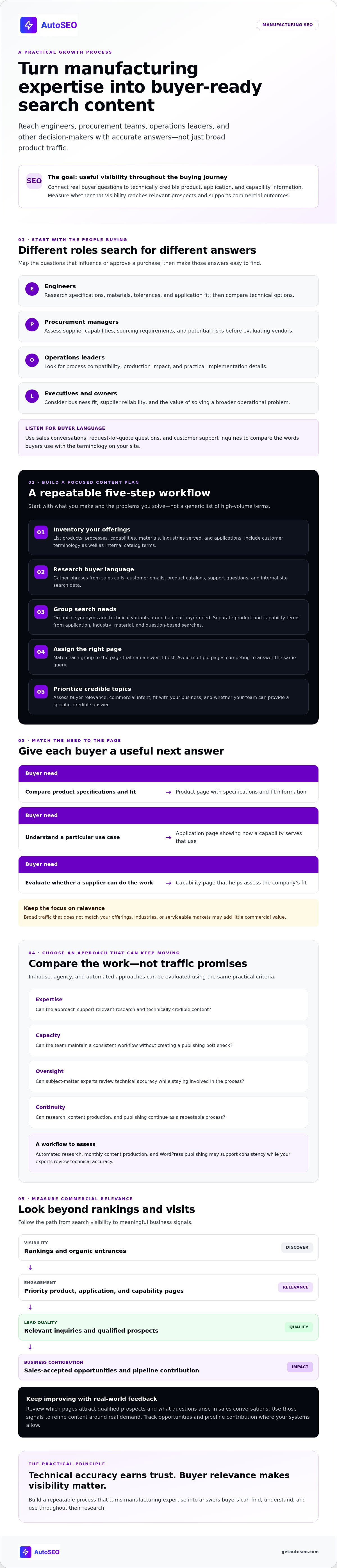
Start with the roles that influence or approve a purchase, then match their needs to each buying stage. For example:
- Engineers research specifications, materials, tolerances, and application fit, then compare technical options.
- Procurement managers assess supplier capabilities, sourcing requirements, and potential risks before evaluating vendors.
- Operations leaders look for process compatibility, production impact, and practical implementation details.
- Executives and owners consider business fit, supplier reliability, and the value of solving a broader operational problem.
These roles may search for different information even when they’re evaluating the same product. Use sales conversations, request-for-quote questions, and customer support inquiries to capture the language buyers actually use. Compare those phrases with the terms on your site. The differences can reveal gaps between your internal product vocabulary and the words customers enter into search.
What should manufacturing SEO contribute to growth?
Manufacturing SEO is buyer-focused organic visibility that connects relevant search questions with accurate product, application, and capability information. Its purpose is to help the right people find useful answers and take a meaningful next step, not to inflate traffic with visitors outside your markets.
Connect each important page to a buyer need. A product page can explain specifications and fit. An application page can show how a capability serves a particular use case. A capability page can help buyers assess whether your company handles the work they need. Broad traffic that doesn’t match your offerings, industries, or serviceable markets may add little commercial value.
Measure more than rankings. Track organic entrances to priority pages, relevant inquiries, and, where your systems allow, sales-accepted opportunities and pipeline contribution. Review which pages attract qualified prospects and what questions come up in sales conversations. These signals help you refine content around real demand. Rankings show visibility, but qualified inquiries help show whether that visibility is reaching potential buyers.
How to Build a Manufacturing SEO Keyword and Content Plan
A useful keyword plan starts with what you make and the problems you solve, not a generic list of high-volume terms. For seo for manufacturing companies, buyer relevance and technical credibility matter more than traffic that doesn’t fit your offerings or markets.
Use this five-step workflow to turn product knowledge into a focused content plan:
- Inventory your offerings. List products, processes, capabilities, materials, industries served, and applications. Include the names customers use, not just internal catalog terminology.
- Research buyer language. Gather phrases from sales calls, customer emails, product catalogs, support questions, and internal site search data. Note recurring technical questions and comparison criteria.
- Group search needs. Organize synonyms and technical variants around one clear buyer need. Separate product and capability terms from application, industry, material, and question-based searches.
- Assign a page. Match each group to the page that can answer it best. Avoid creating several pages that compete to answer the same query.
- Prioritize topics. Assess buyer relevance, commercial intent, fit with your business, and whether your team can provide a credible, specific answer.
How do you find keywords for manufacturing products and services?
Start with evidence you already have. A prospect asking whether a component suits a particular environment may reveal a more valuable topic than a broad product phrase. Group alternate names, abbreviations, and technical variants when they reflect the same need. Then use current keyword research tools to check search demand and intent. Don’t assume a specialized term has meaningful volume, or dismiss it because a tool reports little data. Confirm that the topic matches the buyers and work you want.
How should you map topics to manufacturing website pages?
Give each search need a clear home. Product queries belong on product pages; process and equipment queries belong on capability pages. Create application pages for distinct use cases only when you can add specific, useful detail rather than repeat generic claims. Support these commercial pages with educational content that answers related technical questions, then link to the relevant product or capability page using descriptive anchor text.
Before publishing, ask a subject-matter expert to review specifications, standards, tolerances, and application claims. A keyword tool can surface an opportunity, but it can’t verify engineering accuracy. If your team needs help maintaining a regular research and content workflow, automated SEO research and publishing is one option, with technical review remaining part of your process.
How to Compare Manufacturing SEO Options Without Chasing Vanity Metrics
The right SEO model depends on your team’s expertise, available time, and need for consistent execution. In seo for manufacturing companies, product knowledge is essential, but so is the capacity to keep research, publishing, and measurement moving. Compare what each approach can reliably handle, not just what it promises.
| Approach | Strengths | Trade-offs to assess |
|---|---|---|
| In-house | Direct product knowledge, access to sales teams, and close editorial control. | Capacity may be limited, especially when marketing staff have competing responsibilities. |
| Agency | External SEO expertise and dedicated execution capacity. | Assess how the team learns technical details, coordinates with your experts, and reports progress. Continuity and oversight depend on the engagement. |
| Automation | Can support repeatable research, publishing workflows, and consistent content operations. | Requires clear direction and qualified review. Automation can scale production, but it can’t independently verify every technical claim. |
When should manufacturers use in-house SEO, an agency, or automation?
Choose in-house execution when your team has the time and SEO skills to turn customer and product knowledge into a steady program. Consider an agency when you need outside expertise and can provide the access and oversight needed to keep work aligned with your products. Automation can reduce repetitive work and help maintain publishing consistency, particularly when internal capacity is tight. It can also complement in-house expertise rather than replace it.
These models don’t have to be exclusive. A manufacturer might keep strategy and technical approval in-house while using external execution capacity or automation for recurring tasks. Define who owns topic selection, technical review, publishing, and performance reporting before committing to a model.
How can you assess content quality and backlink activity?
Review sample content against product documentation, and ask a subject-matter expert to check specifications, standards, tolerances, and application statements. Look for clear sourcing and language that reflects what the company can actually deliver. For backlink activity, ask how links are selected and reported, and whether referring sites are relevant to your market. Don’t treat an authority score as proof of traffic, qualified inquiries, or revenue.
Judge reporting by whether it connects search activity to business signals. Track qualified inquiries, assisted conversions, and sales-accepted opportunities where your systems allow. Rankings can help diagnose visibility, but they don’t show whether the right buyers are entering your pipeline. For a closer look at automation in SEO workflows, read how SEO automation works.
How to Implement and Measure SEO for a Manufacturing Website
Turn your SEO plan into a repeatable operating cycle. Start with pages that support priority products and capabilities, then fix technical barriers before expanding content. This keeps effort focused on pages buyers need and makes it easier to see what’s working.
- Audit key pages. Check priority product, capability, and application pages for accuracy, usefulness, and clear next steps.
- Fix crawl barriers. Confirm search engines can access and index important pages. Resolve broken links, unintended blocks, and confusing site structure.
- Publish priority content. Create or improve pages that address the buyer needs identified in your keyword plan.
- Improve internal links. Connect related educational content to relevant commercial pages with clear, descriptive link text.
- Review results. Use search and analytics data to identify pages to strengthen, update, or investigate further.
Which technical SEO checks matter on a manufacturing site?
Check that important product and capability pages are crawlable, indexable, and reachable through internal links. Review navigation depth so buyers and search engines can find key information without navigating a maze. Inspect shared page templates for duplicate or thin content, and test mobile usability and page speed. Apply structured data only when the page content and relevant eligibility requirements support it accurately.
Clear site architecture matters. Organize pages around products, capabilities, applications, and industries served so related information is easy to locate. Recheck technical elements after significant site updates, including changes to navigation, templates, or product pages.
Which SEO metrics help connect visibility to sales?
Use Google Search Console to monitor impressions, clicks, queries, and landing pages from search. Pair that view with analytics reporting to assess engagement, inquiry actions, and conversion paths. Separate informational visits, such as educational article landings, from higher-intent visits to product or supplier-evaluation pages. Then check whether those visits lead to relevant inquiries or sales conversations.
Judge SEO impact by its contribution to qualified business outcomes, not visibility metrics alone. Track what happens after an organic visit: which page brought the buyer in, whether they took a meaningful next step, and whether sales accepted the opportunity. Connect analytics and sales records where practical, while recognizing that a long buying process may involve several visits before an inquiry.
Set a review cadence that fits your team, such as a monthly performance check and a deeper quarterly review. Update pages when product details, capabilities, or buyer questions change. This keeps search information aligned with what your company can deliver. To streamline recurring SEO research and publishing, explore the AutoSEO platform.
How AutoSEO Can Help Keep Manufacturing SEO Moving
A manufacturing SEO workflow needs more than a content calendar. It needs consistent research and publishing, clear quality controls, and reporting tied to the pages and business outcomes that matter. AutoSEO is an automated platform subscription that can handle recurring SEO work when internal capacity is limited.
The subscription includes 30 SEO-optimized articles per month, automated publishing to WordPress, and backlinks described as “100 Domain Authority worth.” The platform’s AI researches your business, customers, and competitors to inform a content plan and identify relevant keywords. Review technical claims before publication, and assess backlink relevance and reporting rather than treating an authority score alone as proof of business impact.
What should a manufacturer prepare before automating SEO?
Automation works best with accurate inputs and defined oversight. Prepare company and product information, applications, target markets, and the questions customers ask. Identify an internal reviewer, such as an engineer or product specialist, who can check specifications, standards, tolerances, and sensitive claims before content goes live.
Set priorities before production begins. Decide which product, capability, or application pages deserve support, and define what progress means, such as relevant inquiries or sales-accepted opportunities. This gives your team a standard for reviewing content and evaluating whether the workflow supports your seo for manufacturing companies goals.
What are the next steps for evaluating an SEO workflow?
Compare any workflow against the criteria established earlier: relevance to your buyers, technical quality control, publishing consistency, and useful reporting. Review sample outputs for accuracy and fit. Confirm who approves content, how WordPress publishing is configured, and what reporting you’ll receive. Then monitor results over time. Search visibility and pipeline activity don’t always move in step, especially when buyers take time to evaluate suppliers.
For another perspective on using automation to support ongoing content operations, read AI Content Creation: Your 24/7 SEO Writing Team on Autopilot. Whatever workflow you choose, keep subject-matter review in place. Automation can increase production capacity; your experts protect the accuracy manufacturing buyers expect.
If the workflow fits your team’s needs, explore SEO on Autopilot as an option for maintaining consistent SEO research and publishing.
Build a Manufacturing SEO Process You Can Sustain
Effective seo for manufacturing companies connects buyer questions to accurate product and capability information, then measures whether that visibility supports qualified inquiries and pipeline. Start with the pages and topics that matter most. Keep technical experts involved, and review performance regularly so your content stays aligned with changing products and buyer needs.
Consistency is often the hard part. AutoSEO’s subscription includes 30 SEO-optimized articles per month and automated publishing to WordPress, supporting an ongoing content workflow. Your team should still review technical content before publication and assess results over time. Automation can increase output, while expert oversight protects quality.
To evaluate whether this workflow fits your team, explore SEO on Autopilot. With a clear process and the right level of review, you can make organic search a more reliable part of manufacturing growth. Start with focused topics, keep improving, and build momentum one useful page at a time.
Frequently Asked Questions
How does SEO work for manufacturing companies?
SEO for manufacturing companies helps relevant buyers find useful product, capability, and application information through organic search. The process typically includes researching buyer questions, mapping search needs to useful website pages, improving technical accessibility, and building clear internal links. Measure whether those pages attract relevant visits and inquiries, not just whether they rank. Strong SEO supports buyers as they research and compare suppliers, often before they’re ready to contact sales.
What keywords should a manufacturing company target?
Target terms that reflect your products, capabilities, materials, applications, industries, and the technical questions buyers ask. For example, a manufacturer might research phrases related to a production process, a component’s material, or its use in a specific application. Collect language from sales conversations, customer emails, catalogs, and site searches. Then validate search intent and demand with current research tools, and prioritize terms that fit your business and expertise.
How long does manufacturing SEO take to show results?
There’s no reliable fixed timeline for SEO results. Progress depends on factors such as your website’s current technical condition, the competition for relevant searches, the quality of your content, and how consistently you improve it. First monitor whether key pages are being indexed and gaining impressions and clicks. Then assess relevant inquiries and pipeline signals over time. Treat rankings as diagnostic information, not a guaranteed schedule for leads or revenue.
Can AI-generated content work for manufacturing SEO?
AI can support manufacturing SEO by helping scale research and content production, but generated material needs qualified human review. A subject-matter expert should verify specifications, standards, tolerances, and application claims against reliable company information before publication. Provide accurate business context and buyer questions, then edit for technical precision and usefulness. The goal is quality at scale, not publishing more pages without evidence, expertise, or a clear purpose for the intended buyer.
What should a manufacturing company look for in an SEO provider?
Look for a provider or workflow that understands your commercial priorities, explains how it will handle technical review, and reports on meaningful outcomes. Ask how topics are selected, who checks product claims, how publishing is managed, and what performance data you’ll receive. Compare expertise, capacity, oversight, continuity, and cost structure against your internal resources. Be cautious of promises based only on rankings or traffic, since neither proves that qualified buyers are engaging.
How do manufacturers measure SEO leads and ROI?
Track organic landing pages, impressions, clicks, relevant inquiries, and conversion paths using search and analytics reporting. Where possible, connect inquiry records with your sales process to identify sales-accepted opportunities and pipeline contribution. Separate informational visits from visits to product, capability, or supplier-evaluation pages. Manufacturing purchases may involve multiple interactions, so review assisted conversions and trends over time. Define lead quality with sales, then assess SEO against qualified business outcomes, not traffic alone.
Does a manufacturing website need technical SEO?
Yes. Technical SEO helps search engines access and understand important pages, and helps buyers navigate them. Check that key product and capability pages are crawlable, indexable, mobile-friendly, and connected through clear site navigation. Review page speed, broken links, duplicate or thin content, and how easily users can reach priority information. Use structured data only when the page content and applicable requirements support it. Technical improvements make useful content easier to discover and use.


