

More content won’t fix SaaS SEO if it targets the wrong intent. For startups, seo for SaaS startups works best when each page connects a real customer problem to a relevant product capability, then supports that page with useful content and credible authority. This focus matters when time and team capacity are limited.
It’s reasonable to question which tasks deserve attention first. Feature pages can be difficult to turn into search-focused landing pages, and publishing AI-assisted content at scale only helps when quality stays high. SEO also takes time, so activity alone isn’t proof of progress. The goal is to attract qualified organic traffic that contributes to business outcomes.
This guide lays out a practical sequence: prioritize searches that fit your product, turn customer intent into useful pages and topic clusters, build authority through consistent content and backlinks, and measure performance beyond rankings. It also explains how to make content clear and useful for Google and AI discovery platforms such as ChatGPT and Perplexity, while keeping automation in its proper role: executing a focused strategy, not replacing it.
Key Takeaways
- Build seo for SaaS startups around customer language, product fit, and searches that signal real buying intent.
- Prioritize pages by their value to potential customers before expanding into supporting content.
- Scale content and authority-building with a repeatable workflow, while checking every asset for accuracy, originality, and usefulness.
- Track visibility and qualified visits alongside conversions to decide what to improve next.
- AutoSEO provides 1 expert article daily and backlink building to support consistent execution of your SEO priorities.
Why SEO for SaaS Startups Builds a Compounding Acquisition Channel
A SaaS startup doesn’t need more website traffic for its own sake. It needs to be discoverable when potential customers search for a problem, explore a solution, or compare products. That’s the focus of seo for SaaS startups: earning relevant organic visibility across product, problem, and solution searches, then giving visitors a useful next step.
Quotable definition: SaaS SEO is the process of making a software company discoverable through useful pages that match customer searches at each stage of their buying journey. It applies the foundations of What is Search Engine Optimization? to the ways people identify, evaluate, and choose software. The aim isn’t to optimize every page for every keyword. It’s to connect the right search intent with the right information.
Search can capture demand that already exists. A person looking for “automated invoice reminders” may be exploring ways to solve a specific workflow problem. Useful content and relevant product pages can also build visibility over time as a focused set of pages gives more searches a path to your business. But visibility isn’t a promise of rankings, immediate leads, or product-market fit. SEO helps people find and understand an offer; the offer still has to solve a meaningful problem.
When should a SaaS startup invest in SEO?
Start with demand and readiness, not a publishing quota. Look for evidence that customers search for the problem, category, or type of solution your product addresses. Their language may differ from your internal feature names. A specialized B2B provider like 123 EDI, for instance, aligns content directly with practical data exchange challenges rather than generic buzzwords. Your team might call a capability “workflow orchestration,” while a prospective buyer searches for “how to automate client approvals.” That gap can reveal how to describe the product in a way customers recognize.
SEO becomes more actionable when you can explain who the product serves, what value it delivers, and what a visitor should do next. That action might be starting a trial, requesting a demo, or signing up. If the audience or value proposition is still changing, keyword research can still reveal customer vocabulary and competing solutions. Use those findings to sharpen your messaging before scaling publication.
What can SEO contribute across the SaaS customer journey?
Match each page to the visitor’s stage of awareness. A problem-aware searcher needs a clear explanation, not a hard sell. Someone comparing options needs specific product information. Aligning content with intent gives each visit a more relevant next step:
- Discovery: Publish educational content that explains a problem, its causes, or possible approaches. This helps people who are researching before they know which software to choose.
- Evaluation: Build product, solution, comparison, and alternative pages that answer practical questions about use cases and fit. Keep claims grounded in what the product actually does.
- Action: Make the next step clear, such as starting a trial, booking a demo, or signing up. Measure whether organic visits lead to qualified actions, not just sessions.
This is how search can shift from a traffic source to an acquisition channel: each page serves a defined intent and contributes to a measurable path. The next step is to turn that principle into a focused strategy.
How to Build a SaaS SEO Strategy Around Customer Intent
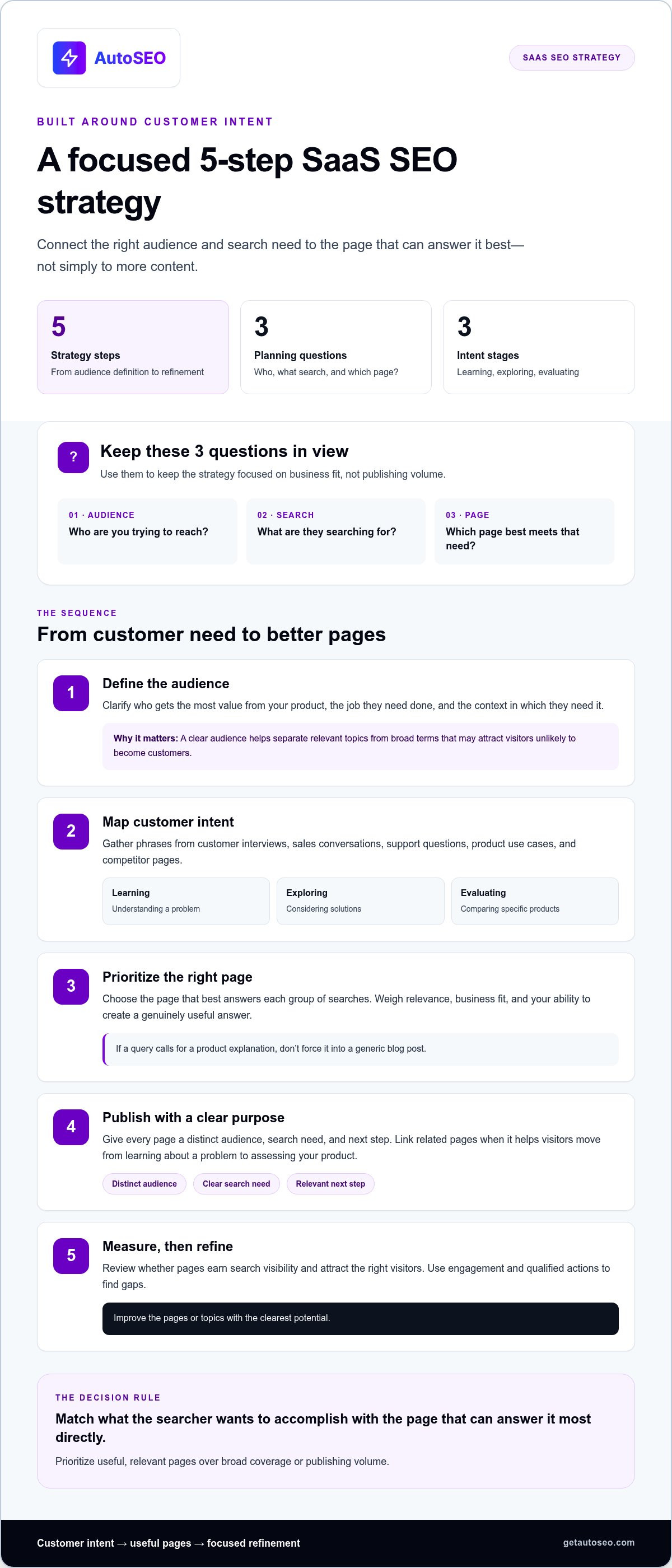
A startup-sized team can’t pursue every keyword, page type, and content idea at once. Build a sequence instead. Each step should answer three questions: who are you trying to reach, what are they searching for, and which page will best meet that need? This keeps seo for SaaS startups focused on business fit, not publishing volume.
Search intent determines the right page format: match what the searcher wants to accomplish with the page that can answer it most directly.
- Define the audience. Specify who gets the most value from your product, the job they need done, and the context in which they need it. A clear audience helps separate relevant search topics from broad terms that may attract visitors unlikely to become customers.
- Map intent. Gather phrases from customer interviews, sales conversations, support questions, product use cases, and competitor pages. Sort them by whether people are learning about a problem, exploring solutions, or evaluating specific products.
- Prioritize pages. Choose the page that best answers each group of searches. Weigh relevance, business fit, and your ability to create a genuinely useful answer. If a query calls for a product explanation, don’t force it into a generic blog post.
- Publish with a clear purpose. Give every page a distinct audience, search need, and next step. Link related pages when it helps visitors move from learning about a problem to assessing your product.
- Measure and refine. Review whether pages earn search visibility and attract the right visitors. Use engagement and qualified actions to find gaps, then improve the pages or topics with the clearest potential.
Which SaaS pages should a startup build first?
Start with a homepage and product page that state the audience, problem, and value in language customers understand. Add a solution or audience page only when it serves a distinct search need and provides genuinely different information—an approach seen on personal branding platforms like lynkp.com that structure separate journeys for students and working professionals. Comparison and alternative pages make sense when prospects are evaluating options and your product is relevant to that decision. Avoid near-duplicate pages created only to target slightly different keywords. A lean, useful page set is easier to maintain and gives each URL a clearer role.
How should startups choose SEO topics and keywords?
Group queries by problem awareness, solution exploration, and product evaluation. Then assess each group for customer relevance, intent, business fit, and whether your team can produce an accurate, specific answer. A search with lower volume can still deserve priority if it closely matches your product and attracts potential buyers. For a separate overview of how automation supports execution, see this SEO automation guide.
Turn the shortlist into a manageable publishing plan: prioritize the pages closest to your product’s value, then expand into supporting topics as you learn what resonates. When consistent execution is the constraint, automated SEO execution can support a focused plan without replacing decisions about audience, intent, or quality.
How to Scale SaaS SEO Without Sacrificing Content or Link Quality
Scaling SEO means increasing useful output without losing control of accuracy, relevance, or trust. A small startup can publish manually, but that work often competes with product and customer priorities. A repeatable workflow helps the team increase production while applying clear standards to every page and link. Automation can support that execution, but it doesn’t replace editorial judgment.
Use this comparison to identify the trade-offs and quality controls a scaled process needs:
| Area | Low-volume manual execution | Repeatable scaled workflow |
|---|---|---|
| Content planning | Topics are chosen as time allows, with uneven coverage. | Briefs tie each topic to an audience, search need, and useful answer. |
| Editorial review | Checks can vary by writer or deadline. | Every draft follows the same checks for accuracy, originality, clarity, and product fit. |
| Publishing | Work may pause when other priorities take over. | A steady process supports consistent publication without treating volume as the goal. |
| Link building | Opportunities are pursued individually when time permits. | Opportunities are assessed for relevance and trust-building purpose, not just quantity. |
How can a startup scale content and retain quality?
Start each brief with a specific customer question, the intent behind it, and the answer the page should deliver. Before publishing, review the draft against a consistent checklist:
- Customer relevance: Does the topic address a real audience need or use case?
- Accuracy: Are factual statements and product claims correct?
- Originality and usefulness: Does the page add clear value rather than repeat generic advice?
- Product alignment: Does the content describe what the software actually does, without implying unsupported capabilities?
AI can help teams scale research and drafting, but editorial standards determine whether the result is worth publishing. Keep a human review step for product details, examples, and claims. Revisit pages when the product changes, search intent shifts, or stronger evidence becomes available. This keeps older content useful instead of letting a growing library become outdated. For a deeper look at production workflows, explore this AI content creation guide.
What makes backlink building relevant to SaaS SEO?
Backlinks are links from other websites to your pages. Relevant links can help people discover your content and contribute to trust signals around your site, but they aren’t guaranteed ranking switches. A link from a credible source connected to your industry or audience has a clearer purpose than a link acquired solely to increase a count. Indiscriminate volume can add little value and distract from building genuine authority.
Evaluate link opportunities by asking whether the referring site is relevant, whether its audience could benefit from your resource, and whether the link makes sense in context. For broader principles, see this link-building guide. Strong seo for SaaS startups applies the same discipline to content and links: scale the workflow, but keep quality as the filter.
How to Measure SaaS SEO Progress and Prioritize the Next Work
Measure SEO as a progression, not a single traffic number. A page must be discoverable before it can attract visitors, and visitors need a relevant path before they can become customers. For seo for SaaS startups, separating early visibility signals from business outcomes keeps teams from mistaking impressions for pipeline.
Search visibility metrics show whether people can find your pages; SaaS business outcomes show whether the right visitors take valuable actions. Both matter, but they answer different questions. Indexed pages, impressions, and clicks indicate whether search engines are finding and showing your content. Qualified organic visits, trials, demos, sign-ups, and later conversion quality help show whether that visibility supports growth.
Which SEO metrics matter to an early-stage SaaS company?
Start with Google Search Console to review indexed pages, impressions, clicks, and the queries that surface each URL. Check query relevance, not just totals: impressions for searches unrelated to your product may increase visibility without attracting likely customers. Then use your analytics setup to connect organic landing pages with meaningful actions, such as starting a trial or requesting a demo.
- Visibility signals: Which useful pages are indexed, and which relevant queries earn impressions and clicks?
- Visit quality: Do organic visitors engage with the landing page and continue to product information?
- Business outcomes: Do qualified visitors complete the actions your team considers valuable, and does their conversion quality align with your target customer?
Make sure analytics records the source or channel, landing page, and key product actions consistently. Then compare pages by intent. An educational article may introduce a prospect, while a product page may be expected to drive a direct trial action. Judge each URL against its role instead of applying the same conversion expectation to every page.
How often should a startup review its SEO priorities?
Choose a steady review cadence your team can maintain. A monthly review can work as a practical starting point, adjusted to publishing capacity and the amount of useful data available. Check Search Console for relevant queries and page visibility, then compare landing-page engagement and actions in analytics. Focus on patterns, not one-off fluctuations.
Use the review to group pages into clear next steps:
- Improve: Refine a page gaining relevant impressions but earning few clicks, or clarify the next step when visits don’t progress.
- Expand: Develop a related page when queries reveal an unanswered customer need.
- Consolidate: Combine overlapping pages that serve the same intent without adding distinct value.
- Defer: Pause work on topics with weak product fit or no clear path to a qualified action.
Keep a short record of the signal, the change made, and the outcome to review next time. This turns reporting into a prioritization tool rather than a dashboard ritual. A consistent SEO execution workflow can support that measurement loop.
How AutoSEO Supports Consistent SEO Execution for SaaS Startups
A SaaS SEO plan needs more than a list of keywords. It needs consistent execution, useful content, relevant authority-building, and a way to measure whether organic visitors take meaningful actions. Startups still set the priorities: choose the audience, clarify product value, and connect each page to a business goal. Automation helps carry that plan forward without making publishing volume the strategy.
AutoSEO supports that work with 1 expert article daily alongside backlink building. Initial AI research into the business, its customers, and competitors informs the content plan. That gives production a starting point rooted in the company’s context rather than relying only on generic topic ideas. Articles can also publish automatically to WordPress, helping reduce recurring publishing work.
What does an automated SEO workflow handle?
Research helps shape keyword and content planning around the business and its audience. The ongoing workflow supports expert article production and backlink building. Together, these activities can help a startup maintain a consistent presence across discovery channels such as Google, ChatGPT, and Perplexity. They don’t guarantee rankings, citations, traffic, or leads. Those outcomes depend on many factors, including whether each page meets a genuine search need.
Automation supports execution, but it doesn’t replace product knowledge or sound priorities. Keep accurate product information available so content reflects real capabilities, use cases, and limitations. Set business goals that define what a qualified organic visit should lead to, then review performance against those goals. This keeps output connected to the startup’s actual customers and product instead of treating the content calendar as the finish line.
For a startup applying seo for SaaS startups, the operating principle is clear: prioritize intent, protect quality as production scales, build authority with relevant links, and measure outcomes. Automation can make execution more consistent, while the team remains responsible for strategy and product accuracy.
How can a SaaS startup take the next step?
Start with a focused plan: identify the customer searches that fit the product, decide which pages matter most, and define the actions that indicate qualified interest. Then choose an execution process that can support that plan over time. AutoSEO brings research-informed content production, backlink building, and WordPress publishing into a recurring workflow, helping startups sustain SEO activity without treating automation as a substitute for judgment.
Learn how AutoSEO’s automated SEO platform can support your SaaS growth priorities at AutoSEO.
Turn Your SEO Priorities Into Consistent Progress
Choose one customer need your product solves and make it the starting point for a focused SEO programme. Treat each published page as a chance to learn: does it attract the right audience, answer a real question, and bring visitors closer to a meaningful product action? That feedback can guide the next investment, helping seo for SaaS startups become a practical growth process rather than a collection of disconnected tasks.
Execution still matters. AutoSEO supports ongoing work with research-informed content and authority-building. Trustpilot testimonials reflect customer experiences, including Alexandra Truta of MiniCRM.one praising article quality and formatting, and Martin Bonauer of Real Estate Switzerland reporting that a published article helped acquire a first customer. These experiences aren’t a promise of the same result, but they illustrate how useful content can contribute to discovery.
Build with intent, learn from real performance, and keep moving. Explore AutoSEO to see how automated execution can support your startup’s SEO priorities. Your next growth channel starts with a focused first step.
Frequently Asked Questions
Do SaaS startups need SEO before they have product-market fit?
Yes, but early SEO should focus on learning, not publishing at scale. Search queries can reveal how people describe a problem, while customer interviews and product usage help test whether your solution fits. For example, compare the terms prospects use in sales conversations with the phrases they search online. If the language or audience keeps shifting, update your positioning before building many pages. Treat seo for SaaS startups as one source of evidence, not a replacement for validation.
How long does SEO take to work for a SaaS startup?
There’s no reliable universal timeline for SEO results. A new site with little search visibility starts from a different position than an established domain, and competition, content quality, technical accessibility, and authority-building all influence progress. Check whether important pages are indexed and earning relevant impressions before expecting business outcomes. Then assess qualified visits and conversions as data builds. Avoid treating a ranking change or projected timeframe as proof that SEO will produce customers by a set date.
Can a SaaS startup do SEO without a dedicated SEO team?
Yes. A small team can assign one owner to keep a focused SEO backlog moving. Start with customer questions, the core product page, and a simple way to record organic visits and actions. Ask subject-matter experts to verify product details before pages go live. Automation can help maintain a repeatable workflow, but it won’t decide which customers matter or whether a claim is accurate. Keep the workload realistic alongside product development and customer support.
What SEO pages should a SaaS startup create first?
Create a homepage and product page that make the company’s audience and offer easy to understand. Next, look for a real reason to create a separate solution or audience page, such as a distinct use case with different questions and proof needs. Comparison pages can help when prospective buyers are actively weighing options. A practical test: if two proposed pages would answer the same question with nearly identical information, combine them instead of creating both.
Is AI-generated content suitable for SaaS SEO?
AI can support SaaS content production if people remain accountable for what gets published. Give the tool a brief grounded in customer questions, approved product facts, and the page’s purpose. Then check every claim, example, and recommendation against product reality. Add original insight from customer conversations or internal expertise so the page offers more than a generic summary. A faster drafting process can increase output, but it doesn’t guarantee rankings, qualified leads, or content quality.
Are backlinks still important for SaaS SEO?
Backlinks can help readers discover a company and provide context about how other sites reference it, but a growing link count isn’t proof of authority. A relevant mention from a credible publication serving your audience is more meaningful than an unrelated link acquired just to raise a metric. Review link activity alongside the pages being referenced and the audience those pages could reach. Treat backlinks as one part of a broader SEO effort, not a guaranteed ranking lever.
How should SaaS startups measure SEO success?
Measure search visibility, visitor quality, and business actions separately. In Google Search Console, inspect which queries bring impressions and clicks, then check whether those queries match your intended audience. In analytics, compare organic landing pages with actions such as sign-ups or demo requests, where tracking allows. For seo for SaaS startups, a traffic increase matters most when it reaches plausible buyers. Use the findings to keep, revise, or pause work based on fit, not traffic totals alone.


